Connect with us

Published

on

As businesses look for ways to reduce costs and improve sustainability, one of the best options is adopting solar energy. In 2025, solar power is becoming an even more attractive choice for businesses in Australia looking to lower energy bills.  

Solar for businesses is a great way to cut energy costs while contributing to a greener, more sustainable future. In this blog, we’ll explore how solar systems, particularly rooftop solar, can benefit your business and help you save money on electricity bills. 

Why Solar Energy is a Smart Choice for Businesses

Solar energy is a renewable energy source that uses the sun’s power to generate electricity. As the price of electricity continues to rise, more Australian businesses are turning to solar power as a way to cut costs and reduce their reliance on the grid.  

By installing solar panels for business use, companies can generate their own electricity, reducing the need to buy expensive energy from utilities. 

One of the main benefits of installing solar systems for your business is the potential savings on energy bills. Solar panels allow you to harness free energy from the sun, which can significantly reduce your monthly electricity costs.  

By using solar power, you can avoid paying high rates for energy from the grid and keep your energy bills under control. 

Take Kew Golf Club, for example. Located in Victoria, this premier golfing destination has seen impressive financial and environmental benefits since adopting solar power with the help of Cyanergy.  

The club now saves over $26,165 annually, cutting its electricity bills by 50% while generating clean, renewable energy. 

After installing a 99kW solar system, Kew Golf Club’s annual energy costs dropped from $52,330 to $26,165. 

Your business can achieve similar energy savings, just like Kew Golf Club, while taking the lead in sustainability and producing clean, renewable energy for the future. 

How Does Rooftop Solar Work for Commercial Businesses?

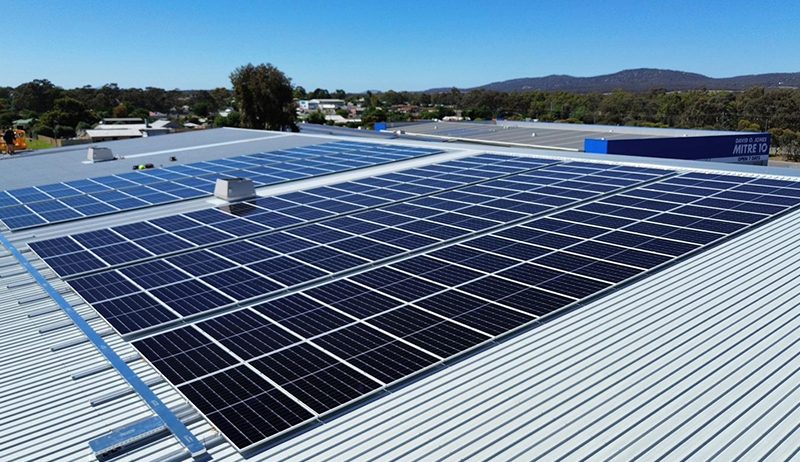
Commercial solar power uses solar photovoltaic (PV) technology, which involves installing solar panels to turn sunlight into electricity. Rooftop solar is one of the most popular options for businesses looking to adopt solar power as it’s more cost-effective and solar helps to lower energy costs and reduce their environmental impact. 

Commercial solar systems are larger than residential ones and can produce more energy. For example, a typical residential solar system in 2025 is around 6kW-13kW. 

In contrast, commercial systems come in various sizes from 20kW-500kW, there are sizes available for small businesses to large. 

Since commercial systems are bigger, they can accommodate more panels and generate more electricity, which is especially useful for businesses with higher energy needs or large rooftops. 

However, commercial solar systems also come with higher installation costs and more complex setups compared to residential systems.  

This is mainly due to the grid connection process and the need for special protection units if the system exceeds 30 kW of inverter capacity. 

Recent advancements in solar PV technology have made commercial solar cells much more efficient. For example, Australian companies have developed some of the world’s most efficient commercial solar cells, with efficiency rates between 22% and 25% just ten years ago. This means businesses can now generate even more power from their solar systems. 

Understanding commercial solar power means knowing the differences between residential and commercial systems. Factors like system size, energy output, and improved solar cell efficiency help businesses make informed decisions about using solar energy to meet sustainability goals and reduce costs. 

The benefits of commercial solar power are clear: significant savings on energy bills, a reduced environmental footprint, and even a potential increase in property value, providing long-term returns on investment. 

In some cases, any extra energy generated by the solar system can be sold back to the grid, allowing you to earn money through feed-in tariffs. 

Feed-in tariffs are payments offered by energy providers for the electricity that your solar panels produce and send back to the grid.  

This is an excellent way for businesses to not only save on energy bills but also earn extra income. Depending on the tariff rates in your area, this can add up to significant savings and revenue. 

To ensure your solar system lasts and performs well, it’s important to choose the right equipment and work with a reliable solar installer.  

Commercial Solar

How Much Are Solar Panels for Business?

The cost of installing solar panels for business use depends on various factors, including the size of your building, the energy needs of your business, and the type of solar system you choose. 

On average, businesses in Australia can expect to pay anywhere from $12,999 to $73,000 for a commercial solar system. 

However, it’s important to consider that the long-term savings on energy bills can make the initial investment worthwhile. Plus, there are government incentives and rebates available for businesses in Australia, which can help reduce the upfront cost of installation.  

Over time, the energy savings will offset the installation cost, and your business can start seeing a return on investment. 

Benefits of Solar for Business

  1. Reduced Energy Bills: One of the main reasons businesses switch to solar energy is to lower electricity costs. With solar panels, you can produce your own electricity, reducing your need to buy from the grid. 
  1. Sustainability: Solar power is a clean, renewable energy source. By switching to solar, your business will reduce its carbon footprint and contribute to the fight against climate change. 
  1. Energy Independence: With solar power, you won’t be as dependent on energy suppliers. You’ll have more control over your energy costs, and during power outages, your solar system can continue to generate electricity if paired with batteries. 
  1. Increased Property Value: Installing solar panels can increase the value of your business property, making it more attractive to potential buyers or investors. 
  1. Government Incentives: Installing a solar system for your business can give you access to government rebates of up to $50,000! The Australian government encourages businesses to adopt solar energy, offering various rebates, subsidies, and loan options to reduce the cost of installing commercial solar panels and batteries. 

A key program, the Small-scale Renewable Energy Scheme (SRES), makes rooftop solar systems more affordable. This program provides tradable certificates called small-scale technology certificates (STCs) for most commercial solar systems if the installer is accredited. The value of these certificates is based on your system’s expected electricity generation until 2030, depending on its size and your business location. Typically, you can transfer the STCs to your installer in exchange for a discount on your system. 

solar for business

Get Solar for Business Today!

In 2025, solar for businesses is not just an option; it’s a smart financial move. By installing rooftop solar and taking advantage of feed-in tariffs, businesses can significantly reduce their electricity bills while contributing to a cleaner environment.  

If you’re thinking about going solar, it’s important to understand the costs involved, but with the right system, your business can start saving money and benefiting from renewable energy.  

Don’t wait too long – start exploring solar options today and begin cutting energy costs for your business. 

Cyanergy will support you with every step of your solar journey! For a smooth experience, talk to an expert or get a free quote. 

Your Solution Is Just a Click Away

The post Solar For Businesses: Cut Energy Costs in 2025 appeared first on Cyanergy.

https://cyanergy.com.au/blog/solar-for-businesses-cut-energy-costs-in-2025/

Continue Reading

Renewable Energy

How “Marie Antoinnete” Can We Get?

Published

on

To many of use, the holidays serve as a reminder that most Americans (61%) live paycheck-to-paycheck, and many have trouble paying for groceries.  All this in a nation where the top 0.1% have more wealth that the bottom 50%.

Perhaps most egregious is the fact that people (like me) who write posts like this are regarded as “communists” by the far-right.

How “Marie Antoinnete” Can We Get?

Continue Reading

Renewable Energy

Statement on the Bipartisan American Affordability and Jobs Act Passing the Senate from ACORE President and CEO Ray Long

Published

on

Statement on the Bipartisan American Affordability and Jobs Act Passing the Senate from ACORE President and CEO Ray Long

WASHINGTON, D.C. — ACORE congratulates the U.S. Senate on the passage of the  Bipartisan American Affordability and Jobs Act (BAAJA), legislation that is an essential step to achieving affordable and reliable power across the United States.

BAAJA comes at a critical time when we need to build out our energy infrastructure to help reduce escalating power prices and prevent expected shortages in just the next few years. This legislation is expected to reduce residential electricity bills by $19 billion, create over 100,000 new jobs, invest $55 billion from data centers into energy infrastructure, and reduce CO2 emissions from the power sector by 20 percent in the next decade. 

There’s no time to waste. We need to improve our electric grid and build out 15 times the peak power of New York City in just the next four years. Let’s get this bill passed in the House so we can get building.   

### 

About ACORE  
ACORE is a nonpartisan nonprofit organization that operates at the intersection of affordability, reliability, and clean energy deployment. Our work is focused on stabilizing energy prices, strengthening the electric grid, and driving investment in cost-effective technologies to ensure that clean energy delivers for people, businesses, and the U.S. economy.

ACORE convenes a membership spanning the full clean energy value chain—investors and financiers, developers and EPCs, hyperscalers and energy buyers, manufacturers and advisors. Our members were directly involved in more than 80% of the American clean energy infrastructure projects added to the grid in 2025. We champion all clean energy technologies including transmission, solar, wind, storage, geothermal, hydropower, nuclear, and beyond. ACORE members are the companies investing in and building tomorrow’s electric power system, accelerating infrastructure development, strengthening grid reliability, and enhancing domestic competitiveness.   

Media Contacts: 

Tamari Palmer 
Associate, Communications
palmer@acore.org

Chris Higginbotham 
VP, Communications
higginbotham@acore.org  

The post Statement on the Bipartisan American Affordability and Jobs Act Passing the Senate from ACORE President and CEO Ray Long appeared first on ACORE.

https://acore.org/news/statement-on-the-bipartisan-american-affordability-and-jobs-act-passing-the-senate-from-acore-president-and-ceo-ray-long/

Continue Reading

Renewable Energy

What’s Destroying the World?

Published

on

I would say it’s the vicious circle that goes like this: ignorance –> electing authoritarian leaders –> leaders further destroy the educational system –> greater ignorance.

Given that there are still tens of millions of Trump supporters living among us, it’s really a miracle that we didn’t elect a criminal sociopath much earlier.

What’s Destroying the World?

Continue Reading

Trending