


Duke University achieved carbon neutrality in 2024, marking a significant milestone in its sustainability journey. However, achieving this status does not mean the university eliminated all its emissions.
Instead, it represents a strategic balance between reducing emissions and offsetting those that remain. In Duke’s case, this included a $4 million investment in carbon offsets to neutralize its greenhouse gas (GHG) emissions.
Duke’s Path to Carbon Neutrality: Balancing Reductions and Offsets
Duke University, under the American College and University Presidents’ Climate Commitment, pledged to achieve carbon neutrality across its emissions-generating activities. Its Climate Action Plan (CAP) categorizes emissions into three scopes:

Duke’s approach aligns with GHG accounting standards from the World Resources Institute, ensuring comprehensive tracking and reduction strategies for all emission sources. The university has significantly cut GHG emissions through various levers including:
- Eliminating coal use,
- Boosting building and utility efficiency, and
- Reducing commuting emissions.
Future reductions are planned through off-site solar investments and campus upgrades like steam-to-hot-water conversions and heat recovery chillers. Duke remains on track to achieve its 2030 emissions goals.
However, 2023 emissions rose 9% compared to 2022, primarily due to air travel nearing pre-pandemic levels. Despite this, energy-related emissions are down 41% since 2007, and 2023 levels remain 21% lower than in 2019.
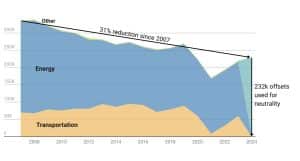
Duke’s progress toward carbon neutrality began in 2007 when it launched an institution-wide effort to measure and reduce emissions. By fiscal year 2022, Duke had reduced its emissions by 43%, with plans to reach a 45% reduction by its 2024 deadline.
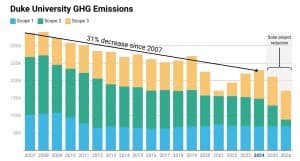
- However, emissions rose slightly, requiring Duke to offset nearly 69% of its 2007-level emissions instead of the planned 55%.
This reliance on carbon offsets underscores a critical reality: achieving net-zero emissions without offsets is nearly impossible for large institutions. Matthew Arsenault, Duke’s assistant director of carbon and sustainability operations, highlighted that:
“No institution, no company is going to be carbon neutral without using carbon offsets. There’s literally no way to reduce your emissions actually to zero.”
Carbon offsets provide a mechanism to balance emissions from essential activities, such as powering campus buildings and transportation. These activities, while minimized through efficiency measures, can only be partially eradicated.
How Carbon Offset Credits Work
Carbon offsets allow institutions to balance emissions by funding projects that either reduce GHG emissions or remove existing emissions from the atmosphere. Institutions like Duke use these tools to purchase carbon accounting units traded on carbon markets. These markets enable organizations to buy and sell surplus credits to meet their sustainability and net zero goals.
For Duke, offsets became a practical and ethical way to achieve carbon neutrality, given the current limitations of emission reduction technologies.
Carbon Offsets in Action: The Key to Duke’s Carbon Neutrality
Duke’s approach to carbon offsets has evolved over the years. In 2009, the university launched the Duke Carbon Offsets Initiative (DCOI), the first university-based program of its kind. This initiative focused initially on developing new offset projects, such as a methane-capture effort at a North Carolina hog farm, where methane was converted into usable electricity instead of being released into the atmosphere.
Other early projects included residential energy efficiency upgrades, urban tree plantings, and solar installations. These efforts were designed to both reduce GHG emissions and align with Duke’s broader sustainability values.
As the 2024 carbon neutrality deadline approached, Duke University shifted its strategy to focus on larger, externally sourced projects to meet its offset needs.
Almost 80% of Duke’s carbon offset portfolio consisted of projects targeting ozone-depleting refrigerants, which contain potent GHGs that can leak into the atmosphere. These projects, developed in collaboration with international partners, represented a significant step in reducing emissions from refrigerants.
The remaining offsets focused on methane capture from dairy farms and landfills, similar to Duke’s earlier hog farm project. By investing in these projects, Duke ensured its offsets addressed emissions effectively and sustainably.
Ensuring Quality and Accountability
Duke’s commitment to sustainability extends beyond simply purchasing offsets. The university employs a rigorous verification process to ensure the quality and ethical standards of its investments. This process involves collaboration with Ruby Canyon Environmental, a registered verifier on carbon markets, to vet prospective offset projects.
To guide decision-making, Duke developed a comprehensive evaluation tool that includes detailed questions about each project. Criteria such as “additionality” (ensuring the emissions reductions would not occur without the project) and “permanence” (long-term commitment to emissions reductions) are prioritized.
Projects that meet these standards are further reviewed by an advisory committee of faculty and students before purchase. Fewer than 10% of potential projects pass Duke’s initial evaluation, highlighting the university’s commitment to investing in high-impact and high-integrity carbon offsets.
What’s Next? Duke’s Plan Beyond Neutrality
While offsets played a key role in Duke’s 2024 achievement, the university recognizes the importance of continuing to reduce its emissions. Efforts are ongoing to expand energy efficiency measures on campus and integrate more renewable energy sources into operations.
Duke University’s carbon footprint will significantly decrease by mid-2025 when three off-campus solar facilities come online. They have a combined capacity of 101 megawatts. These projects will provide about 50% of the campus’s electricity and contribute renewable energy to North Carolina’s grid for decades.
Additionally, Duke is exploring ways to include its health system and international campuses, such as Duke Kunshan University, in future emissions tracking.
The university is now determining its “next-generation” climate goals, focusing on sustaining its carbon-neutral status and further reducing its offset dependency. This includes exploring innovative carbon offset projects, expanding renewable energy use, and encouraging campus-wide engagement in sustainability initiatives.
Carbon offsets will remain an essential tool in the university’s strategy, but Duke aims to rely on them less as it continues to refine its emissions reduction efforts. With its comprehensive approach and commitment to quality, Duke serves as a model for other institutions seeking to balance sustainability goals with the practical realities of carbon offsetting.
The post Duke University Achieves Carbon Neutrality: How Do Carbon Offsets Help? appeared first on Carbon Credits.

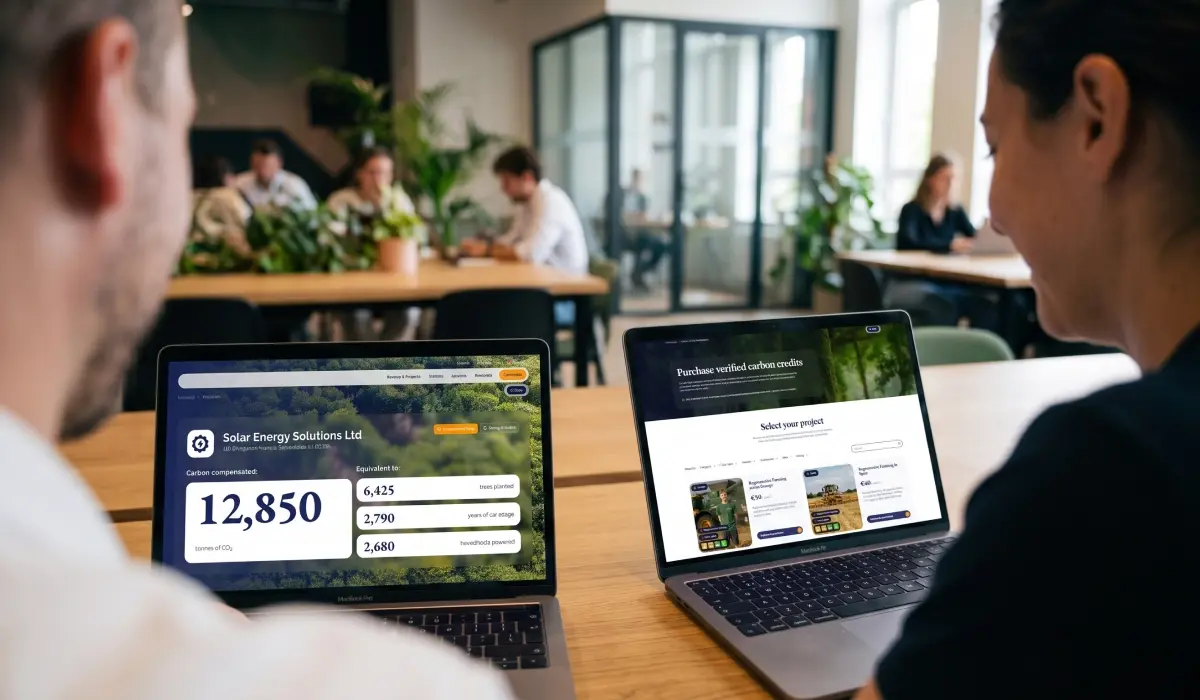
Most businesses that decide to act on their net-zero targets reach the same point of friction. Buying carbon credits has meant tracking down brokers, sitting through sales calls, and requesting a quote just to learn a price, sometimes with limited proof of what you are buying.

The earnings calls that quietly reframed climate from sustainability question to operating risk.
Three earnings calls in the last 18 months tell the story without any help from a press release.
Hershey, May 2024: cocoa price exposure compresses margin, and the company attributes part of the cost shock to West African weather. Olam, July 2024: coffee climate exposure quantified in the annual report. JBS, January 2025: supply chain climate disclosures expanded materially in response to investor pressure and regulatory expectation. None of these companies issued the announcement as climate news. They issued it as financial news. The climate-linked supply chain risk did not arrive with a sustainability framing; it arrived as a P&L line.
You are probably reading this article because you suspect the same thing is happening to your business. This piece walks through what is showing up on which earnings calls, how procurement and finance leaders are quantifying the exposure, and what serious corporates are doing about it before the regulator asks.
Where climate risk has already appeared in earnings
The pattern is consistent across resource-intensive sectors. A weather event compresses supply, the price spikes, the cost flows through the income statement, and the analyst on the call asks whether the event is anomalous or structural. Increasingly, the honest answer is the second one.
Cocoa is the cleanest example. The 2023 to 2024 West African harvest fell sharply on the back of erratic rainfall and disease. Cocoa futures more than tripled. Companies with concentrated West African sourcing absorbed the cost; companies with diversified sourcing absorbed less. The exposure was not climate as ESG topic. It was climate as cost of goods.
Coffee follows the same pattern. Brazilian and Vietnamese harvests have moved on weather more sharply across the last several seasons. Roasters with long-tenor supplier relationships and origin diversification have managed the volatility; roasters with spot-market exposure have not. Wheat, sugar, palm oil, beef: the same dynamic in different commodities, a pattern the IPCC AR6 Working Group II report projects will intensify across agricultural systems through mid-century.
What this means: climate risk is no longer a footnote in the 10-K. It is a line item the CFO has to explain on the call.
The three commodity exposures that hit margin first
For most companies with material Scope 3 exposure, three exposures dominate the near-term P&L risk.
- Concentrated single-origin sourcing in a climate-vulnerable region. If your tier-one supply for any material commodity sits in one geography, you have a concentration risk that climate amplifies. Diversification across origins is the obvious hedge, but it takes years to build and requires relationships you cannot acquire by tender.
- Supplier financial fragility under climate stress. Smallholder farmers, who supply a large share of the global cocoa, coffee, and palm oil market, do not carry the balance sheets to absorb yield shocks. When yields collapse, they exit. When they exit, your supply base shrinks, and the surviving suppliers raise prices. The risk is structural, not cyclical.
- Logistics and storage exposure to extreme weather. Hurricane disruptions to Gulf shipping, drought-driven Panama Canal restrictions, flooding in European inland waterways: each of these has moved input costs in the last three years, a pattern documented in Munich Re’s natural catastrophe data. The exposure shows up as a one-quarter event in the financial press but accumulates over time on the cost line.
TCFD and ISSB disclosure changes
The disclosure architecture has now caught up with the risk. The Task Force on Climate-related Financial Disclosures, whose recommendations are now embedded in the ISSB’s IFRS S2 climate standard, requires companies to disclose climate-related risks across physical and transition categories, with quantification where possible.
For physical risk specifically (the climate-linked supply chain risk you are reading about), the disclosure must address both acute exposures (extreme weather events) and chronic exposures (gradual changes in temperature, precipitation, and growing seasons). The disclosure must address the time horizon over which the risk is material, the parts of the value chain exposed, and the financial impact under different scenarios.
The CSRD imposes similar requirements under European law, with double materiality (both financial and impact materiality) embedded in the assessment. The practical effect: your auditors and your investor relations team now need a defensible answer to the climate-linked supply chain risk question, and the answer needs to be quantified.
What procurement and finance can do now
Three actions matter near-term.
Map your exposure. Most companies do not have a clear view of which tier-one and tier-two suppliers sit in which climate-vulnerable geographies. Without the map, you cannot quantify the risk, and without the quantification, you cannot disclose it credibly. The map is the foundation, and World Resources Institute climate risk research provides useful public tooling to start.
Diversify and deepen, in that order. Diversification across origins reduces concentration risk, but the deeper move is to invest in the resilience of the suppliers you already have. Regenerative practices, agroforestry, soil health interventions: these reduce yield volatility under climate stress and protect your input cost trajectory.
Embed the climate spend inside procurement, not outside it. Treating climate risk as a sustainability cost line subordinates it to the ESG budget. Treating it as a procurement and resilience investment puts it in the budget that matters, which is the cost-of-goods budget that the CFO defends quarterly.
Nature-based supply chain investments are the asset class designed for exactly this purpose. They sit inside the value chain, they reduce climate-linked supply risk, they generate verifiable Scope 3 reductions, and they produce the documentation an auditor and a regulator can both test.
If you are quantifying climate-linked supply chain risk in advance of the next earnings cycle or the next disclosure period, the carbon and sustainability experts at Carbon Credit Capital can help you map your exposure and structure a Dual-Value Model response that addresses reduction, resilience, and disclosure-readiness in a single program. Schedule a consultation.

More and more small and medium-sized businesses are hearing the same question from their larger customers: What is your carbon footprint? That question now travels down entire supply chains, and it arrives next to tender requirements, certification criteria, and rising customer expectations.




-
Climate Change1 year ago
Guest post: Why China is still building new coal – and when it might stop
-

 Greenhouse Gases2 years ago
嘉宾来稿:满足中国增长的用电需求 光伏加储能“比新建煤电更实惠”
-
Greenhouse Gases1 year ago
Guest post: Why China is still building new coal – and when it might stop
-

 Climate Change2 years ago
嘉宾来稿:满足中国增长的用电需求 光伏加储能“比新建煤电更实惠”
-

 Renewable Energy11 months ago
Sending Progressive Philanthropist George Soros to Prison?
-
Climate Change2 years ago
Bill Discounting Climate Change in Florida’s Energy Policy Awaits DeSantis’ Approval
-
Greenhouse Gases1 year ago
嘉宾来稿:探究火山喷发如何影响气候预测
-

 Carbon Footprint2 years ago
US SEC’s Climate Disclosure Rules Spur Renewed Interest in Carbon Credits