Living on a floating island off the Gulf, Samuele Landi advises a little-known company with big plans to shake up the carbon offsetting market.
Blue Carbon plans to take over forested areas the size of the United Kingdom and sell carbon credits from their conservation under a mechanism established by the UN. The UAE firm, chaired by a member of Dubai’s royal family, has been on a deal-making spree with African governments to make that happen.
The 58-year-old Italian is no forestry expert, but – he says – he was tapped by the company right after its launch a year ago because of his decades-long technology experience. In Dubai, Landi is known as the owner of a cybersecurity firm devising fully encrypted phones.
In his native country, Landi is a wanted man. He was convicted in two separate trials for a bankruptcy fraud that sank one of Italy’s largest telecommunications companies and left over 2,200 people without a job nearly 15 years ago.
Landi’s advisory role in Blue Carbon is likely to fuel concerns over the integrity of a company bidding to become a large player in a sector already plagued by environmental and social risks.
Blue Carbon did not respond to emailed questions. After Climate Home contacted the company, Landi emailed the reporter in a personal capacity and agreed to a video call. He rejected the legitimacy of the court judgments against him, alleging that Italian judges ruling over his case were corrupt.
Bankruptcy fraud
Samuele Landi was the founder and chief executive of Eutelia, an Italian company providing landline and internet services to millions of users across the country in the early 2000s.
The firm, which had ballooned in size through acquisitions, seemed set on a meteoric rise. But in 2008 cracks started to appear. Drowning in debt, Eutelia asked the government to place most of its workers in a state-funded job retention scheme while trying to restructure its activities.
But at the same time, according to court records, Samuele Landi and other senior executives illicitly moved funds worth dozens of millions of euros outside of Eutelia and into shell companies mainly based outside of Italy.
Shades of green hydrogen: EU demand set to transform Namibia
Eutelia went bankrupt. By the time Italian police moved in to arrest Landi in mid-2010, he had relocated to Dubai. At the time Italy had no extradition treaty with the UAE. Landi told Climate Home News he did not move to Dubai out of fear of being arrested but because he was looking for more freedom.
Landi never returned to Italy. Two separate trials against him and other executives went ahead in his absence. In one Samuele Landi was handed an 8-year prison sentence on bankruptcy fraud charges in 2020. In a second one, stemming from the bankruptcy of a company linked to Eutelia, the court of appeal in Rome sentenced him to 6 years and six months in prison at the end of October.
Landi said he had referred the first case to the European Court of Human Rights, claiming it was an unfair trial. He said he is going to appeal against the second sentence to the Italian Supreme Court. “There is no evidence. I did not steal one single euro”, he told Climate Home.
Liberian diplomat
While his legal troubles rumbled on in Italy, Landi started a new life in Dubai. He set up a cybersecurity company and became a diplomat, after being appointed as consul general in the UAE for the African state of Liberia.
Landi told Climate Home he “developed the diplomatic relations between the Liberian and the UAE governments”, which resulted in the construction of roads, hospitals and sports centers in the African nation over the last few years.
It is through this role that he first came in contact with people from Blue Carbon. Landi said he accompanied a delegation from Liberia to a meeting with Sheikh Ahmed Dalmook Al Maktoum, a member of the Dubai royal family and chairman of Blue Carbon. “When they formed the company a year ago they asked me to be their advisor”, Landi said. “I help them with information technology. Sometimes they call me to make evaluations on IT solutions.”

A screenshot from the Blue Carbon website
Liberia is one of the African countries that have signed a raft of memorandums of understanding with Blue Carbon in the run-up to Cop28, alongside the governments of Kenya, Angola, Zimbabwe, Zambia and Tanzania. Landi said he was not directly involved in the negotiations between Blue Carbon and Liberia.
Blue Carbon’s African scramble
The deals, which are not yet definitive, could see the UAE firm gain control over more than 30 million hectares of forests across the countries. In Zimbabwe alone, it is set to secure rights over a fifth of its total landmass.
Blue Carbon plans to set up forestry protection schemes, produce carbon offsets on a never-seen-before scale and sell them to polluting governments and companies.
The firm is looking to operate under a new mechanism established by Article 6 of the Paris Agreement, which is set to transform carbon markets. Blue Carbon wants to trade a specific type of credit, internationally transferred mitigation outcomes (ITMOs), that can be used by governments to achieve emission reduction goals set out in their nationally determined contributions.
View this post on Instagram
Blue Carbon’s foray into Africa has prompted numerous concerns.
Civil society and indigenous groups fear communities will be forced to make way for the projects, losing control over land that constitutes their primary livelihoods. A number of forest protection offsetting projects – unrelated to Blue Carbon – have been suspended recently following allegations of abuse and forced evictions.
Exposed: carbon offsets linked to high forest loss still on sale
The second concern is that little money would actually end up in the hands of African governments and local communities, contrary to what the mechanism is set up to achieve.
Finally, there are worries that the unprecedented volume of credits created could end up greenwashing oil and gas operations without providing any meaningful emission reductions. Forestry offsetting programs have been hotly debated after a series of articles and scientific studies cast doubts over their climate integrity.
COP28 plans
Blue Carbon has said the deals will bring “vital environmental impacts” and “a transformative wave of economic opportunities” for the African countries signing on. Sheik Dalmook Al Maktoum told the Zimbabwean government the programme could bring $1.5 billion of climate finance into the country.
“Beyond the immediate goal of carbon emissions reduction, the heart of these carbon projects pulsates with the intent to bring about tangible improvements at the grassroots level,” the company added when announcing the agreement in Harare.
The company has indicated that more details about its carbon credit plans will be revealed at Cop28 in Dubai. It told CNN that it would present its deals at the climate summit as a “blueprint” for carbon trading.
Landi said he has no intention to take part in Cop28. Nearly a year ago he moved to a barge moored in the international waters off the Arabian coast with the goal to set up a so-called decentralized autonomous organisation.
“The idea is to create a place where people can stay without being subjected to the matrix,” he told Climate Home. “No one can say which kind of insects or fake meat you have to eat, which kind of injections you have to get. A libertarian state is very important.”
The post Meet the Italian fugitive advising Emirati start-up Blue Carbon appeared first on Climate Home News.
https://www.climatechangenews.com/2023/11/23/meet-the-italian-fugitive-advising-emirati-start-up-blue-carbon/
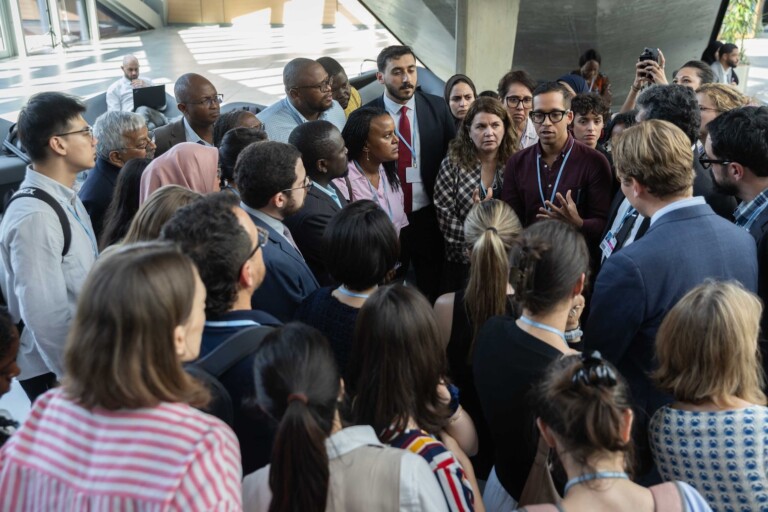
Delegates will soon gather in the Turkish resort city of Antalya for UN climate negotiations, against a backdrop of war, energy crisis and climate extremes.
At COP31, nations will try to find agreement on various issues, including climate finance for developing countries and a global “just transition” towards a cleaner economy.
This summit is unusual due to its joint presidency, which means that Australia is leading the negotiations while Turkey hosts the conference.
Outside the formal negotiations, Turkey is also pushing its own priorities as part of a wider “action agenda”, including electrification, oceans and “green industrialisation”.
In order to track parties’ positions on key negotiating points and wider issues at COP31, Carbon Brief has analysed around 100 documents and captured them in the interactive table below.
The first column shows the countries and UN negotiating blocs, the second shows the topics up for debate and the third indicates specific issues within those topics.
The final column indicates the positions that the parties have expressed on each topic. These range from “priority” – meaning the party is likely to be pushing the issue – to “oppose”, meaning it is likely to push against it.
This is a “living document” that will be updated over the course of COP31.
Please get in touch if you would like to offer additions by emailing policy@carbonbrief.org.
Brief explanations of the key issues and jargon-filled language that permeate the talks can be found below the interactive table.
Just transition
At COP30 in Brazil in 2025, nations agreed to establish a practical mechanism to help drive a “just transition” to a low-carbon economy.
Key aspects of this “Belém-Antalya mechanism” (BAM) – often referred to as the “just transition mechanism” (JTM) – were agreed during the June climate negotiations this year, but many details are missing and dividing lines remain between parties.
Parties have disagreed about the scope of the mechanism and whether it should be tied to the provision of finance.
Nevertheless, following progress in June within the “just transition work programme” (JTWP), civil society groups highlighted that getting the mechanism up and running is a “key expected outcome” from COP31.
Climate finance
Climate finance is always a highly contested issue at UN climate negotiations.
Developing countries have successfully pushed for a “work programme” on climate finance to feature on the conference agenda.
These parties see this programme as a way to pressure developed countries into providing more funding from their public coffers, specifically under Article 9.1 of the Paris Agreement. Some are even proposing a “burden sharing” arrangement for climate-finance provision.
This comes against a backdrop of major donors cutting their aid budgets and the Trump administration in the US pressuring multilateral development banks (MDBs) to drop their climate objectives.
Developed countries, which have traditionally been responsible for providing finance, would prefer to keep a broader focus on issues such as improving access to existing finance and broadening the range of donors. Some developing countries, such as small-island states, also support these goals.
Nations have also been discussing Article 2.1c of the Paris Agreement under the “Veredas dialogue”. This focuses on making all global “financial flows” consistent with climate action.
Countries have different views about what this involves, with developing countries again hoping to keep the focus on developed countries’ responsibilities to financially support them.
Adaptation and mitigation
At negotiations in June, parties were unable to agree on the details of a “global goal on adaptation” (GGA), which is intended to drive climate adaptation worldwide.
Having agreed at COP30 on a list of 59 “indicators” – ways to assess progress towards the GGA – nations now need to refine these before COP32 in Addis Ababa, Ethiopia. This is a highly technical process that involves a taskforce working out how to use and track these indicators.
Broadly, developing countries stress the importance of finance to fund adaptation efforts, rather than simply to track progress. They also want reassurances about a pledge made last year to “triple adaptation finance”.
At the June climate negotiations, negotiators also failed to make any progress when discussing the mitigation work programme (MWP) – the only formal agenda item that concerns cutting greenhouse gas emissions.
Among other things, parties disagreed on whether the MWP should continue running over the next few years, or simply be brought to a close.
Global stocktake and NDCs
Back in 2023, the first “global stocktake” (GST) of the Paris Agreement set out the state of climate action and what needed to be done to set the world on course.
On mitigation, nations agreed to a package of measures, including “transitioning away from fossil fuels”, tripling renewable energy and “halting and reversing deforestation” by 2030.
Some of these outcomes remain contentious among certain parties, particularly large, developing countries and those with economies that rely on fossil-fuel exports.
Developing countries have persistently argued that they need more climate finance to implement the global stocktake outcomes.
Parties were meant to update their climate plans under the Paris Agreement, informed by the first global stocktake, by 2025. These plans, known as nationally determined contributions (NDCs), cover the period out to 2035.
So far, only 150 parties – responsible for three-quarters of global emissions – have submitted new NDCs.
Iran, Vietnam, Egypt and Argentina are among those without new NDCs – and the US has withdrawn its climate plan under the Trump administration.
Some parties, such as the EU, have stressed the need for countries to submit their new NDCs ahead of COP31 – and to ensure they are aligned with the 1.5C temperature limit.
COP31 will also see the launch of the second global stocktake, which will conclude in 2028.
Action agenda and other issues
Turkey will be pushing its “action agenda” priorities at COP31, including global targets for electrification, reducing waste and reducing building-sector emissions.
(The Australian “presidency of negotiations” is intending to pursue a “cover text” decision at COP31 that may capture some of these wider targets, such as the electrification goal.)
The action agenda is meant to provide a complementary track to the formal negotiations, where governments and non-state actors can advance specific, real-world solutions.
A new COP31 presidency effort dubbed the “climate implementation bridge” is also meant to complement these ambitions by turning NDC goals into an “investable project portfolio”
Some parties have explicitly signalled their support for various elements beyond the formal negotiations, in the run-up to COP31.
For example, a joint letter signed by 105 parties called for COP31 to “put the ocean at the heart of climate action” by embedding ocean-based climate action in the UNFCCC architecture.
The post Interactive: Who wants what at the COP31 climate change summit appeared first on Carbon Brief.
Interactive: Who wants what at the COP31 climate change summit
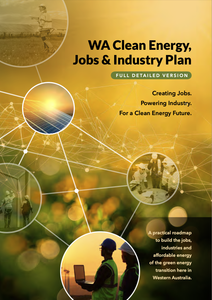
Prepared by a coalition of nine Western Australian union, industry, conservation, and community organisations—including UnionsWA, the Conservation Council WA, and the Smart Energy Council—the WA Clean Energy, Jobs & Industry Plan provides a practical roadmap to transform Western Australia into a clean energy powerhouse while creating thousands of secure local jobs.
Western Australia stands at a pivotal crossroads: lead the global clean energy economy or watch investment, future industries, and secure jobs go elsewhere. The WA Clean Energy, Jobs & Industry Plan outlines a transformative blueprint to harness the state’s world-class solar and wind resources. Discover how legislated renewable targets, green iron manufacturing, and a dedicated regional training strategy can generate tens of thousands of local jobs, lower household bills, and build a resilient, net-zero future for all Western Australians.