

 NPR’s special series, “The Undercount: The invisible death toll from climate change,” aims to answer this question. When climate and health reporter Alejandra Borunda asked doctors what important topics she should focus on, she heard the same thing over and over: Climate change is hurting a lot of people, but we aren’t doing a good job of keeping track of how many. “We’re undercounting the damage by an enormous amount,” Borunda says.
The answer to the basic question here is no; it’s impossible to provide even a good guess as to this figure, if only because there is no way to ascribe a certain catastrophic event, say a hurricane or a wildfire, to climate change. It’s really not a matter of doing a good or a bad job at keeping track.
Consider what appears to be a far more black-and-white situation, deaths from COVID-19. As discussed in this paper, it’s not a straightforward task to say that a certain victim died “with” COVID or “of” COVID.
As unsatisfying as it may be, I’m afraid that the community of climate scientists will eventually give up on the task of counting the deaths due to global warming.
NPR: Is it Possible to Know How Many People Have Died Because of Climate Change?

 You could live next door to this guy.
It’s good to see that overt stupidity like this is on the decline. Sure, 30% of American voters think this way, but very few are willing to display that ignorance in public.
In the semi-rural part of California that 2GreenEnergy “headquarters” makes it home, we’ve seen a huge reduction is Trump hats, banners, and so forth, especially since his second term began. Now, this could due to the natural beauty of the region that is pulling well-educated and affluent young people up from Los Angeles. It could also have something to do with COVID, where people working from home wanted to get of of the city and into a prettier and more relaxed setting.
But one has to think that MAGA means something more degraded with each passing day, as Trump commits a new atrocity or says something that betrays his lack of respect for the Constitution, his disgusting character, and his mental deterioration.
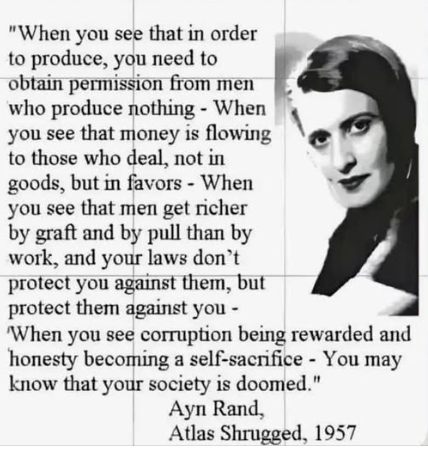 Ayn Rand was a “thing” in the mid-20th Century. Libertarians point out, correctly, that governments tend to be bloated and corrupt. And still today, many people advocate for small government.
What most of us have realized in the last 70 years, however, is that unbridled capitalism results in the centralization of power into the hands of a few billionaires who essentially own our lawmaking apparatus. It leaves the rest to struggle with poverty, inflation, war, racism, sexism, pollution, climate change, poor education, and limited/no access to healthcare.
With a few exceptions, the super-rich really don’t care about the wellbeing of anyone but themselves, and this is resulting in the implosion of our civilization and the slow destruction of our planet.
 In a better world, the International Criminal Court would have much greater power to prosecute war crimes.
Today, winding up at The Hague requires terrible luck, and it’s virtually impossible to happen to a Donald Trump or a Pete Hegseth, given the enormous military might that the United States possesses.
Contrast this to what happened to Slobodan Milošević, who was arrested when his countries, Yugoslavia and Serbia, were overthrown.



-
Climate Change1 year ago
Guest post: Why China is still building new coal – and when it might stop
-

 Greenhouse Gases2 years ago
嘉宾来稿:满足中国增长的用电需求 光伏加储能“比新建煤电更实惠”
-
Greenhouse Gases1 year ago
Guest post: Why China is still building new coal – and when it might stop
-

 Climate Change2 years ago
嘉宾来稿:满足中国增长的用电需求 光伏加储能“比新建煤电更实惠”
-

 Renewable Energy12 months ago
Sending Progressive Philanthropist George Soros to Prison?
-
Climate Change2 years ago
Bill Discounting Climate Change in Florida’s Energy Policy Awaits DeSantis’ Approval
-
Greenhouse Gases1 year ago
嘉宾来稿:探究火山喷发如何影响气候预测
-

 Climate Change2 years ago
Analysis: China’s CO2 falls 1% in Q2 2024 in first quarterly drop since Covid-19