

This week’s European parliamentary election results saw parties on the populist right making big gains in France and Germany, while the historic “green wave” of 2019 receded.
Despite polling showing a large majority of EU voters are in favour of continued or strengthened climate action, the results have “raised concerns” over the future of the bloc’s climate ambition.
The Green Deal package of EU laws passed during the past five years are expected to be “hard to undo”. However, these laws will need to be fully implemented in order to meet EU climate targets.
Moreover, while centrist parties continue to hold a majority in the new European parliament, the stronger presence of right-wing parties could make ambitious new laws harder to pass.
Carbon Brief has asked a range of policy experts what they think the European election results will mean for EU climate action over the next five years.
These are their responses, first as sample quotes, then, below, in full:
- Prof Federica Genovese: “[W]e should expect a rhetorical downscaling of the relevance of climate action. Whether this also means a substantive downscaling of the Green Deal depends on whether the EU will be looking at climate as a social redistributive agenda or a geopolitical security one.”
- Simone Tagliapietra: “[T]he pro-European centre has retained its majority of seats in the European Parliament, [sd] Europe is not going to reverse course on the green transition.”
- Luca Bergamaschi: “The results are a strong wake up call for climate action compared to the euphoria of 2019…The politics of climate action needs to be reengineered and reconnected with the needs of society.”
- Linda Kalcher: “While the threat from Moscow lingers we can expect Brussels to back its Green Deal – even if it’s sold as a weapon against Putin.”
- Vincent Hurkens: “The upcoming negotiations on the next European Commission president and her/his policy agenda will be decisive for Europe’s capacity to address the severe impacts and risks of climate change for Europe and EU’s global climate leadership.”
- Nils Redeker: “The results will complicate EU climate politics…the overall shift is likely to dampen enthusiasm for ambitious climate policies in [the European] parliament and could deter member states in the European Council from adopting new measures.”
 Prof Federica Genovese
Professor of political science and international relations
University of Oxford
At least two results of the European Parliament (EP) elections will have important implications for Europe’s climate policy.
The first one is the self-evident main election outcome at the aggregate level. The right and far-right European party families – the governing European People’s Party and the European Conservatives and Reformists, plus the NI group – visibly increased their vote share, while the more progressive Renew Europe liberal party and, in particular, the Greens lost significantly.
[See Carbon Brief’s EU elections manifesto tracker for more on the party groupings.]
Whereas this is less of a gain of extreme-right populism as some had predicted, it is still a clear ideological shift from left to right. This is climate news because more progressive left-leaning parties have so far championed the urgency of climate change mitigation and adaptation, so the composition of the new EP will threaten the political momentum of the EU climate policy agenda.
Some expression of continuity with past policies will remain, both because the historical EPP-S&D balance remains relatively strong, and also because [current European Commission president Ursula] Von Der Leyen will probably continue heading the commission.
However, we should expect a rhetorical downscaling of the relevance of climate action. Whether this also means a substantive downscaling of the Green Deal depends on whether the EU will be looking at climate as a social redistributive agenda or a geopolitical security one.
There is also another electoral result that deeply affects the future of Europe’s climate policy, namely that this shift is particularly determined by the French and German EP elections. This is important as it is not a result observed in other comparably large countries.
In the short term, this result could have some negative impacts. France and Germany are the largest European economies, where much of decarbonisation should take place. Despite their controversial policies, political leaders from both countries – Emmanuel Macron in France and Robert Habeck in Germany – have championed climate action in the past, and these voices are being traded with more ambiguous – if not openly sceptical – views.
At the same time, this could be the opportunity to rethink how climate issues can enter the heart of mainstream parties – in France and Germany, but also across Europe – that want to distinguish themselves and credibly compete with the far right. The Socialists and Democrats (S&D) from across the board now have a big chance to appropriate the climate issue and push the EP towards more progressive climate action.
 Simone Tagliapietra
Senior fellow
Bruegel
In the run up to the European elections there has been substantial speculation about the future of the Green Deal, with some pointing at its potential being dismantled following an eventual dramatic surge in far-right parties.
The good news for Europe, and for the world, is that this scenario has been avoided: as the pro-European centre has retained its majority of seats in the European Parliament, Europe is not going to reverse course on the green transition.
However, business-as-usual is not an option, either. The elections have unveiled an important sense of unease in our societies – and in the case of Germany and France, even more than largely anticipated – that must be taken seriously and duly addressed, also when it comes to climate policy.
The Green Deal has come a long way since it was conceived five years ago, and these elections mark a new beginning for this agenda rather than its dismissal. It must now restart with a new agenda focused on green investments, green social support and green industrial policy. Decarbonisation is the only route for Europe to get to resilience and competitiveness. The new majority in the European Parliament has the responsibility to drive it, by avoiding futile shortcuts.
 Linda Kalcher
Executive director
Strategic Perspectives
While it’s correct that the European Parliament elections hit Green parties hard, it’s simply not the case that this means EU climate legislation and plans will be undone. We’ve seen a lot of – quite frankly – lazy analysis to this effect, but what matters here are the numbers across parliament and capitals in the European Council.
One: the European Green Deal still has a majority in the house. The appetite for any roll-backs of laws is really low, especially given the uncertainty of how the French parliamentary elections will affect majorities in Council. European industry knows it risks losing ground to China and the US in the clean energy transition and investors crave policy certainty.
Two: while climate may be less explicitly referenced by the Commission it will still be central. We can expect that many new initiatives under the next Commission will be about strengthening industrial competitiveness and energy security. The high geopolitical and economic cost of being dependent on gas, oil and coal imports remains a major challenge for the competitiveness of the economy and energy bills.
Three: energy prices are still two times higher in the EU than in the US. The answer to this is to invest in resilient and secure clean energy and storage systems that can offer the continent long term security and lower risks of Russia exerting leverage over gas-dependent members. While the threat from Moscow lingers we can expect Brussels to back its Green Deal – even if it’s sold as a weapon against Putin.
 Luca Bergamaschi
Co-founding director
ECCO
The results are a strong wake up call for climate action compared to the euphoria of 2019. The low turnout and the increasing dissatisfaction with established parties in many countries are yet a further symptom of the distrust of many towards the current political offer – both in terms of representatives and policy.
The politics of climate action needs to be reengineered and reconnected with the needs of society. While the desirability of the transition remains high, politics is failing to make it more accessible and tangible for the most.
At citizens’ level, one of the main tasks should be to design and offer concrete solutions for different social classes. At the economic level, we need to see bolder plans for mobilising the capital needed and directing it to the industrial players that want to invest in innovation.
European leaders and ministers now need to work together to build an agenda and design policy that can bridge the gap between long-term targets and everyday needs and desires.
 Vincent Hurkens
Programme lead
EU politics and climate governance at E3G
Although far-right gains have garnered significant attention, a large majority of Europeans supported centrist parties that have committed to continuing the green transition.
It depends on the largest pro-democracy political forces of social democrats, liberals – and particularly the centre-right – how much influence they allow the far right to have on the EU’s climate agenda for the next five years.
Sustained climate action and a predictable regulatory framework towards climate neutrality are crucial to deliver on electoral promises made by pro-European political families for more security, competitiveness and strategic autonomy.
The upcoming negotiations on the next European Commission president and her/his policy agenda will be decisive for Europe’s capacity to address the severe impacts and risks of climate change for Europe and EU’s global climate leadership.
The European Council and political groups in the European Parliament should prioritise a science-based green transition, integrating a strong and global dimension to ensure Europeans feel the benefits of it domestically and to increase the EU’s trust and credibility internationally.
 Nils Redeker
Deputy director
Jacques Delors Centre thinktank
The results will complicate EU climate politics, primarily due to developments in a few major countries. In France and Germany, Green parties suffered losses, which will substantially reduce the number of Green lawmakers in the European Parliament. Additionally, these countries, along with Italy, contributed to a strengthening of far-right groups.
Although left-wing and green parties did unexpectedly well in Denmark and Sweden, the overall shift is likely to dampen enthusiasm for ambitious climate policies in parliament and could deter member states in the European Council from adopting new measures.
However, the next phase of the Green Deal will focus on implementation. The key question is, therefore, whether the EU will stick to its existing policies or unravel its landmark green legislation. The latter option seems unlikely. To secure a second term, Ursula von der Leyen will need the support of the Social Democrats. To avoid risks in her confirmation vote, she may also seek backing from the remaining Green forces. This will limit the scope for a big and official role-back.
But still, there is plenty of room to throw sand in the wheels of execution. Two key aspects are therefore crucial to watch. First, how the European People’s Party (EPP) will interpret its mandate on climate. The party may seek to dilute implementation by forming issue-specific alliances with the far-right. Our research suggests that this would be at odds with its electorate’s preferences, but recent months have already shown a willingness to pursue this approach. Second, it will be crucial to see how the next Commission integrates climate goals into less controversial areas where progress is still possible such as industrial policy, competitiveness and economic resilience.


The post Experts: What do the European elections mean for EU climate action? appeared first on Carbon Brief.
Experts: What do the European elections mean for EU climate action?

Drought and heatwaves occurring together – known as “compound” events – have “surged” across the world since the early 2000s, a new study shows.
Compound drought and heat events (CDHEs) can have devastating effects, creating the ideal conditions for intense wildfires, such as Australia’s “Black Summer” of 2019-20 where bushfires burned 24m hectares and killed 33 people.
The research, published in Science Advances, finds that the increase in CDHEs is predominantly being driven by events that start with a heatwave.
The global area affected by such “heatwave-led” compound events has more than doubled between 1980-2001 and 2002-23, the study says.
The rapid increase in these events over the last 23 years cannot be explained solely by global warming, the authors note.
Since the late 1990s, feedbacks between the land and the atmosphere have become stronger, making heatwaves more likely to trigger drought conditions, they explain.
One of the study authors tells Carbon Brief that societies must pay greater attention to compound events, which can “cause severe impacts on ecosystems, agriculture and society”.
Compound events
CDHEs are extreme weather events where drought and heatwave conditions occur simultaneously – or shortly after each other – in the same region.
These events are often triggered by large-scale weather patterns, such as “blocking” highs, which can produce “prolonged” hot and dry conditions, according to the study.
Prof Sang-Wook Yeh is one of the study authors and a professor at the Ewha Womans University in South Korea. He tells Carbon Brief:
“When heatwaves and droughts occur together, the two hazards reinforce each other through land-atmosphere interactions. This amplifies surface heating and soil moisture deficits, making compound events more intense and damaging than single hazards.”
CDHEs can begin with either a heatwave or a drought.
The sequence of these extremes is important, the study says, as they have different drivers and impacts.
For example, in a CDHE where the heatwave was the precursor, increased direct sunshine causes more moisture loss from soils and plants, leading to a drought.
Conversely, in an event where the drought was the precursor, the lack of soil moisture means that less of the sun’s energy goes into evaporation and more goes into warming the Earth’s surface. This produces favourable conditions for heatwaves.
The study shows that the majority of CDHEs globally start out as a drought.
In recent years, there has been increasing focus on these events due to the devastating impact they have on agriculture, ecosystems and public health.
In Russia in the summer of 2010, a compound drought-heatwave event – and the associated wildfires – caused the death of nearly 55,000 people, the study notes.
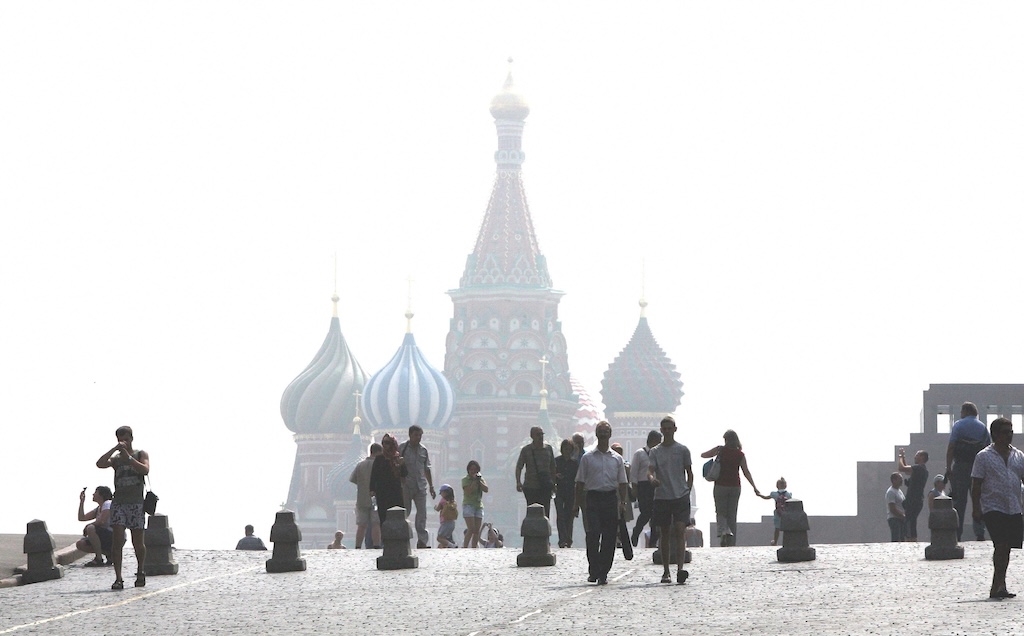
The record-breaking Pacific north-west “heat dome” in 2021 triggered extreme drought conditions that caused “significant declines” in wheat yields, as well as in barley, canola and fruit production in British Columbia and Alberta, Canada, says the study.
Increasing events
To assess how CDHEs are changing, the researchers use daily reanalysis data to identify droughts and heatwaves events. (Reanalysis data combines past observations with climate models to create a historical climate record.) Then, using an algorithm, they analyse how these events overlap in both time and space.
The study covers the period from 1980 to 2023 and the world’s land surface, excluding polar regions where CDHEs are rare.
The research finds that the area of land affected by CDHEs has “increased substantially” since the early 2000s.
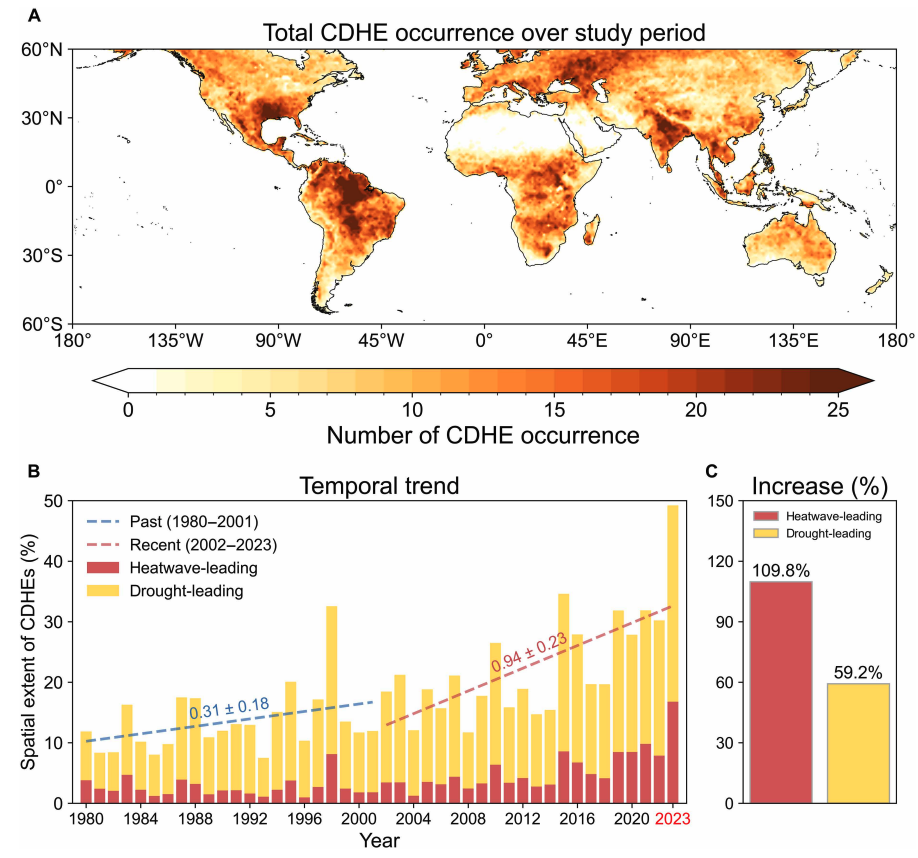
Heatwave-led events have been the main contributor to this increase, the study says, with their spatial extent rising 110% between 1980-2001 and 2002-23, compared to a 59% increase for drought-led events.
The map below shows the global distribution of CDHEs over 1980-2023. The charts show the percentage of the land surface affected by a heatwave-led CDHE (red) or a drought-led CDHE (yellow) in a given year (left) and relative increase in each CDHE type (right).
The study finds that CDHEs have occurred most frequently in northern South America, the southern US, eastern Europe, central Africa and south Asia.
Threshold passed
The authors explain that the increase in heatwave-led CDHEs is related to rising global temperatures, but that this does not tell the whole story.
In the earlier 22-year period of 1980-2001, the study finds that the spatial extent of heatwave-led CDHEs rises by 1.6% per 1C of global temperature rise. For the more-recent period of 2022-23, this increases “nearly eightfold” to 13.1%.
The change suggests that the rapid increase in the heatwave-led CDHEs occurred after the global average temperature “surpasse[d] a certain temperature threshold”, the paper says.
This threshold is an absolute global average temperature of 14.3C, the authors estimate (based on an 11-year average), which the world passed around the year 2000.
Investigating the recent surge in heatwave-leading CDHEs further, the researchers find a “regime shift” in land-atmosphere dynamics “toward a persistently intensified state after the late 1990s”.
In other words, the way that drier soils drive higher surface temperatures, and vice versa, is becoming stronger, resulting in more heatwave-led compound events.
Daily data
The research has some advantages over other previous studies, Yeh says. For instance, the new work uses daily estimations of CDHEs, compared to monthly data used in past research. This is “important for capturing the detailed occurrence” of these events, says Yeh.
He adds that another advantage of their study is that it distinguishes the sequence of droughts and heatwaves, which allows them to “better understand the differences” in the characteristics of CDHEs.
Dr Meryem Tanarhte is a climate scientist at the University Hassan II in Morocco, and Dr Ruth Cerezo Mota is a climatologist and a researcher at the National Autonomous University of Mexico. Both scientists, who were not involved in the study, agree that the daily estimations give a clearer picture of how CDHEs are changing.
Cerezo-Mota adds that another major contribution of the study is its global focus. She tells Carbon Brief that in some regions, such as Mexico and Africa, there is a lack of studies on CDHEs:
“Not because the events do not occur, but perhaps because [these regions] do not have all the data or the expertise to do so.”
However, she notes that the reanalysis data used by the study does have limitations with how it represents rainfall in some parts of the world.
Compound impacts
The study notes that if CDHEs continue to intensify – particularly events where heatwaves are the precursors – they could drive declining crop productivity, increased wildfire frequency and severe public health crises.
These impacts could be “much more rapid and severe as global warming continues”, Yeh tells Carbon Brief.
Tanarhte notes that these events can be forecasted up to 10 days ahead in many regions. Furthermore, she says, the strongest impacts can be prevented “through preparedness and adaptation”, including through “water management for agriculture, heatwave mitigation measures and wildfire mitigation”.
The study recommends reassessing current risk management strategies for these compound events. It also suggests incorporating the sequences of drought and heatwaves into compound event analysis frameworks “to enhance climate risk management”.
Cerezo-Mota says that it is clear that the world needs to be prepared for the increased occurrence of these events. She tells Carbon Brief:
“These [risk assessments and strategies] need to be carried out at the local level to understand the complexities of each region.”



The post Heatwaves driving recent ‘surge’ in compound drought and heat extremes appeared first on Carbon Brief.
Heatwaves driving recent ‘surge’ in compound drought and heat extremes
Greenhouse Gases
DeBriefed 6 March 2026: Iran energy crisis | China climate plan | Bristol’s ‘pioneering’ wind turbine
Welcome to Carbon Brief’s DeBriefed.
An essential guide to the week’s key developments relating to climate change.
This week
Energy crisis
ENERGY SPIKE: US-Israeli attacks on Iran and subsequent counterattacks across the Middle East have sent energy prices “soaring”, according to Reuters. The newswire reported that the region “accounts for just under a third of global oil production and almost a fifth of gas”. The Guardian noted that shipping traffic through the strait of Hormuz, which normally ferries 20% of the world’s oil, “all but ground to a halt”. The Financial Times reported that attacks by Iran on Middle East energy facilities – notably in Qatar – triggered the “biggest rise in gas prices since Russia’s full-scale invasion of Ukraine”.
‘RISK’ AND ‘BENEFITS’: Bloomberg reported on increases in diesel prices in Europe and the US, speculating that rising fuel costs could be “a risk for president Donald Trump”. US gas producers are “poised to benefit from the big disruption in global supply”, according to CNBC. Indian government sources told the Economic Times that Russia is prepared to “fulfil India’s energy demands”. China Daily quoted experts who said “China’s energy security remains fundamentally unshaken”, thanks to “emergency stockpiles and a wide array of import channels”.
‘ESSENTIAL’ RENEWABLES: Energy analysts said governments should cut their fossil-fuel reliance by investing in renewables, “rather than just seeking non-Gulf oil and gas suppliers”, reported Climate Home News. This message was echoed by UK business secretary Peter Kyle, who said “doubling down on renewables” was “essential” amid “regional instability”, according to the Daily Telegraph.
China’s climate plan
PEAK COAL?: China has set out its next “five-year plan” at the annual “two sessions” meeting of the National People’s Congress, including its climate strategy out to 2030, according to the Hong Kong-based South China Morning Post. The plan called for China to cut its carbon emissions per unit of gross domestic product (GDP) by 17% from 2026 to 2030, which “may allow for continued increase in emissions given the rate of GDP growth”, reported Reuters. The newswire added that the plan also had targets to reach peak coal in the next five years and replace 30m tonnes per year of coal with renewables.
ACTIVE YET PRUDENT: Bloomberg described the new plan as “cautious”, stating that it “frustrat[es] hopes for tighter policy that would drive the nation to peak carbon emissions well before president Xi Jinping’s 2030 deadline”. Carbon Brief has just published an in-depth analysis of the plan. China Daily reported that the strategy “highlights measures to promote the climate targets of peaking carbon dioxide emissions before 2030”, which China said it would work towards “actively yet prudently”.
Around the world
- EU RULES: The European Commission has proposed new “made in Europe” rules to support domestic low-carbon industries, “against fierce competition from China”, reported Agence France-Presse. Carbon Brief examined what it means for climate efforts.
- RECORD HEAT: The US National Oceanic and Atmospheric Administration has said there is a 50-60% chance that the El Niño weather pattern could