

Weather Guard Lightning Tech

Vestas V236 Blade Fails, Japan Wires Wind to a Data Center
Allen covers the V236 blade failure at He Dreiht, Maine’s first full-size floating turbine, and Japan’s wind-powered data center.
Sign up now for Uptime Tech News, our weekly newsletter on all things wind technology. This episode is sponsored by Weather Guard Lightning Tech. Learn more about Weather Guard’s StrikeTape Wind Turbine LPS retrofit. Follow the show on YouTube, Linkedin and visit Weather Guard on the web. And subscribe to Rosemary’s “Engineering with Rosie” YouTube channel here. Have a question we can answer on the show? Email us!
Happy Monday Everyone
The V236 just had a bad week last week.
a blade failed on one of the turbines at ENBW’s [EN-bay-vay’s]
HE DREIHT [hay DRYT] offshore wind farm
in the German North Sea.
Nine hundred and sixty megawatts.
There are 64 of those V236 machines.
The project hit first power just last November.
ENBW says no one was hurt.
VESTAS says it has launched a root cause investigation.
But a blade failure on your flagship turbine …
at one of Germany’s biggest offshore wind farms?
That will be a headline.
And the industry is watching.
Now … from the North Sea … to the coast of Maine.
The UNIVERSITY OF MAINE has done something
no one in America has done before.
They put a full-size floating wind turbine in the ocean.
And it is delivering power to the grid.
The platform is called VOLTURNUS [vol-TURN-us].
It was assembled onshore … in Brewer, Maine …
then towed thirty miles down the PENOBSCOT [peh-NOB-skot] River
and out to sea.
No specialized heavy-lift vessels.
No deepwater pile driving.
The hull is made of concrete … sourced locally.
Not imported steel.
Eighty percent of the best offshore wind in America
sits over water too deep for fixed-bottom foundations.
Floating platforms like VOLTURNUS
could change that math entirely.
Meanwhile … in Japan …
wind energy just found a brand-new customer.
Data centers.
EURUS [YOO-rus] ENERGY and TOYOTA TSUSHO [TOY-oh-tah TSOO-shoh]
have broken ground on a wind-powered data center
in HOKKAIDO [hoh-KY-doh].
It is the first data center in Japan
directly connected to a wind farm.
The facility sits next to the KOBAOKO [koh-bah-OH-koh] Wind Farm …
forty-two megawatts …
with a private power line running straight to the servers.
And here is the bigger picture.
Japan has most of its data centers packed into Tokyo and Osaka.
HOKKAIDO has the wind … but not the demand.
So instead of sending the power somewhere else …
they are bringing the demand to the wind.
TOYOTA TSUSHO already operates ten wind farms in the region …
more than five hundred megawatts.
They are planning a much larger data center cluster by twenty thirty.
Ten to twenty megawatts of capacity.
And speaking of scale …
China just laid out its five-year plan for renewables.
The target?
A fifty-three percent jump in renewable energy consumption
by twenty thirty.
According to BLOOMBERG …
renewable power use should rise to about
one-point-eight billion tons of coal equivalent …
Wind and solar generation alone
should nearly double …
from two-point-three trillion kilowatt-hours
to four trillion.
And here is the part that matters for reliability.
China wants wind and solar … backed by storage …
to provide twenty percent of electricity
during peak summer and winter evening hours.
That is double the current level.
Three hundred gigawatts of peak generation from renewables.
That is not an aspiration.
That is a published national target.
Now … before we go …
a story from the other end of the scale.
In KONGIGANAK [KAHN-gig-uh-nak] … a village in western Alaska …
they built five wind turbines.
There is no grid connection.
No transmission lines running to the outside world.
For years … the village ran on diesel generators.
The turbines changed that.
But they created a new problem.
Sometimes … the wind made more electricity
than the village could use.
No grid to send it to.
No big battery bank to store it in.
So the engineers came up with something simple.
They put special ceramic heaters inside every home.
When the wind blows hard …
the extra power flows into those heaters.
Dense ceramic bricks soak up the energy as heat.
And when the wind dies down …
that stored heat slowly releases into the house.
In Alaska … where winter never seems to end …
surplus wind power now keeps homes warm
and cuts diesel bills at the same time.
There is a shift in the wind energy business at the moment.
It used to be utilities buying megawatts.
Now it is tech companies buying uptime.
Remote villages buying independence from diesel.
And entire nations buying credibility on their climate commitments.
Each of those buyers has a different definition of reliability.
And every one of them needs turbines that can run for years and years.
The wind industry has never had more demand.
The question is whether the hardware
can keep up with the ambition.
`That is the state of the wind industry
for the twenty-seventh of July … twenty twenty-six.
Join us for the Uptime Wind Energy podcast tomorrow.

 For most of our lives, many of us boomers have believed that the biggest threat to the United States was our president, starting with Tricky Dick Nixon, the inventor of the “trickle-down economics,” liar Ronald Reagan, and GW (the moron) Bush.
But yes, none of us was prepared for the cold, calculating criminal who is Donald Trump.
There Were Prior Threats to the Nation Stemming from the White House
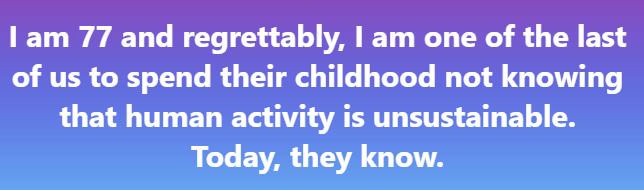 The fact that human activity is unsustainable has been revealed to us gradually over the last century. Rachel Carson’s “Silent Spring” was published 63 years ago.
That said, the ideas of climate change, ocean acidification, and loss of biodiversity have been essentially unchallenged by scientists for just the last couple of decades.
The only thing standing in the way of rapid environmental progress is greed, and in the end, that may prove to be an unbeatable foe. Decarbonizing our grid and transportation sector will eventually destroy the fossil fuel industry, a group so powerful that it has a stranglehold, both on our lawmakers and on our corporate-owned media, that works so hard to misinform our citizenry.
 It’s still possible that our most senior military leaders will insert themselves in time to prevent some truly catastrophic event here in the United States/abroad.
I keep thinking I’ll read about an exchange like this:
Trump: We’re invading Greenland.
Some four-star general: The f*** we are.
This may sound like a pipe dream, but these are people of real honor and integrity who take their oaths to our constitution quite seriously.
Will the U.S. Top Military Intervene Before Trump Inflicts Irreparable Damage



-

 Greenhouse Gases2 years ago
嘉宾来稿:满足中国增长的用电需求 光伏加储能“比新建煤电更实惠”
-
Climate Change1 year ago
Guest post: Why China is still building new coal – and when it might stop
-
Greenhouse Gases1 year ago
Guest post: Why China is still building new coal – and when it might stop
-

 Climate Change2 years ago
嘉宾来稿:满足中国增长的用电需求 光伏加储能“比新建煤电更实惠”
-

 Renewable Energy11 months ago
Sending Progressive Philanthropist George Soros to Prison?
-
Climate Change2 years ago
Bill Discounting Climate Change in Florida’s Energy Policy Awaits DeSantis’ Approval
-
Greenhouse Gases1 year ago
嘉宾来稿:探究火山喷发如何影响气候预测
-

 Climate Change2 years ago
Analysis: China’s CO2 falls 1% in Q2 2024 in first quarterly drop since Covid-19