Connect with us

Published

on

The global electric vehicle (EV) market is gaining speed again. A sharp rise in oil prices, triggered by the recent U.S.–Iran conflict in early 2026, has changed how consumers think about fuel and mobility. What looked like a slow market just months ago is now showing strong signs of recovery.

According to SNE Research’s latest report, this sudden shift in energy markets is pushing EV adoption faster than expected. Rising gasoline costs and uncertainty about future oil supply are driving buyers toward electric cars. As a result, the EV transition is no longer gradual—it is accelerating.

Oil Price Shock Changes Consumer Behavior

The conflict in the Middle East sent oil markets into turmoil. Gasoline prices jumped quickly, rising from around 1,600–1,700 KRW per liter to as high as 2,200 KRW. This sudden spike acted as a wake-up call for many drivers.

Consumers who once hesitated to switch to EVs are now rethinking their choices. High and unstable fuel prices have made traditional gasoline vehicles less attractive. At the same time, EVs now look more cost-effective and reliable over the long term.

SNE Research noted that even if oil prices stabilize later, the fear of future spikes will remain. This uncertainty is a key driver behind early EV adoption. People no longer want to depend on volatile fuel markets.

EV Growth Forecasts Get a Major Boost

SNE Research has revised its global EV outlook. The firm now expects faster adoption across the decade.

  • EV market penetration is projected to reach 29% in 2026, up from an earlier estimate of 27%.
  • By 2027, the share could jump to 35%, instead of the previously expected 30%.
  • Most importantly, EVs are now expected to cross 50% of new car sales by 2030, earlier than prior forecasts.
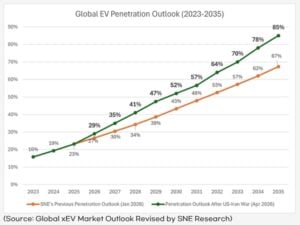
The research firm also highlighted a clear timeline shift. EV demand has moved forward by half a year in 2026. By 2027, this lead increases to one full year. From 2028 onward, adoption is expected to accelerate by more than two years. This shows that the global EV transition is happening much faster than industry players had originally planned.

EV growth

Higher Fuel Costs Improve EV Economics

One of the biggest drivers behind this shift is simple: EVs are becoming cheaper to own compared to gasoline cars.

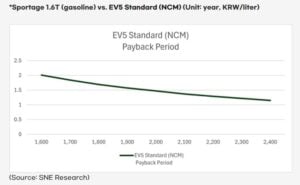
SNE Research compared two popular models—the gasoline-powered Kia Sportage 1.6T and the electric Kia EV5. The results highlight how rising fuel prices change the equation.

At a gasoline price of 1,600 KRW per liter, it takes about two years to recover the higher upfront cost of an EV. However, when fuel prices rise to 2,000 KRW per liter, the payback period drops to just one year and two months.

ev sales

So, over a longer period, the savings are even clearer:

  • Total 10-year cost of a gasoline car: 59–65 million KRW
  • Total 10-year cost of an EV: around 44 million KRW

This large gap makes EVs a smarter financial choice, especially when fuel prices remain high.

Battery Shake-Up: Market Struggles While CATL Surges Ahead

While EV demand is improving, the battery industry is seeing mixed results.

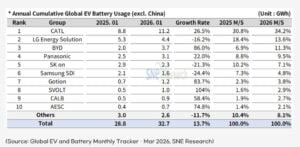
In the first two months of 2026, global EV battery usage reached 134.9 GWh, a modest increase of 4.4% year-over-year. However, not all companies are benefiting equally.

South Korean battery makers—LG Energy Solution, SK On, and Samsung SDI—saw their combined market share fall to 15%, down by 2.2 percentage points. Each company reported declining growth:

  • LG Energy Solution: down 2.7%
  • SK On: down 12.9%
  • Samsung SDI: down 21.9%

This drop was mainly due to weaker EV sales in the U.S. market earlier in the year.

  • In contrast, Chinese battery giant CATL continued to expand its lead. Its market share grew from 38.7% to 42.1%, strengthening its global dominance.

SNE Research explained that future competition will depend less on overall EV growth and more on supply chain strategy. Companies that diversify across customers and regions will be in a stronger position.

catl battery

Automakers Feel the Impact Across Markets

Battery demand also reflects trends in automaker performance. Samsung SDI, for example, supplies batteries to brands like BMW, Audi, and Rivian. However, slower EV sales across these companies reduced overall battery demand.

Some key factors include:

  • Lower sales of BMW’s electric lineup, including models like the i4 and iX
  • Weak demand for Audi EVs despite new launches
  • Declining sales from North America-focused brands like Rivian and Jeep

In some cases, new models even reduced demand for older ones. For instance, Audi’s Q6 e-tron impacted sales of the Q8 e-tron, lowering overall battery usage.

ev sales

A Structural Shift in the EV Market

Despite short-term fluctuations, SNE Research believes the EV market is entering a new phase. The current surge is not just a reaction to oil prices—it reflects a deeper shift in consumer mindset.

People now see EVs as a safer and more stable option. Energy security, cost savings, and environmental concerns are all playing a role.

As SNE Research’s Vice President Ik-hwan James Oh explained, even if oil prices fall, the memory of sudden spikes will remain. This lasting concern will continue to push EV adoption.

In conclusion, the events of early 2026 have shown how quickly market dynamics can change. A single geopolitical shock has reshaped the global auto industry outlook.

For automakers, the message is clear: EV demand can rise faster than expected. For battery companies, the focus must shift to global expansion and supply chain resilience. For consumers, the decision is becoming easier as EVs offer both savings and stability.

The global EV market is no longer just growing—it is accelerating. And if current trends continue, the shift to electric mobility could arrive much sooner than anyone expected.

The post Global EV Sales Set to Hit 50% by 2030 Amid Oil Shock While CATL Leads Batteries appeared first on Carbon Credits.

Continue Reading

Carbon Footprint

Where should an SME start with a carbon action plan?

Published

on

More and more small and medium-sized businesses are hearing the same question from their larger customers: What is your carbon footprint? That question now travels down entire supply chains, and it arrives next to tender requirements, certification criteria, and rising customer expectations.

Continue Reading

Carbon Footprint

Insetting vs Offsetting: Which Actually Counts Toward Your Scope 3 Targets

Published

on

The accounting differences that decide whether your nature investment shows up in inventory, in BVCM, or nowhere at all.

The question reaches a procurement team about three weeks before the next sustainability committee meeting. Someone has read about insetting. Someone else has just signed off on an offset purchase. The CSO wants to know if the two are interchangeable. The answer is no, and the GHG Protocol Land Sector and Removals Standard is the reason why.

This article walks through what each term means at audit-grade specificity, what the standards actually say about how each gets counted, and how to decide which tool fits which target. The insetting vs offsetting question is one of the most-searched in corporate climate strategy, and one of the most poorly answered. By the end of this piece, you should be able to brief a committee on the difference without notes.

The two definitions, in plain English

Offsetting means buying carbon credits generated outside your value chain and retiring them against your residual emissions. The reduction happens somewhere else, financed by you, and the credit is the receipt.

Insetting means investing in emission reductions or removals inside your own value chain, typically with suppliers, where the reduction is directly linked to the products and services you buy. The reduction happens inside the boundary of your Scope 3 inventory, and the accounting treatment is fundamentally different.

The shorthand from the University of Oxford’s Nature-based Insetting Initiative is useful: insetting is what you do with the supply chain you have; offsetting is what you do with the supply chain you do not have.

What the GHG Protocol Land Sector Standard actually says

The GHG Protocol Land Sector and Removals Standard, finalised in 2024 after a multi-year pilot, sets the rules for how land-based emission reductions and removals enter corporate inventories. The Standard distinguishes between inventory accounting (Scope 1, 2, and 3) and project or intervention accounting (a separate methodology for crediting).

For insetting, the practical implication is that supplier-level interventions, when properly measured and attributed, can reduce your Scope 3 category 1 (purchased goods and services) emissions in your inventory. The reduction is not a credit retired against the inventory; it is a lower inventory number, period.

For offsetting, the credit is retired separately. It can be reported as a contribution toward a net-zero claim under the SBTi Beyond Value Chain Mitigation framework or as part of a VCMI Carbon Integrity claim, but it does not lower the inventory number.

A practical consequence: if your Science Based Target requires a 50% absolute reduction in Scope 3 emissions by 2030, insetting moves you toward the target. Offsetting does not. This single point of difference reshapes the procurement decision.

When insetting counts toward Scope 3 (and when it does not)

Insetting counts toward Scope 3 only when several conditions are met:

  • The intervention must occur with an entity in your value chain.
  • The emissions reduction or removal must be measured against a defensible baseline.
  • The reduction must be attributed to your share of that supplier’s output, not double-counted with other buyers.
  • It must follow the inventory accounting rules in the GHG Protocol Land Sector Standard, not the project accounting rules used to generate credits.

The most common failure mode is double counting. If your supplier sells the same reduction as a credit on the voluntary market and also reports it to you as a Scope 3 reduction, the math breaks. The Standard requires you to address this risk, typically by purchasing and retiring the supplier-issued credit as part of your inventory or by contractual provisions that prevent the supplier from selling the reduction twice.

When insetting does not count toward Scope 3: when the intervention sits with a supplier you do not buy from, when the baseline is not defensible, when the attribution is unclear, or when the documentation does not survive audit. Those cases default to Beyond Value Chain Mitigation, which is still useful but operates on a different ledger.

The procurement and supplier engagement question

Insetting is harder than offsetting. That is the unfashionable truth most buyers eventually confront. Offsetting is a transaction; insetting is a relationship.

To run an insetting program, you need supplier mapping precise enough to know which farms or facilities sit at which Scope 3 boundary. You need an engagement model that gets suppliers to participate, which usually requires multi-year commitments and shared economics. You need an MRV architecture that measures the right things and produces audit-ready documentation. And you need a contractual structure that prevents double counting and protects both sides.

The trade-off you receive in return is significant. Reductions count against your inventory rather than your residual. Supplier relationships deepen, which protects sourcing continuity. Yield and quality improvements often follow regenerative interventions, which reduces your input cost over time. And the regulatory file, under CSRD, CSDDD, EUDR, and the SBTi FLAG Guidance, is materially stronger.

Choosing the right tool for the right target

A practical decision rule. If your target is a science-based Scope 3 reduction and you operate in a FLAG sector or source FLAG commodities, insetting is the structurally correct tool. If your target is a net-zero claim that includes neutralising hard-to-abate residual emissions outside your value chain, BVCM via high-integrity offsets is the structurally correct tool. Most companies with material Scope 3 exposure need both, in different proportions, sequenced over time.

The sequencing matters. Insetting takes longer to stand up but produces a permanent reduction in the inventory. Offsetting can be transacted faster but does not change the inventory and now sits under tighter claim restrictions. Treat them as complementary tools with different jobs, not as substitutes. The Accountability Framework Initiative and the IUCN Global Standard for Nature-based Solutions both provide useful guardrails for the insetting side, with biodiversity, human rights, and benefit-sharing requirements that go beyond carbon math.

If you are mapping a Scope 3 reduction roadmap and need to scope which interventions count toward your inventory versus which sit in Beyond Value Chain Mitigation, the carbon and sustainability experts at Carbon Credit Capital can help you structure a nature-based supply chain investment program that fits your FLAG exposure, your target architecture, and your audit horizon. Schedule a consultation.

Continue Reading

Carbon Footprint

Net zero needs nature: a carbon credit guide

Published

on

Net zero is often described as a balancing act: cut what you can, account for the rest, and reach zero on the ledger. That framing is useful, but it leaves something out. It treats every tonne of carbon as interchangeable and every route to zero as equally sound, while the science tells a more specific story.

Continue Reading

Trending

Copyright © 2022 BreakingClimateChange.com