


Canada has taken a major step in its mining history. The country recently approved the first large-scale uranium mine in more than 20 years. This new project is part of Canada’s effort to support clean energy and nuclear power production.
The federal and provincial governments approved the Phoenix In Situ Recovery (ISR) uranium mine. This mine is part of Denison Mines’ Wheeler River Project in Saskatchewan. This approval allows the construction of both the mine and its processing mill.
Phoenix will use ISR mining, a method seen as more environmentally friendly than traditional open-pit or underground mining. The technique uses liquid to dissolve uranium underground. It then brings the uranium to the surface for processing. This method reduces land disturbance compared to traditional methods.
With its license now issued and environmental reviews completed, construction is expected to take about two years. The project remains on track for its first production by mid-2028.
The approval is a milestone for Canada’s nuclear fuel sector. It signals renewed interest in uranium mining at a time when nuclear power is gaining traction as a low-carbon energy source.
A New Era for Canada’s Uranium Sector
Uranium is the key fuel for nuclear power plants. Nuclear power provides large amounts of low-carbon electricity around the world. As countries seek to reduce greenhouse gas emissions, nuclear energy is playing a growing role in clean energy strategies.
Canada is one of the world’s top uranium producers. Mines like Cigar Lake, McClean Lake, and Rabbit Lake in Saskatchewan have been supplying uranium for decades.
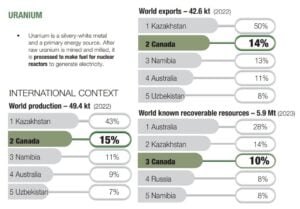
However, no new large mining projects had been approved at the federal level in over two decades before Phoenix. Canada can now boost uranium production. This will help support nuclear fuel supply chains at home and abroad.
The Phoenix mine will create economic benefits. This includes jobs during both construction and operations in northern Saskatchewan. It will also contribute to local tax revenue and community development.
Rising Power Needs Put Nuclear Back in Focus
Nuclear power accounts for a significant share of clean electricity globally. Nuclear reactors produce constant, reliable power that does not depend on weather like wind or solar. Many countries view nuclear energy as critical to meeting climate goals while maintaining grid stability.
As electric grids transition to cleaner energy sources, the demand for uranium — the core fuel for nuclear plants — is rising.
According to the International Energy Agency (IEA), global electricity demand grew by 3 % in 2025, following a 4.4 % increase in 2024. The agency expects demand to rise by about 3.6% each year from 2026 to 2030. This growth will come from industrial use, electrification, electric vehicles, cooling needs, and more data centers.
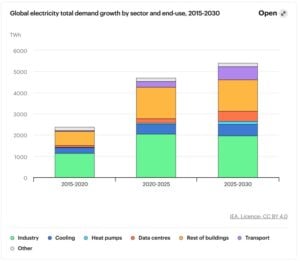
This growth underscores the need for reliable, low-carbon generation capacity. Nuclear energy is a strong candidate because it supplies large volumes of consistent electricity with low emissions.
Tech Sector Turns to Nuclear for 24/7 Power
As electricity demand grows, especially from data centers, tech companies are focusing on long-term power solutions.
Executives at NexGen Energy, developing Canada’s largest uranium project in Saskatchewan, say they’ve talked with data center providers. They discussed financing uranium mining projects and securing a long-term uranium supply. These talks aim to ensure stable fuel for nuclear plants that could help power future data infrastructure.
CEO Leigh Curyer said,
“It’s coming. You’ve seen it with automakers. These tech companies, they’re under an obligation to ensure the hundreds of billions that they are investing in the data centres are going to be powered.”
NexGen is working on the Rook I uranium project in Saskatchewan’s Athabasca Basin. This area is one of the richest for uranium and hosts Canada’s largest development-stage uranium project.
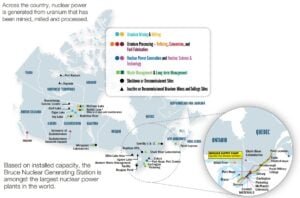
The company anticipates full government approval soon, and it aims for production around 2030. NexGen executives say the mine could supply more than 20 % of global uranium demand once operational.
NexGen’s discussions with data center operators focus on financing and long-term supply agreements. The idea is like car makers investing in battery material mines. They do this to secure vital supplies for electric vehicles.
These talks do not involve giving tech firms any control of NexGen. Instead, they focus on ways to help ensure uranium supply and potentially support early project development.
- MUST READ: From Now to 2060: How Canada’s SMRs and Maritime Nuclear Power Will Drive a Net-Zero Future
Why Tech Firms Are Interested in Nuclear Fuel
Modern data centers need a lot of electricity. This is especially true for those supporting AI, cloud computing, and large digital services. Power demand from data centers is a key driver of rising global electricity use, according to the IEA.
Unlike intermittent renewables, nuclear power provides 24/7 electricity that is not affected by weather. This reliability makes it attractive for companies that need stable energy for critical infrastructure.
Some technology firms have already signaled interest in long-term arrangements with nuclear energy providers. These supply arrangements might involve financing for mining, long-term fuel contracts, or offtake agreements when projects start production.
Long-term contracts for uranium can help companies lock in fuel supply for decades. This can reduce risks related to supply shortages or price volatility in commodity markets.The discussions show how energy security and climate goals are intersecting with corporate planning in the tech sector.
- SEE MORE: Project Matador: America’s $90B Nuclear Power Solution for AI, Semiconductors, and Data Centers
Tight Supply and Rising Prices Reshape the Market
The uranium market has tightened in recent years. Uranium prices have gone up. This rise shows supply issues and increasing interest in nuclear energy. Recent trading values put uranium at almost US$89 per pound, after briefly exceeding US$100 per pound in end of January.
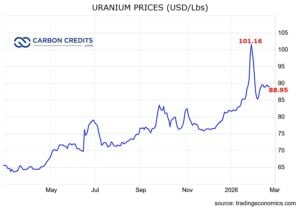
Projections suggest that global nuclear capacity will need more fuel in coming decades as new reactors come online and existing ones are extended. Countries like China and India are expanding nuclear power to meet their growing electricity needs.
In Canada, new mines such as Phoenix and big projects like Rook I can fill global supply gaps. They also support national energy plans.
Global Supply Strain: U.S. and China Reshape the Uranium Market
The scramble for uranium supply is accelerating beyond Canada.
In the United States, a ban on Russian enriched uranium imports will take full effect in January 2028. Russia holds around 44% of the world’s uranium enrichment capacity. In 2023, it provided 27% of U.S. utility enrichment purchases, according to S&P Global Commodity Insights.
To reduce this dependence, the U.S. Department of Energy announced $2.7 billion in task orders to expand domestic enrichment capacity. The funding supports Centrus Energy, General Matter, and Orano Federal Services.
- Orano got $900 million to build a new enrichment facility in Oak Ridge, Tennessee. They expect to submit a license application in the first half of 2026.
Conversion capacity is also expanding. Solstice Advanced Materials plans to increase uranium conversion output by 20% at its Metropolis Works plant in Illinois. The facility is expected to exceed 10 kilotonnes of UF₆ production in 2026, and it is reportedly sold out through 2030.
At the same time, China’s nuclear buildout is adding pressure to global supply. China operates 58 reactors, with 34 more under construction. Citi Research estimates China’s uranium needs will rise from 35 million pounds in 2025 to 58 million pounds by 2030, equal to about 27% of global demand. Yet, China produces only around 4 million pounds domestically.
Global uranium demand could reach 400 million pounds by 2040, more than double today’s levels. Meanwhile, about 70% of post-2027 uranium requirements remain uncontracted, highlighting the growing supply gap.
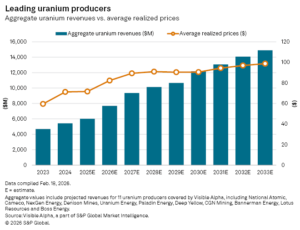
S&P Global expects a uranium market upcycle until 2028, fueled by rising nuclear demand, especially from AI data centers. Global capacity is set to double, reaching 561-992 GW by 2050. Production jumps 141% to 141.2 million pounds by 2033, generating $14.9 billion revenue at $98.7/lb—65% above current prices.
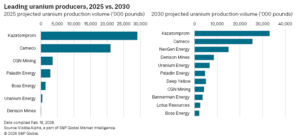
Kazatomprom and Cameco will lead in 2025, generating $5.4 billion in revenue. This accounts for 86% of the group’s output. After 2028, NexGen and Denison will drive the supply wave, peaking at $1.6 billion in capex. Big Tech (Meta, AWS, Google, Microsoft) signs PPAs and equity deals.
Nuclear Fuel Security Becomes a Climate Strategy
The approval of a new mine after more than 20 years shows that uranium is regaining importance in global energy planning. The Phoenix ISR project and other potential mines reflect renewed confidence in nuclear fuel production.
Early interest from tech companies in securing uranium supply shows a shift in energy planning. As power demand increases, companies are exploring new clean energy options. They want stable, low-carbon electricity.
For countries pushing decarbonization, nuclear power — supported by a stable uranium supply — offers a path to reduce emissions while meeting baseload electricity demand.
In this context, the Canadian uranium sector is poised for growth. New mines and potential private sector involvement may strengthen nuclear fuel security, supporting both national and global energy transitions.
The post Canada Approves First Uranium Mine in 20 Years as Tech Giants Eye Nuclear Fuel for AI Power appeared first on Carbon Credits.

The post Promoting Improved Cooking Practices in Nigeria appeared first on Terrapass.
For most companies, the largest figure in the carbon inventory is not the office, the vehicle fleet, or the electricity bill. It sits upstream, in the goods and materials a business buys to make and sell its products. These purchased inputs form the bulk of a company’s Scope 3 emissions, which routinely exceeds everything the business controls directly, and can add up to 90% of their global footprint.




-
Climate Change1 year ago
Guest post: Why China is still building new coal – and when it might stop
-

 Greenhouse Gases2 years ago
嘉宾来稿:满足中国增长的用电需求 光伏加储能“比新建煤电更实惠”
-
Greenhouse Gases1 year ago
Guest post: Why China is still building new coal – and when it might stop
-

 Climate Change2 years ago
嘉宾来稿:满足中国增长的用电需求 光伏加储能“比新建煤电更实惠”
-

 Renewable Energy12 months ago
Sending Progressive Philanthropist George Soros to Prison?
-
Climate Change2 years ago
Bill Discounting Climate Change in Florida’s Energy Policy Awaits DeSantis’ Approval
-
Greenhouse Gases1 year ago
嘉宾来稿:探究火山喷发如何影响气候预测
-

 Climate Change2 years ago
Analysis: China’s CO2 falls 1% in Q2 2024 in first quarterly drop since Covid-19