

- Formal negotiations
- Finance
- Global review
- Global report
- Digital sequence information
- Harmful subsidies
- Marine biodiversity
- Planning, monitoring, reporting and review
- Article 8(j) implementation
- Biodiversity and climate change
- Links with other bodies
- Around the COP
- Armenian presidency
- Protests
- Lobbying and influence
- Carbon and biodiversity markets

Three years after the first deal was signed with South Africa, top officials from the UK and Germany have disclosed that they are hesitant to pursue additional Just Energy Transition Partnerships (JETPs) – an initiative launched at COP26 in 2021 to help developing countries leap frog fossil fuels, especially coal, to renewables.
So far the multi-billion-dollar deals – which involve a package of government and private investment – have been launched for South Africa, Indonesia, Vietnam and Senegal, backed by several European countries, the European Union, the United States and Canada.
At a briefing with journalists at the COP29 climate talks in Baku last month, Jochen Flasbarth, state secretary in Germany’s Ministry for Economic Cooperation and Development, said his country and the other developed nations involved are “reluctant” to enter into more JETPs, emphasising that the current priority is to “make the existing JETPs work”.
Flasbarth said wealthy donor nations and multilateral development banks are working on what he described as a “country-led platform” approach for additional countries, which will incorporate a range of lessons from the JETPs.
These lessons, according to UK Special Representative on Climate Rachel Kyte, include establishing “country ownership” as “a key element”, offering support based on a country’s progress in its transition, and addressing “sensitivities around different stakeholders” on the ground.
Kyte said there is no other way to do a clean energy transition except to put in place ambitious plans that are managed by the developing country in question with support from international partners.
Evolution of JETPs
With discussion surrounding the future of JETPs, links to similar initiatives with different names are being identified. Kyte said momentum is picking up around country platforms, whereby recipient governments present a “tailored, focused programme” with financing needs and projects that fit priorities defined by them.
At COP29, for example, the government of Lesotho, Standard Chartered and Standard Bank announced a “country platform” to support the southern African nation’s ambitions to provide clean, affordable power for its people and the wider region.
The agreement – entitled “His Majesty King Letsie III Just Energy Transition Fund” – will finance the build-out of renewable energy to meet domestic demand in Lesotho and surplus generation for export to neighbouring South Africa.
Failure of Busan talks exposes fossil fuel barrier to UN plastics pact
John Murton, a former British diplomat who was heavily involved in negotiating the initial JETPs, now advises Standard Chartered on sustainability. On LinkedIn, he said that through Lesotho’s new platform, partners can cooperate to identify barriers to private investment, support long-term policy and regulatory reform in the country, and discuss where lending on easy terms can be used most effectively.
This is not the first initiative that looks similar to a JETP. In October, Colombia – which could have been a country of interest for a JETP coal-to-clean deal – launched a $40-billion investment plan for its green energy transition and nature protection, targeting a shift away from fossil fuel production. Environment minister Susana Muhamad said it would mirror the JETPs.
Flasbarth also noted that Germany is cooperating with India on renewable energy and urban development to aid the South Asian country’s energy transition. But he said in a separate interview with Clean Energy Wire at COP29 that a JETP is no longer on the cards with India.
One key reason, according to analysts, is that India – the world’s most populous country with growing energy needs – is not interested in a deal, like the other JETPs, that would focus on phasing out coal, given that its coal production is projected to keep rising this decade, and it prefers to seek financing for clean energy expansion.
Global North countries must step up on protecting their own forests
Laura Sabogal Reyes, a senior policy advisor on development finance with E3G, said country platforms are “the evolution of JETPs”. But unlike their predecessors, they are unlikely to kick off with big top-line financing numbers, instead taking a “more mature” bottom-up approach that is less “flashy”, she said.
The idea, she added, is to meet countries where they are now on what they want to prioritise, their pipeline of projects, and their needs for technical support and policy reform, with donors coming in to contribute on that basis.
Slow progress
Sabogal Reyes said many expectations and promises behind the JETP concept “were not fully realised” within the expected time-frame, casting doubt on whether the initiative – which was praised as the “end of coal” by the UK government in Glasgow – will continue.
The next step for JETPs is to “deliver [the promises] to the best way possible”, while taking into consideration “the good, the bad and the ugly” from the process and using that to develop new country platforms, she added.
Thandolwethu Lukuko, Climate Action Network’s director for South Africa, said the initial JETP pledges had been made with no established pipeline of projects, meaning that when an investment plan was later presented by the government receiving the money “it was then the partners saying, ‘well, we might not want to finance this’.” That led to negotiations that have lengthened the process, he added.
COP29: Five most dramatic moments from the UN climate summit in Baku
Wale Shonibare, director for energy financial solutions, policy and regulation at the African Development Bank, said future country partnerships would need to evolve in response to the delays affecting the JETPs and the emphasis on debt in their financing mix which has prioritised soft loans over pure grants – something South Africa had not expected at the beginning.
Of the $8.5 billion originally pledged to South Africa, less than 3% was due to be delivered in the form of grants.
“It’s not just about what the donors are willing to give; it’s also about what the countries are willing to accept,” Shonibare said.
Since the launch of the deal, just one coal-fired plant – Komati – has been decommissioned and repurposed to produce renewable energy, a development made possible through World Bank support rather than under the JETP. The initiative, meanwhile, has provoked a backlash from the country’s labour union which called for its suspension.
A November update on the JETP, issued by the British government, said that, based on energy security considerations, power utility Eskom had decided to delay the planned decommissioning of three coal-fired power stations until 2030, and to front-load renewables repowering and community development at those sites ahead of the coal plant closures.
In Indonesia, there has been divergence with donors on financing terms and coal plants, with little progress recorded in retiring fossil fuel power stations. The Indonesian government also criticised the deal’s financing terms, as only 0.8% of the total was offered as grants.
Last month at the G20 summit in Brazil, President Prabowo Subianto announced that Indonesia will phase out coal-fired and all other fossil-fuel power plants by 2040 – but did not specify whether this would be part of the country’s JETP deal.
In Vietnam, the JETP has been criticised for a lack of transparency by a government partner organisation. The share of loans versus grants has been another bone of contention, with only 2% of the financial package offered as grants.
Senegal’s deal, announced in 2023, is still in the development stage, but Aida Diop, senior programme officer with the Natural Resource Governance Institute (NRGI), told Climate Home its successful implementation will depend on inclusive and transparent governance. Of the €2.5 billion ($2.6 billion) pledged, only about 6.6% is in grants. This, alongside delays in disbursing funds and the absence of a clear investment plan to date, “risks increasing public debt and slowing progress on renewable energy”, Diop said.
Call for climate reparations at the ICJ even more urgent after COP29 falls short
A further problem with the JETPs has been scepticism over whether they are pursuing the people-centred approach that is regarded as fundamental to just transition. South Africa’s investment plan, for example, prioritised three sectors – electricity, new energy vehicles (NEVs) and green hydrogen – while skills development ranked low.
A 2023 investigation by Climate Home and Oxpeckers Investigative Environmental Journalism found that people in coal-reliant communities feared they would be unemployable in the near future as mines and power plants are decommissioned, and planned training programmes to reskill coal workers had yet to be rolled out at the local level.
Learning lessons
At COP29, Germany and Britain’s senior officials agreed there are lessons to be learned from how the JETPs have unfolded so far but said the experience has been a success nonetheless.
Flasbarth said South Africa’s JETP has “had its ups and downs, but in total it is a success story”. Kyte agreed, saying she would not claim the initiative is “going as fast as everybody would like it to” but that the original idea behind the JETPs remains important – and is one that the UK is pursuing as a priority.
Addressing concerns over slow progress, the UK climate envoy – who has worked on energy access for many years – also said unlocking certain financial flows first requires reforms including to markets, policy and regulation – which take time. These reforms need to happen alongside investment to build out the grid for renewable power supplies, before any coal decommissioning can take place, Kyte added.
In the case of South Africa, Flasbarth said public funding from donors had helped the South African government reform the regulatory framework for its electricity sector, which had created “legal certainty, transparency and lowered the risk for investing”. That, in turn, has opened up opportunities for the private sector to invest in expanding renewables.
On the funding instruments used in the JETPs, Kyte said multiple sources of finance had been brought together, depending on countries’ differing needs – and of the $9.3 billion committed to South Africa, “over $700 million of that was grants”, in addition to concessional loans and investments. Flasbarth said Germany’s €1.8 billion ($1.9bn) share of that JETP had included “a substantial amount of grants, coming to roughly 20%”, while the rest was highly concessional loans from the KfW Development Bank.
Kyte added that there is a need to double down on the JETPs to deliver them effectively, and also to draw lessons from the model so that other countries that want something similar – no matter what formal label is attached to it – can build on that experience.
(Reporting by Vivian Chime; editing by Joe Lo and Megan Rowling)
The post Why rich countries are “reluctant” on additional JETP coal-to-clean deals appeared first on Climate Home News.
Why rich countries are “reluctant” on additional JETP coal-to-clean deals
Continue Reading
Prepared by a coalition of nine Western Australian union, industry, conservation, and community organisations—including UnionsWA, the Conservation Council WA, and the Smart Energy Council—the WA Clean Energy, Jobs & Industry Plan provides a practical roadmap to transform Western Australia into a clean energy powerhouse while creating thousands of secure local jobs.
Western Australia stands at a pivotal crossroads: lead the global clean energy economy or watch investment, future industries, and secure jobs go elsewhere. The WA Clean Energy, Jobs & Industry Plan outlines a transformative blueprint to harness the state’s world-class solar and wind resources. Discover how legislated renewable targets, green iron manufacturing, and a dedicated regional training strategy can generate tens of thousands of local jobs, lower household bills, and build a resilient, net-zero future for all Western Australians.

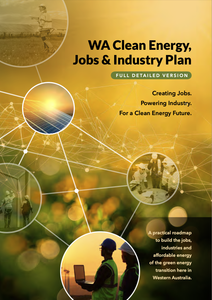
WA needs a clear and forward-thinking plan if it is going to become a competitive renewable energy powerhouse and maintain its economic strength through the energy transition.
“Western Australians know a faster renewable energy transition will lower their household expenses and prevent harmful climate pollution. But the community also needs clear direction to ensure this transition will create jobs, lower costs and not cause undue environmental harm.
“Here, sectors representing a broad range of interests have laid the groundwork for those outcomes, clearly outlining what is needed to create a future for WA that is good for the environment, for the climate, for workers and for the economy.
Summary
The WA Clean Energy, Jobs & Industry Plan sets out a strategic roadmap to position Western Australia as a global clean energy superpower while creating thousands of secure local jobs.
The report establishes three overarching goals:
- Creating local employment.
- Maintaining industrial competitiveness.
- Lowering household energy costs
To realize this vision, the framework details actionable measures to follow on from the recent WA Government announcement of a 75% Renewable Energy Target by 2031 for the South West Interconnected System. This includes developing a statewide Renewable Energy Target, coordinating statewide workforce and training pipelines, strategically planning regional infrastructure to safeguard high-value biodiversity and cultural heritage, and ensuring equitable benefit-sharing through household electrification incentives and First Nations equity partnerships. Ultimately, the plan highlights that establishing clear policy and regulatory certainty will unlock lower energy bills, boost power reliability, and secure the state’s global competitiveness in emerging green commodity export markets.

Key Findings
- Statewide Renewable Energy Target and Emissions Reduction Targets: The report calls for a statewide RET and 1.5°C aligned emission reduction targets to remove policy risk, lower capital costs, and attract clean energy investment.
- Transformative Job Creation: Accelerating the transition offers massive employment prospects, including up to 8,800 solar and battery jobs by 2050, as well as 24,000 ongoing and 11,000 construction jobs in a commercial green iron industry.
- Industrial Electrification & Competitiveness: Requiring large gas users to adopt binding electrification timetables and providing concessional financing will protect existing energy-intensive manufacturers from rising energy costs and impending domestic gas shortfalls.
- Green Commodity Export Leadership: Western Australia can build new export markets in green iron, green ammonia, and offshore oil/gas decommissioning by constructing shared common-user infrastructure and setting dedicated Green Commodity Export Targets.
- Coordinated Workforce & Training Pipeline: To address critical skill shortages the plan recommends establishing a WA Clean Energy Jobs Plan 2050, three regional training hubs, and dedicated pathways for female and under-represented apprentices.
- Environmental Safeguards & Community Benefits: Fast-tracked development must be paired with State Planning Policies that avoid high-biodiversity and cultural heritage lands, mandate new data centres to run on additional renewable power, and deliver household electrification rebates and First Nations equity partnerships.
What you can do
WA has an opportunity to lead on sustainable, clean energy and associated industries. You can help by:
- Sending an email to Environment Minister Murray Watt and Prime Minister Anthony Albanese, calling on them to reject Browse.
- Sharing this story to help more Australians understand what’s at stake.
- Encouraging your friends and family to take action.
Countries have completed the first “global review” of their progress towards reversing nature loss by 2030 at the COP17 biodiversity talks in Yerevan, Armenia.
The review “notes with deep concern” that, unless action is “rapidly accelerated”, the goal to reverse nature loss and meet a set of 23 targets by 2030 “will not be achieved”.
It “urges” countries to accelerate action, including by “increased ambition in addressing the gaps”.
Much of the discussions in Yerevan focused on how to raise the necessary funds to help developing countries protect nature.
Some major economies pushed to expand the range of nations that are expected to provide finance, with countries agreeing at the end of the two weeks of talks that non-donors that want to contribute can “signal interest” before COP18.
This came after developed countries failed to meet a target to significantly ramp up nature finance over the last few years.
It also came as a landmark fund agreed at COP16 in Colombia to pay communities for the genetic resources derived from nature stands nearly empty two years on.
The Yerevan talks marked the halfway point of the “Kunming-Montreal Global Biodiversity Framework” (GBF), the “Paris Agreement for nature” first made in 2022 and due to be achieved by 2030.
During the nearly 12-hour-long final plenary, countries voted for Quito, Ecuador, to host the COP18 nature talks, which will be held in 2028.
Countries managed to sign off on all the major negotiation texts, marking a stark contrast to COP16, which ran so far over time that the Colombian presidency lost “quorum”, forcing talks to resume in Rome months later.
Below, Carbon Brief has detailed analysis of all of the key outcomes from COP17.