


According to the latest Crunchbase report, global investment in sustainability is hitting a four-year low. To be more precise, this was a year of lull for cleantech equity funding with dropping deal counts. All data and analysis indicated a slowdown across the board.
However, the story isn’t all grim.
While major sectors like batteries, wind, and solar took big hits, others gained momentum. Carbon capture, storage, and reuse saw strong growth. Hydrogen startups also continued to attract significant funding. This shift reflects a strategic focus on areas and specific sectors with high long-term sustainability potential. Notably, investors are doubling down on what they believe will drive future climate solutions.
So, let’s dive deeper into this report…
Big Equity Bets Amid Overall Funding Dip
On a brighter note, even though the overall equity funding has weakened, mega-rounds show cleantech is still attracting major investments. Several companies secured large financings across sectors like fusion energy, carbon capture, energy storage, and electric vehicles (EVs).

These deals show a strong focus on innovative solutions for clean energy and sustainability. Here are the top players grabbing massive cleantech deals.
Pacific Fusion
Pacific Fusion, a Fremont, California-based startup, grabbed headlines with a massive $900 million Series A in October. Led by General Catalyst, the investment is a stellar example of high confidence in the company’s ambitious goals. Pacific Fusion is pioneering pulsed magnetic inertial fusion, a technology it claims could deliver “limitless, clean, on-demand power.” This groundbreaking approach has all the potential to transform it into a leader in the race for next-generation energy.
Intersect Power
This month, Intersect Power, a developer of clean energy projects, raised over $800 million. The financing round was led by TPG Rise Climate Fund and Google. Notably, Google has teamed up with Intersect Power and TPG Rise Climate to launch a $20 billion partnership that promises to transform the energy source for data centers. The company’s success is an example of the growing appeal of integrated clean energy projects that directly address large-scale energy needs.
Form Energy
In the energy storage sector, Form Energy secured a $405 million Series F in October, led by T. Rowe Price. The Massachusetts-based company is developing low-cost, long-duration battery systems designed to stabilize renewable energy grids. These advanced systems aim to ensure a reliable power supply even as renewables like wind and solar become more prevalent.
Apart from these mega players other cleantech innovators also secured substantial investments. Crunchbase named carbon transformation company Twelve, battery materials maker Sila, and EV charging provider Electra in their list.
These standout deals demonstrate that, despite a broader funding decline, transformative technologies in cleantech continue to draw significant capital. Investors are betting big on innovations that promise a sustainable future.
Debt Financing Gains Ground in Cleantech
Another interesting aspect is the rise of debt financing for the cleantech sector this year. It’s a stark contrast to the projected slowdown of equity funding. Crunchbase highlighted that in 2024, at least five debt deals surpassed $1 billion, totaling over $14 billion. This figure represents nearly half the year’s equity funding which shows the emergence of debt financing in cleantech growth.

This surge in debt financing reflects a shift in how companies fund their expansion. Infrastructure-heavy cleantech firms, particularly those reaching maturity, are turning to debt for a more sustainable alternative. These companies use their assets and revenue to secure debt which helps them to grow without diluting shares. This approach also attracts investors looking for safer options.
Climate-Focused Investors Dominate
This year climate-focused funds and strategic investors dominated the cleantech funding space. While general venture and growth firms played a role, most deals were driven by funds and companies with a clear focus on sustainability. Crunchbase data revealed Lowercarbon Capital and Breakthrough Energy Ventures, led the pack, and each involved in at least 34 deals.
Lowercarbon, co-founded by Chris Sacca, the early investor in Twitter and Uber, made waves as a frequent lead investor. One prominent deal was its recent $150 million Series B co-led for Heirloom, a company pioneering in direct air capture technology.
Breakthrough Energy Ventures had a strong year, supporting major funding rounds for Pacific Fusion and Form Energy. The fund also focused on seed and early-stage startups which showcased its commitment to innovation.
TPG Rise, another big player, took part in seven deals but made massive investments in companies like Intersect Power and Twelve.
Crunhbase also included Chevron and Shell. The former participated in eight deals through its Chevron Technology Ventures and Chevron New Energies divisions. Shell and its venture arm, Shell Ventures, were involved in seven investment deals.
In conclusion, this report shows that while overall cleantech funding declined in 2024, some sectors experienced growth. Last but not least, experts believe that a balance of debt and equity funding is essential to keep the cleantech market thriving in the future.
The post Why Cleantech Funding Slowed Down in 2024—And Where It Still Boomed? appeared first on Carbon Credits.


The U.S. biofuel industry stepped into 2026 with strong policy backing and rising demand. However, global events quickly changed the tone. A sharp escalation in the US–Israel–Iran conflict in late February sent shockwaves through energy markets. Oil prices jumped, supply chains tightened, and uncertainty spread across fuel markets.
At the same time, the U.S. Environmental Protection Agency (EPA) introduced its most ambitious biofuel policy yet under the Renewable Fuel Standard (RFS). This created a powerful but complicated mix—long-term policy certainty collided with short-term geopolitical chaos.
As a result, the U.S. biofuel sector now faces a defining moment. Growth looks strong on paper, but rising costs and market volatility are testing how sustainable that growth really is.
EPA Administrator Lee Zeldin said:
“President Trump promised a Golden Age of American agriculture. Once again, his administration is delivering. Overall, ‘Set 2’ creates a larger, more stable, and more reliable domestic market for U.S. crops, strengthening farm income and rural economies.
For 20 years, this program has diversified our nation’s energy supply and advanced American energy independence. EPA is proud to deliver on this mission and to do so at historic levels.”
EPA’s RFS ‘Set 2’ Rule Changes the Game
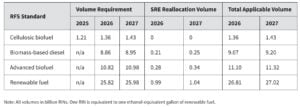
Amid this volatility, U.S. policy took a decisive turn. On March 26, 2026, the EPA finalized the Renewable Fuel Standard (RFS) “Set 2” rule, setting new blending targets for 2026 and 2027.
- The new requirements are the highest in the program’s history. The EPA set total renewable volume obligations at 26.81 billion RINs for 2026 and 27.02 billion RINs for 2027.
These targets reflect a major increase compared to previous years and signal a strong push toward domestic biofuel production.
- The policy focuses heavily on expanding the use of biomass-based diesel, including biodiesel and renewable diesel. This includes a 70 percent reallocation of small refinery exemptions granted for 2023–2025
- At the same time, ethanol blending levels remain stable at 15 billion gallons annually, providing consistency for corn producers.
Additionally, the rule puts back 70% of the biofuel volumes that small refineries didn’t have to blend from 2023 to 2025. This effectively increases the burden on refiners while ensuring that biofuel demand remains strong.
Policy Pivot Favors U.S. Biofuel Producers
Beyond volume targets, the EPA introduced structural changes. The agency removed renewable electricity from the RFS program, narrowing its focus to liquid and gaseous fuels. It also introduced measures to limit the role of foreign feedstocks in the future.
Starting in 2028, imported biofuels will receive a lower compliance value compared to domestic products. In addition, incentives such as the 45Z tax credit are designed to favor U.S.-based production.
The broader goal is clear. The policy aims to strengthen energy independence, support farmers, and reduce reliance on foreign oil. Estimates suggest that these measures could cut oil imports by hundreds of thousands of barrels per day over the next two years.
At the same time, the EPA expects significant economic benefits. The rule could generate billions of dollars for rural economies and create thousands of new jobs across agriculture and manufacturing sectors.
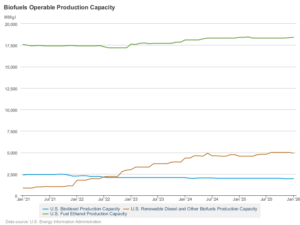
The U.S. Energy Information Administration (EIA) recently published updated data on the country’s biofuel production capacity, shown below.
Demand Surges but Supply Faces Pressure
While policy is driving demand higher, supply conditions remain tight. The U.S. biofuel market is projected to exceed $41 billion in 2026, supported by transportation demand and decarbonization goals.

Ethanol continues to dominate the market, especially through E10 fuel blends. However, advanced biofuels such as renewable diesel and SAF are growing faster due to stronger policy incentives and rising interest in low-carbon fuels.
Despite this growth, feedstock availability is becoming a major concern. Domestic sources such as soybean oil, used cooking oil, and tallow are under pressure. Prices have risen sharply due to limited supply and increased competition from both the fuel and food industries.
At the same time, import restrictions have reduced access to cheaper global feedstocks. Tariffs and lower compliance values for foreign inputs are shifting the market toward domestic sourcing. While this supports local producers, it also reduces flexibility during supply shortages.
New processing capacity is helping to ease some of the pressure. Agribusiness companies are expanding oilseed crushing operations, and renewable diesel plants are increasing output. However, these efforts may take time to fully balance supply and demand.
War-Driven Oil Shock Makes Biofuels More Valuable
The U.S. biofuel market is gaining momentum as rising oil prices and global conflict reshape energy choices. The ongoing U.S.-Israel-Iran war has disrupted key oil infrastructure and shipping lanes near the Strait of Hormuz, sending crude prices sharply higher.
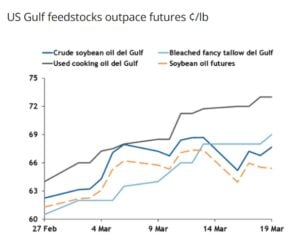
As conventional fuels become more expensive, alternatives like ethanol, renewable diesel, and sustainable aviation fuel (SAF) are increasingly attractive, driving demand across the sector. This surge has pushed feedstock costs to multi-year highs, with soybean oil, used cooking oil, and animal fats climbing steadily.
At the same time, renewable fuel credits, or RINs, have reached levels not seen in years, boosting margins for biofuel producers but raising compliance costs for refiners. Reports from Argus Media show that U.S. renewable diesel feedstocks hit their highest prices in over two years this month, highlighting the market’s sensitivity to war-driven disruptions.
While industry groups argue that strong domestic production stabilizes supply and reduces reliance on imported oil, refiners warn that these rising costs could eventually reach consumers, especially in regions with less competition. The combination of strong demand, tight supply, and geopolitical risk is redefining U.S. biofuel market dynamics.
Opportunities for Farmers, Challenges for Refiners
The current landscape is creating both opportunities and challenges.
Biofuel producers and farmers are seeing strong benefits. Higher demand for crops like corn and soybeans is supporting agricultural incomes. Investment in renewable fuel projects is also increasing, driven by policy certainty and market growth.
However, refiners and fuel distributors are facing tighter margins. The cost of compliance, combined with volatile feedstock prices, is making operations more difficult. Smaller players may struggle to compete in this environment.
Consumers could also feel the impact through higher fuel prices, especially if cost pressures continue. To manage these risks, many companies are turning to hedging strategies. Storage, long-term contracts, and flexible sourcing are becoming essential tools in navigating market uncertainty.
Supporting this announcement, U.S. Secretary of Agriculture Brooke L. Rollins, said:
“Today’s announcement is truly historic for our nation’s farmers and energy producers. These numbers represent the highest levels of biofuels ever required to be blended into our fuel supply. With President Trump and Administrator Zeldin’s leadership, these historically high volumes are expected to create a $3 to $4 billion dollar increase in net farm income. The Renewable Fuel Standard Set 2 Rule will create a $31 billion dollar value for American corn and soybean oil for biofuel production in 2026, which is $2 billion more than in 2025. Our farmers are stepping up to grow American energy dominance.”
Strong Growth, But Uncertain Path
Looking ahead, the U.S. biofuel market is expected to grow steadily, with projections showing annual growth of up to 10% through the next decade. Strong EPA mandates and supportive policies will continue to drive demand.
However, the path forward is far from stable.
The mismatch between long-term policy goals and short-term geopolitical disruptions will remain a key challenge. Events like the ongoing Middle East conflict can quickly shift market dynamics, creating sudden price swings and supply risks.
The rest of 2026 will depend on several key factors, including potential EPA waivers, movements in RIN markets, and developments in global energy supply. In the end, the success of U.S. biofuels will depend on balance. Policy support provides a strong foundation, but flexibility will be critical in managing real-world challenges.
Despite the industry growing fast, the question remains—can it handle the pressure of both policy ambition and global uncertainty at the same time?
The post U.S. Biofuel Market 2026: Can EPA Policies Offset War-Driven Volatility? appeared first on Carbon Credits.
Carbon Footprint
TotalEnergies and Masdar’s $2.2 Billion Deal Signals a Big Push into Asia’s Renewable Energy Boom
Asia is entering a new energy era. Electricity demand is rising fast, and global energy giants are moving quickly to secure their position. A major $2.2 billion joint venture between TotalEnergies and Masdar reflects this shift. The deal is not just about building renewable assets. It is about capturing one of the biggest growth stories in global energy.
The simple reality is: Asia will drive most of the world’s electricity demand in the coming decade.
TotalEnergies and Masdar: A Power Partnership Built for Scale
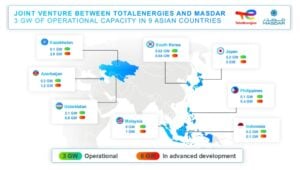
The new joint venture brings together the strengths of both companies under a single platform. It creates a 50:50 partnership that will manage onshore renewable energy assets across nine countries. These include Indonesia, Japan, South Korea, and several fast-growing markets in Southeast Asia and Central Asia.
The platform already holds 3 gigawatts (GW) of operational capacity. On top of that, it has a pipeline of 6 GW expected to come online by 2030. This combination gives the venture a strong starting point and a clear growth path.
More importantly, the focus goes beyond just building solar or wind farms. The joint venture plans to integrate solar, wind, and battery storage systems. This approach supports grid stability and ensures a reliable energy supply. As renewable energy expands, such integration becomes essential.
This is not a small regional project. It is a large, coordinated effort designed to meet rising demand while supporting cleaner energy systems.
His Excellency Dr Sultan Al Jaber, UAE Minister of Industry and Advanced Technology and Chairman of Masdar, noted:
“The UAE has established itself as a global energy leader by delivering at scale, investing with conviction, and building partnerships that endure. Masdar epitomizes that approach. We are proud to have pioneered renewable energy deployment in Central Asia and the Caucasus, and we have an expanding portfolio in some of the most attractive growth markets in Asia-Pacific. Asia will be the main driver of global electricity demand growth this decade, and this collaboration with TotalEnergies will accelerate our progress across the continent, unlocking new opportunities to deliver the competitive, reliable energy solutions that our partners and customers need.”
- READ MORE:
- TotalEnergies and Google’s 1 GW Solar Deal Signals a New Phase in the Data Center Energy Race
- TotalEnergies and AllianzGI Team Up on $580M Battery Storage Push in Germany
Asia’s Electricity Boom Is Reshaping Markets: Wood Mackenzie’s Analysis
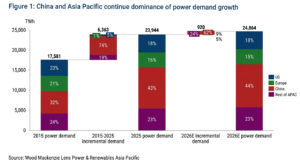
Asia has become the engine of global electricity demand. Over the past decade, the region accounted for nearly all new power demand compared to the United States and Europe.
In 2025, the scale reached a historic milestone. As per Wood Mac’s Asia Pacific Power & Renewables: What to look for in 2026 report, China alone generated over 10,000 terawatt-hours (TWh) of electricity. That was more than the combined output of the U.S. and Europe. At the same time, the rest of Asia continued to produce more electricity than either region year after year.
This growth is not random. It is driven by three powerful forces: rapid industrial expansion, urban population growth, and rising digital infrastructure.
Data centers are now a major driver. As artificial intelligence and cloud computing expand, electricity demand is rising sharply. Countries like Japan, China, and those in Southeast Asia are seeing new demand from this sector alone.
- For example, Japan could add up to 66 TWh of demand from data centers by 2034. China may need an extra 668 TWh by 2030. Southeast Asia will also see steady increases as digital services grow.
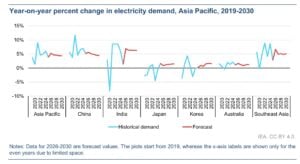
Even short-term slowdowns have not changed the bigger picture. In early 2025, trade tensions and tariffs slowed demand growth. China’s power demand growth dropped to 2.5% in the first quarter. India and Southeast Asia also saw weaker numbers.
However, the slowdown did not last long. By the third quarter, demand rebounded strongly. China recorded over 6% growth again. India and Southeast Asia also recovered, supported by industrial output and extreme heat driving cooling needs.
This resilience shows that Asia’s demand growth is not fragile. It is deeply rooted in economic and technological change.
Clean Energy Expansion Keeps Pace
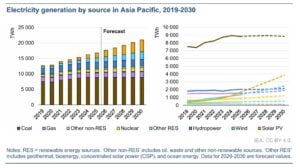
As demand rises, clean energy is expanding quickly across Asia. IEA predicts that by 2030, 56% of the world’s electricity use will be in the Asia Pacific, up from 53% in 2025.
In 2025 alone, the region added nearly 500 GW of wind and solar capacity. This shows strong momentum toward decarbonization.
Governments are also playing a key role. Many countries are introducing policies that allow renewable energy to reach consumers directly. These steps make clean power more accessible and encourage further investment.
However, challenges remain. Supply chain bottlenecks and trade barriers continue to create uncertainty. Equipment shortages, especially for gas turbines, could slow down parts of the energy transition. At the same time, global political shifts are affecting trade flows and investment decisions.
Despite these issues, the overall direction is clear. Clean energy is growing, and it is becoming central to Asia’s power systems.
Strategic Moves in a Competitive Market
The partnership between TotalEnergies and Masdar reflects a deeper strategy. Both companies are positioning themselves for long-term growth in high-demand markets.
For TotalEnergies, the deal supports its Integrated Power strategy. This approach combines renewable generation with flexible energy solutions and market access. It helps the company manage supply and demand more effectively.
For Masdar, the partnership strengthens its presence across Asia. It also brings the advantage of working with a global energy major. This combination improves its ability to scale projects and enter new markets.
Leadership also highlights the importance of this collaboration. Dr. Sultan Al Jaber, Chairman of Masdar, emphasized that Asia will drive global electricity demand growth. He also pointed out that partnerships like this will help deliver reliable and competitive energy solutions.
The choice of Abu Dhabi as the control hub adds another layer of significance. It shows how the UAE is expanding its role in global energy markets, especially in clean energy investments.
The Road Ahead: Demand, Data, and Decarbonization
Looking forward, Asia will remain the dominant force in global electricity demand. By 2026, the region is expected to account for about 85% of new power demand worldwide. This is a massive share, especially as the U.S. and Europe also increase their demand due to AI and data centers.
China will continue to lead in absolute terms. However, India and Southeast Asia will play equally important roles as growth engines. Together, they will shape the region’s energy future.
At the same time, the energy transition will face key questions:
- Can renewable energy keep up with rising demand?
- Will supply chain issues slow progress?
- How will countries balance growth with sustainability?
The answers will define the next phase of Asia’s energy story.
Thus, the $2.2 billion joint venture is a signal of where the energy world is heading. Companies are not just building power plants. They are building platforms that combine scale, technology, and market access.
Asia offers the biggest opportunity, but it also demands smart execution. Projects must be large, reliable, and integrated. They must support both growth and sustainability.
And this is why partnerships like the one between TotalEnergies and Masdar matter. They bring together capital, expertise, and long-term vision.
The post TotalEnergies and Masdar’s $2.2 Billion Deal Signals a Big Push into Asia’s Renewable Energy Boom appeared first on Carbon Credits.
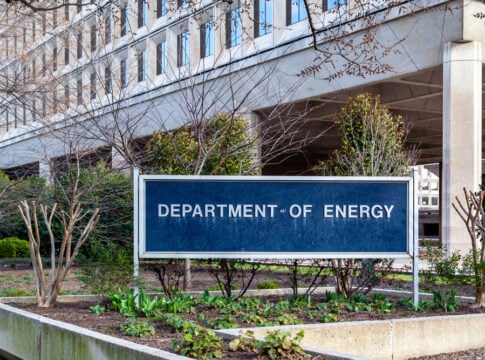
The U.S. Department of Energy is intensifying efforts to secure critical minerals as global supply risks rise. In a new collaboration, the DOE’s Ames National Laboratory and the Critical Materials Innovation Hub have joined hands with Amazon to recover high-value materials from waste.
The partnership focuses on extracting battery-grade graphite and key minerals from discarded textiles and electronic waste. This move reflects a broader U.S. strategy—reduce import dependence, build domestic capacity, and create a circular supply chain for critical materials.
Assistant Secretary of Energy (EERE) Audrey Robertson, leading DOE’s Office of Critical Materials and Energy Innovation, said:
“At scale, the recovery of critical minerals from end-of-life technologies and textile waste has the potential to transform our domestic critical materials supply chains. This pioneering work, made possible by an exciting new partnership with Amazon, supports the Trump Administration’s efforts to reduce our reliance on foreign imports and strengthen our national security.”
U.S. Aims for Domestic Graphite Supply
The collaboration combines materials science with artificial intelligence. Ames Lab and CMI bring decades of expertise in metals refining and advanced materials. Amazon contributes AI, logistics, and large-scale supply chain capabilities.
Ames Laboratory Director Karl Mueller also noted,
“This is an excellent match for Ames National Laboratory’s deep expertise in materials science. For decades, Ames Lab has led the nation in metals refining, purification, and critical materials research—and applying that strength to real-world challenges.”
Turning Textiles into Battery-Grade Graphite
A major project aims to convert discarded textiles into battery-grade graphite. This is significant because graphite is essential for lithium-ion batteries used in electric vehicles (EVs) and energy storage systems.
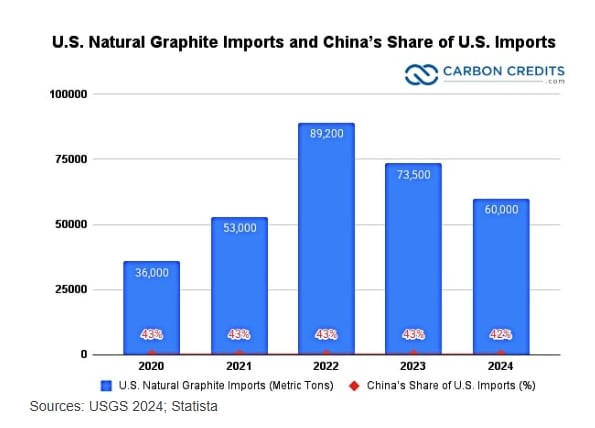
Today, the U.S. remains heavily dependent on imports for graphite. In fact, more than 90% of global battery-grade graphite processing is concentrated in China, creating a major supply risk.
- As of 2024, the U.S. imported about 60,000 metric tons of natural graphite, down from roughly 84,000 tons in 2023.
- China remained the largest supplier, accounting for around 67.6% of all natural graphite imports by value.
This is worth roughly $375 million. It represents a slight decrease in volume but still a dominant share of the market.
By extracting graphite from waste, the U.S. can reduce both landfill pressure and foreign dependence. This approach aligns with the DOE’s push to secure materials from “secondary sources” such as waste streams.
AWS Powers AI-Driven Mineral Recovery
A second initiative focuses on recovering minerals like gallium from end-of-life IT hardware. Gallium is a critical input for semiconductors, power electronics, and defense technologies.
The importance of this effort is clear. In recent years, China has restricted exports of gallium and germanium, disrupting global supply. These restrictions effectively removed up to 90% of global gallium supply from international markets, exposing major vulnerabilities.
Here, Amazon Web Services will deploy AI tools to map supply chains, identify recovery opportunities, and assess economic feasibility. At the same time, CMI researchers will develop efficient extraction and refining methods.
This fusion of AI and materials science could transform recycling. Instead of being discarded, old electronics could become a reliable domestic source of critical minerals.
A Fragile Supply Chain: Why the U.S. Is Acting Now
Critical minerals are the core of modern industries—from EVs and renewable energy to semiconductors and defense systems. However, U.S. supply chains remain highly vulnerable.
According to recent industry analysis:
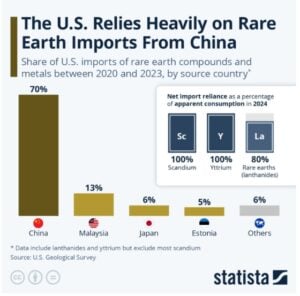
- The U.S. is 100% import-reliant for at least 13 critical minerals
- Over 20 additional minerals have an import dependence above 50%
- The country exports much of its raw materials for processing overseas due to limited domestic capacity
China dominates refining and processing, backed by decades of industrial policy. This concentration creates risks of supply disruptions, price spikes, and geopolitical leverage.
To address this, the U.S. government is mobilizing large-scale investments. In 2025, the DOE announced nearly $1 billion in funding to strengthen domestic critical mineral supply chains, with a strong focus on battery materials processing and recycling.
Additionally, new initiatives such as strategic stockpiles and international partnerships are being developed to secure long-term supply.
CMI Hub Leads the Shift to Circular Supply Chains
The Amazon–DOE partnership reflects a major shift in strategy. Traditionally, supply security depended on mining new resources. Now, recycling and “urban mining” are becoming equally important.
The CMI Hub is leading this transition through research in:
- Expanding material supply sources
- Developing substitutes for scarce minerals
- Recovering materials from waste
- Accelerating the commercialization of new technologies
Recycling offers several advantages. It is faster to deploy than mining, less environmentally damaging, and often more cost-effective in the long run. For example, the U.S. has already committed funding to advanced graphite recycling projects to build domestic battery supply chains.
CMI Hub Director Tom Lograsso
“This collaboration is a natural extension of the expertise that CMI Hub was created to deliver. CMI’s mission is to move breakthrough materials technologies from the laboratory into real-world applications on timelines that meet industry’s needs. Working with Amazon gives us the opportunity to apply our capabilities at scale—combining CMI’s materials science expertise with Amazon’s AI to turn innovations into practical solutions that strengthen the nation’s critical materials supply chains.”
Public–Private Partnerships Drive Scale
This collaboration also highlights a broader trend—closer ties between government research institutions and private companies.
Amazon brings AI, data analytics, and global logistics. Ames Lab and CMI contribute scientific expertise and research infrastructure. Together, they aim to move solutions from the lab to real-world deployment at scale.
Such partnerships are critical because the challenge is not just technical. It also involves economics, infrastructure, and supply chain coordination. By combining strengths, these collaborations can accelerate innovation and reduce risks.
Conclusion: A Strategic Shift With Global Impact
The U.S. is clearly redefining its critical minerals strategy. Instead of relying only on mining, it is tapping into waste as a new resource base.
This approach offers strong advantages:
- Waste streams are abundant and underutilized
- Recycling reduces environmental impact
- Domestic recovery improves supply security
However, challenges remain. Domestic processing capacity is still limited, and scaling recycling technologies will require sustained investment and policy support.
At the same time, AI is emerging as a key enabler. It can optimize recovery processes, improve efficiency, and reduce costs. As adoption grows, it could become a critical tool in securing mineral supply chains.
And the partnership between the DOE, Ames Lab, CMI, and Amazon marks a turning point in how the U.S. approaches critical minerals.
- READ MORE: DOE Launches $500M Funding Drive to Strengthen U.S. Battery Supply Chains and Critical Minerals Processing
- LATEST: AI Solutions from Microsoft and NVIDIA Power DOE’s Nuclear Energy Genesis Mission • Carbon Credits
The post DOE and Amazon Partner to Secure Critical Minerals Through AI-Driven Recycling appeared first on Carbon Credits.


-
Greenhouse Gases8 months ago
Guest post: Why China is still building new coal – and when it might stop
-
Climate Change8 months ago
Guest post: Why China is still building new coal – and when it might stop
-

 Greenhouse Gases2 years ago
嘉宾来稿:满足中国增长的用电需求 光伏加储能“比新建煤电更实惠”
-
Climate Change2 years ago
Bill Discounting Climate Change in Florida’s Energy Policy Awaits DeSantis’ Approval
-

 Climate Change2 years ago
嘉宾来稿:满足中国增长的用电需求 光伏加储能“比新建煤电更实惠”
-
Climate Change Videos2 years ago
The toxic gas flares fuelling Nigeria’s climate change – BBC News
-

 Renewable Energy5 months ago
Sending Progressive Philanthropist George Soros to Prison?
-

 Carbon Footprint2 years ago
US SEC’s Climate Disclosure Rules Spur Renewed Interest in Carbon Credits