

 The answer to the question at left fully would take me a several days. But for the sake of brevity, let’s focus on the environment.
To facilitate North America’s coming together to clean up its electricity grid, President Obama announced the partnership that the U.S. made with Canada and Mexico. The goal: 50% clean energy by 2025, facilitated by transmitting large amounts of power between the three countries as required to maximize the penetration of renewable energy.
For those who may not have noticed Obama’s other accomplishments regarding the environment, I offer the following, from PleaseCutTheCrap.com.
Now, how much of this is this still in place, after Trump’s have taken a wrecking ball to environmental responsibility to further enrich his billionaire donors? Little if any, I’m sure.
Addressed the Environment While Dealing with Energy Needs
Doubled federal spending on clean energy research. http://bit.ly/iN0sCE
Pushed through a tax credit to help people buy plug-in hybrid cars. http://bit.ly/j8UP5Y
Created a program to develop renewable energy projects on the waters of our Outer Continental Shelf that will produce electricity from wind, wave, and ocean currents. http://1.usa.gov/fgfRWq
Reengaged in the climate change and greenhouse gas emissions agreements talks, and proposed one himself. He also addressed the U.N. Climate Change Conference, officially reversing the Bush era stance that climate change was a “hoax.” http://bit.ly/dX6Vj3 http://bit.ly/fE2PxK http://nyti.ms/hfeqvv
Fully supported the initial phase of the creation of a legally-binding treaty to reduce mercury emissions worldwide. http://bit.ly/eJ6QOO
Required states to provide incentives to utilities to reduce their energy consumption. http://bit.ly/lBhk7P
Under Obama, our dependence on foreign oil has dropped to its lowest rate since 1985, and continues to drop. http://1.usa.gov/1p6kTUy
Meanwhile, oil consumption is way down because of reduced driving and higher mileage standards. http://ti.me/1z4HFG8
Improved siting, review and permitting stations for power plants, in an attempt to seriously improve the nation’s electric grid. http://1.usa.gov/1l8zNqn
Reengaged in a number of treaties and agreements designed to protect the Antarctic. http://bit.ly/fzQUFO
Created tax write-offs for purchases of hybrid and electric vehicles. http://bit.ly/glCukV
Established a quadrennial review of our energy infrastructure, to encourage a modernization of the grid, and to encourage the transition away from fossil fuel use. http://1.usa.gov/1nx2oMo
Mandated that federal government fleet purchases be for fuel-efficient American vehicles, and encouraged that federal agencies support experimental, fuel-efficient vehicles. http://1.usa.gov/hmUSbk http://1.usa.gov/fLWq5c http://bit.ly/h5KZqy
Encouraged BP to pay $20 billion to establish Oil Spill Liability Trust Fund, to reduce the need for taxpayer funds to be used for compensation and clean up. http://wapo.st/ds2BxT (Note: it took 20 years to get $1.3 billion for the Exxon Valdez spill. )
Oversaw and pushed through an amendment to the Oil Pollution Act of 1990 authorizing advances from Oil Spill Liability Trust Fund for the Deepwater Horizon oil spill. http://1.usa.gov/yTRYVo
Actively tried to amend the Oil Pollution Act of 1990 to eliminate the liability limits for those companies responsible for large oil spills. http://nyti.ms/bxjDi3
Became the first President to simply say “Climate Change is a fact,” and set up the first federal government protocols for dealing with the impacts of climate change. http://1.usa.gov/1b7V67B
Initiated Criminal and Civil inquiries into the Deepwater Horizon oil spill. http://nyti.ms/bVuB7a
Asserted federal legal supremacy to bar Texas from authorizing new refinery permits on its own.http://bit.ly/ww8eMd
Set up new, stricter standards limiting power plant emissions. http://1.usa.gov/1mML2M3
Strengthened the Endangered Species Act. http://bit.ly/hscjsH
Strengthened protection for wildlife, and expanded enforcement of laws against wildlife trafficking. http://1.usa.gov/1fce1Ai
Obama EPA improved boiler safety standards to improve air quality, and save 6500 lives per year. http://bit.ly/jYH7nt
Through the EPA, attemped to take steps to severely limit the use of antibiotics in livestock feed, to increase their efficacy in humans. http://bit.ly/fBuWd2
Through new EPA regulations, he created a pretext for closing the dirtiest power plants in the country, by limiting emissions of mercury and other toxic gasses. http://bit.ly/rQCIgA
Increased funding for National Parks and Forests by 10% http://bit.ly/fbJPjY
Announced greatly improved commercial fuel efficiency standards. http://1.usa.gov/oQiC1K
Announced a huge increase in average fuel economy standards from 27.5mpg in 2010 to 35.5mpg starting in 2016 and 54.5 starting in 2025 http://1.usa.gov/qtghsW
Facilitated investment in industrial energy efficiency to create jobs and strengthen US manufacturing while saving businesses $100 billion over a decade. http://1.usa.gov/WsIgbx
Set up the Gulf Coast Ecosystem Restoration Council to oversee Gulf Coast restoration efforts after the 2010 BP oil spill. The money to fund the restoration efforts comes from fines against BP. http://1.usa.gov/Rxjb29
Engaged in the most comprehensive plan to combat climate change in a generation. http://bit.ly/13lXhET
Ordered energy plants to prepare to produce at least 15% of all energy through renewable resources like wind and solar, by 2021. http://reut.rs/fV155p
Oversaw the creation of an initiative that converts old factories and manufacturing centers into new clean technology centers. http://bit.ly/mjnq2R
Guided a 418% increase in solar power capacity between 2010 and 2014. http://bit.ly/1rHkWJC
As of May 2015, 74% of new electrical capacity was provided by solar and wind power. http://bit.ly/1T5r0LC
Bypassed Congress and ordered EPA to begin regulating and measuring carbon emissions. http://bit.ly/froaP5
Oversaw a tripling in the use of wind power to generate electricity. The US now leads the world in increased wind power capacity. http://www.worldwatch.org/node/5448
Ordered the federal government to incorporate climate resilience and climate science into all international development in which the United States engages. http://1.usa.gov/YV1EpW
Fast-tracked regulations to allow states to enact fuel efficiency standards that exceeded federal standards. http://nyti.ms/e8e94x
Fast-tracked increased fuel economy standards for vehicles beginning with the 2011 model year. It was the first time such standards had been increased in more than a decade. http://politi.co/hiaPKM
Oversaw establishment of an Energy Partnership for the Americas, to create more markets for American-made biofuels and green energy technologies. http://bit.ly/lZp73y
Obama EPA reversed a Bush-era decision to allow the largest mountaintop removal project in US history. http://bit.ly/lP3yEL
Ordered the Department of Energy to implement more aggressive efficiency standards for common household appliances. http://1.usa.gov/g3MTbu
Obama EPA ruled that excess CO2 is a pollutant. http://bit.ly/iQTSNN
Closed a deal with China to limit carbon emissions to slow down climate change. http://nyti.ms/1xzyS8K
Blocked all oil and gas drilling in Bristol Bay, Alaska, one of the most pristine environments in North America http://lat.ms/13xUVFD
Signed an Executive Order to improve environmental efforts in the Arctic region and to combat climate change by better coordinating the efforts of the 23 federal agencies operating in the area. http://usat.ly/ZEzLzE
Vetoed a bill to fast track construction of the parallel Keystone XL pipeline. http://nbcnews.to/1DVDFo7
Expanded clean water regulations to more stringently protect all of the nation’s waterways, even when states fail in their duty. http://bit.ly/1RdQpTc
Signed an Executive Order committing the federal government to lead the way in building a sustainable economy. It’s his fifth doing just that. http://1.usa.gov/1EzO2ne
Banned the use of antibiotics in food served in US Government-run cafeterias and ordered agencies to only use antibiotic-free meat. http://bit.ly/1G1vUxi http://bit.ly/1KHkl4N
Developed new rules to address climate change and to create a significant boost to clean energy. http://bit.ly/1UnQcuR
Negotiated and signed a virtually Republican-Proof global agreement on climate change, with 190 countries signing on. http://bit.ly/1RkjVG8
Became one of 196 countries that signed onto a UN Framework on Climate Change. http://unfccc.int/2860.php
Ordered a moratorium on new coal leasing on federal land, and they will examine the whole leasing process. http://wapo.st/23Q6en8
What Obama Did Better than Trump, But Let’s Talk about Environmental Progress

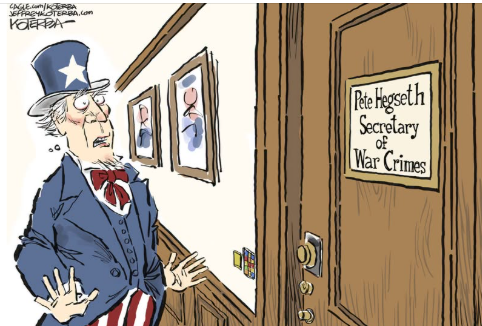 In a better world, the International Criminal Court would have much greater power to prosecute war crimes.
Today, winding up at The Hague requires terrible luck, and it’s virtually impossible to happen to a Donald Trump or a Pete Hegseth, given the enormous military might that the United States possesses.
Contrast this to what happened to Slobodan Milošević, who was arrested when his countries, Yugoslavia and Serbia, were overthrown.
 The prediction made here is nearly certain to come true.
The question is what happens at the point. E.g., how long does it take to rebuild trade deals and relationships with allies?
Keep in mind that regardless of the manner in which Trump loses power, there will always be “news” outlets like Fox and Newsmax, trying their best to convince the idiots that Trump was hounded and persecuted by the communists who hate America.
 All I can say about the me here is that personally I refused, against considerable pressure from my family, to indoctrinate my children into something I myself could not accept.
Is it actually “psychological abuse” to indoctrinate children into monotheistic religion? Whether to take it that far is an open question.
My parents, both atheists, sent my brother and me to Sunday School, as they thought it wrong to cut us off from a modality of growing up in America in the early 1960s. I don’t blame them, but again, it’s not something I was willing to replicate with my own children.



-
Climate Change1 year ago
Guest post: Why China is still building new coal – and when it might stop
-

 Greenhouse Gases2 years ago
嘉宾来稿:满足中国增长的用电需求 光伏加储能“比新建煤电更实惠”
-
Greenhouse Gases1 year ago
Guest post: Why China is still building new coal – and when it might stop
-

 Climate Change2 years ago
嘉宾来稿:满足中国增长的用电需求 光伏加储能“比新建煤电更实惠”
-

 Renewable Energy12 months ago
Sending Progressive Philanthropist George Soros to Prison?
-
Climate Change2 years ago
Bill Discounting Climate Change in Florida’s Energy Policy Awaits DeSantis’ Approval
-
Greenhouse Gases1 year ago
嘉宾来稿:探究火山喷发如何影响气候预测
-

 Climate Change2 years ago
Analysis: China’s CO2 falls 1% in Q2 2024 in first quarterly drop since Covid-19