

Warming driven by deforestation caused an extra 28,000 heat-related deaths per year across Africa, South America and Asia over 2001-20, new research finds.
The study, published in Nature Climate Change, is the first to look at human health impacts of warming caused specifically by tropical deforestation, as opposed to the burning of fossil fuels, its lead author tells Carbon Brief.
The authors find that deforestation alone drove, on average, 0.45C of warming in the tropics over 2001-20, accounting for 64% of the total warming in regions with tropical forest loss.
They also find that tropical deforestation over 2001-20 exposed 345 million people to “local warming”, in addition to the warming they were already facing due to global warming.
Six out of every 100,000 people living in deforested areas died as a result of deforestation-induced warming during this time, they warn.
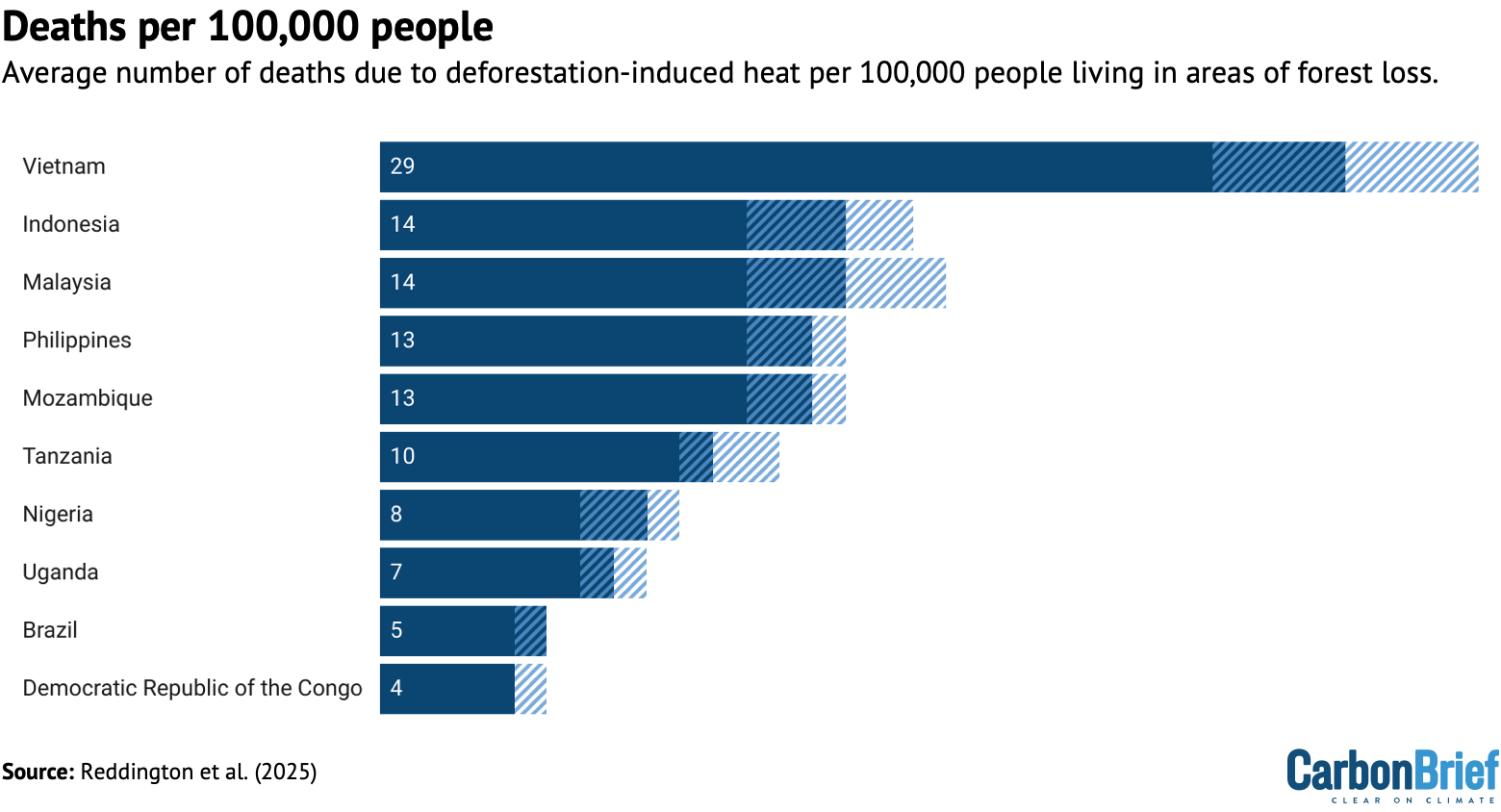
This number is higher in south-east Asia, with Vietnam setting a record of, on average, 29 deaths per 100,000 people.
A researcher who was not involved with the study tells Carbon Brief that the “sobering” paper “reframes tropical deforestation as not only a carbon emissions and ecological issue, but also a critical public health concern”.
Tropical deforestation
Tropical forests, mainly distributed across South America, Africa and Asia, account for 45% of global forest cover.
These regions are well-known for their high biodiversity and the crucial ecosystem services that they provide, such as carbon storage.
However, tropical forest loss is on the rise.
A record 6.7m hectares of previously intact tropical forest was lost last year, mainly due to fires and land clearing for agriculture. As the planet warms, worsening heat and drought extremes are also causing trees to become less resilient to change, resulting in forest degradation.
The new study uses data from the Global Land Analysis and Discovery laboratory at the University of Maryland to assess how tropical forest cover has changed year on year. The authors find that over 2001-20, a total of 1.6m square kilometres (160m hectares) of tropical forest was lost globally. This is shown on the map below, where blue indicates high forest loss and yellow indicates low loss.
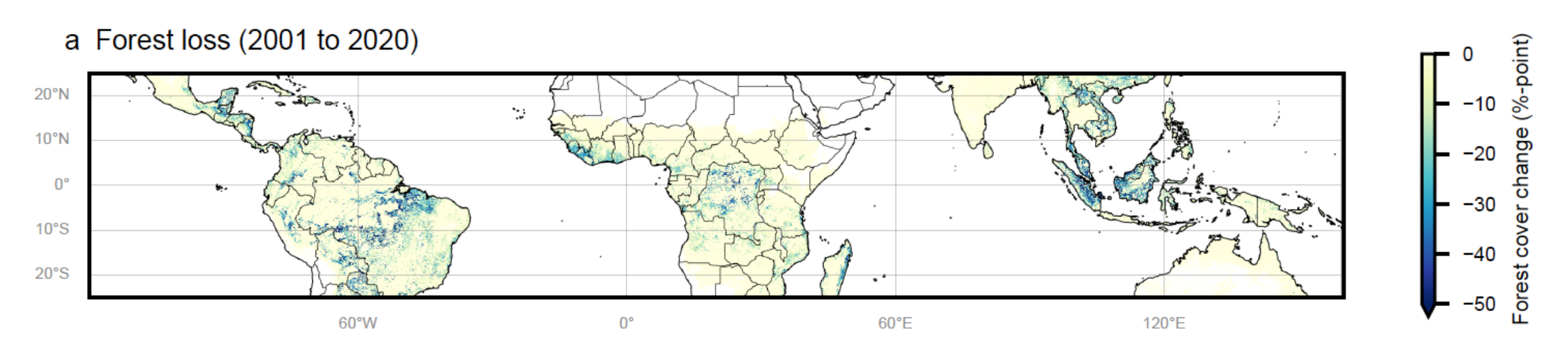
The authors find the largest forest loss was in central and South America, but also highlight “extensive” loss in south-east Asia and tropical Africa.
Forest warming
Tropical deforestation has a wide range of negative consequences, including decreasing biodiversity, releasing carbon into the atmosphere and threatening the safety of Indigenous communities.
Loss of tree cover can also affect local temperatures by influencing the water cycle.
Water is constantly moving from the surface of the land into the atmosphere through a process called evapotranspiration. Plants play a crucial part in this process by moving water from the soil up through their roots and into their leaves, where it evaporates, cooling the air above. When trees are cut down, this cooling effect is reduced.
The authors use data of land surface temperatures from the NASA MODIS satellite to map warming in tropical regions over 2001-20. These results are shown in the map below, where red indicates warming and blue indicates cooling.
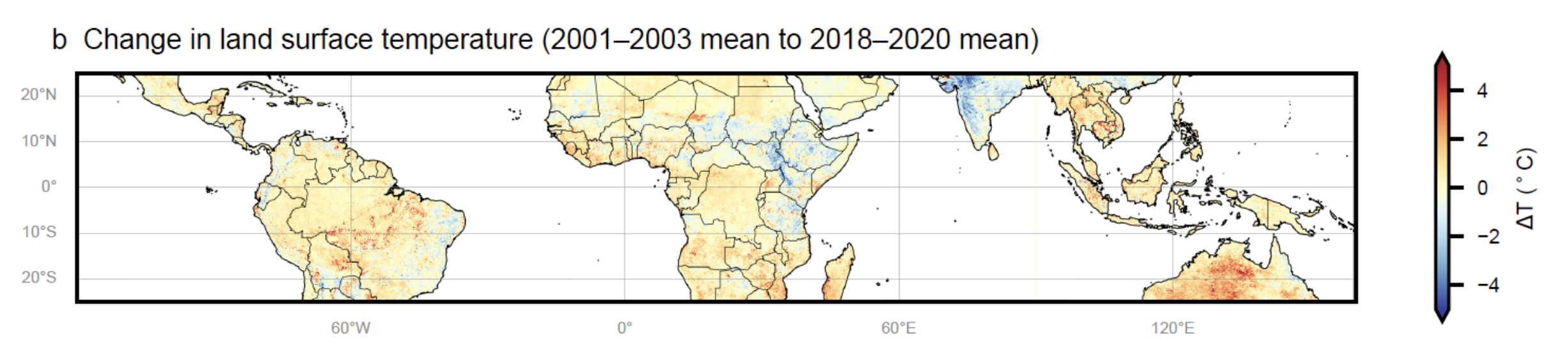
The authors find that between 2001-03 and 2018-20, surface temperatures increased by 0.34C in tropical central and South America, 0.1C in tropical Africa and 0.72C in south-east Asia. They add that “areas of forest loss coincide with areas of strong positive change in temperature across many regions of the tropics”.
By comparing their deforestation and surface warming maps, the authors find that deforested regions of the tropics saw an average of 0.7C warming over 2001-20, while areas that “maintained forest cover” saw an increase of only 0.2C.
By comparing the change in temperature in deforested regions with that in neighbouring locations without forest loss, they find that deforestation alone caused 0.45C of warming in the tropics over 2001-20 – accounting for 64% of total warming experienced over those regions.
Heat exposure
High temperatures can be deadly.
During periods of extreme heat, people can suffer from heat stroke and exhaustion – and even die. Those with underlying health conditions are at higher risk of fatal complications.
The authors use data from Oak Ridge National Laboratory’s LandScan to map where people live in the tropics. They estimate that 425 million people live in regions that were exposed to tropical deforestation over 2001-20, and just over three-quarters of them were exposed to warming as a result of the loss of forest cover.
Finally, the authors estimated “heat-related excess mortality” due to nearby tropical deforestation.
Using data from the 2019 Global Burden of Disease study, they determine the number of “non-accidental” deaths in each deforested tropical area. This excludes deaths from “external” causes, such as accidents and suicides, but includes “internal” causes, such as disease.
The researchers then used previously published “temperature-mortality” relationships for different countries. These relationships show the link between temperature and excess mortality rate, indicating the percentage increase in mortality for every degree of warming.
These relationships vary between countries, as people in hotter regions are generally better adapted to extreme heat.
By combining the data on local warming due to deforestation, temperature-mortality relationships and the non-accidental mortality data, the authors calculated how many non-accidental deaths would have been expected in deforested regions if they had not warmed due to the loss of forest cover.
By comparing the real and counterfactual mortality rates, the authors were able to calculate the total mortality burden due to tropical deforestation-induced warming.
Overall, the authors find that tropical deforestation drove an additional 28,300 deaths every year over 2001-20, accounting for 39% of the total heat-related mortality from global climate change and deforestation combined over locations of forest loss.
The study finds that, on average, six out of every 100,000 people living in deforested areas died as a result of deforestation-induced warming. However, these numbers vary by country.
The chart below shows the average annual deaths due to deforestation-induced heat per 100,000 people living in areas of forest loss.
Dr Carly Reddington is a research fellow at the University of Leeds and lead author of the study. She tells Carbon Brief that it is the “first study to look at human health impacts of tropical deforestation-induced warming”.
Dr Nicholas Wolff, a climate change scientist at the Nature Conservancy who was not involved with the study, tells Carbon Brief that the paper is “sobering”. He adds that it “reframes tropical deforestation as not only a carbon emissions and ecological issue, but also a critical public health concern”.
Data-scarce
The authors note that there are no country-specific heat vulnerability indices available for African countries. To develop their data for African countries, they used the average heat vulnerability index for South America.
Reddington tells Carbon Brief that Africa is the most “uncertain region” in the study and tells Carbon Brief that “more data is really crucial” to develop more accurate estimates.
Wolff tells Carbon Brief that extrapolating heat-mortality relationships “from data-rich regions to data-poor ones” is a “common practice in global-scale climate-health research”.
He praises the overall methodology as “innovative, transparent and scientifically sound, with appropriate caveats”.
Dr Luke Parsons, a climate modelling scientist at the Nature Conservancy, tells Carbon Brief that the conclusions are “robust”. However, he notes some “methodological issues” with the paper, such as the fact that all results are modelled, rather than measured.
He tells Carbon Brief that future work could assess “near-surface air temperature and humidity changes associated with deforestation, as well as study regional air temperature changes beyond deforested areas”.
While the new study focuses on warming within one square kilometre of forest loss, Reddington tells Carbon Brief that “deforestation is associated with warming up to 100km away”.
Furthermore, the study notes that the increase in deaths due to excess heat is likely to affect the most vulnerable members of society the most. It says:
“Vulnerable populations, particularly traditional and Indigenous communities, often live near deforested areas and face limited access to resources and infrastructure needed to cope with the combination of rising temperatures and environmental changes caused by deforestation and climate change.”
Wolff also stresses this disparity, adding that “many of these communities depend on forest clearing for agriculture, income and survival, and are forced to make difficult choices between short-term economic needs and long-term health and environmental stability”.
The authors also note that deforestation can drive a range of other interacting health problems, which were not considered in this study. For example, deforestation is linked to a rise in zoonotic diseases, such as malaria.
Dr Vikki Thompson, a climate scientist at the Royal Netherlands Meteorological Institute who was not involved in the study, says that the findings of the paper are “relevant to everyone”. She continues:
“We can reduce impacts of extreme heat by planting more trees and reducing deforestation everywhere, on both local and international scales.”



The post Warming due to tropical deforestation linked to 28,000 ‘excess’ deaths per year appeared first on Carbon Brief.
Warming due to tropical deforestation linked to 28,000 ‘excess’ deaths per year

Drought and heatwaves occurring together – known as “compound” events – have “surged” across the world since the early 2000s, a new study shows.
Compound drought and heat events (CDHEs) can have devastating effects, creating the ideal conditions for intense wildfires, such as Australia’s “Black Summer” of 2019-20 where bushfires burned 24m hectares and killed 33 people.
The research, published in Science Advances, finds that the increase in CDHEs is predominantly being driven by events that start with a heatwave.
The global area affected by such “heatwave-led” compound events has more than doubled between 1980-2001 and 2002-23, the study says.
The rapid increase in these events over the last 23 years cannot be explained solely by global warming, the authors note.
Since the late 1990s, feedbacks between the land and the atmosphere have become stronger, making heatwaves more likely to trigger drought conditions, they explain.
One of the study authors tells Carbon Brief that societies must pay greater attention to compound events, which can “cause severe impacts on ecosystems, agriculture and society”.
Compound events
CDHEs are extreme weather events where drought and heatwave conditions occur simultaneously – or shortly after each other – in the same region.
These events are often triggered by large-scale weather patterns, such as “blocking” highs, which can produce “prolonged” hot and dry conditions, according to the study.
Prof Sang-Wook Yeh is one of the study authors and a professor at the Ewha Womans University in South Korea. He tells Carbon Brief:
“When heatwaves and droughts occur together, the two hazards reinforce each other through land-atmosphere interactions. This amplifies surface heating and soil moisture deficits, making compound events more intense and damaging than single hazards.”
CDHEs can begin with either a heatwave or a drought.
The sequence of these extremes is important, the study says, as they have different drivers and impacts.
For example, in a CDHE where the heatwave was the precursor, increased direct sunshine causes more moisture loss from soils and plants, leading to a drought.
Conversely, in an event where the drought was the precursor, the lack of soil moisture means that less of the sun’s energy goes into evaporation and more goes into warming the Earth’s surface. This produces favourable conditions for heatwaves.
The study shows that the majority of CDHEs globally start out as a drought.
In recent years, there has been increasing focus on these events due to the devastating impact they have on agriculture, ecosystems and public health.
In Russia in the summer of 2010, a compound drought-heatwave event – and the associated wildfires – caused the death of nearly 55,000 people, the study notes.

The record-breaking Pacific north-west “heat dome” in 2021 triggered extreme drought conditions that caused “significant declines” in wheat yields, as well as in barley, canola and fruit production in British Columbia and Alberta, Canada, says the study.
Increasing events
To assess how CDHEs are changing, the researchers use daily reanalysis data to identify droughts and heatwaves events. (Reanalysis data combines past observations with climate models to create a historical climate record.) Then, using an algorithm, they analyse how these events overlap in both time and space.
The study covers the period from 1980 to 2023 and the world’s land surface, excluding polar regions where CDHEs are rare.
The research finds that the area of land affected by CDHEs has “increased substantially” since the early 2000s.
Heatwave-led events have been the main contributor to this increase, the study says, with their spatial extent rising 110% between 1980-2001 and 2002-23, compared to a 59% increase for drought-led events.
The map below shows the global distribution of CDHEs over 1980-2023. The charts show the percentage of the land surface affected by a heatwave-led CDHE (red) or a drought-led CDHE (yellow) in a given year (left) and relative increase in each CDHE type (right).
The study finds that CDHEs have occurred most frequently in northern South America, the southern US, eastern Europe, central Africa and south Asia.

Threshold passed
The authors explain that the increase in heatwave-led CDHEs is related to rising global temperatures, but that this does not tell the whole story.
In the earlier 22-year period of 1980-2001, the study finds that the spatial extent of heatwave-led CDHEs rises by 1.6% per 1C of global temperature rise. For the more-recent period of 2022-23, this increases “nearly eightfold” to 13.1%.
The change suggests that the rapid increase in the heatwave-led CDHEs occurred after the global average temperature “surpasse[d] a certain temperature threshold”, the paper says.
This threshold is an absolute global average temperature of 14.3C, the authors estimate (based on an 11-year average), which the world passed around the year 2000.
Investigating the recent surge in heatwave-leading CDHEs further, the researchers find a “regime shift” in land-atmosphere dynamics “toward a persistently intensified state after the late 1990s”.
In other words, the way that drier soils drive higher surface temperatures, and vice versa, is becoming stronger, resulting in more heatwave-led compound events.
Daily data
The research has some advantages over other previous studies, Yeh says. For instance, the new work uses daily estimations of CDHEs, compared to monthly data used in past research. This is “important for capturing the detailed occurrence” of these events, says Yeh.
He adds that another advantage of their study is that it distinguishes the sequence of droughts and heatwaves, which allows them to “better understand the differences” in the characteristics of CDHEs.
Dr Meryem Tanarhte is a climate scientist at the University Hassan II in Morocco, and Dr Ruth Cerezo Mota is a climatologist and a researcher at the National Autonomous University of Mexico. Both scientists, who were not involved in the study, agree that the daily estimations give a clearer picture of how CDHEs are changing.
Cerezo-Mota adds that another major contribution of the study is its global focus. She tells Carbon Brief that in some regions, such as Mexico and Africa, there is a lack of studies on CDHEs:
“Not because the events do not occur, but perhaps because [these regions] do not have all the data or the expertise to do so.”
However, she notes that the reanalysis data used by the study does have limitations with how it represents rainfall in some parts of the world.
Compound impacts
The study notes that if CDHEs continue to intensify – particularly events where heatwaves are the precursors – they could drive declining crop productivity, increased wildfire frequency and severe public health crises.
These impacts could be “much more rapid and severe as global warming continues”, Yeh tells Carbon Brief.
Tanarhte notes that these events can be forecasted up to 10 days ahead in many regions. Furthermore, she says, the strongest impacts can be prevented “through preparedness and adaptation”, including through “water management for agriculture, heatwave mitigation measures and wildfire mitigation”.
The study recommends reassessing current risk management strategies for these compound events. It also suggests incorporating the sequences of drought and heatwaves into compound event analysis frameworks “to enhance climate risk management”.
Cerezo-Mota says that it is clear that the world needs to be prepared for the increased occurrence of these events. She tells Carbon Brief:
“These [risk assessments and strategies] need to be carried out at the local level to understand the complexities of each region.”




The post Heatwaves driving recent ‘surge’ in compound drought and heat extremes appeared first on Carbon Brief.
Heatwaves driving recent ‘surge’ in compound drought and heat extremes
Greenhouse Gases
DeBriefed 6 March 2026: Iran energy crisis | China climate plan | Bristol’s ‘pioneering’ wind turbine
Welcome to Carbon Brief’s DeBriefed.
An essential guide to the week’s key developments relating to climate change.
This week
Energy crisis
ENERGY SPIKE: US-Israeli attacks on Iran and subsequent counterattacks across the Middle East have sent energy prices “soaring”, according to Reuters. The newswire reported that the region “accounts for just under a third of global oil production and almost a fifth of gas”. The Guardian noted that shipping traffic through the strait of Hormuz, which normally ferries 20% of the world’s oil, “all but ground to a halt”. The Financial Times reported that attacks by Iran on Middle East energy facilities – notably in Qatar – triggered the “biggest rise in gas prices since Russia’s full-scale invasion of Ukraine”.
‘RISK’ AND ‘BENEFITS’: Bloomberg reported on increases in diesel prices in Europe and the US, speculating that rising fuel costs could be “a risk for president Donald Trump”. US gas producers are “poised to benefit from the big disruption in global supply”, according to CNBC. Indian government sources told the Economic Times that Russia is prepared to “fulfil India’s energy demands”. China Daily quoted experts who said “China’s energy security remains fundamentally unshaken”, thanks to “emergency stockpiles and a wide array of import channels”.
‘ESSENTIAL’ RENEWABLES: Energy analysts said governments should cut their fossil-fuel reliance by investing in renewables, “rather than just seeking non-Gulf oil and gas suppliers”, reported Climate Home News. This message was echoed by UK business secretary Peter Kyle, who said “doubling down on renewables” was “essential” amid “regional instability”, according to the Daily Telegraph.
China’s climate plan
PEAK COAL?: China has set out its next “five-year plan” at the annual “two sessions” meeting of the National People’s Congress, including its climate strategy out to 2030, according to the Hong Kong-based South China Morning Post. The plan called for China to cut its carbon emissions per unit of gross domestic product (GDP) by 17% from 2026 to 2030, which “may allow for continued increase in emissions given the rate of GDP growth”, reported Reuters. The newswire added that the plan also had targets to reach peak coal in the next five years and replace 30m tonnes per year of coal with renewables.
ACTIVE YET PRUDENT: Bloomberg described the new plan as “cautious”, stating that it “frustrat[es] hopes for tighter policy that would drive the nation to peak carbon emissions well before president Xi Jinping’s 2030 deadline”. Carbon Brief has just published an in-depth analysis of the plan. China Daily reported that the strategy “highlights measures to promote the climate targets of peaking carbon dioxide emissions before 2030”, which China said it would work towards “actively yet prudently”.
Around the world
- EU RULES: The European Commission has proposed new “made in Europe” rules to support domestic low-carbon industries, “against fierce competition from China”, reported Agence France-Presse. Carbon Brief examined what it means for climate efforts.
- RECORD HEAT: The US National Oceanic and Atmospheric Administration has said there is a 50-60% chance that the El Niño weather pattern could return this year, amplifying the effect of global warming and potentially driving temperatures to “record highs”, according to Euronews.
- FLAGSHIP FUND: The African Development Bank’s “flagship clean energy fund” plans to more than double its financing to $2.5bn for African renewables over the next two years, reported the Associated Press.
- NO WITHDRAWAL: Vanuatu has defied US efforts to force the Pacific-island nation to drop a UN draft resolution calling on the world to implement a landmark International Court of Justice (ICJ) ruling on climate, according to the Guardian.
98
The number of nations that submitted their national reports on tackling nature loss to the UN on time – just half of the 196 countries that are part of the UN biodiversity treaty – according to analysis by Carbon Brief.