

Welcome to Carbon Brief’s China Briefing.
China Briefing handpicks and explains the most important climate and energy stories from China over the past fortnight. Subscribe for free here.
Key developments
Emissions fell in first half
POWERING THE TRANSITION: China’s carbon dioxide (CO2) emissions fell 1% year-on-year in the first half of 2025, new analysis for Carbon Brief found, extending a decline that began in March 2024. Power sector emissions fell by 3% during this period, as growth in solar power alone matched the 170 terawatt-hour (TWh) rise in electricity demand, the analysis said. It noted that the sector’s coal use fell 3.4% year-on-year, while gas use increased by 6%. The analysis added that, even if China’s emissions fall in 2025, it will likely miss multiple climate targets this year, such as carbon intensity.
DEMAND UP, PRICES DOWN: Reuters reported that in July, which is not covered in the Carbon Brief analysis, China’s fossil-fuelled power generation “rose 4.3%…from a year earlier”, due to high cooling demand. Extreme heat continued to push power demand to new highs in early August, China Energy News said, with China seeing record demand continuously over 4-6 August. At one point demand reached 1,233 gigawatts, it added. Business news outlet Caixin reported that, despite this, power was “actually getting cheaper in some regions”, driven by the “growing share of renewables in the power mix”.

‘SHORT-TERM SHOCKS’: Extreme heat, heavy rains and floods “caused short-term shocks to economic operations”, Singapore-based outlet Lianhe Zaobao quoted a government official as saying. “Bad weather” specifically affected “steel and coal output”, according to Bloomberg, with the coal industry “also contending with government inspections”. The government will allocate 100bn yuan ($14bn) to “support businesses hit by natural disasters”, Reuters said.
PETROCHEMICALS RISING: The only major sector that saw growth in emissions during the first half of 2025 was the chemicals sector, the Carbon Brief analysis said, rising around 47% year-on-year. At least one segment of the industry is “set to expand by almost half between now and 2028”, Reuters cited a representative of oil giant Sinopec as saying. Meanwhile, state news agency Xinhua said Sinopec is “promoting the construction of a Beautiful China through the development of a beautiful petrochemical industry”.
Clean-tech exports stayed strong
OVERSEAS GROWTH: China’s exports of clean-energy technologies “rose further in July”, Caixin said, with Chinese lithium-ion battery and electric vehicle (EV) exports in the first seven months of 2025 rising around 26% year-on-year, by value. Solar cell exports also rose 54% in terms of volume over this period, it noted, although by value they “fell 23%”. Industry outlet PV Magazine said that China’s exports of solar cells and wafers had “increased significantly”, but that exports of panels declined. Meanwhile, the government has held its second meeting in two months with solar industry representatives on curbing overcapacity, Reuters said. Elsewhere, the Hong Kong-based South China Morning Post (SCMP) covered new research finding that, in 2024, Chinese EV companies invested more overseas than they did in China “for the first time”.
-
Sign up to Carbon Brief’s free “China Briefing” email newsletter. All you need to know about the latest developments relating to China and climate change. Sent to your inbox every Thursday.
‘PRAGMATIC’ ON CLIMATE: Chinese ambassador to the UK Zheng Zeguang argued China and the UK should work “more closely” to address climate change, in a Guardian commentary. (Zheng has also become China’s first permanent representative to the London-based International Maritime Organization, according to Xinhua.) In response to an article by UK government adviser Chris Stark saying that the UK should join China in becoming an “electrostate”, the Global Times published an editorial saying the UK’s energy transition “hinges on pragmatic cooperation” with China. Meanwhile, President Xi Jinping said China and Brazil should “ensure the success” of COP30, Xinhua reported.
CHINA’S SECURITY CONCERNS: China’s third-largest hydropower station has “fully transitioned away” from using western-made chips due to “national security and supply chain resilience concerns”, SCMP reported. The government also issued a notice on “strengthening” supervision of smart EVs, International Energy Net said, including software updates. China’s exports of permanent magnets and other rare-earth products “extended their recovery in July”, Bloomberg said, with export volumes rising 69% from a month earlier. The country is also warning foreign companies not to “stockpile rare earths and derived products such as magnets”, the Financial Times reported.
National ecology day
GREEN TO GOLD: China must “adopt green development approaches to grow our mountains of gold and silver”, Premier Li Qiang said, according to energy news outlet International Energy Net, at an event marking national ecology day. The event was also held on the 20th anniversary of President Xi Jinping’s speech in Zhejiang province, in which he emphasised that “lucid waters and lush mountains are invaluable assets”. [Read more on Xi’s “two mountains” theory in this analysis by Carbon Brief.] Li added that China must “steadily promote the green and low-carbon transformation of industries” and “collaborate with all parties to…address climate change”, it said.
OFFICIALS SPEAK: Speaking a few days earlier, Chinese climate envoy Liu Zhenmin told a conference that “green and low-carbon innovation… [is] the new engine driving global economic growth”, the state-run newspaper China Daily reported, adding that he “attributed much of [China’s energy] transformation to the ‘two mountains’ theory”. National Development and Reform Commission head Zheng Shanjie wrote an essay on the theory for the ideological journal Research on Xi Jinping Economic Thought, saying China must “coordinate efforts to reduce carbon emissions, mitigate pollution, expand green spaces and promote economic growth”. Environment minister Huang Runqiu also said this in a speech broadcasted by the Communist party-affiliated newspaper People’s Daily, adding that the tasks “may seem independent, but are actually closely interconnected”.
MEDIA REACTIONS: State media also issued commentaries on the theory, with the People’s Daily publishing a “Ren Ping” commentary – a byline indicating the article reflects party leaders’ views – saying it is a “beacon” for “global green development”. A People’s Daily commentary under the byline He Yin – which similarly signals that the article reflects party leaders’ views on international affairs – said the theory “contributes Chinese wisdom and solutions to building a clean and beautiful world”. An editorial in the state-supporting Global Times said: “Especially at a time when climate change is an urgent global challenge, [the theory] is timely, visionary and inspiring.”
Draft policies and pilot projects
COUNTING CARBON: The Ministry of Ecology and Environment (MEE) issued four more draft methodologies for China’s voluntary carbon market, three of which address “gas recovery and utilisation” from oil- and gas-fields, BJX News reported. The MEE also published a draft revision to guidelines for provincial greenhouse gas inventories that aims to “enhance the scientific rigour, standardisation and practicality” of compiling the documents, another BJX News article said. Meanwhile, China will also develop “national carbon measurement centres” to help support the development of carbon measurement capabilities, finance outlet EastMoney said.
‘GREEN FUELS’: Meanwhile, China has established nine pilot projects to develop “green fuels” including ammonia, methanol and ethanol, finance news outlet Yicai said, adding that many of the projects use “green hydrogen as a raw material to produce” the chemicals. Separately, China’s National Energy Administration (NEA) said in a statement that it placed “great importance on the development of green liquid fuels”, with co-firing in coal-fired power plants an “important pathway…to achieve low-carbon development”, BJX News reported. According to another BJX News article, the NEA also said it attached “great importance” to the gas-power industry and would continue to plan new “peak-shaving gas-fired power plants”.
OTHER POLICIES: Elsewhere, the NEA released draft guidelines for “assessing the capacity of power grids to accommodate distributed power sources”, BJX News said. Guangdong has become the first province in China to “recognise greenhouse gas emissions quotas as legal collateral for loans”, Yicai reported. Xinhua reported that the China Consumer Association has issued draft guidelines for “green consumption” that explore how “every green consumption choice can contribute to significant emission reduction effects”.
Spotlight
Guest spotlight: How China could decarbonise its cement industry
China could use a “whole-of-system” approach to decarbonise its cement industry, according to a report released today by thinktank Climate Analytics.
In this issue, report author James Bowen, Climate Analytics climate and energy policy analyst, examines how China could reduce the sector’s country-sized emissions.
China’s challenge in managing the carbon dioxide (CO2) emissions accompanying its economic rise is best illustrated by cement.
From about 200m tonnes (Mt) in 1990, Chinese cement production – almost all of which is domestically consumed – climbed to 2.5bn tonnes (Gt) in 2014 and has remained near this level for about a decade.
Its cement sector now emits more than the entire economies of all but three countries other than China itself – more than 1.2bn tonnes of CO2 (GtCO2) a year.
Cement decline significant but not enough for 1.5C
China’s main cement emissions challenge is that it continues to use far more cement and cement products per person than most countries.
Cement demand is now entering sustained decline as China’s economy restructures. Based on current trends, national production could drop below 1Gt by 2050.
But analysts have estimated that in addition to cutting demand – potentially even further than expected by 2050 – the emissions per unit of production would also need to fall, to align with the goals of the Paris Agreement.
Specifically, they estimate that emissions per unit would need to fall to around 360kg of CO2 per tonne by 2030 and 55-90kg by 2050. If each tonne of future Chinese cement continues to generate about 550kg of CO2, as at present, then the sector will remain well off this pace.
This task is formidable. Cement is an inexpensive, high-performance building material with widely available feedstocks.
About 90% of its emissions come from producing clinker – a key ingredient.
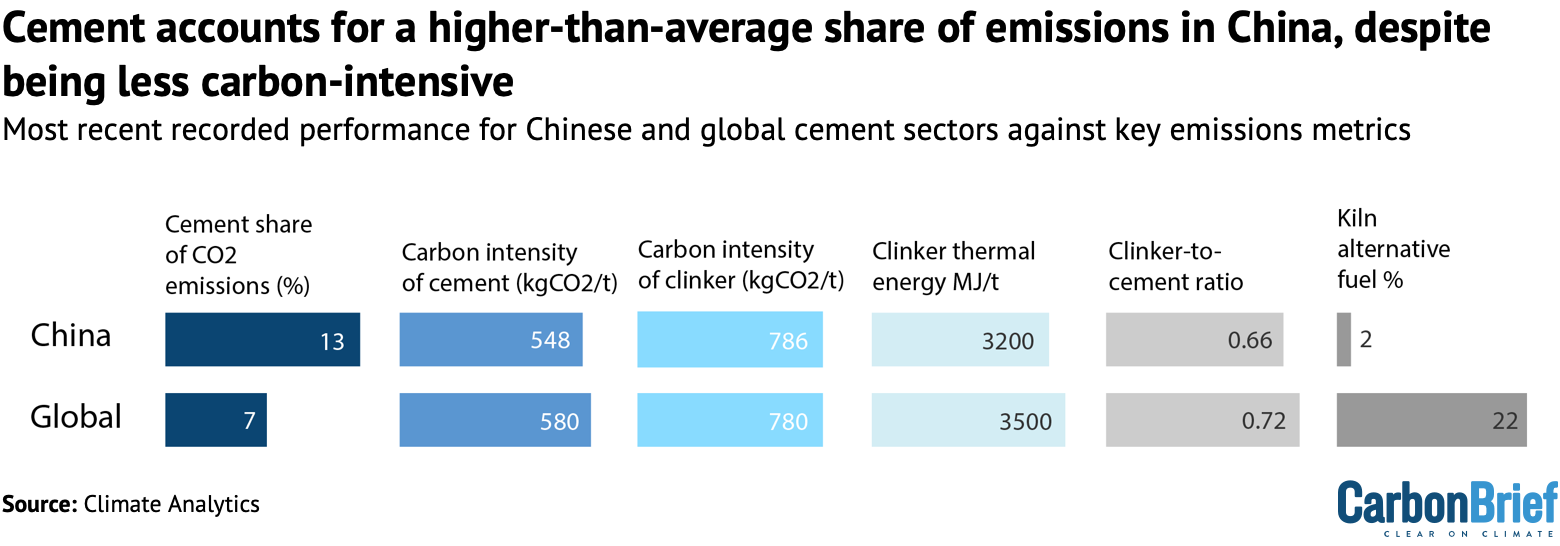
Unavoidable process emissions account for the majority of these emissions. But producers globally have also not yet managed to eliminate the remainder of clinker emissions, which result from heating cement kilns.
Cement’s emissions intensity in China has also rebounded since 2015, driven by new restrictions on cement with lower clinker content, due to quality concerns.
Many areas of past emissions-reduction success in China’s cement sector, such as energy efficiency, are approaching their technical limits.
These challenges help explain why carbon capture, utilisation and storage (CCUS) remains prominent in cement net-zero roadmaps globally.
But CCUS remains expensive and underperforming, given relatively little improvement in learning rates and related cost reductions. Plans to deploy CCUS therefore present a risk of diverting attention from cheaper and more effective abatement options – or failing to deliver as expected. This could sustain considerable mid-century residual emissions, jeopardising net-zero goals.
A ‘whole-of-system’ approach
An alternative “whole-of-system” approach could help China meet its cement emissions challenge more cheaply, without relying so heavily on the promise of CCUS.
This could include enhanced cement demand reduction, such as by extending building lifespans; optimising how concrete is designed and used; using alternative materials – such as timber – where appropriate; and reducing and reusing construction waste.
It could also include accelerating uptake of lower-carbon production technologies, such as alternative cement kiln fuels, electrified kiln heating, as well as low-clinker and alternative binder cements.
A wide range of policy support could advance this whole-of-system approach, including by ensuring a just transition for cement workers and impacted communities.
China has said it is working to include cement in the national emissions trading system (ETS) by 2027.
China could also incentivise companies to use less clinker by adopting a cement-based ETS benchmark, rather than a clinker benchmark, which has encouraged EU firms to continue using the carbon-intensive material under the region’s own ETS.
China could also displace coal from kiln heating, by adopting European-like measures to encourage the use of biomass or waste-derived fuels.
Meanwhile, reform in areas including industry standards, finance, market access and research and development could accelerate adoption of other low-emissions technologies and processes.
Watch, read, listen
WINNING ON STEEL?: China is gradually putting the conditions in place to become a world leader in developing low-carbon steel, according to Canary Media.
TRANSMISSION OMISSION: Jiemian explored how limited transmission capacity and “pricing discrepancies” is hampering China’s development of sending low-carbon power across provinces.
CHINA’S RISE: The Asia Society broadcasted a panel event from its summer summit discussing the factors behind China’s rise as a leader in new-energy and other technologies.
INDUSTRIAL DECARBONISATION: The Institute for Global Decarbonization Progress assessed key steps for improving China’s ability to tackle industrial emissions through zero-carbon industrial parks, informed by an expert dialogue.
15
The number of people who died during flooding in northern China’s Gansu province in early August, China Daily reported.
13
The death toll of flooding this week in Inner Mongolia, another northern province, according to Reuters.
New science
Increasing tropical cyclone residence time along the Chinese coastline driven by track rotation
npj Climate and Atmospheric Science
Tropical cyclones now spend “substantially” more time travelling along China’s coastal regions than they did in the 1980s, according to new research. The study found that tropical cyclones travelling along the coast of China have “become more parallel to the coastline since the 1980s” and the amount of time they spend travelling along the Chinese coast has increased by 2.5 hours per decade during this period. It added that these changes have “led to prolonged durations of heavy rainfall in the coastal regions”.
Resources, Conservation and Recycling
A new study estimated that the average carbon intensity of the electricity used in China fell from 983 grams of carbon dioxide per kilowatt-hour (gCO2/kwh) in 1997 to 545gCO2/kwh in 2022, “cumulatively avoiding 15.8bn tonnes of potential CO2 emissions”. The study used electric-generating unit level data and decomposition analysis to evaluate the effects of different decarbonisation policies on power plants. It found that changes to the fuel mix in China’s coal-fired power plants, reductions in the amount of heat energy needed to generate electricity and deployment of large-sized plants contributed most to reducing carbon emissions.
China Briefing is compiled by Wanyuan Song and Anika Patel. It is edited by Wanyuan Song and Dr Simon Evans. Please send tips and feedback to china@carbonbrief.org

The post China Briefing 21 August 2025: China’s CO2 decline; ‘Two mountains’; China’s cement challenge appeared first on Carbon Brief.
China Briefing 21 August 2025: China’s CO2 decline; ‘Two mountains’; China’s cement challenge

Drought and heatwaves occurring together – known as “compound” events – have “surged” across the world since the early 2000s, a new study shows.
Compound drought and heat events (CDHEs) can have devastating effects, creating the ideal conditions for intense wildfires, such as Australia’s “Black Summer” of 2019-20 where bushfires burned 24m hectares and killed 33 people.
The research, published in Science Advances, finds that the increase in CDHEs is predominantly being driven by events that start with a heatwave.
The global area affected by such “heatwave-led” compound events has more than doubled between 1980-2001 and 2002-23, the study says.
The rapid increase in these events over the last 23 years cannot be explained solely by global warming, the authors note.
Since the late 1990s, feedbacks between the land and the atmosphere have become stronger, making heatwaves more likely to trigger drought conditions, they explain.
One of the study authors tells Carbon Brief that societies must pay greater attention to compound events, which can “cause severe impacts on ecosystems, agriculture and society”.
Compound events
CDHEs are extreme weather events where drought and heatwave conditions occur simultaneously – or shortly after each other – in the same region.
These events are often triggered by large-scale weather patterns, such as “blocking” highs, which can produce “prolonged” hot and dry conditions, according to the study.
Prof Sang-Wook Yeh is one of the study authors and a professor at the Ewha Womans University in South Korea. He tells Carbon Brief:
“When heatwaves and droughts occur together, the two hazards reinforce each other through land-atmosphere interactions. This amplifies surface heating and soil moisture deficits, making compound events more intense and damaging than single hazards.”
CDHEs can begin with either a heatwave or a drought.
The sequence of these extremes is important, the study says, as they have different drivers and impacts.
For example, in a CDHE where the heatwave was the precursor, increased direct sunshine causes more moisture loss from soils and plants, leading to a drought.
Conversely, in an event where the drought was the precursor, the lack of soil moisture means that less of the sun’s energy goes into evaporation and more goes into warming the Earth’s surface. This produces favourable conditions for heatwaves.
The study shows that the majority of CDHEs globally start out as a drought.
In recent years, there has been increasing focus on these events due to the devastating impact they have on agriculture, ecosystems and public health.
In Russia in the summer of 2010, a compound drought-heatwave event – and the associated wildfires – caused the death of nearly 55,000 people, the study notes.

The record-breaking Pacific north-west “heat dome” in 2021 triggered extreme drought conditions that caused “significant declines” in wheat yields, as well as in barley, canola and fruit production in British Columbia and Alberta, Canada, says the study.
Increasing events
To assess how CDHEs are changing, the researchers use daily reanalysis data to identify droughts and heatwaves events. (Reanalysis data combines past observations with climate models to create a historical climate record.) Then, using an algorithm, they analyse how these events overlap in both time and space.
The study covers the period from 1980 to 2023 and the world’s land surface, excluding polar regions where CDHEs are rare.
The research finds that the area of land affected by CDHEs has “increased substantially” since the early 2000s.
Heatwave-led events have been the main contributor to this increase, the study says, with their spatial extent rising 110% between 1980-2001 and 2002-23, compared to a 59% increase for drought-led events.
The map below shows the global distribution of CDHEs over 1980-2023. The charts show the percentage of the land surface affected by a heatwave-led CDHE (red) or a drought-led CDHE (yellow) in a given year (left) and relative increase in each CDHE type (right).
The study finds that CDHEs have occurred most frequently in northern South America, the southern US, eastern Europe, central Africa and south Asia.

Threshold passed
The authors explain that the increase in heatwave-led CDHEs is related to rising global temperatures, but that this does not tell the whole story.
In the earlier 22-year period of 1980-2001, the study finds that the spatial extent of heatwave-led CDHEs rises by 1.6% per 1C of global temperature rise. For the more-recent period of 2022-23, this increases “nearly eightfold” to 13.1%.
The change suggests that the rapid increase in the heatwave-led CDHEs occurred after the global average temperature “surpasse[d] a certain temperature threshold”, the paper says.
This threshold is an absolute global average temperature of 14.3C, the authors estimate (based on an 11-year average), which the world passed around the year 2000.
Investigating the recent surge in heatwave-leading CDHEs further, the researchers find a “regime shift” in land-atmosphere dynamics “toward a persistently intensified state after the late 1990s”.
In other words, the way that drier soils drive higher surface temperatures, and vice versa, is becoming stronger, resulting in more heatwave-led compound events.
Daily data
The research has some advantages over other previous studies, Yeh says. For instance, the new work uses daily estimations of CDHEs, compared to monthly data used in past research. This is “important for capturing the detailed occurrence” of these events, says Yeh.
He adds that another advantage of their study is that it distinguishes the sequence of droughts and heatwaves, which allows them to “better understand the differences” in the characteristics of CDHEs.
Dr Meryem Tanarhte is a climate scientist at the University Hassan II in Morocco, and Dr Ruth Cerezo Mota is a climatologist and a researcher at the National Autonomous University of Mexico. Both scientists, who were not involved in the study, agree that the daily estimations give a clearer picture of how CDHEs are changing.
Cerezo-Mota adds that another major contribution of the study is its global focus. She tells Carbon Brief that in some regions, such as Mexico and Africa, there is a lack of studies on CDHEs:
“Not because the events do not occur, but perhaps because [these regions] do not have all the data or the expertise to do so.”
However, she notes that the reanalysis data used by the study does have limitations with how it represents rainfall in some parts of the world.
Compound impacts
The study notes that if CDHEs continue to intensify – particularly events where heatwaves are the precursors – they could drive declining crop productivity, increased wildfire frequency and severe public health crises.
These impacts could be “much more rapid and severe as global warming continues”, Yeh tells Carbon Brief.
Tanarhte notes that these events can be forecasted up to 10 days ahead in many regions. Furthermore, she says, the strongest impacts can be prevented “through preparedness and adaptation”, including through “water management for agriculture, heatwave mitigation measures and wildfire mitigation”.
The study recommends reassessing current risk management strategies for these compound events. It also suggests incorporating the sequences of drought and heatwaves into compound event analysis frameworks “to enhance climate risk management”.
Cerezo-Mota says that it is clear that the world needs to be prepared for the increased occurrence of these events. She tells Carbon Brief:
“These [risk assessments and strategies] need to be carried out at the local level to understand the complexities of each region.”

