



- What timeline options were delegates debating?
- How did the timeline discussions unfold?
- What were the main points of disagreement?
- Why is the IPCC in a ‘serious funding crisis’?
- How have scientists reacted?
- What other issues remain unresolved?
- How are the IPCC AR7 reports progressing?
- How might the IPCC use AI and enhance gender inclusivity?

The United States will provide a $4.7-billion loan to a fossil gas plant in Mozambique that has been described as a “carbon bomb” and is beset by allegations of human rights abuses.
The US Export-Import Bank (EXIM), a government agency, on Thursday approved financial support for the liquefied natural gas (LNG) project run by French energy giant TotalEnergies in the country’s northern Cabo Delgado region.
US EXIM has yet to publicly confirm the deal, but its approval has been widely reported.
The US backing was seen as key to unlocking financing for what is set to be one of Africa’s largest-ever energy projects, with a total expected cost of $20 billion. The loan also marks a U-turn from a possible ban on public funding for oil and gas developments abroad that rich countries, including the US, were on the verge of agreeing at the end of last year.
Risky investment
The US export credit agency had already agreed to finance the Mozambique project in 2019 during President Donald Trump’s first stint in office, but fresh approval was required after TotalEnergies triggered a contractual “force majeure” pause in 2021.
The French energy giant halted construction on the facility following an attack by the Al-Shabaab militant group in the Cabo Delgado region where the plant is located. Up to 1,200 civilians are estimated to have died or gone missing in the assault.
Age of “climate whiplash” puts residents of Africa’s fast-growing cities in danger
French authorities began investigating Total last year for possible involuntary manslaughter after survivors of the attack accused the company of failing to ensure the safety of its subcontractors. Total has rejected the accusations.
An investigation by Politico also alleged that Mozambican soldiers operating out of Total’s plant abducted, raped and killed dozens of civilians. The company’s Mozambican subsidiary told Politico it had no knowledge of the events.
Total had hoped to restart construction at the site in 2024 but conceded this January that it would not begin operations before 2029 amid security concerns and funding uncertainties.
Rich nations ignore polluting past to claim climate plans are 1.5C-compatible
Patrick Pouyanné, CEO of TotalEnergies, launched a lobbying blitz at the end of last year, hoping to secure the backing of the Biden administration for the project, but his efforts ultimately failed.
Speaking to Bloomberg this week on the sidelines of CERAWeek, Poyuanné asserted, “now you have a functional US EXIM” after President Trump appointed a new board at the agency.
The Total boss added that “most of the contracts have been awarded to US companies”, which he described as the “driver” of the US government’s support for the project.
‘Carbon bomb’
Opposing the mega-project, climate campaigners have described the Mozambique LNG venture as a “carbon bomb” that threatens the world’s chances of keeping global warming in check. It could produce up to 121 million tonnes of CO2 equivalent every year over its life-cycle of close to four decades, including emissions generated from the final use of the gas, according to calculations by Friends of the Earth.
Collin Rees, US campaign manager at Oil Change International, called the project “a climate and human rights nightmare”.
“The Trump administration is committing billions in taxpayer funds to a fossil fuel project linked to severe human rights violations, while simultaneously cutting federal jobs and essential public services for working families [in the US],” he added.
Kate DeAngelis, economic policy deputy director at Friends of the Earth US, described EXIM’s decision as “the pinnacle of government waste and an egregious abuse of taxpayer dollars”.
Since taking office in January, the Trump administration has cancelled more than 80% of US international aid programmes – including dozens of projects in Mozambique – claiming they did not serve the country’s national interests.
“Clearly, the only aid Trump supports is foreign aid for billionaires and foreign gas companies,” DeAngelis added.
Decision time for UK and Netherlands
Total’s LNG venture in Mozambique also won support from the British and Dutch export credit agencies before the project’s halt in 2021. The two lenders have been reportedly reassessing their financial commitment and have yet to announce a final decision.
The Financial Times reported last month that the UK government was taking legal advice on whether it could withdraw its £1.15-billion ($1.49-billion) support for the project without facing legal repercussions.
Oil Change’s Rees said UK Prime Minister Keir Starmer should “show courage and break with the previous UK government’s foolish decision to support this nightmare”.
Brazil decides leaders will speak before COP30, easing logistics crunch
US EXIM approved billions in support for oil and gas developments abroad under former President Joe Biden, even though the US had joined 33 other countries at the COP26 climate summit in pledging to end direct public finance for overseas fossil fuel projects by the end of 2022.
The Biden administration made a late attempt to change course before Trump’s return to the White House by belatedly backing a proposal to ban export credit support for oil and gas abroad, put forward by member states of the Organisation for Economic Co-Operation and Development (OECD).
But the push, led primarily by the EU and the UK, failed after opposition from South Korea and Türkiye stalled the discussions. Negotiators met again in Paris this week, but an observer told Climate Home that the deal now appears to be off the table given the seismic geopolitical changes since Trump took office in January.
The post US approves multi-billion-dollar loan for troubled Mozambique gas plant appeared first on Climate Home News.
US approves multi-billion-dollar loan for troubled Mozambique gas plant
Continue Reading
Three countries have been named by the Paris Agreement’s compliance committee for failing to submit a nationally determined contribution (NDC) and repeatedly snubbing offers of help with their climate plans.
After months of internal debate over whether to identify serial non-responders, the Paris Agreement’s Implementation and Compliance Committee (PAICC) named the three countries which have failed to engage with it over their NDCs on Friday.
It named Democratic Republic of Congo, Senegal and North Korea in a footnote of its annual report, adding that it decided to name them “with a view to facilitating engagement”, adding that representatives of the three nations had been invited to its meeting in early 2027 “with the purpose of identifying any challenges and constraints”.
“The Committee noted the importance of Parties engaging with the Committee in a timely manner, while noting that some delays may be due to the national capabilities and circumstances of the Parties”, the report said.
-
Under US pressure, World Bank says it will back gas “where appropriate”
The US wants the World Bank to expand its gas support while climate campaigners are pushing for it to end – its head spoke this week of limited backing for the fossil fuel -
IPCC scientists vow to press on with climate reports despite political deadlock
After governments again failed to agree a timeline, nearly 120 IPCC authors pledged to complete their assessment on time and with full scientific rigour -
Paris Agreement committee snubbed over missing NDC climate plans
Many governments have still not submitted a nationally determined contribution to the UN, breaching a key requirement of the Paris Agreement
In July, PAICC said 12 countries had ignored its repeated attempts to discuss why they had not published an NDC as required every five years under the 2015 Paris accord.
Members of the committee had been divided over whether to name them, but at a September meeting decided to do so in their annual report to the annual climate COP summit.
By the time the report was published on Friday, only Congo, Senegal and North Korea “had not communicated an NDC or submitted a [Biennial Transparency Report] and had not yet responded to any of the Committee’s notifications, despite several reminders issued by the Committee in this regard”.
Rainforest and renewable energy ambitions
The silence from Congo and Senegal is notable because the former is home to much of the Congo Basin rainforest while the latter has sought billions of dollars in climate finance to support its renewable energy ambitions.
After Brazil, Congo has more rainforest than any country in the world. This forest, and the country’s peatlands, absorb huge amounts of greenhouse gas but are fast being lost to expanding farmland, charcoal production, logging and mining.
Senegal signed a Just Energy Transition Partnership with Canada and wealthy European nations in 2023, to help it meet its renewable energy targets under the-then government of Macky Sall. It was chair of the Least Developed Countries group between January 2022 and December 2023.

Tejas Rao, who is researching the PAICC as part of a doctoral thesis at Cambridge University, said the governments of the three countries should engage with the committee.
“Engagement costs these governments very little and the committee has shown it will listen,” he said.
“Silence leaves the committee with no basis to help, and it leaves the [governments] exposed to the narrative that they are simply disengaged,” he told Climate Home News.
Paris Agreement requirement
The 2015 Paris Agreement requires all parties to publish an NDC every five years outlining their emissions reduction targets, with each plan meant to be more ambitious than the country’s last NDC.
The latest set – the third round of plans, with new targets for 2035 – was due in February 2025. While most countries missed this deadline, all but around 30 – mostly small emitters but including Egypt, Vietnam and Argentina – have now submitted them.
Over the year, the PAICC – which is made up of government climate officials from developed and developing countries – has been communicating with governments that have not submitted NDCs and trying to overcome barriers to them doing so.
Some nations have cited exceptional circumstances as the reason for not submitting an NDC, a process that requires a significant amount of work in tracking emissions and consulting on how to curb them across the economy. For example, a letter from a Sudanese official to the PAICC, seen by Climate Home News, said that the country’s civil war had led to the suspension of its NDC preparation.
-
IPCC scientists vow to press on with climate reports despite political deadlock
After governments again failed to agree a timeline, nearly 120 IPCC authors pledged to complete their assessment on time and with full scientific rigour -
Under US pressure, World Bank says it will back gas “where appropriate”
The US wants the World Bank to expand its gas support while climate campaigners are pushing for it to end – its head spoke this week of limited backing for the fossil fuel -
Who shapes climate science? The equity question facing the IPCC
Early completion of the next global climate science assessment reports risks excluding research from the Global South, which is key to ensuring the findings are fair
The US and Iran are not signed up to the Paris Agreement and so do not have active NDCs, nor does Taiwan, which is not a UN member state.
Rao said that because the PAICC is “facilitative and non-punitive”, naming the countries “is meant to open a door, not close one – the invited consultation is the point”.
“In recent months, governments that explained their constraints, whether capacity, finance or domestic process, have been met with follow-up and support rather than sanction, and the number of silent governments has fallen sharply,” Rao said.
The post Paris Agreement committee names three countries snubbing it over NDCs appeared first on Climate Home News.
Paris Agreement committee names three countries snubbing it over NDCs
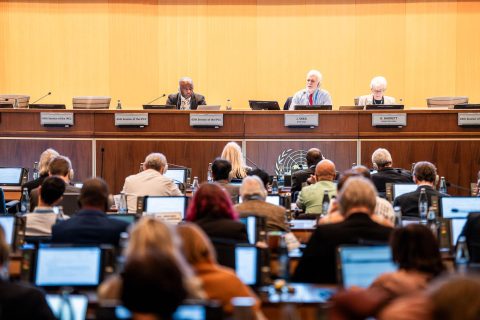
Countries have failed – for the sixth time running – to agree on the timeline for publishing the Intergovernmental Panel on Climate Change’s (IPCC) next set of influential reports.
The IPCC’s 65th session (IPCC-65) was seen by many to be the final opportunity for countries to agree on a schedule where its seventh assessment report (AR7) would be published in time for the UN’s second “global stocktake” of climate action.
Before last week’s meeting in Addis Ababa, Ethiopia, IPCC chair Prof Sir Jim Skea had warned that releasing the reports in time for the stocktake in 2028 would depend on a timelines being agreed by the end of 2026.
But the week-long meeting descended into fraught disagreements between governments, resulting in Skea “suspending” the talks on Friday evening with no decision made.
Countries were also unable to agree on the IPCC’s budget for the rest of the AR7 cycle, leaving the body with a “serious funding crisis”.
The IPCC has pledged to reconvene the meeting at the “earliest opportunity”; however, it has not yet given an indication of when this will be.
In his concluding remarks, Skea described the Addis Ababa summit as a “profound disappointment” and “among the most difficult IPCC meetings”, according to reporting from the Earth Negotiations Bulletin (ENB).
Some countries have reacted with dismay to the breakdown of negotiations, warning that a failure to have the IPCC’s latest assessments on climate adaptation and mitigation ready for the UN stocktaking exercise would undermine global climate action.
A climate envoy fr