Prime Minister Justin Trudeau’s announcement to step down has created a vacuum that will shape the future of Canada’s leadership. This decision has ignited a fierce race for leadership within the Liberal Party, with former Bank of Canada Governor Mark Carney emerging as a key contender. On the other side, Conservative Party Leader Pierre Poilievre stands in stark opposition, ready to challenge the current climate policies.
With the ideological divide between Carney’s progressive climate agenda and Poilievre’s economic-focused stance, Canada’s climate future hangs in the balance. Let’s take a closer look at each of the potential replacements’ climate and net zero stance.
Mark Carney: A Champion of Climate Finance and Global Leadership
Mark Carney’s entry into the political race marks a significant moment for Canada and the global climate movement. Carney’s extensive experience as the Governor of the Bank of Canada, along with his tenure as the UN Special Envoy on Climate Action and Finance, positions him as a leading figure on the international stage.
For years, Carney has been a vocal proponent of transitioning to a net-zero economy. He has been emphasizing the potential for economic growth through climate action.
He often refers to net zero as “the greatest commercial opportunity of our time”, specifically noting in an interview that:
“…And what we have seen increasingly, spurred initially by the Sustainable Development Goals, accelerated by Paris, and then by social movements and governments, is societies putting tremendous value on achieving net zero. Companies, and those who invest in them and lend to them, and who are part of the solution, will be rewarded. Those who are lagging behind and are still part of the problem will be punished.”
He sees it as a way to unlock investment in renewable energy, clean technologies, and sustainable infrastructure.
A recent report by the International Renewable Energy Agency (IRENA) estimates that the global renewable energy market could generate up to $98 trillion in investment by 2050. This presents a significant economic opportunity for countries, like Canada, that choose to embrace green policies.
Carney’s vision for the country aligns with global trends, calling for a balanced approach to climate policy that integrates both environmental and economic goals. His leadership would likely usher in policies focused on scaling up investments in clean energy, carbon capture technologies, and creating more sustainable industries.
Under Carney, Canadians could see the implementation of mandatory carbon disclosure for corporations, helping drive transparency and accountability in the private sector. The UN climate envoy also advocates for leveraging private sector finance to accelerate the transition to a net-zero economy.
Pierre Poilievre: Opposing Carbon Taxes and Prioritizing Affordability
Pierre Poilievre, the current leader of Canada’s Conservative Party, has built his political identity on opposing carbon taxes. He is also questioning the effectiveness of environmental regulations.
With his populist messaging and a strong emphasis on affordability, Poilievre has become a leading figure for those disillusioned by rising costs of living. His “Axe the Tax” campaign resonates with voters who view the carbon tax as an economic burden rather than a solution to climate change. The campaign aimed at eliminating Trudeau’s carbon pricing system.
Per the Canada Taxpayers Federation, the carbon tax under the current system costs an average family of four $1,200 annually. The chart below from the Canadian Energy Centre shows how much it will affect vehicle fuel costs by 2030.
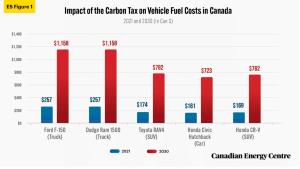
Poilievre’s criticism of the carbon tax is largely driven by concerns over this financial impact. This becomes more paramount as inflationary pressures and cost-of-living concerns continue to grow.
Poilievre’s anti-carbon tax stance has been consistent. He argues that it disproportionately affects working Canadians, driving up the cost of goods and services, particularly in northern communities.
While Poilievre has voiced concern about the economic impact of such policies, he has yet to present a clear and actionable alternative to address climate change. His positions on climate policy, therefore, raise questions about Canada’s ability to meet its emissions reduction targets without strong regulatory frameworks.
Under Poilievre’s leadership, Canada might see a rollback of several key climate policies, including the following:
- carbon tax,
- emissions caps for oil and gas, and
- investments in clean energy technologies.
Analysts think that this would likely distance Canada from international climate commitments, potentially putting the nation at odds with global efforts to mitigate climate change.
A Deepening Divide: What’s at Stake for The Future of Canada’s Climate Policy?
Trudeau’s resignation sets the stage for a new political era. The next leadership race will be pivotal in determining Canada’s climate future.
- According to Environment and Climate Change Canada, the country must reduce emissions by at least 40-45% by 2030 compared to 2005 levels to meet its international commitments.
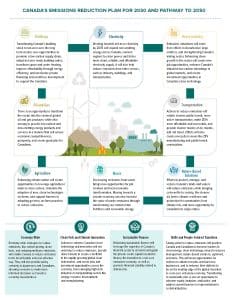
Carney’s policies would likely drive the investments and regulatory changes necessary to achieve these ambitious goals. On the other hand, Pierre Poilievre’s rise to power could shift Canada’s climate trajectory in a different direction. Prioritizing deregulation and affordability over bold climate action could lead to a retreat from critical environmental commitments.
Moreover, Carney’s proposed policies on climate finance, carbon pricing, and clean energy investments align with global efforts on sustainability. These measures reflect a commitment to both tackling climate change and positioning Canada as a leader in climate finance.
A report from Canada’s Clean Growth Hub reveals that Canada’s renewable energy sector has seen significant growth. It contributes nearly $4.5 billion to the national economy in 2020 alone. Carney’s platform would likely continue to build on this momentum as he noted in his speeches, further bolstering the sector.
In contrast, Poilievre’s carbon pricing opposition prioritizes short-term economic relief for Canadians. While Poilievre’s stance might appeal to those frustrated with rising costs, it lacks a clear strategy for long-term climate solutions.
As the leadership race heats up, Canadians will have to decide which path they want to take: Will the nation take the opportunity to lead in global climate action, or will it retreat from its environmental commitments? The outcome will not only shape Canada’s domestic climate policy but also its role in the global fight against climate change.
The post Trudeau’s Resignation Sparks Leadership Race: Mark Carney vs. Pierre Poilievre on Canada’s Climate Future appeared first on Carbon Credits.
Carbon Footprint
Google Locks In 100 MW of Offshore Wind to Power Europe’s AI Growth
Google has signed a long-term offshore wind power deal in Germany as it expands artificial intelligence and cloud infrastructure across Europe. The agreement is a 15-year power purchase agreement (PPA) with German utility EnBW. It covers 100 megawatts (MW) of electricity from the He Dreiht offshore wind farm in the North Sea.
The deal links Google’s growing electricity demand directly to new renewable generation. It also reflects a wider shift among large technology firms toward long-term clean power contracts tied to specific projects.
Adam Elman, Director of Sustainability EMEA at Google, remarked:
“Meeting the demand for AI infrastructure requires direct investment in the energy systems that make this technology possible. By contracting for new wind power from EnBW, we are bringing more clean energy online in Germany to power our operations, while accelerating the broader transition to a more sustainable electricity grid.”
AI Is Turning Electricity Into a Strategic Asset
According to EnBW, the He Dreiht wind farm will have a total capacity of 960 MW. It will use 64 offshore wind turbines and is expected to connect to the grid by spring 2026. The site is located around 90 kilometers northwest of Borkum and 110 kilometers west of Helgoland.
For Google, the agreement supports its goal of operating on 24/7 carbon-free energy by 2030. This means matching electricity use with carbon-free power every hour of the day, not just on an annual basis.
Google’s power demand is rising quickly. The main driver is artificial intelligence. AI systems need large amounts of computing power, which in turn requires large amounts of electricity.
The International Energy Agency (IEA) estimates that data centers used about 415 terawatt-hours (TWh) of electricity in 2024. That equals around 1.5% of global electricity demand. The IEA also notes that data center demand has grown at a double-digit annual rate in recent years. The same trend is forecasted by an industry report, as shown below.

Germany plays a key role in Google’s European expansion. In late 2025, Google announced plans to invest €5.5 billion in the country between 2026 and 2029. The investment includes a new data center in Dietzenbach, near Frankfurt, and continued development of its Hanau data center campus, which opened in 2023.
Data centers need reliable power around the clock. They also face rising pressure from governments, investors, and customers to reduce emissions. Long-term renewable PPAs help companies manage both issues.
- MUST READ: Environmental Groups Urge U.S. Congress to Pause Data Center Growth as Federal AI Rule Looms
By signing a 15-year contract, Google gains price certainty and supply stability. At the same time, the contract helps EnBW finance a large offshore wind project that adds new clean electricity to Germany’s grid.
A Flagship Wind Farm in the North Sea
Germany already has one of Europe’s largest offshore wind fleets. By the end of 2024, the country had 31 offshore wind farms fully in operation. Installed offshore wind capacity reached about 9.2 gigawatts (GW) in total. Around 7.4 GW sits in the North Sea, while about 1.8 GW is in the Baltic Sea.
He Dreiht is one of the largest offshore wind projects currently under construction in Germany. With 960 MW of capacity, it will add a meaningful share to the national total once it comes online.
The project also reflects a broader trend toward larger offshore turbines. According to industry data, offshore turbines commissioned in Germany in 2024 had an average capacity of 10.2 MW. The first 11 MW turbine entered operation that year, and 15 MW turbines are expected to appear in German waters starting in 2025.

Larger turbines can generate more electricity with fewer units. This can reduce seabed disturbance and installation time. However, it also requires stronger foundations, larger vessels, and more robust grid connections.
For EnBW, He Dreiht is a flagship project. The utility has already signed multiple PPAs for the wind farm with corporate buyers. This shows how offshore wind developers are increasingly relying on long-term corporate demand alongside traditional utility customers.
Why Corporates Are Becoming Power Buyers
Power purchase agreements play a growing role in clean energy finance. A PPA is a contract where a buyer agrees to purchase electricity from a specific project at agreed terms over many years.
For developers, PPAs reduce financial risk. They help secure loans and attract investors by offering predictable revenue. For buyers, PPAs provide access to clean power without owning generation assets.
This model is becoming more common as electricity demand rises and clean energy targets tighten. The IEA reports that global energy investment exceeded $3 trillion in 2024 for the first time. Around $2 trillion of that went into clean energy technologies and infrastructure, including renewables, grids, and storage.
Europe is a key market in this shift. Offshore wind plays a major role because it can produce large volumes of electricity close to industrial and urban centers. Germany plans to keep expanding offshore wind as part of its long-term energy strategy. It plans to expand grid-connected offshore wind power capacity to at least 30 gigawatts by 2030, 40 gigawatts by 2035, and 70 gigawatts by 2045.

Corporate PPAs like Google’s agreement with EnBW help speed up this build-out. They send clear demand signals to developers and help reduce reliance on government subsidies.
From Annual Offsets to 24/7 Clean Power
Google’s long-term climate strategy goes beyond buying renewable energy certificates. The company aims to operate on 24/7 carbon-free energy in every region where it runs data centers and offices.

This approach focuses on real-time matching. It encourages a new, clean generation in the same places where electricity is used. Offshore wind PPAs fit well into this strategy in coastal countries like Germany.
Still, a 100 MW contract covers only part of Google’s total electricity needs. Large data centers can consume hundreds of megawatts on their own. As AI workloads grow, total demand could rise further.
That means Google will likely need a mix of solutions. These may include additional wind and solar PPAs, energy storage, grid upgrades, and partnerships with utilities and governments.
SEE MORE on Google:
- Google Rides the Wind: First Offshore Wind Deal in Asia Pacific For 24/7 Carbon-Free Energy
- Google Powers U.S. Data Centers with 1.2 GW of Carbon-Free Energy from Clearway
Google’s clean energy buying reached a new scale in 2024, as rising AI and digital demand pushed electricity use higher. The company signed contracts for over 8 gigawatts (GW) of new clean energy this year. This is its largest annual procurement ever and double the amount from 2023.
Since 2010, Google has secured over 22 GW of clean energy through more than 170 agreements. This amount is about the same as Portugal’s total renewable power output in 2024. More than 25 projects came online in 2024 alone, adding 2.5 GW of new generation.
Despite a 27% rise in electricity use, Google cut data center energy emissions by 12%. This shows how clean energy purchases support its goal to run on 24/7 carbon-free energy by 2030.

The EnBW agreement shows one way forward. It ties new AI infrastructure directly to new renewable supply. It also spreads investment risk between a technology company and a utility.
Big Tech Is Reshaping How Power Gets Built
Google’s 15-year offshore wind deal highlights a broader shift in how clean energy projects are financed and used. Large corporate buyers are no longer just passive consumers of electricity. They are becoming active players in energy markets.
For Germany, the deal supports offshore wind expansion at a time when power demand is rising from electrification, industry, and digital services. For EnBW, it provides long-term revenue certainty, and for Google, it helps align AI growth with climate goals.
The next phase will test execution, but the direction is clear. As AI drives electricity demand higher, long-term renewable contracts are becoming a central part of energy planning. Google’s offshore wind agreement in Germany is one of the clearest examples of how these trends are coming together.
The post Google Locks In 100 MW of Offshore Wind to Power Europe’s AI Growth appeared first on Carbon Credits.
Carbon Footprint
How BYD’s European Surge and Canada Deal Are Challenging Tesla’s EV Dominance
Chinese electric vehicle (EV) giant BYD is accelerating its global expansion, especially in Europe and Canada. In contrast, Tesla is losing ground across key markets. New sales data, policy shifts, and geopolitical deals suggest a major shift in the EV landscape.
This trend matters not just for automakers. It also impacts battery metals, supply chains, carbon markets, and the future of clean mobility.
BYD’s Germany Boom Marks Europe’s EV Shake-Up
BYD recorded a dramatic surge in German sales in January 2026. Bloomberg highlighted data from Germany’s Federal Motor Transport Authority (KBA) showing that BYD’s registrations jumped more than 10-fold from January 2025. The company sold only 235 vehicles in Germany last year, but recent data suggests sales likely exceeded 2,500 units.
Meanwhile, Tesla struggled. BYD more than doubled Tesla’s registrations in Germany during the same month.
Overall, car sales in Germany declined 6.6% to 193,981 vehicles in January. However, electric cars still accounted for 22% of new registrations, highlighting strong demand for EVs despite a weak auto market. This surge shows that BYD’s low-cost models and expanding lineup are gaining traction in Europe’s largest automotive market.
Significantly, the German numbers reflect a broader European trend. Throughout 2025, BYD recorded more than 200% year-on-year growth in many months. In December 2025 alone, its European registrations reached 27,678 units—up nearly 230%.

Breakthrough in Spain
Spain emerged as another key battleground. BYD dominated the Spanish EV and plug-in hybrid market in January 2026.
- The company registered 1,962 vehicles, a 64.6% year-on-year increase. It captured a 13.6% market share, leading both fully electric and plug-in hybrid segments.
- Fully electric sales rose nearly 30% to 1,039 units, putting BYD ahead of Kia and Mercedes-Benz. Tesla ranked fourth, with only 458 fully electric vehicles sold.
Spain’s performance highlights BYD’s strategy of combining affordable EVs with hybrids to capture diverse buyers.
Notably, BYD also sold 1,326 battery-electric vehicles in the UK, marking a nearly 21% increase from the previous year.
Tesla’s European Sales Collapse Deepens
Tesla, on the other hand, saw sales decline every month in Europe during 2025. The trend continued into 2026. Its struggles were especially visible in Northern and Western Europe.
In five major European markets, Tesla’s registrations fell 44% year-over-year in January. This marked the third consecutive year of shrinking sales across the region.
- Norway: Registrations collapsed by 88%, with only 83 vehicles sold.
- Netherlands: Sales dropped 67%.
- France: Registrations fell 42% to 661 vehicles, the lowest in over three years.
- United Kingdom: Sales plunged more than 57% to just 647 vehicles.
Policy changes played a role. Norway reduced EV tax incentives starting January 1, which hurt Tesla demand. However, the scale of the decline surprised analysts.
Even in Sweden and Denmark, where Tesla saw sales rise by 26% and 3%, the total number of cars sold remains low. These minor gains do little to offset the sharp decline compared with two years ago.

Analysts believe that one key issue is Tesla’s aging lineup. The Model Y, once a top seller, is now over four years old, and buyers are looking for newer options. Although Tesla launched more affordable “Standard” versions of the Model Y and Model 3, these updates have not been enough to reverse the downward trend.
In the current scenario, Tesla is not only losing ground to Chinese brands. European automakers are also regaining market share. Volkswagen overtook Tesla in 2025 to become Europe’s top-selling EV brand. It sold around 274,000 units, compared to Tesla’s 235,000.
This shows Europe’s EV market is becoming more competitive, with local manufacturers and Chinese brands challenging Tesla’s early dominance.

Canada Opens the Door to Chinese EVs
Europe is not the only region where BYD is gaining ground. Prime Minister Mark Carney signed a landmark trade agreement with China on January 16, 2026. This deal allows Chinese-made EVs to enter the market at low tariffs.
- So Canada will allow up to 49,000 Chinese EVs annually at a tariff rate of 6.1%. This marks a sharp reversal from the 100% tariff imposed in October 2024.
Also, the quota could rise to about 70,000 vehicles within five years. By 2030, at least half of imported Chinese EVs must be priced below CAD 35,000. In exchange, China agreed to reduce tariffs on Canadian canola seed, improving agricultural trade relations.
PM Carney said,
“At its best, the Canada-China relationship has created massive opportunities for both our peoples. By leveraging our strengths and focusing on trade, energy, agri-food, and areas where we can make huge gains, we are forging a new strategic partnership that builds on the best of our past, reflects the world as it is today, and benefits the people of both our nations.”
BYD Gains a Regulatory Edge in Canada
BYD holds a unique advantage in Canada. Its manufacturing facilities in Shenzhen and Xi’an are already approved for Canadian imports. This pre-clearance gives BYD a head start over rivals like NIO, XPeng, and Li Auto. However, other Chinese brands must wait for regulatory approvals or rely on slower case-by-case processes.
BYD also operates an electric bus assembly plant in Ontario, strengthening its local presence. Furthermore, affordable models like the Seagull and Dolphin, priced between $20,000 and $30,000, could qualify under Canada’s affordability requirements.
Political Backlash and U.S. Concerns
The Canada-China EV deal triggered political controversy. Ontario Premier Doug Ford initially urged Canadians to boycott Chinese EVs, warning the agreement could hurt domestic manufacturing.
Labor unions and automakers also expressed concern. They fear the deal could weaken North America’s automotive industry and strain U.S.-Canada trade relations.
As per reports, U.S. President Donald Trump threatened tariffs on Canadian goods if the deal moves forward, calling it a “disaster.” However, Canadian officials argue the agreement aligns with USMCA rules and will expand the EV market.
Analysts estimate Chinese EVs could capture around 23% of Canada’s EV sales in the first year, saving consumers about CAD 6,700 per vehicle.

Stock Market Snapshot: BYDDY vs TSLA
BYD’s (BYDDY) stock trades around $11.28 per share, with a market cap of roughly $102 billion. The stock is near the lower end of its 52-week range, reflecting margin pressures and geopolitical risks.

Tesla’s (TSLA) stock trades near $406 per share, with a market cap of about $1.35 trillion. Analysts expect a volatile 2026, with forecasts ranging widely depending on EV demand and margins.

Despite Tesla’s valuation premium, BYD’s rapid sales growth is reshaping investor sentiment.
The Bigger Picture: A Global EV Power Shift
BYD’s rapid rise shows how the EV industry is changing. Chinese automakers are using scale, government support, and efficient production to challenge Western rivals. At the same time, Tesla remains strong in technology, software, and brand recognition. Yet, price competition and shifting policies are reshaping the market.
In Europe, declining subsidies, along with Canada’s new trade rules and ongoing geopolitical tensions, are affecting EV adoption and corporate strategies. As BYD gains ground in Germany, Europe, and Canada, it signals a turning point in the global EV race. Tesla’s falling sales highlight the increasing pressure from both Chinese and European competitors.
For investors, policymakers, and climate advocates, these trends matter. They will influence battery supply chains, emissions targets, and the demand for carbon credits. The EV transition is no longer led by a single company—today, it has become a global contest for scale, affordability, and sustainable leadership.
The post How BYD’s European Surge and Canada Deal Are Challenging Tesla’s EV Dominance appeared first on Carbon Credits.
Carbon Footprint
Walmart Hits $1 Trillion Milestone And Its Climate Footprint Just Got Bigger
Walmart has crossed a historic financial mark. It became the first traditional retailer to reach a $1 trillion market value, a level previously limited to technology and energy giants.
The milestone followed a strong move in the company’s share price. During recent trading in New York, Walmart’s stock rose by about 1.6% and hit an intraday high of around $126 per share.
That gain pushed the Bentonville, Arkansas-based retailer past the trillion-dollar threshold. Since the start of the year, Walmart’s stock has been up about 12%, far ahead of the S&P 500, which has gained less than 2% over the same period.

Investors have responded to Walmart’s steady revenue growth, digital expansion, and cost control. At the same time, the company has continued to expand its environmental and climate commitments. Given Walmart’s size, those efforts carry weight across global supply chains.
Big Targets for an Even Bigger Footprint
Walmart has set long-term climate targets that cover its own operations and its value chain. The company aims to reach zero greenhouse gas emissions across global operations by 2040, without using carbon offsets. It also plans to source 100% renewable electricity by 2035.
These targets apply to Scope 1 and Scope 2 emissions. Scope 1 includes direct emissions from company operations. Scope 2 covers emissions from purchased electricity. Walmart’s strategy includes improving energy efficiency, switching to low-impact refrigerants, and electrifying parts of its vehicle fleet.

Most of Walmart’s emissions sit outside its direct control. Like many large retailers, the bulk of its footprint comes from suppliers, logistics, and product use. To address this, Walmart launched Project Gigaton in 2017. The program set a goal to avoid, reduce, or remove one billion metric tons of greenhouse gas emissions from the global value chain by 2030.

Progress Made, Deadlines Slipping
Walmart’s reporting shows clear progress in several areas.
On clean power, the company said that nearly half of its global electricity use now comes from renewable sources. This includes on-site generation and long-term power purchase agreements tied to wind and solar projects. These steps move Walmart closer to its 2035 renewable energy target.
On emissions, Walmart has reduced Scope 1 and Scope 2 emissions by about 18% compared with its 2015 baseline. During this time, the company cut carbon intensity by 45%. This means it emits less for each unit of business activity.
Project Gigaton has also delivered results. Walmart announced it hit its one-billion-ton emissions reduction goal six years early, 1.19 billion metric tons of CO₂e. Over 5,900 suppliers joined in. They helped cut down on energy use, packaging, transportation, and waste.

Still, the path to net zero is not smooth. Walmart has admitted that it probably won’t meet its interim goals. These include reducing Scope 1 and 2 emissions by 35% by 2025 and 65% by 2030, based on 2015 levels. The company has pushed those timelines further out as it faces technical and operational limits.
Where Most Emissions, and Leverage, Live
Supply chains remain Walmart’s biggest climate challenge. In retail, Scope 3 emissions often account for the vast majority of total emissions. Industry research shows that for large retailers, supply chain emissions can make up as much as 90% to 98% of total carbon output.

Project Gigaton targets this gap. It asks suppliers to set goals in six areas, including energy, waste, packaging, agriculture, and logistics. Many suppliers focus on energy efficiency and renewable power, while others work on sustainable sourcing and transport optimization.
With that initiative, emissions intensity in Scope 3 has dropped by about 6.2% since 2022. This shows progress in lowering the carbon intensity of the wider supply chain.
Beyond emissions, Walmart has expanded work on waste reduction and responsible sourcing. The company promotes circular economy practices, aims to cut food waste, and supports sustainable agriculture across key commodities. These efforts link climate goals with land use, water, and biodiversity outcomes.
Transport innovation:
Walmart is investing in new technologies to reduce emissions in transport and logistics. They are focusing on heavy-duty electric vehicles and hydrogen fuel cell forklifts. This comes as transportation emissions have recently increased because Walmart decided to bring more fleet operations in-house.
Refrigerant upgrades:
The retailer is replacing high-impact refrigerants with lower global warming potential systems. This effort contributed to a 2.4% decrease in refrigerant emissions in 2024, aided by preventive maintenance and specialized technician training.
Packaging challenges and circularity:
Walmart is working to increase recycled content in private-brand packaging. In 2024, recycled content in plastic packaging reached 8%, up from prior years, although it remains below the company’s 2025 goal of 20%. Efforts also include recycling and reuse programs for cardboard and other materials.
When Growth Multiplies the Climate Test
Walmart’s financial scale helps explain both its influence and its difficulty. In its latest fiscal year, the company generated more than $680 billion in revenue, making it the largest retailer in the world.
That scale means even small efficiency gains can lead to large absolute emissions cuts. But it also means that business growth can offset progress if demand rises faster than efficiency improves. Areas such as refrigeration, trucking, and cold-chain logistics remain hard to decarbonize quickly.
Technology limits also play a role. Some low-carbon solutions are still costly or not available at scale. These constraints have slowed progress toward interim targets, even as long-term goals remain in place.
Still, the retail giant continues to work on its sustainability actions spanning energy, supply chains, packaging, climate intensity, and innovation.
A Trillion-Dollar Reminder of Climate Responsibility
Walmart’s rise to a $1 trillion market value highlights how financial performance and sustainability planning now move side by side. The company has invested heavily in clean energy, supplier engagement, and efficiency. It has also been open about where progress has fallen short.
For the wider retail sector, Walmart’s experience offers a clear lesson. Large climate commitments can drive change, but execution takes time, capital, and coordination across thousands of partners. Success depends not only on targets, but on steady delivery and transparent reporting.
As Walmart continues to grow, its climate strategy will remain under scrutiny. The company’s size ensures that progress, delays, and course corrections all carry global impact. In that sense, Walmart’s trillion-dollar milestone is not just a financial marker; it is also a reminder of how closely corporate scale and environmental responsibility are now linked.
The post Walmart Hits $1 Trillion Milestone And Its Climate Footprint Just Got Bigger appeared first on Carbon Credits.
-
Greenhouse Gases6 months ago
Guest post: Why China is still building new coal – and when it might stop
-
Climate Change6 months ago
Guest post: Why China is still building new coal – and when it might stop
-
Climate Change2 years ago
Bill Discounting Climate Change in Florida’s Energy Policy Awaits DeSantis’ Approval
-
Greenhouse Gases2 years ago嘉宾来稿:满足中国增长的用电需求 光伏加储能“比新建煤电更实惠”
-

Climate Change2 years ago
Spanish-language misinformation on renewable energy spreads online, report shows
-
Climate Change2 years ago嘉宾来稿:满足中国增长的用电需求 光伏加储能“比新建煤电更实惠”
-
Climate Change Videos2 years ago
The toxic gas flares fuelling Nigeria’s climate change – BBC News
-
Renewable Energy2 years ago
GAF Energy Completes Construction of Second Manufacturing Facility


