Connect with us

Published

on

Carbon Credits in 2024: What to Expect in 2025 and Beyond (Up to $250B by 2050)

The global carbon credit market in 2024 remained stagnant, valued at around US$1.4 billion, per MSCI report. Demand for carbon credits—measured by the number of credits “retired” or permanently used—did not grow significantly. Carbon prices, meanwhile, continued to fall.

However, the market is showing signs of potential growth. With more companies committing to ambitious climate goals and new policies emerging, experts believe the market could expand significantly. 

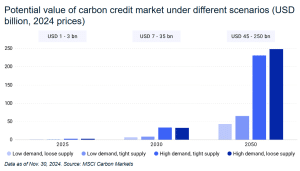
  • By 2030, the market is projected to reach between $7 billion and $35 billion, and by 2050, it could climb to $250 billion

Carbon Credits in 2024: Key Numbers

Carbon credits allow businesses and governments to offset their greenhouse gas emissions. Each credit represents one ton of carbon dioxide either reduced or removed from the atmosphere. These credits come from a variety of projects, including:

  • Nature-Based Solutions: Reforestation, forest conservation, and soil carbon storage.
  • Renewable Energy: Projects like wind and solar farms that replace fossil fuel-based energy.
  • Carbon Capture Technologies: Direct air capture or storing carbon in the soil through biochar.

When companies buy and retire these credits, they use them to meet their climate targets, like achieving net-zero emissions.

By the end of 2024, the carbon credit market had grown in some areas, even if overall demand remained flat. The MSCI report shows the following achievements last year:

  • Projects: Over 6,200 carbon credit projects were registered worldwide.
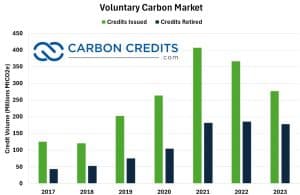
  • Issuance: These projects issued 305 million tons of credits (MtCO2e) in 2024 alone, bringing the total to over 2.1 billion credits since the 2016 Paris Agreement.
  • Retirements: Only 180 million credits were retired in 2024, roughly the same as in 2023.

Of the credits retired in 2024:

  • 91% came from projects that reduce emissions (e.g., renewable energy or forest protection).
  • 9% came from projects that remove carbon from the atmosphere, such as reforestation.

carbon credits annual retirements 2024 by project type

Falling Prices

Despite the growing number of carbon credits issued, their prices have dropped. In 2024, the average price of a carbon credit fell to just $4.8 per ton, a 20% decline compared to 2023.

Prices vary depending on the type of credit:

  • Nature-Based Projects: These often fetch higher prices because they are seen as more reliable and long-lasting.
  • Technology-Based Projects: Carbon capture and other engineered solutions command even higher premiums due to their permanence and innovation.

Why the Market Is Stuck But Shows Signs of Growth

Even with more companies announcing climate goals, the carbon credit market has struggled. Several factors have contributed to this stagnation. 

One is the concern about quality. Questions about the reliability and impact of some projects have undermined trust. Another is the lack of urgency as many companies have climate targets set far into the future, reducing the immediate need to buy credits. 

Lastly, negative publicity also impacted carbon credit markets heavily. Reports of fraud and overestimated project impacts have hurt the market’s credibility. As a result, demand (retired credits in the chart) has remained steady but unimpressive, and prices continue to drop. 
voluntary carbon credit retired and issued 2023

Despite these challenges, there are promising signs that the carbon credit market could soon expand.

In 2024, more climate commitments were reported. Over 2,700 companies set science-based climate targets, a 65% increase from 2023. As deadlines approach, many companies will need to rely on carbon credits to meet their goals.

Additionally, policy improvements and new standards like the Core Carbon Principles (CCPs) aim to improve the quality and integrity of carbon projects. These alleviated trust in the market.

These factors could boost demand for high-quality credits and push the market out of its current stagnation. So, what does this year look like for carbon credits?

2025: A Year of Transition

The year 2025 and beyond hold immense potential for growth and impact. It marks a pivotal moment for the carbon market as it transitions toward greater maturity and alignment with global climate goals.

Demand for carbon credits could rise steadily, driven by companies ramping up efforts to meet their 2030 emissions reduction targets. As more organizations integrate carbon offsets into their climate strategies, the emphasis will shift toward high-quality carbon removal credits (CDR), which are increasingly considered essential for achieving net-zero emissions. 

According to the Deloitte report, robust CDR credit sales and high prices highlight market confidence in carbon dioxide removal methods for achieving tangible removals. Elevated pricing offers a potential revenue stream. This enables emerging renewable energy providers to collaborate with CDR projects and secure a share of the generated credits.
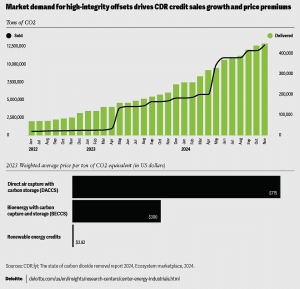
This growing demand is likely to push prices higher, especially for credits that meet stringent integrity and additionality standards.

The aviation sector is anticipated to emerge as a significant player in the carbon market. The Carbon Offsetting and Reduction Scheme for International Aviation (CORSIA) will enter its first mandatory phase in 2027, but airlines could begin preparing earlier by purchasing credits to offset their emissions. This development will further bolster demand and drive innovation within the voluntary carbon market.

Policy advancements will also play a crucial role in shaping the market in 2025. The continued implementation of Article 6 of the Paris Agreement, alongside national regulations like the EU’s Green Claims Directive and the U.S. transparency laws, will provide clearer guidelines for credit use and enhance market credibility. 

However, challenges persist, including addressing fragmented market standards and ensuring robust monitoring and verification systems.

As the carbon market evolves, 2025 will serve as a year of progress and adjustment. This year will lay the groundwork for a more transparent, efficient, and impactful mechanism to combat climate change.

Beyond 2025: Projections for 2030 and 2050
carbon credit market value 2050 MSCI

By 2030, the carbon credit market could grow significantly, reaching between $7 billion and $35 billion, according to the MSCI analysis shown above. Several trends are driving this potential growth:

  1. Rising Demand for Carbon Removal Credits: These tend to be more expensive but are considered more credible.
  2. Corporate Climate Goals: Companies with ambitious targets for 2030 will likely rely more on carbon credits to bridge the gap between their emissions and goals.
  3. Higher-Quality Credits: Buyers are increasingly choosing credits from projects with higher standards and transparency, which boosts trust in the market.

MSCI’s long-term outlook for carbon credits is even more optimistic. By 2050, the market could be worth between $45 billion and $250 billion, driven by:

  • Urgent Corporate Demand: Many companies will be nearing their net-zero deadlines by 2050, increasing the need for offsets.
  • Shift to Removal Credits: Around two-thirds of the market value by 2050 could come from credits that actively remove carbon.
  • Engineered Solutions: Technologies like direct air capture could become key players, with their market value potentially reaching $42 billion.

A Market Worth Watching

The carbon credit market may be stuck for now, but the outlook is promising. With stricter standards, growing corporate commitments, and innovative solutions, the market is poised for growth. As 2030 approaches, the demand for high-quality credits is likely to rise, thawing the frozen market and creating new opportunities for businesses and investors alike.

The post Carbon Credits in 2024: What to Expect in 2025 and Beyond ($250B by 2050) appeared first on Carbon Credits.

Continue Reading

Carbon Footprint

SBTi Net-Zero Standard V2: What the Revision Means for Every Business

Published

on

The Science Based Targets initiative (SBTi) just rolled out a major revision to its Net-Zero Standard, Version 2.0. It changes how companies set climate targets, how much room they actually have to hit those targets, and how carbon credits fit into a credible net-zero strategy. Below, we break down what’s changing, when it takes effect, and why it matters even if your business isn’t formally an SBTi participant.

Key takeaways

  • SBTi is the default reference point for corporate climate action: 51% of Fortune Global 500 companies now hold net-zero targets, up from 8% in 2020, and over 11,000 organizations worldwide have SBTi-validated targets.
  • Net Zero Standard V2 redefines climate leadership as reducing emissions and mitigating ongoing emissions, not reduction alone.
  • The new standard adds flexibility through five-year cycles, a “best efforts” standard, and an Asset Transition Method for companies whose path to net-zero doesn’t fit a straight-line trajectory.
  • Voluntary carbon credits are formally recognized for the first time, with reduction and removal credits accepted from 2027, and removals required from 2035.
  • Companies with 2030 targets keep using V1 for their current cycle and move to V2 in 2028; companies without targets can start using V2 on February 1, 2027.

Why every business needs to understand the SBTi Net-Zero Standard revision

The Science Based Targets initiative (SBTi) has become the default reference point for credible corporate climate action. Net-zero targets are now held by 51% of Fortune Global 500 (FG500) companies, up dramatically from just 8% in 2020, and more than 11,000 organizations worldwide have set SBTi-validated targets.

However, SBTi’s influence extends well beyond the companies formally participating in the program. Every business in the value chain of an SBTi participant will have to reduce its own carbon emissions, and businesses that aren’t SBTi participants themselves still look to the program for guidance on climate action.

In short, SBTi gives every business a credible blueprint for climate action, and companies that follow its principles can pursue climate action with confidence, whether or not they’re formally part of the program.

How will the Net Zero Standard revision affect business climate action?

SBTi participation is expected to grow. Despite strong target-setting participation among the F500, only 17% of companies use the SBTi Net Zero Standard V1 beyond target setting, largely because its rules have been seen as too rigid to apply in practice. Much of the Net Zero Standard revision has focused on creating more flexibility to enable higher participation. Medium and small businesses will also increasingly feel pressure for climate action, since SBTi mandates that its participants reduce carbon emissions across their value chains.

Net Zero Standard V2 also redefines climate leadership: leading climate action now means reducing emissions and mitigating ongoing emissions. Reducing your own emissions while ignoring the emissions you continue to release along the way is no longer considered leadership. Supporting voluntary carbon projects with high-integrity carbon credits is now backed by the leading authority on corporate climate action.

What lessons shaped the Net Zero Standard V2 revision?

The revision reflects a few learnings about what actually drives climate progress, and how SBTi built those lessons into the new standard.

Net Zero Standard V1 Learnings Net Zero Standard V2 Implementation
Making real short-term progress is more important and more difficult than making big long-term promises Focus on short-term climate progress
Every company has a different path to net zero that doesn’t always fit generalized net-zero rules Create asset transition plans based on each company’s unique asset lifecycles and capital planning
We need to mitigate our ongoing emissions to keep global carbon emissions in check Reduce global carbon emissions by financing voluntary carbon projects with high-integrity carbon credits

What are the key changes between the old and new Net Zero Standard?

Both versions of the standard are grounded in net-zero by 2050. However, the old standard treated climate leadership as simply reducing emissions, expected a long-term commitment to net zero, based emission reduction targets on generalized net-zero goals, revoked status from companies that fell behind on targets, and ignored voluntary carbon projects entirely.

The new standard treats climate leadership as reducing emissions and mitigating ongoing emissions. It shifts the focus to short-term progress through five-year cycles, and it bases emission reduction targets on both the net-zero goal and a company’s own asset decarbonization plan. A new Asset Transition Method lets companies set decarbonization targets through asset plans with committed, verifiable steps; an ambitious but achievable path based on a company’s starting point, financial resources, and technology, with multiple pathways to reflect the unique opportunities and constraints of different industries and companies.

Crucially, the new standard moves to a “best efforts” basis that creates real flexibility on progress against targets. Businesses that miss their targets can keep their status if they’ve used “every lever” within their control, and minimum progress rules will be set out in the SBTi Assurance Manual.

Finally, the new standard formally uses voluntary carbon projects to mitigate ongoing emissions. From 2027 through 2034, this mitigation is recognized, and both carbon reduction and removal credits are accepted. From 2035 forward, mitigation with carbon removal credits becomes required, with durability matching between the removal and the emission it offsets.

Old Net Zero Standard New Net Zero Standard
Grounded in net-zero by 2050 Grounded in net-zero by 2050
Climate leadership is reducing emissions Climate leadership is reducing emissions and mitigating ongoing emissions
Make a long-term commitment to net-zero Focus on short-term progress in 5-year cycles
Emission reduction targets are based on net-zero goal
  • Emission reduction targets are based on net-zero goal and asset decarbonization plan
  • Adds SBTi’s Asset Transition Method
  • Decarbonization targets are set through asset plans with committed, verifiable steps
  • Ambitious but achievable path based on starting point, financial resources, technology
  • Multiple pathways for unique opportunities and constraints of industries and companies
Businesses who fall behind targets lose status
  • “Best efforts” basis creates flexibility on progress to targets
  • Businesses that miss targets can keep status if they used “every lever” in their control
  • Minimum progress rules will be provided in the SBTi Assurance Manual
Ignores voluntary carbon projects
  • Uses voluntary carbon projects to mitigate ongoing emissions
  • 2027–2034: Mitigation is recognized. Carbon reduction and removal credits are accepted.
  • 2035 forward: Mitigation with carbon removal credits is required, with durability matching.

When does the new Net Zero Standard take effect?

Companies with existing 2030 targets should continue using the old Net Zero Standard for their current cycle, and start using the new Net Zero Standard in 2028 to set targets for the next cycle (2030–2035).

Companies that don’t yet have targets can use the new Net Zero Standard starting February 1, 2027.

What are SBTi’s Category A and Category B companies?

The new Net Zero Standard splits companies into two categories, with different requirements attached to each.

Category A covers large companies from all countries and medium-sized companies from high-income countries. A company from any country qualifies if it meets at least one of: net turnover of €450 million or more, or 1,000 or more full-time employees. A company from a high-income country qualifies if its Scope 1 and 2 emissions are 10,000 tCO2e or more, or if it meets at least two of: balance sheet of €25 million or more, net turnover of €50 million or more, or 250 or more full-time employees.

Category B covers small companies from all countries and medium-sized companies from lower-income countries.

How do Scope 1 targets work under Net Zero Standard V2?

Scope 1 targets aim to transition companies to net-zero direct emissions by 2050 or sooner, and companies can choose from three approaches.

  1. Absolute emissions reduction follows a straight-line emissions trajectory from the target base year to the net-zero year.
  2. Emissions intensity reduction lets companies follow sector-specific pathways designed to reflect the reduction opportunities available in sectors like steel, cement, or chemicals.
  3. Asset transition is designed for companies whose capital stock turnover doesn’t follow a linear or sector pathway. These companies design a transition plan to operate existing assets efficiently and replace them with low-carbon assets, using predetermined milestones.

How do Scope 2 targets work under Net Zero Standard V2?

Scope 2 targets address emissions from purchased electricity through three pathways:

  1. Reducing electricity consumption,
  2. Reducing grid consumption by installing onsite or direct-line offsite clean energy generation, and
  3. Cleaning up the regional grid using market-based tools like PPAs, RECs, and GOs that drive clean energy development.

V2 introduces a dual Scope 2 framework requiring two separate targets, with an overall goal of 100% low-carbon electricity by 2040.

The location-based target addresses the carbon intensity of a company’s physical power use, and requires companies to show that their grid consumption is falling and/or that their physical grid use is getting cleaner; in other words, that their market-based solutions are actually making the grid cleaner.

The market-based (or zero-carbon electricity) target tracks a company’s use of low-carbon power generation contracts and Energy Attribute Certificates. It requires geographical matching of these certificates with electricity consumption based on deliverability regions (grid regions); annual matching is allowed, though hourly matching is encouraged. Category A companies with large electricity loads must report the percentage of their Scope 2 electricity consumption matched with low-carbon attributes on an hourly basis, and there’s an optional recognition framework for companies that meet hourly matching thresholds.

How do Scope 3 targets work under Net Zero Standard V2?

Scope 3 targets share the same 2050-or-sooner net-zero goal, but companies set near-term targets only for material emissions sources in their value chain and areas where they have real influence. Long-term Scope 3 targets are generally not required.

Limited, justified exclusions are allowed for near-term targets, including categories that individually account for less than 5% of total Scope 3 emissions, and activities where a company lacks practical influence, like leased assets it doesn’t operationally control, or the processing of sold products. Optional exclusions are also available in specific categories.

Companies can choose from three approaches to near-term Scope 3 targets:

  1. An overarching emissions reduction target, which follows a linear contraction of emissions from the base year to residual emissions of 10% or less by 2050 or sooner;
  2. An overarching supplier/customer alignment target, benchmarked against a growing share of tier 1 suppliers and customers reaching net-zero by 2050 or sooner; or
  3. A category- or activity-specific target, tailored for companies with concentrated emissions in particular Scope 3 categories or high-emitting activities.

What is “ongoing emissions mitigation” under the new SBTi standard?

This is one of the most significant additions in Net Zero Standard V2. Accelerated climate contributions are needed to help the world achieve climate objectives, limit temperature overshoot, mitigate transition risks, and support the scale-up of climate solutions, and V2 formally recognizes that. Ongoing emissions mitigation runs as a parallel track to companies also reducing their own emissions.

The framework is initially voluntary, with recognition available at three contribution levels to encourage early action.

  1. Engaged companies address more than 1% of total Scope 1, 2, and 3 emissions.
  2. Advanced companies address more than 10% of total Scope 1, 2, and 3 emissions, including 100% of Scope 1 and 2 emissions.
  3. Leadership companies address 100% of total Scope 1, 2, and 3 emissions with a contribution budget of $80/tCO2e.

Carbon credits used for this purpose have to meet certain quality standards. They must be ex-post (issued after the mitigation has actually occurred), independently third-party-assured, emissions reductions or removals, measured in tCO2e, that occur within five years prior to the reporting year. They must be sourced from outside the company’s own value chain. Further minimum criteria will be set to align with high-integrity frameworks, with additional details on the recognition program expected in the second half of 2026.

Starting in 2035, carbon removals become mandatory for Category A companies. From that point, the carbon removal coverage requirement rises linearly from 1% of Scope 1–3 emissions to 100% by a company’s net-zero year. Within that, 10% of long-lived GHG emissions must specifically be covered by durable removals, also rising linearly to 100% by the net-zero year.

How must companies neutralize residual emissions?

At a company’s net-zero target year and thereafter, it must reduce its Scope 1, 2, and 3 emissions to zero or to residual levels, and neutralize all residual emissions using eligible carbon removals. Those removals have to meet two conditions: they must occur within the same reporting period as the residual emissions they’re neutralizing, and long-lived GHGs must be neutralized with long-lived removals, matching the durability of the removal to the atmospheric lifetime of the emission being addressed.

What is the SBTi implementation hierarchy?

Net Zero Standard V2 also lays out how companies should prioritize their actions for credible target delivery, in three tiers.

  1. Direct actions, at the activity level, are actions that reduce emissions at the source within a company’s own operations and value chain; things like efficiency improvements, fuel switching, and engaging suppliers and customers to reduce their emissions.
  2. Actions within shared systems, or activity pools that reduce the emissions of shared systems like electricity or gas grids. This includes market instruments that convey low-carbon attributes, such as PPAs, RECs, and GOs, all of which must meet minimum integrity criteria that SBTi will elaborate on in future guidance.
  3. Sector-level actions relate to the same type of activity occurring in a relevant geography or system, in a way that meaningfully reduces the emissions a company is responsible for.

How Terrapass helps businesses meet the new SBTi standard

As the rules around carbon credits become more rigorous, the quality of the credits behind them matters more than ever. Terrapass has expanded our global network of carbon projects: more project types, locations, prices, ICVCM CCPs, and UN SDGs, spanning super-pollutant destruction, nature-based solutions, and durable removals. We offer Green-e® Climate Certification and we only source from third-party-verified projects on ICVCM-Eligible registries.

We also help clients with impact beyond carbon: EACs, RECs, and GOs including Green-e® Certified credits that support leading renewable energy projects; water credits that support water restoration projects; and custom environmental product needs like RNG and SAF. Wherever your organization is on its sustainability journey, we help clients around the world address climate risk, advance their environmental and social goals, and get the most out of their sustainability budgets.

FAQ: SBTi Net-Zero Standard revision

What is the SBTi Net-Zero Standard?

It’s the framework the Science Based Targets initiative publishes for companies that want validated, credible net-zero targets tied to limiting global warming.

What is changing in the SBTi Net Zero Standard V2 revision?

The biggest changes are more flexibility (five-year cycles and a “best efforts” standard), a new Asset Transition Method for companies whose emissions don’t follow a straight-line path, and formal recognition of voluntary carbon credits for mitigating ongoing emissions.

When do companies need to switch to the new SBTi standard?

If your company already has 2030 targets, you keep using V1 for your current cycle and move to V2 in 2028. If you don’t have targets yet, you can start using V2 as of February 1, 2027.

Can companies use carbon credits to meet SBTi targets?

They can. Under V2, high-integrity carbon reduction and removal credits count toward mitigating ongoing emissions from 2027 through 2034. Starting in 2035, only removal credits count, and they need to be durability-matched to the emissions they offset.

What’s the difference between Category A and Category B companies under SBTi?

Category A is large companies everywhere plus medium-sized companies in high-income countries, based on thresholds like revenue, headcount, or emissions. Category B is small companies everywhere and medium-sized companies in lower-income countries.

What happens if a company misses its SBTi target?

Under the old standard, falling behind could cost a company its SBTi status. Under V2’s “best efforts” approach, a company can hold onto its status as long as it’s used every lever within its control, with minimum progress rules coming in the SBTi Assurance Manual.

Sources: This post is based on Terrapass’s internal analysis of the SBTi Corporate Net-Zero Standard V2.0. Facts and figures were checked against SBTi’s official V2.0 announcement, SBTi’s Corporate Net-Zero Standard V2.0 — Chapter 6: Ongoing Emissions Responsibility, Trellis’s coverage of the standard, Trellis’s reporting on Ongoing Emissions Recognition costs, Sylvera’s analysis of what comes next, Anthesis Group’s Fortune 500 net-zero commitments research, and Climate Impact Partners’ seventh annual FG500 analysis, as reported by CarbonUnits.com.

The post SBTi Net-Zero Standard V2: What the Revision Means for Every Business appeared first on Terrapass.

Continue Reading

Carbon Footprint

How to improve Scope 3 data accuracy for CSRD

Published

on

For most businesses, the emissions that matter most sit outside their own walls. Scope 3 emissions, everything generated across your value chain, from the suppliers who make your inputs to the customers who use your products, typically make up the majority of a company’s total carbon footprint. Under the Corporate Sustainability Reporting Directive (CSRD), those value-chain emissions now have to be measured and disclosed with a rigour that spend-based estimates alone struggle to satisfy. This guide sets out how to improve Scope 3 data accuracy for CSRD: the calculation methods open to you, how to move from estimates to verified supplier data, and how to govern that data so it holds up to audit.

Continue Reading

Carbon Footprint

How community stewardship makes carbon credits durable

Published

on

A carbon credit is a commitment that extends well into the future. The tonne of CO₂ compensated for today from a nature-based carbon project must remain out of the atmosphere for good, which means the forest behind the credit has to remain standing long after the transaction is complete. For any buyer, this raises a defining question: What ensures that the forest endures?

Continue Reading

Trending

Copyright © 2022 BreakingClimateChange.com

