

Weather Guard Lightning Tech

The Empire Wind 1: What’s Behind the Offshore Wind Controversy
On April 16, 2025, the U.S. offshore wind industry was rocked by a directive from the Department of the Interior ordering an immediate halt to all construction activities on the Empire Wind 1 project. The Bureau of Ocean Energy Management (BOEM) cited the need for further review of environmental analyses and interagency consultation, referencing feedback from the National Oceanic and Atmospheric Administration (NOAA). Yet, the order stopped short of providing specifics, leaving industry observers, local officials, and clean energy advocates scrambling for answers.
This abrupt move stands in stark contrast to the administration’s approach to other major offshore wind projects which have been, so far, allowed to proceed without new federal impediments. What’s behind this selective intervention? And what does it signal for the future of offshore wind in America?
A Brief History: Empire Wind and the Offshore Boom
Empire Wind 1, developed by Equinor, is a flagship project in New York’s ambitious clean energy portfolio. Slated to deliver 810 MW, which is enough to power half a million homes, the project had cleared a rigorous four-year federal and state review, secured all major permits, and begun offshore construction in April 2024. Its companion project, Empire Wind 2, was shelved in late 2023 due to soaring costs and supply chain turmoil, a fate shared by Orsted’s Ocean Wind 1 and 2 in New Jersey during the Biden administration.
Despite these setbacks, the U.S. offshore wind sector had been gaining momentum. Vineyard Wind off Massachusetts became the nation’s first commercial-scale project, and South Fork Wind off New York and CVOW in Virginia followed suit. The Biden administration’s early years saw historic lease sales and an all-of-government push to expand offshore wind capacity.
Trump’s Second Term: A New Approach to Offshore Wind
President Trump’s return to the White House in 2025 brought with it a familiar skepticism toward wind energy. Yet, unlike his first term-when permitting delays were widespread but lease sales continued-the new administration’s actions have been more targeted.
Why Only Empire Wind 1?
The April 16 directive halting Empire Wind 1 construction was justified by the administration as a response to “insufficient analysis” in the project’s permitting, particularly regarding environmental impacts and interagency consultation. Interior Secretary Doug Burgum cited feedback from NOAA but did not point to any fatal flaws or legal violations. The project’s comprehensive review process, which included NOAA’s input and resulted in mitigation measures for sensitive habitats like Cholera Bank, had already been completed under the previous administration.
Meanwhile, other major projects-Vineyard Wind, South Fork Wind, CVOW, and Revolution Wind-have not faced new federal obstacles. Their construction and operation continue, suggesting that the Empire Wind 1 halt is not part of a blanket policy against offshore wind, but rather a selective intervention.
A Deeper Look at the Cholera Bank Dispute
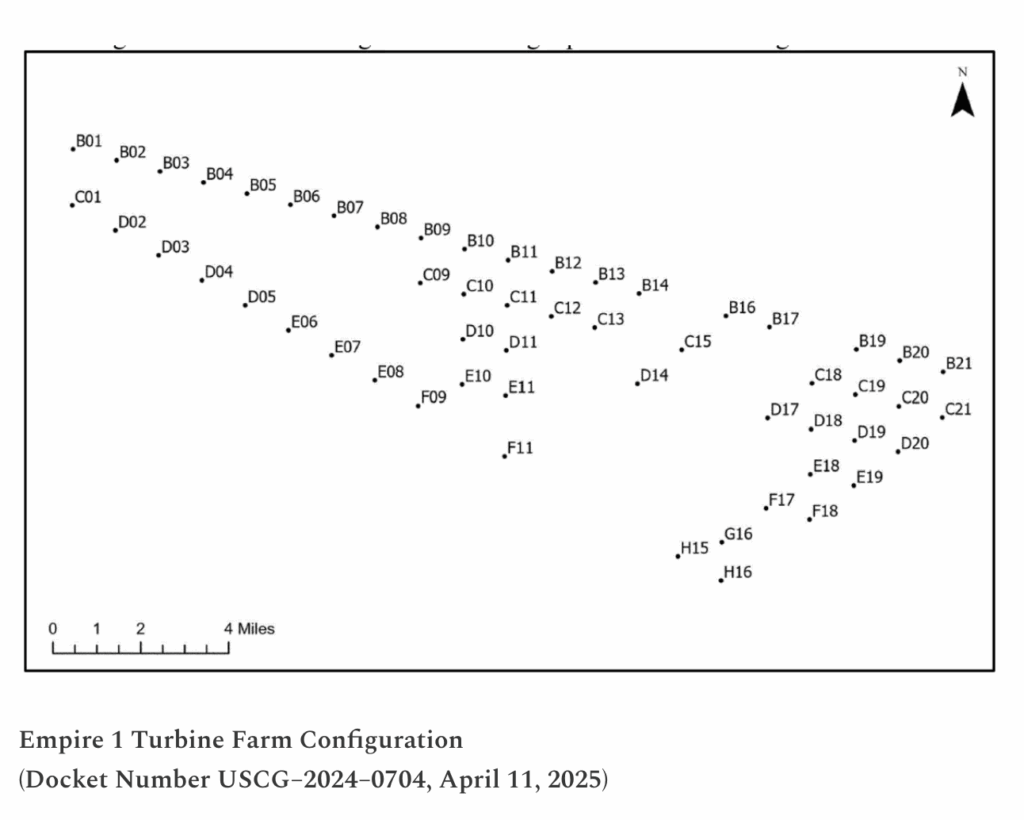
A major point of contention has been the fate of Cholera Bank, a sensitive benthic habitat within the western end of the Empire Wind 1 lease area. NOAA’s National Marine Fisheries Service (NMFS) formally recommended the removal or relocation of up to six turbines (identified as B01, C01, B02, D02, B03, D03) to further protect this habitat. However, according to the November 2023 BOEM Record of Decision, these recommendations were not implemented. BOEM determined that further turbine removal or relocation would jeopardize the project’s ability to meet its contractual obligations with NYSERDA, which requires a minimum power output. Instead, BOEM relied on prior lease area adjustments (removal of 1,780 acres in 2016), monitoring, and compensation funds as mitigation, but the final turbine layout remained unchanged.
The BOEM Record of Decision acknowledges that NOAA did not fully agree with this approach and maintained that the mitigation measures did not completely address the ecological risks to Cholera Bank. NOAA’s concerns were significant enough that the agency indicated it would continue working with the U.S. Army Corps of Engineers on potential further permit conditions. This unresolved interagency disagreement is likely at the heart of the Trump administration’s justification for the 2025 work stoppage, which specifically referenced NOAA’s feedback and the need for further review.
Financial and Market Realities: Lessons from Empire Wind 2 and Ocean Wind
It’s important to note that not all recent offshore wind project cancellations or delays are the result of federal policy. Under the Biden administration, Orsted withdrew from Ocean Wind 1 and 2 in New Jersey, and Equinor abandoned Empire Wind 2, both citing inflation, supply chain disruptions, and rising interest rates. These market forces have reshaped the industry, raising the bar for project viability and investor confidence.
The Trump administration’s action on Empire Wind 1, therefore, is not occurring in a vacuum. It comes at a time when the industry is already under pressure from global economic headwinds. However, the selective nature of the intervention-targeting a New York project while allowing others to proceed-raises questions about the administration’s criteria and long-term intentions.
What’s Next for Empire Wind 1 and U.S. Offshore Wind?
For now, Empire Wind 1 remains in limbo. Equinor is exploring legal options and has warned of potential termination fees and lost jobs if the pause persists. BOEM has not provided a timeline for its review or clarified what additional analysis is required. The uncertainty threatens to ripple through the supply chain, from turbine manufacturers to local ports and construction workers.
The broader U.S. offshore wind sector, meanwhile, continues to evolve. Projects in Massachusetts, Connecticut, Rhode Island, and Virginia are moving forward, buoyed by state-level support and existing federal permits. Yet, the Empire Wind 1 pause is a stark reminder that federal policy-especially under an administration skeptical of wind energy-can still shape the industry’s trajectory.
Conclusion: A Pivotal Moment for Clean Energy
President Trump’s administration has not issued a blanket halt on offshore wind, yet. However, the targeted halt of Empire Wind 1 signals a new era of selective federal intervention, injecting uncertainty into an industry already grappling with economic challenges.
The unresolved dispute between BOEM and NOAA over Cholera Bank mitigation-specifically, the decision not to remove or relocate turbines as NOAA requested-appears to be the pivotal event cited by the Trump administration. As the offshore wind sector navigates this complex landscape, the fate of Empire Wind 1 will serve as a bellwether for the future of clean energy in the United States. Will the administration’s review lead to a resumption of construction, or will it mark the beginning of a broader retrenchment? For now, all eyes are on BOEM and on the winds of political change.
This article was written by Weather Guard Lightning Tech CEO Allen Hall on May 6, 2025 based on a review of data on the BOEM website and other federal sites. We will update the article if and when Empire Wind or government officials provide comments. Occasional articles and other industry news content like this is sent to subscribers of the Weather Guard Substack channel. The Weather Guard Substack subscription is free. Sign up here.
Join the conversation about Wind Energy – the industry and the innovations – on our LinkedIn page.
https://weatherguardwind.com/the-empire-wind-1-whats-behind-the-offshore-wind-controversy/

 For those who struggle with elementary school arithmetic, Trump won the election (50%+ approval) out of more than 150 million votes cast, and now his approval rating is in the low 30s.
That’s ~30 million voters who regret their choices, out of the common American.
Add in the Tucker Carlsons of the world.
Absolutely.
It must be done, because our country is home to some hateful morons who want to see honest, hardworking, taxpaying people with brown skin deported, and their families torn apart.
It wasn’t the American way until recently, but it sure is now.
 As shown at left, the United States is loaded with people who twist the facts to their liking.

After a Slow Start on Climate, Zohran Mamdani Faces Scrutiny Over Parks Budget and Environmental Promises
Who Loses in the Trump Administration’s $1 Billion ‘Deal’ to Abandon Offshore Wind?
Minneapolis Activists Launch Hunger Strike to Protest Polluting Trash Incinerator
-
Climate Change8 months ago
Guest post: Why China is still building new coal – and when it might stop
-
Greenhouse Gases8 months ago
Guest post: Why China is still building new coal – and when it might stop
-

 Greenhouse Gases2 years ago
嘉宾来稿:满足中国增长的用电需求 光伏加储能“比新建煤电更实惠”
-
Climate Change2 years ago
Bill Discounting Climate Change in Florida’s Energy Policy Awaits DeSantis’ Approval
-

 Climate Change2 years ago
嘉宾来稿:满足中国增长的用电需求 光伏加储能“比新建煤电更实惠”
-
Climate Change Videos2 years ago
The toxic gas flares fuelling Nigeria’s climate change – BBC News
-

 Renewable Energy6 months ago
Sending Progressive Philanthropist George Soros to Prison?
-

 Carbon Footprint2 years ago
US SEC’s Climate Disclosure Rules Spur Renewed Interest in Carbon Credits