


Solar-plus-storage systems are rapidly emerging as a game-changing solution in renewable energy. These systems tackle two critical issues: the intermittency of solar power and the mismatch between when solar energy is produced and when it is most needed.
By combining solar panels with battery storage, these hybrid setups deliver consistent energy, enhance grid reliability, and create new income opportunities for solar plants. Solar facilities can now earn through capacity payments and arbitrage—buying energy at low costs, storing it, and selling it when prices are higher.
What Are Solar-Plus-Storage Systems and How They Tackle Energy Gaps
The U.S. solar industry is expanding rapidly, closing the gap with wind power. Utility-scale solar now totals nearly 120 GW of capacity, compared to 155 GW for wind, according to S&P Global Commodity Insights.

However, stand-alone solar projects still dominate, accounting for 93 GW, with eight states hosting two-thirds of this capacity. This heavy concentration is causing market saturation in some areas. During peak daytime hours, solar output is so high that energy prices plummet, cutting into solar plant revenues.
Additionally, many solar facilities must limit or curtail production because peak solar generation around noon does not align with peak energy demand, which typically occurs in the late afternoon or evening. This challenge is particularly pronounced in regions like California and Texas, where record solar curtailments have already occurred in 2024.
Recognizing these issues, developers and grid operators are shifting toward solar-plus-storage systems. These systems integrate batteries with solar facilities to store excess energy generated during the day and release it during peak demand hours. This combination enhances energy reliability and independence.
This shift is evident in the U.S. energy pipeline and grid interconnection queues.
Today, operational solar-plus-storage systems contribute around 33 GW of capacity, including 22.8 GW of solar power paired with 10 GW of battery storage, per S&P Global data.
- Additionally, 162 GW of hybrid solar-plus-storage projects are in the planning stages, with 42% of capacity dedicated to battery storage.
RELATED: SolarBank Charges Ahead with $3M Boost for Battery Energy Storage System Projects
Many of these new projects are strategically located in “energy communities,” areas eligible for a 10% tax credit bonus under the Inflation Reduction Act. This incentive supplements the base tax credits for investment and production, making these projects even more attractive.
New Revenue Streams Energize Solar-Plus-Storage Systems
The solar-plus-storage market is more concentrated than standalone solar. Per Wood Mackenzie’s report, Tesla Energy and Sunrun dominate the residential segment with nearly 50% market share. Non-residential solar-plus-storage follows a similar trend, with the top six installers capturing over 50% of the market in 2023, compared to just 16% for non-residential solar alone.
The next four largest solar-plus-storage installers—SunPower, Titan Solar Power, Freedom Forever, and Semper Solaris—collectively hold an additional 13% of the market.
The move toward solar-plus-storage is also reflected in grid interconnection requests.
- By April 2024, hybrid solar-plus-storage projects accounted for 658 GW—30% of the total interconnection queue across U.S. grid operators.
In California, where stand-alone solar projects face market saturation, over 92% of new solar projects seeking interconnection include battery storage.
Over the next decade, experts expect the deployment of solar-plus-storage systems to significantly reshape the energy landscape. These systems will help balance energy supply and demand, reduce curtailment, and increase renewable energy adoption.
According to S&P Global Market Intelligence’s Power Forecast, utility-scale solar will account for nearly 17% of U.S. electricity generation by 2035, making it the third-largest energy source behind natural gas and wind.
For solar companies, adding battery storage creates exciting new revenue opportunities. These include earnings from arbitrage—charging batteries during low-cost periods and selling stored energy when prices are higher—and capacity revenue, and payments for ensuring resource availability.
S&P Global shared its annual financial forecast for solar-plus-storage systems market, broken down in different revenue sources.
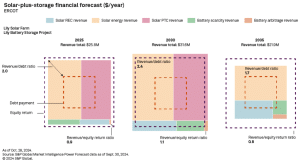
However, the profitability of these systems varies by region. Factors like natural resources, energy demand patterns, fiscal incentives, and local market dynamics play a significant role. Battery sizing also influences revenues, with smaller solar-to-battery capacity ratios expected to boost arbitrage earnings.
The Global Race in Bridging Solar Supply and Demand Divide
Globally, the solar-plus-storage market is expected to exceed 30 GWh by 2025, with China and the U.S. leading the way, according to the InfoLink report. China’s over 260 GW of installed PV capacity, supported by local policies, positions it as the largest solar-plus-storage market.
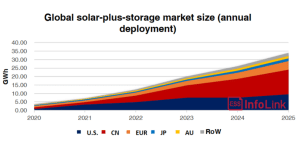
InfoLink projects that by 2025, more than 50% of solar deployments will incorporate storage globally. This trend highlights the intertwined growth of renewable energy and energy storage, providing insights into future regional developments. Solar and wind energy progress serve as key indicators for advancing energy storage systems.
As more hybrid projects come online, solar-plus-storage systems are proving to be a critical piece of the energy transition puzzle. They bridge the gap between energy production and demand, enhance grid stability, and open new financial avenues for solar developers.
With strong policy support and technological advancements, solar-plus-storage could play a leading role in achieving the clean energy goals of tomorrow.
The post Solar-Plus-Storage: The Hybrid Solution Revolutionizing America’s Clean Energy Landscape appeared first on Carbon Credits.

Carbon credit providers vs marketplaces is the first comparison many buyers try to make. In this comparison, a carbon credit provider is the project developer: the company that originates credits from its own projects and sells them directly. A carbon credit marketplace is a platform that lists credits from many projects at published prices.

Carbon Footprint
Democrats who call climate change an emergency should not defend a permitting system too slow to build the clean energy that would address it.”
Democrats, Take The Deal. New York Times editorial, Nov. 12.
Insetting program design starts with your supplier map. The carbon claim comes much later.
Consider a coffee procurement team that funds a farm intervention before checking its sourcing data. The supplier aggregates coffee lots from several regions. The buyer lacks farm-level traceability. Another purchaser expects to report the same outcome. A more attractive project brochure solves none of these problems.
If the distinction between a value-chain intervention and a purchased credit is still open, read CCC’s Insetting vs Offsetting guide before you set the brief.
Insetting program design begins with the purchasing relationship and works outward. You need to decide 1) where an intervention belongs, 2) what business problem it addresses, 3) who pays for it, 4) how results will be measured, and 5) what the evidence will let you say about them. This five-step playbook turns that sequence into a procurement plan.
Step 1: Insetting program design starts with supplier mapping
Start with the commodities that matter most to your Scope 3 inventory and sourcing continuity. Ask finance for spend by supplier, sustainability for the emissions baseline, and category managers for origin and volume records. Then identify which suppliers can trace material to a jurisdiction, sourcing region, producer group, or individual land-management unit.
The level of traceability affects what you can account for. Under the GHG Protocol Land Sector and Removals Standard, the spatial boundary for purchased land-based products depends on the traceability associated with each volume. Farm-specific factors or removals require physical traceability through an acceptable chain-of-custody model. A contract with a tier-one trader, by itself, does not establish a link to the farms behind its deliveries.[1]
Build a first-pass table with five columns: commodity and annual volume; supplier and origin; current traceability level; land-use and production risks; and the business owner who can change the purchasing terms. Mark missing data plainly. A blank cell is cheaper to fix before a program starts than after a claim is drafted.
If your company sets an SBTi Forest, Land and Agriculture target (FLAG), keep its land-related target boundary separate from energy and industry emissions. The current FLAG guidance also requires relevant companies to assess primary deforestation-linked commodities in their value chains.[2]
Step 2: Choose a commodity and jurisdiction for a pilot
Select one supply corridor where the sourcing connection can be established and procurement has a reason to stay. A useful pilot has repeat purchases, suppliers willing to share records, an intervention matched to a diagnosed problem, and a defined plan to measure the result. Carbon potential alone is a poor selection rule if the supplier cannot deliver the crop your business needs.
Compare candidate regions on land-use risk, supplier concentration, local rights and tenure, the availability of baseline data, and exposure to drought, erosion, or forest conversion. Check the relevant legal requirements separately. A nature project does not satisfy a due-diligence obligation merely because it has a carbon method attached.
Consider a coffee buyer sourcing from two districts. In the first, producer-group records identify the farms, while recent dry seasons have increased rejected green coffee lots. In the second, deliveries pass through several intermediaries and farm origins are unknown. Pilot shade management in the first district, with local agronomic advice and quality checks built into the plan. The buyer can trace purchases there and test the intervention against a defined sourcing problem.
Use a short decision memo to record why the selected corridor beats the alternatives, what remains uncertain, and what would stop the pilot. That memo is the first control against a project drifting toward whatever happens to photograph well.
Step 3: Design the supplier engagement and commercial model
The intervention needs an owner on each side of the contract. Decide who supplies planting material or training, who maintains the practice, who bears the cost if a harvest disappoints, and how long the buyer expects to purchase from participating suppliers. Where smallholders participate, budget cash flow and technical support for practices that offer a later return.
Put these terms in a supplier agreement or pilot addendum. It should cover eligible farms and volumes, consent to data collection, access for monitoring, any land or carbon rights that matter, benefit sharing, and what happens if the purchasing relationship ends. Ask local counsel and producer representatives to review the arrangement. The Accountability Framework is a useful reference for supply-chain work involving forests, ecosystems, and human rights.[3]
Avoid assigning an automatic carbon benefit to the buyer. The contract should say which party has the right to report each outcome, how overlapping claims will be checked, and how any issued credits will be handled. A reduction reported in a buyer’s inventory cannot simply be sold for someone else’s offset claim without an accounting review. SBTi FLAG guidance excludes purchased credits used as offsets from near-term FLAG target achievement.[2]
Set commercial measures beside environmental ones: delivered volume, rejection rate, supplier retention, and procurement cost. They tell you whether the program works as a supply-chain investment, even if carbon accounting takes longer to resolve.
Step 4: Build monitoring, reporting, and verification before rollout
Agree on the baseline and data flow before paying for a full rollout. Identify the land units or sourcing regions in scope, the practices that change, the records suppliers already keep, and the additional measurements the program requires. Decide which data can come from field visits, transaction records, or remote sensing, and who checks each source.
For carbon, separate three questions. Did the practice happen? Did emissions or removals change under an applicable method? Can the buyer attribute a defensible share to its purchased goods without double counting? The GHG Protocol’s 2026 guidance includes dedicated chapters on spatial boundaries, data and methods, evaluating actions, credited outcomes, and assurance.[1] These are distinct jobs. A photograph of a planted tree answers only part of the first.
CCC’s MRV and Additionality article explains the separate evidence questions a project reviewer will ask.
Create an evidence file for every reporting period: dated supplier and farm records, purchase volumes, methods and emission factors, uncertainty, quality checks, and changes from the baseline. Specify who can challenge the data and how corrections are recorded. If a project also seeks credit certification, keep project accounting and corporate inventory accounting separate. The GHG Protocol says its land standard focuses on entity-level inventories and does not set the rules for credit certification.[4]
Start with the minimum viable measurement design that can survive review. Add complexity when the pilot tells you which data actually changes a decision.
Step 5: Decide what can be reported and claimed
Insetting program design needs reporting rules before the marketing copy. Procurement, sustainability, finance, and legal should agree on four distinct outputs: operational performance; observed land or nature outcomes; inventory effects, if the accounting criteria are met; and any separately issued credits. One dashboard can display them, but they should not share a single unqualified headline.
SBTi FLAG guidance allows certain land-based removals within a company’s operations or supply chain to contribute to FLAG pathways, subject to criteria including permanence, traceability, data quality, and allocation. It does not allow purchased offsets to meet near-term FLAG targets.[2] Eligibility therefore depends on evidence and the applicable target rules, not on calling an activity “insetting.”
Draft a claims register. For each proposed sentence, record the period, boundary, data owner, calculation method, reviewer, and whether the result is measured, estimated, or still a goal. If the evidence supports only “we funded a pilot with 200 farms,” say that. Do not turn a funding fact into a verified emissions reduction.
What good looks like by year three
Treat year three as a review point, not a promised payback date. A mature pilot should have mapped participating supply volumes, a stable supplier agreement, a repeatable data collection process, and a comparison of commercial and environmental results against the baseline. It should also have a documented answer for outcomes that cannot be included in the buyer’s inventory.
Scale only where the pilot improves a sourcing decision and the evidence can follow the product. If neither condition holds, redesign the intervention or change the corridor. A disciplined program can conclude that a site is unsuitable. That is useful procurement intelligence.
Discuss your insetting program with CCC
Carbon Credit Capital designs nature-based supply chain investments around sourcing needs and measurable sustainability outcomes. Schedule a consultation with our carbon and sustainability experts to map your tier-one supplier network, FLAG exposure, and first pilot decision.
Sources
[1] GHG Protocol, Land Sector and Removals Standard, version 1.1, and companion Guidance, June 2026: https://ghgprotocol.org/land-sector-and-removals-standard ; https://ghgprotocol.org/land-sector-and-removals-guidance
[2] Science Based Targets initiative, Forest, Land and Agriculture Science-Based Target-Setting Guidance, version 1.2, March 2026, especially pp. 16–17, 37, and 41: https://sciencebasedtargets.org/resources/files/SBTiFLAGGuidance.pdf
[3] Accountability Framework initiative, Accountability Framework and guidance for companies: https://accountability-framework.org/
[4] GHG Protocol, Frequently Asked Questions: Land Sector and Removals Standard, questions 10 and 18: https://ghgprotocol.org/blog/frequently-asked-questions-land-sector-and-removals-lsr-standard

‘COP-out’: COP31 fails to deliver the ambition needed to phase out fossil fuels and address climate breakdown
COP31 Bulletin Day 13: New draft retains electrification goal but delays adaptation finance and science decisions

How “Marie Antoinnete” Can We Get?

-
Climate Change1 year ago
Guest post: Why China is still building new coal – and when it might stop
-
Greenhouse Gases1 year ago
Guest post: Why China is still building new coal – and when it might stop
-

 Renewable Energy1 year ago
Sending Progressive Philanthropist George Soros to Prison?
-
Greenhouse Gases1 year ago
嘉宾来稿:探究火山喷发如何影响气候预测
-

 Climate Change2 years ago
Analysis: China’s CO2 falls 1% in Q2 2024 in first quarterly drop since Covid-19
-

 Climate Change1 year ago
嘉宾来稿:探究火山喷发如何影响气候预测
-

 Renewable Energy5 months ago
Send a Bible to a Starving Child
-

 Green Living2 years ago
Our Picks for the Top 2024 Black Friday and Cyber Week Sales From Sustainable Brands