

10 requirements to build an export-scale green iron industry in Western Australia
Forging Our Future sets out the ten requirements needed to build a green iron industry in WA quickly.
Standing up an export-scale green iron industry in Western Australia will safeguard Australia’s iron export industry, create tens of thousands of secure jobs, and significantly reduce global emissions. But it won’t happen by chance.
Australia becoming the world’s top green iron producer will require the Commonwealth and Western Australian governments, industry and workers to apply the lessons of how rapid industrialisation has been achieved in the past.
Western Australia is the world’s largest iron ore producer, mining more than 860 million tonnes of iron ore in 2023 equivalent to 39% of global supply.1 Royalties from the iron ore industry account for 85% of WA’s royalty revenue2 and for a quarter of the WA government’s general revenue. Nationally, iron ore is Australia’s single largest export, worth $136bn in 2023 – 20% of Australia’s exports by value3 and 33% of resource and energy commodity exports in 2023-244.
However, iron ore mining, processing, and manufacturing into iron and steel products is extremely emissions intensive. Global steel-making emissions contribute 7-9% of total global emissions in any given year.5 A net zero world will need to have almost completely decarbonised steel production. Because of this, international steelmakers are investing in new non-WA supplies of ore as the bulk of what is exported from the Pilbara is not compatible with the predominate existing green steel technologies.
The world must urgently decarbonise, but this puts Australia’s largest export industry, in its current form, at risk. Without policy support and targeted investment by the Commonwealth and Western Australian governments, the backbone of our export economy is likely to collapse. If the WA iron ore industry isn’t properly prepared for the fast-arriving low-emissions economy, Australians risk significantly lower standards of living and our country becoming a poorer place.
Almost every major iron and steel producer in the world today was initially established as a state-owned enterprise with a clear national objective underpinning their creation. The speed and scale of industrial development required to reduce emissions and secure a green iron industry in Australia means we need to look at what has worked in the past and build on those successes to meet the challenges of today.
Australia becoming the world’s top green iron producer will require the Commonwealth and Western Australian governments, industry and workers to apply the lessons of how rapid industrialisation has been achieved in the past. We have to partner together to achieve scale quickly.
If we fail to do so, Australia’s prosperity and continued high standards of living are at risk, and the world will likely fail to keep global warming below 1.5C.
Importantly, we show how the establishment of a major new joint venture, the Australasian Green Iron Corporation, as a 21st-century partnership between the Western Australian and Commonwealth governments, iron ore miners, the steel industry, and our key trading partners is the fastest and lowest-risk route to a large- scale green iron industry in WA.
Forging Our Future includes 3 complementary scenarios that can enable the building of a large- scale green iron industry:
1. Domestic green iron consumption
The first scenario sees green iron production commence in 2026 with a goal to provide 100% green iron for Australia’s steel production within 10 years. This will create an immediate green iron market and demonstrate Australia’s capacity to produce green iron for investors and trading partners.
2. Green iron exports for South Korea, Japan and Taiwan
Starting with initial green iron exports in 2028 to South Korea, Japan and Taiwan. This scenario builds to meet 70% of the green iron demand of our renewable energy- constrained trading partners by 2040.
3. Top and tail China’s green steel transition
Starting exports to China in 2033 will enable Australia to help provide top and tail green iron exports that will improve China’s capacity to decarbonise its domestic steel industry, the largest in the world.
If delivered in parallel, these three scenarios would:
- Produce 122 million tonnes of green iron per year by 2040 from approximately 40 DRI plants with an average capacity of 4 mtpa
- Over the 14 years produce:
- $380bil in GDP ($27bil per year)
- $350bil in real income ($25bil per year)
- $167bil in Commonwealth and WA state taxation, ($11.9bil per year)6
- Develop a new Western Australian export industry worth $340.2B ($76bil in exports in 2040)
- Create 24,000 ongoing jobs in WA, with an additional 150,000 construction jobs created over 14 years – or an average of 11,000 full-time construction jobs per year
- Drive down emissions from Australia’s and our region’s steel industry with a reduction of 274 MtCO2-e of emissions per annum in 2040 – equivalent to half of Australia’s annual national emissions.
- Department of Jobs, Tourism, Science and Innovation (JTSI), Western Australian Government, March 2024, ‘Western Australia Iron Ore Profile March 2024’.
- https://www.watc.wa.gov.au/media/lbopz4i3/wa-iron-ore-profile-march-2023.pdf
- https://www.dfat.gov.au/sites/default/files/australias-goods-and-services-by-top-25-exports-2023.pdf
- https://www.industry.gov.au/sites/default/files/2024-06/resources_and_energy_quarterly_june_2024.pdf
- https://worldsteel.org/publications/policy-papers/climate-change-policy-paper/

China’s rapidly-expanding clean energy generation and deepening electrification has made the country more resilient to energy shocks, bolstering its position ahead of the COP31 climate talks in Türkiye, where speeding up the world’s electrification is set to dominate.
The growth of China’s renewable energy capacity protected it from the economic fallout from the energy crisis triggered by the closure of the Strait of Hormuz, according to analysis by the Centre for Research on Energy and Clean Air (CREA) published on Thursday.
As oil and gas stopped flowing through the key fossil fuel trade route, leading prices to soar, China’s crude oil imports – the largest in the world – fell sharply, leading the country to start drawing down on its reserves and curbing its exports of petroleum products.
“Yet, the import reduction did not produce the economic and social disruption in China one might normally expect from a shock of this scale,” the report found.
As temporary adjustment cushioned the oil-import shock, clean power and the electrification of the transport sector buffered the economic costs.
The rise of renewable energy and nuclear power have reduced China’s fossil fuel imports bill by more than $9 billion since 2020, more than any other country, according to CREA.
“China remains exposed to imported fuels, particularly where oil is used as a chemical feedstock, but reducing fossil-fuel demand already contributes to energy security,” said Qi Qin, the report’s author.
The view from Beijing: vindicated
CREA’s analysis found the roll-out of electric vehicles (EVs) displaced 38 million tonnes of oil equivalent between March and August, equivalent to around 13% of China’s crude oil imports in the same period the previous year.
China’s ongoing reliance on coal-fired power plants also protected the country against oil and gas supply disruptions, although coal power generation remained broadly flat in the six months since the start of the Iran war, according to the report.
-
Canada, EU agree deeper cooperation on energy and cleantech supply chains
Both sides have pledged to strengthen investment and trade cooperation to make cleantech supply chains more resilient to shocks -
Africa launches long-delayed energy bank to finance fossil fuel projects
The Africa Energy Bank’s main aim is financing oil and gas projects, underscoring support among many African governments for continued fossil fuel development

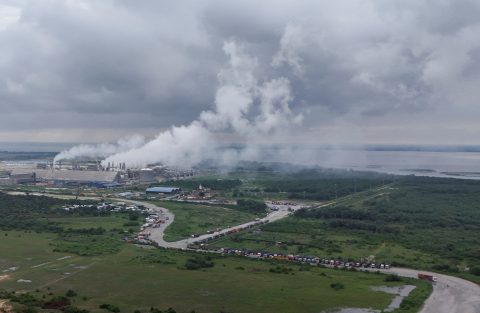
Li Shuo, director of China Climate Hub at the Asia Society Policy Institute, told Climate home News that China’s all-of-the-above approach to energy development has provided the country with the strategic flexibility to face the oil shock.
“While China has often been criticised in previous years for moving too slowly away from coal, this year’s global energy market volatility has given Chinese policymakers a renewed sense of confidence. There is a growing sentiment in Beijing that recent events have vindicated China’s energy strategy as both prudent and pragmatic,” he said.
Can China support the electrification pledge?
Despite its vast cleantech build-out and rapid electrification boosting its energy resilience, China has stopped short of endorsing an initiative by COP31 host Türkiye to increase the global share of electricity to 35% in final energy use by 2035.
Li Gao, vice minister at the Ministry of Ecology and Environment, who will lead the Chinese delegation at COP31, told a press conference the electrification target was in line with Chinese policy. “We believe that increasing electrification levels will help promote a green and low-carbon energy transition and address climate change,” he said.
China’s position on the electrification initiative is one of the major questions hanging over the COP31 talks beginning in Antalya next week.
“What is clear is that China has the most to gain from accelerated electrification because of their manufacturing capabilities,” said Bruce Douglas, CEO of the Global Renewables Alliance.
In 2026 alone, China’s exports of solar panels, batteries, EV and other cleantech are on track to avoid emissions equivalent to Brazil’s annual emissions.
-
China’s industrial engine starts to break its fossil fuel habit
Despite a rebound in coal generation this year, clean energy from wind and solar is gaining ground on the fossil fuels that have powered decades of industry growth -
COP31 electrification pledge leaves out clean power commitment
Campaigners and experts say the goal’s effectiveness in reducing emissions may be limited unless countries agree to meet it using only clean energy

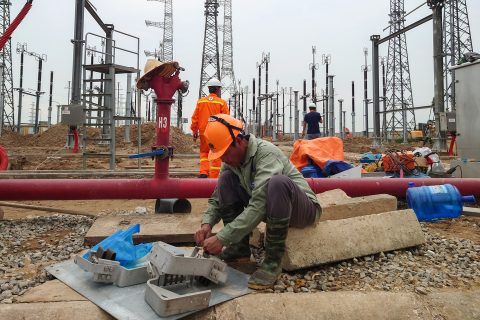
Türkiye’s proposal doesn’t include a commitment to produce the power from clean energy, nor does it explicitly link electrification to the transition away from fossil fuels – issues on which the EU has signalled it is ready to push back.
But Chinese analysts say Beijing is unlikely to support linking a global electrification goal to commitments on phasing out fossil fuels.
Former French climate envoy Laurence Tubiana, the outgoing CEO of the European Climate Foundation, told Climate Home News that the EU and developed countries such as Brazil – which is influential within the BRICS group of large emerging economies – have a responsibility to push China to show leadership in the talks.
Driving the world’s electrification
The electrification of the Chinese economy has outpaced that of any other major economy.
In the US and the EU, the share of electrification has stagnated just above 20%. In China, it has doubled since 2005, reaching close to 30% in 2025.
The International Energy Agency (IEA) expects China will remain the single largest driver of global electricity demand growth through to 2030, as it electrifies its manufacturing sector as well as growing demand for cooling and EV charging.
Over the next five years, the IEA forecasts that China will increase its electricity consumption by as much as the total electricity consumption of the EU today.
In August, the Chinese government set a target to boost the share of electricity in its final energy consumption to 35% by 2030 – five years ahead of Türkiye’s proposed goal.
From laggard to frontrunner
Clean-power growth and electrification could meet all of China’s rising power demand, according to CREA. By 2030, this would mean renewable and nuclear energy could reach 54% of power generation – exceeding China’s target to generate half its electricity from non-fossil sources by the end of the decade.
Clean electricity already met all of China’s demand growth in 2025. “The challenge lies in sustaining such growth over several years,” said Qin.
From Beijing’s perspective, the global targets such as the electrification pledge “no longer appear particularly ambitious or threatening”, said Li, of the Asia Society Policy Institute.
“China, long perceived as a climate laggard, is increasingly moving ahead of countries in the Global North. A global ceiling target is increasingly only a floor for China,” he emphasised.
The post Clean power shields China from oil shock more than any other country appeared first on Climate Home News.
Clean power shields China from oil shock more than any other country
On 3 November, the Brazilian presidency of the COP30 climate talks released its long-awaited “roadmap” on ending deforestation.
Ahead of the Belém summit, Brazilian president Luiz Inácio Lula da Silva made a call for a “roadmap” to halt and reverse deforestation.
Although this voluntary roadmap was outside the COP’s official agenda, it snowballed into a rallying point at the “Amazon” COP.
By the end of the summit, 93 countries had signed on to the deforestation roadmap, committing to develop voluntary pathways to reverse forest loss and degradation by 2030.
The Brazilian presidency called on countries to describe what a pathway away from deforestation could look like, what challenges and support they needed.
This call was answered by 18 countries and four negotiating blocs that offered their inputs on the roadmap, along with scores of NGOs, research centres and other groups.
Now that the roadmap has been published, Carbon Brief explains where it came from, what it entails, why some did not sign on – and what’s next.
What is a deforestation ‘roadmap’?
The “deforestation roadmap” was one of the signature announcements of the Brazilian presidency of the COP30 climate summit in Belém – albeit one that fell outside the official, negotiated outcomes.
Brazilian president Lula first proposed the deforestation and forest degradation roadmap, alongside one on the fossil fuel transition, at the leaders’ summit in Belém a few days before COP30 began.
By the end of COP30, nearly 100 countries had expressed their support for such a roadmap. This includes the EU, with its 27 member states, as well as the 56-member Coalition for Rainforest Nations.
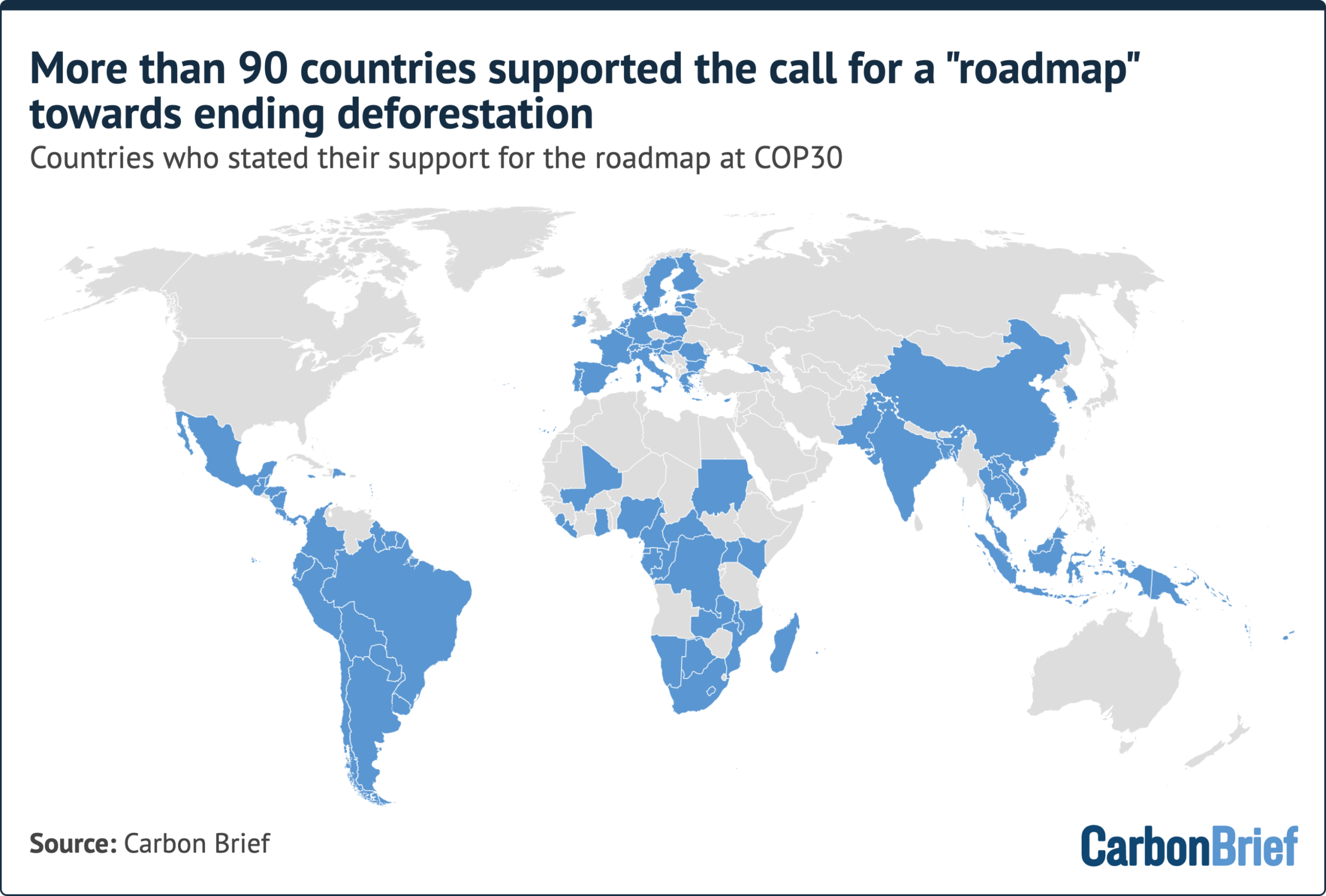
However, this was still short of the 196 parties needed for consensus at a COP, meaning that, ultimately, the roadmap was not a formal outcome.
Instead, COP30 president André Corrêa do Lago announced during the closing plenary session that the presidency would work towards creating both deforestation and fossil-fuel phaseout roadmaps outside of the COP process.
The deforestation roadmap is the latest in a series of international pledges to put an end to forest loss.
In 2014, 39 countries pledged to end natural forest loss by 2030 at UN Climate Week, as part of the New York Declaration on Forests.
Seven years later, at COP26, more than 140 countries signed the Glasgow Leaders’ Declaration on Forests and Land Use. The declaration stated that countries “commit to working collectively to halt and reverse forest loss and land degradation by 2030” – although