

Earlier this month, China published its long-awaited plan to reduce methane emissions.
The document is seen as an important step for China, which is the world’s largest emitter of methane.
It has a focus on emissions from the energy, agriculture and waste sectors. It lists a series of actions, but lacks numerical targets for emissions reduction.
The action plan had been promised in the US-China joint climate statement, issued during the COP26 climate talks in 2021. It finally emerged just days before the launch this month of a new US-China “Sunnylands statement” on climate, in which China pledged to expand its next international climate pledge to cover all greenhouse gases, not just carbon dioxide (CO2).
This Q&A looks at why tackling methane is important, where China’s methane emissions come from, what is in the action plan and whether it will be successful.
The Q&A also looks at the challenges China will face and the prospects for global cooperation.
This is an extended version of a Spotlight section published in the latest issue of Carbon Brief’s China Briefing email newsletter. For the latest on China’s energy and climate policy, sign up here.
- Why is tackling methane important?
- Where do methane emissions come from in China?
- What does the methane action plan say?
- Will China’s plan be effective in curbing emissions?
- What are the most pressing challenges in curbing methane?
- What does this mean for global cooperation on methane?
Why is tackling methane important?
Methane is a potent greenhouse gas, with around 30 times the warming power of CO2 100 years after it is emitted.
It is the second-biggest contributor to current warming, responsible for around 30% of the rise in global temperatures since the industrial revolution.
Reducing methane emissions by 30% by 2030 – the target of the global methane pledge, which China is not a signatory to – is the “fastest way to reduce near-term warming” and keep 1.5C “within reach”, according to a US and EU factsheet.
Cutting methane releases during fossil fuel production to 75% below current levels by 2030 is a key “pillar” to get on track for 1.5C, says the International Energy Agency (IEA).
Methane also leads to the formation of ground-level ozone, according to the UN environment programme, exposure to which causes one million premature deaths every year.
Where do methane emissions come from in China?
China is responsible for 10% of all human-caused methane emissions, with two estimates in 2021 placing its annual output at 58m tonnes (Mt) and 65Mt, respectively, equivalent to 1.7-1.9bn tonnes of CO2 equivalent (GtCO2e).
This makes China the world’s largest emitter of the gas, according to the IEA.
Around 40% of China’s methane emissions are gas that escapes during the mining of coal, according to the Institute for Global Decarbonization Progress (iGDP), a Chinese thinktank.
Another 42% is from agriculture, including livestock and rice cultivation, says the iGDP. Different studies attribute different levels of agricultural emissions to different sources, but, generally, cattle and mid-season rice paddies are considered the largest contributors.
Meanwhile, 10% is attributed to waste and wastewater as a whole. At least 3.2Mt of methane was emitted solely from animal manure, as per China’s last official tally in 2014.
Coal-mine methane emissions are particularly challenging to detect, according to the IEA, as they are “diffuse”.
It adds that abandoned mines, which could contribute “almost one fifth” of global methane emissions, cannot be included in calculations as “reliable data” is often unavailable.
“Many of the methane sources are fugitive emissions, which are usually difficult to accurately account for,” Zhang Yuzhong, a researcher at China’s Westlake University, tells Reuters.
Climate Home reports, however, that according to Global Energy Monitor (GEM) research, “the real figure for coal-mine methane [in China] is almost double what the government claims”.
Shanxi province in northern China, the country’s largest coal-producing region, could emit as much methane from its coal mines as the rest of the world combined, according to GEM.
What does the methane action plan say?
The Methane Emission Control Action Plan, released jointly by the ministry of ecology and environment (MEE) and 10 other Chinese ministries, describes China’s approach as to “control methane emissions in a scientific, rational and orderly manner”, with a specific focus on the energy, agriculture and waste sectors.
It includes 20 “key tasks” in emissions monitoring, technological innovation, development of policy frameworks, global cooperation and other areas.
During the 15th five year plan period (2026-2030), monitoring and accounting of methane emissions will be “significantly enhanced”, it adds. Methane utilisation, emissions control technologies and policy frameworks will be “effectively improved”.
Other notable pledges include that, by 2030, oil and gas producers will “strive” to “gradually” eliminate flaring, and utilisation of coal mine methane will reach 6bn cubic metres annually.
This “corresponds to about 10%” of the coal-mining sector’s total methane emissions, says Lauri Myllyvirta, lead analyst at Centre for Research on Energy and Clean Air (CREA).
(While current levels of coal-mine methane utilisation are unknown, various Chinese oil and gas giants, including Sinopec, PetroChina and the China National Offshore Oil Corporation, have been “actively promoting methane emission reduction”, say two researchers from the Central University of Finance and Economics (CUFE) in China.)
In agriculture, the methane emissions intensity per unit of agricultural product will “steadily decline”. “Utilisation” of livestock waste will reach 80% by 2025 and 85% by 2030.
The document calls for control of both enteric fermentation – the digestive process in ruminant livestock – and methane emissions from rice paddies. The language around rice is more tentative, with calls for control to be pursued “in an orderly manner”.
Will China’s plan be effective in curbing emissions?
The Environmental Defense Fund (EDF), a global NGO with a significant presence in China, has written on WeChat it believes that, “in the long term”, the plan will provide “a clear guiding framework” and better coordination of methane reduction efforts in China.
EDF also points to the role that the plan’s alignment with carbon trading policy could play in methane reduction, by helping to establish “a monitoring, reporting and verification (MRV) system” for the gas. This could underpin a methodology for methane in the “China Certified Emission Reductions” (CCER) mechanism, China’s voluntary carbon market.
Dr Teng Fei, deputy director of the Institute of Energy, Environment and Economy at Tsinghua University, has similarly identified the impact on carbon trading in comments to China Dialogue.
In his view, China needs to establish either binding emissions standards or subsidies for methane utilisation through carbon markets, saying that, without the incentive, “policy targets will be hard to deliver”.
Dr Chen Meian, program director and senior analyst at iGDP, tells Carbon Brief that some of the sector-specific targets in the plan “can help China to reduce methane emissions”, particularly from coalbed methane, livestock manure, sewage sludge and landfill waste.
However, she adds, it is “difficult” for China to set hard targets at this point.
“China is still facing challenges in methane emission data monitoring and data collection”, she says, “[which is why] China also listed the improvement of methane emissions MRV as one of its key tasks”.
Others are less convinced. The plan is “too ambiguous”, “descriptive” and lacking in quantitative targets, Refinitiv lead carbon analyst Yan Qin tells Reuters.
What are the most pressing challenges in curbing methane?
Developing technological solutions to reduce methane emissions from the agriculture sector and sewage treatment will be “crucial” to achieve carbon neutrality, iGDP tells the Hong Kong-based South China Morning Post. (China’s 2060 carbon neutrality target includes all greenhouse gas emissions, according to climate envoy Xie Zhenhua.)
Methods to cut down methane emissions in the agriculture and waste sectors are already in practice in China, including system of rice intensification (SRI), using drought-resistant rice, installing digesters in farms to utilise biogas – for example, in electricity generation – and optimising livestock feed to reduce enteric fermentation.
However, many of these methods are challenging to scale. SRI “isn’t practical”, according to China Dialogue, as farmers found it confusing.
Cattle farms “tend to be small-scale and use non-standardised methods”, researchers at the Feed Research Institute of the Chinese Academy of Agricultural Sciences tell the outlet, making it hard to assess emissions and plan accordingly.
Nevertheless, methods that reduce methane through efficiency gains or monetising emissions cuts could gain more traction.
“I don’t have strong feelings about climate change, melting ice caps or rising sea levels”, one farm executive tells China Dialogue, “but I believe waste has its value…That’s why I’m interested.”
The challenge lies in resolving the “large initial investment, insignificant short-term returns and high levels of technical risk” that deter companies from implementing methane utilisation projects, according to CUFE.
Challenges measuring methane emissions from coal mines also complicate China’s methane mitigation efforts. Ember’s methane analyst Anatoli Smirnov tells Climate Home that the “only real solution to reduce methane emissions is to close coal mines”.
The outlet also quotes CREA’s Myllyvirta saying there is a lack of “political will and buy-in” to curb methane in China. He states that China stopped releasing methane emissions figures in 2014, which he believes was to avoid calling attention to the “huge increase” in emissions since the Paris Agreement.
“I think China is trying to be realistic in target-setting [for its] coal-sector emissions,” Chen tells Carbon Brief. She adds that China “used to set ambitious targets” for coalbed methane capture and utilisation in its five-year plans, but that it repeatedly missed them.
She adds:
“This is in part due to coal mine safety concerns and a lack of cost-effective technologies in methane capture and use for low-concentration coalbed methane (with methane concentration of less than 30%) and ventilation air methane, which is the largest source of methane emissions in China’s energy sector.”
The MEE itself has signalled a cautious approach to curbing methane emissions. In a press conference covered by BJX News, it says that its implementation of the plan will “give full consideration to the actual affordability [of methane utilisation]…and take easy steps before difficult ones”.
One next step, the MEE adds, is to “strengthen coordination” between departments and define different stakeholders’ responsibilities.
Chen agrees that it would be important for local governments to “set their own methane plans…tailored to local conditions” and to improve data monitoring.
What does this mean for global cooperation on methane?
A week after the plan was released, the US and Chinese climate envoys John Kerry and Xie Zhenhua issued a declaration on enhancing climate cooperation, known as the “Sunnylands statement”.
It includes commitments to establish a working group that will look at several areas of cooperation, including methane emissions, and to create another working group to focus on “building on” their current national methane plans.
In addition, the pair have committed to include “actions/targets” on methane reduction in their nations’ next climate pledges under the Paris Agreement, which will also cover other non-CO2 greenhouse gases. They will host, with the UAE, a summit on non-CO2 gases at COP28.
COP28 president-designate Sultan Al Jaber said China’s announcement was a “crucial step for global climate action”, the Financial Times reports.
At COP26, China and the US issued a joint declaration committing to cooperate on a variety of climate change issues, including methane emissions.
In this 2021 declaration, China committed to issuing a national action plan on methane emissions. It finally released the plan just days before the Sunnylands statement.
“Methane is particularly important for our cooperation,” US climate envoy John Kerry told a US congressional hearing in July, according to Reuters.
Li Shuo, director of the China climate hub at the Asia Society Policy Institute, has described China’s decision to publish the plan as “a goodwill gesture”, Bloomberg reports.
While it is “too early to tell” what other outcomes for bilateral methane cooperation might be, without China’s plan there “certainly wouldn’t have been further deals”, he adds.
However, differences in the sources of the US and China’s methane emissions could hamper cooperation. Teng tells China Dialogue that the main source of EU and US methane emissions is oil and gas, compared to coal mining for China.
Tackling coal-mining methane emissions is harder and more costly than oil and gas, analysts told Carbon Brief in 2020. This could be why China has not signed up to the global methane pledge, which may be easier for the EU and US to meet, says Teng.


The post Q&A: What does China’s new methane plan mean for its climate goals? appeared first on Carbon Brief.
Q&A: What does China’s new methane plan mean for its climate goals?

This is a republication of November’s edition of The Climate Agenda – a subscriber-only newsletter designed to keep you informed of the key events, negotiations and announcements happening every month. If you want to receive The Climate Agenda straight to your inbox at the start of each month, sign up as a subscriber today.
COP31 begins in one week, and we’ll have five specialist reporters on the ground in Antalya, Türkiye, bringing you every development as it happens. From the negotiations to leaders’ speeches and side events, we’ll be there to dissect what it all means for international climate policy on electrification, just transition, adaptation finance and much more.
Here’s what you need to know for November, why it matters and what to expect.
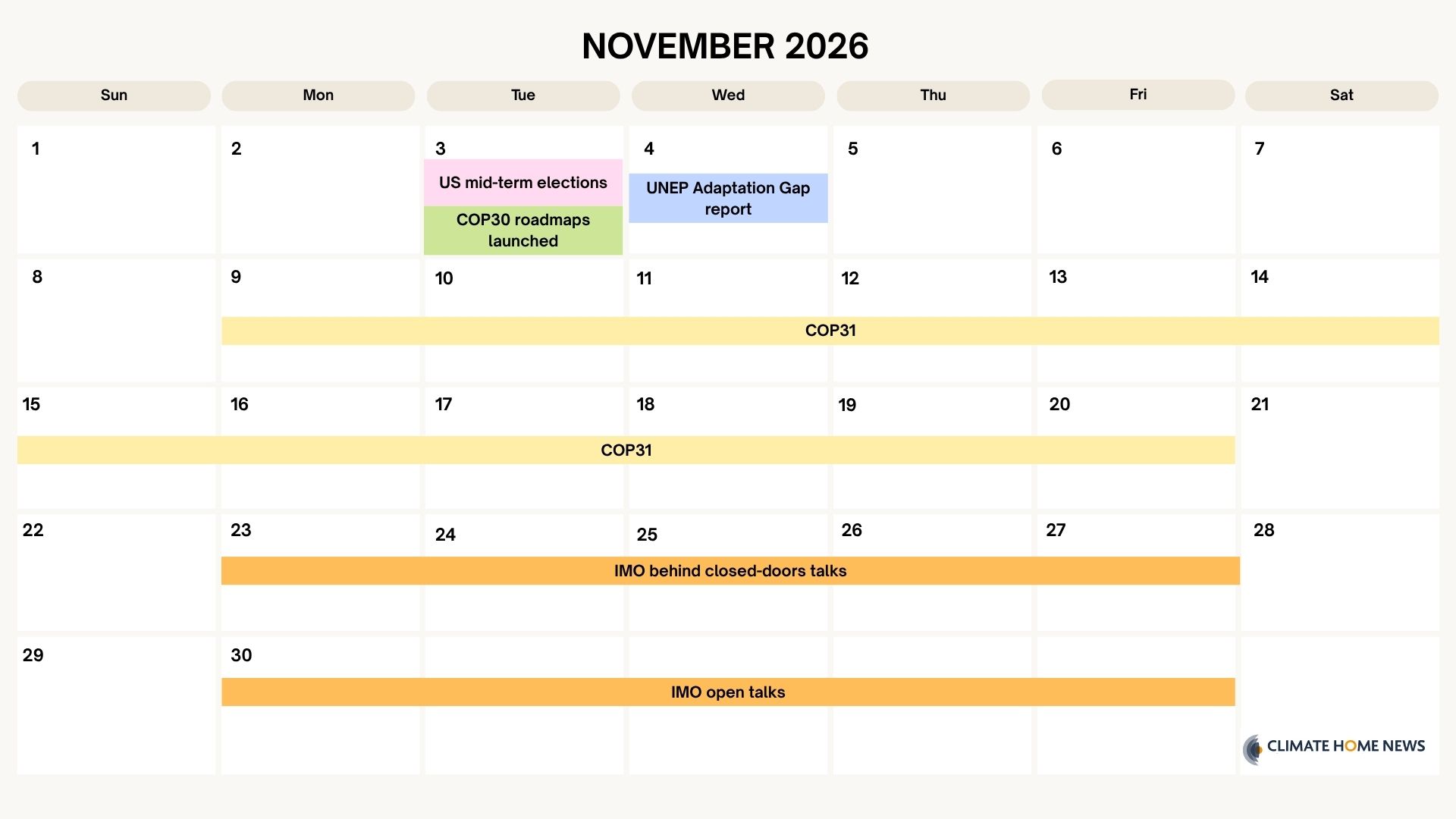
US midterm elections
Tuesday 3 November – United States
The geopolitical highlight for the first week of November is the US midterm elections, which will show whether American voters are in any mood to forgive President Donald Trump for failing to bring down the cost of living. From an energy perspective, his pro-oil and gas stance hasn’t led to cheaper prices for consumers, pushed up by the US-instigated Iran conflict. And his diesel deal with Russia won’t yet have made a difference at the pump.
The key issue for climate and energy policy is whether the Republicans hold onto their governing trifecta. If so, then expect continued dismantling of regulations that protect the environment, as well as strong backing for fossil fuel production. If the Democrats regain control of Congress, which polls suggest is possible, it could trigger a push to restore Biden-era clean energy tax credits, and support states wanting to restart mothballed wind and solar projects.
Data centres have been a hot-wire issue, with growing community opposition to their expansion – partly due to concerns over rising utility bills as the facilities gobble power. Whether Republicans or Democrats win Congress, both are likely to make tech firms pay for the extra electricity production they need, with the latter favouring renewable sources.
Governor races are also taking place in key states for climate issues, including Democrat-run California, which has used the courts to fight Trump’s attacks on clean energy.
Read more: National climate plans now promise half the emission cuts expected by UN
Read more: The more Europe relies on the US for energy, the more it’s vulnerable to pressure by Trump

COP30 Deforestation and Fossil Fuel Transition Roadmaps
Tuesday 3 November – Brazil
Brazil is set to unveil two global roadmaps: one for transitioning away from fossil fuels, the other for ending deforestation.
The COP30 presidency promised them in the dying hours of the Belém summit last November as a last-minute fix to break a political impasse. Since then, it has been consulting with countries, experts and campaigners around the world to gather ideas and sketch out the elements to include in these blueprints.
Don’t expect the roadmaps to offer any new global targets or give direct instructions on what countries must do, either to cut fossil fuel production and consumption or better protect forests. Rather, Brazil has said the documents will identify barriers and priority actions, highlight existing mechanisms and present a range of options that can be adapted to different national contexts.
It remains unclear what will happen with the reports once they are delivered on Tuesday. At the Bonn talks last June, a group of European and small island nations called for the roadmaps to be brought into the official negotiations, warning that a one-off report won’t cut it. But such efforts would undoubtedly face stiff opposition from fossil fuel-producing nations that objected to drafting the energy transition roadmap within the formal UN process last year.
Read more: European, island states seek clear future for global roadmap to cut fossil fuels
Read more: COP30 roadmap to end deforestation will invite countries to draft domestic plans
Read more: What we need to see in the roadmap to transition away from fossil fuels

UNEP Adaptation Gap Report
Wednesday 4 November – Nairobi, Kenya
The UN Environment Programme (UNEP) will publish its annual assessment of how well the world is planning, implementing and – crucially – financing measures to cope with worsening climate impacts.
Past editions have made for grim reading. Last year’s report warned of a widening gap between what developing countries need for adaptation and what they can access. It estimated they will need $310–365 billion a year by 2035, which is 12 to 14 times current international flows. The report also found that a goal of doubling international public adaptation finance by 2025 was likely to have been missed.
This year’s edition will be closely watched with adaptation expected to be a big-ticket item at COP31. Governments are likely to discuss the specifics of a commitment to triple adaptation finance for developing nations by 2035, agreed at COP30 last year – particularly what the baseline for that pledge is. Negotiators will be debating how to track progress against the 59 indicators of the Global Goal on Adaptation.
Read more: Editor’s Desk: Nepal’s disaster has laid bare the world’s adaptation accountability gap
Read more: Bonn climate talks end in “gridlock” on adaptation and emissions-cutting
Read more: New data shows rich nations likely missed 2025 goal to double adaptation finance
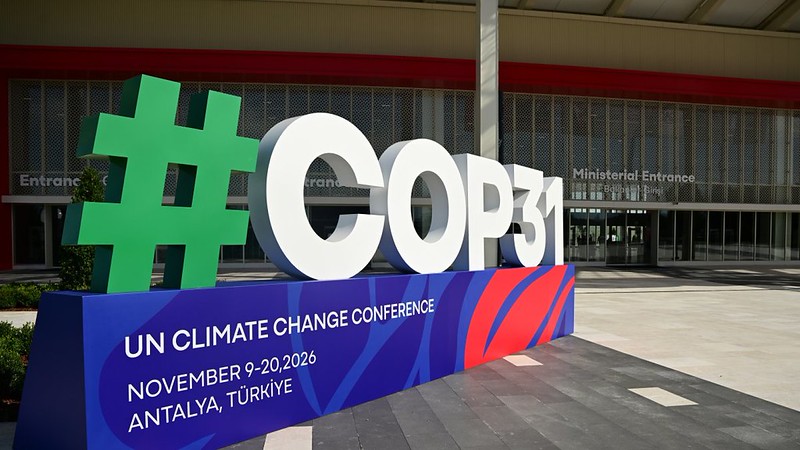
COP31 Climate Conference
Monday 9 November – Friday 20 November – Antalya, Türkiye
The climate community’s attention turns this month to Antalya for the annual UN climate summit. From the outset, COP31 will have an unprecedented, and potentially explosive, set-up: Türkiye is COP president overseeing the non-negotiated Action Agenda, while Australia runs the negotiations.
Billed, once again, as an “implementation COP”, the talks come amid a global energy crisis largely sparked by the actions of the US government, which is not expected to show up on the Turkish Riviera. It is also the first COP in the era of climate overshoot, coming just weeks after the UN officially confirmed the 1.5C warming limit will be breached and set out a narrow pathway to bring temperatures back down to the most ambitious Paris goal.
Unlike most recent COPs, the formal negotiations lack a clear headline item. Countries are due to establish and define the scope of the Just Transition Mechanism agreed in Belém last year, including its rules, governance and possible funding arrangements. On adaptation, vulnerable countries want a clearer path to delivering last year’s pledge to triple finance by 2035 and to putting the new progress indicators to work on the ground.
Governments are also likely to clash over next steps on the transition away from fossil fuels, and especially over whether the mitigation work programme – the forum dedicated to emission-cutting measures – has any future beyond this year.
Notable events to look out for in Antalya:
Opening session (9 November): The summit kicks off with the customary first-morning plenary. After the usual pageantry from the host nation, negotiating blocs and individual countries will deliver statements setting out their stall for the next two weeks. Watch out for a potential fight over the summit’s agenda – perhaps on issues relating to finance and trade following submissions requesting additional items – also a COP tradition.
Electrification (10 November): On Energy Day, the Turkish presidency is expected to formally launch its flagship electrification pledge, revealing which countries have signed up. Signatories will voluntarily commit to raising electricity’s share of global final energy consumption to 35% by 2035, though the current text does not require that power to come from clean sources. There is also a question mark over whether and how this can be included in the political cover decision the COP co-hosts have said they will aim to produce.
Leaders Summit (11-12 November): Heads of state and governments will jet into town for the traditional high-level segment in the middle of the first week, where world leaders typically talk up their climate record, air their grievances and call for more action.
Relatively few powerful leaders are on the list this time. Brazil’s Lula is set for another star turn this year, fresh from his surprise election win in October. The UK’s Andy Burnham, Spain’s Pedro Sanchez and China’s vice-premier Ding Xuexiang are expected, alongside Türkiye’s Recep Tayyip Erdogan and Australia’s Anthony Albanese. In addition, African and small island nations will feature prominently.
Our COP31 Briefing newsletter will offer a more in-depth preview of the talks later this week.
Read more: Early speakers’ list suggests few powerful leaders will attend COP31
Read more: COP31 electrification pledge leaves out clean power commitment
Read more: From Belém to Antalya – gains, gaps and challenges for a new Just Transition Mechanism
International Maritime Organization (IMO) Shipping Talks
Monday 23 November – Friday 4 December – London, United Kingdom
One year on from explosive talks in which Trump’s officials teamed up with Saudi Arabia to delay a deal to make the shipping industry greener, governments will gather on the banks of the Thames for another attempt to reach agreement.
The Net Zero Framework, provisionally agreed in October 2025, includes a series of emissions reduction targets for the owners of large ships along with penalties for not meeting them, rewards for doing so and measures to make the maritime transition fair.
The framework is likely to be either tweaked or radically rewritten so that it’s more acceptable to the US and Saudis. Brazil and Japan have submitted compromise proposals.