Connect with us

Published

on

Philippines Aims for Nickel Dominance with New Mining Reforms

Philippine President Ferdinand Marcos Jr. is set to revitalize the country’s mining sector, particularly its nickel industry, through a proposed reform to the Philippine Mining Act of 1995. The legislation aims to streamline taxation, incorporate environmental considerations, and foster greater stakeholder involvement. These moves could position the country as a leader in the global nickel market.

Revamping Mining Laws to Boost Nickel Industry

The reform bill introduces a four-tier, margin-based royalty system, ranging from 1.5% to 5%, based on mine location. Additionally, environmental factors will play a central role in the approval process for new mines. This approach replaces the current system, which varies based on specific mining agreements and applies royalties only to mines in designated mineral reservations. 

Moreover, the proposed reforms will include essential aspects of project approvals that weren’t there before, per S&P Global analyst Paul Manalo. For instance, local community and local government involvement and biodiversity.

The bill is currently awaiting Senate approval. Yet, it has received strong endorsements from government officials and industry stakeholders. Michael Toledo, chairman of the Chamber of Mines of the Philippines, expressed optimism: 

“The president himself mentioned to me that he is fully aware of mining’s importance to our country’s socioeconomic growth and of the issues that hinder the industry from attaining its full potential.”

Sustainability and Innovation at the Core of New Policies

President Marcos has been a vocal advocate for responsible and sustainable mining practices since taking office in mid-2022. During the 2023 Presidential Mineral Industry Environmental Award ceremony, he emphasized the importance of clean and efficient extraction processes that restore mined lands, noting that:

“We must also foster innovation by driving research into new methods of mineral processing—methods that reduce waste and energy consumption.” 

Marcos reiterated his commitment to refining mining policies to align with these priorities. The Philippines is the second-largest producer of mined nickel in 2023 as seen in the chart. 

2023 Nickel Production by Country

It maintained its position last year, boasting 13.4 million metric tons of reserves and resources. The country produced 387,000 metric tons of nickel last year, trailing only Indonesia, according to S&P Global Market Intelligence data. 
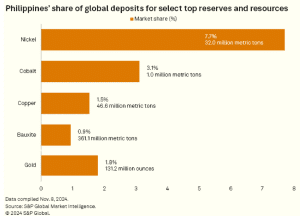
Philippine share of global deposits for nickel and others reserves and resources

However, the government and industry leaders are eager to boost production further and expand the value chain by processing nickel domestically.

Toledo highlighted the need for collaboration with international partners, such as South Korea, Japan, and the European Union, to access alternative smelting technologies. He further noted that mineral extraction and processing are the foundation of the clean energy supply chain. Currently, there isn’t enough ore being mined to meet the demands of facilities still in development.

Digital Transformation in Mining Permits

The Philippine government is taking steps to improve regulatory processes in the nickel and other metals industry, too. In October 2024, a digital application system for mining permits was launched in three regions, with plans for nationwide expansion. This initiative aims to reduce permitting times to two years, significantly faster than the current timeline.

Additionally, the Department of Environment and Natural Resources (DENR) is drafting an executive order to clarify conflicting interpretations of existing mining royalty laws. In the first quarter of 2024, the Philippines approved 785 mining-related permits, including the following:

  • mineral production sharing agreements, 
  • financial or technical assistance agreements, and 
  • exploration permits. 

Despite these approvals, 1,509 applications remain under review.

Prices and Prospects for the Nickel Market

Globally, nickel prices experienced significant volatility in late 2024. It was driven by macroeconomic and political developments following Donald Trump’s U.S. presidential election victory.

The LME three-month nickel price fell to a 4-year low, influenced by various concerns like Trump’s economic policies and rising LME inventories. Investor sentiment was further impacted by China’s fiscal stimulus package, which failed to meet expectations.

Although prices temporarily rose after Trump’s victory, they quickly declined as market concerns about higher tariffs on Chinese imports and prolonged high interest rates intensified. By late November, nickel prices rebounded due to Indonesia’s tighter mining policies and a 50-fold surge in nickel ore imports.

Amid all these, an emerging nickel player is making a huge wave in the United States – Alaska Energy Metals Corporation (AEMC). The company is advancing U.S. nickel independence. Its flagship Nikolai project in Alaska boasts substantial resources of nickel, copper, cobalt, and platinum group metals critical for renewable energy and electric vehicles (EVs).

The Canadian nickel junior prioritizes sustainability and critical mineral supply, reducing U.S. reliance on imports.

Yet, the price volatility highlights the market’s sensitivity to global economic and geopolitical events. However, despite the price challenges in 2024, the Philippine Chamber of Mines remains optimistic about nickel’s long-term prospects.

  • Global nickel production is estimated to grow to more than 4 million metric tonnes in 2030.
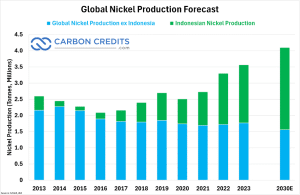
global nickel production forecast

Demand for the metal, driven by the global energy transition, is expected to remain robust. Nickel is a key component in batteries for EVs and renewable energy storage, making it indispensable for achieving net-zero emissions targets.

One factor of uncertainty is the geopolitical impact of U.S. President Donald Trump’s return to office. Trump has threatened to disrupt existing trade relationships, potentially affecting global metals trade flows.

On this note, Toledo said that while Trump’s re-election could slow the push for net zero, it won’t stop it entirely. With rich nickel reserves and strategic reforms on the horizon, the Philippines is well-positioned to strengthen its role in the global mining landscape.

The proposed legislation’s emphasis on sustainability, innovation, and efficiency could unlock new opportunities, attract international investments, and elevate the country’s status as a key supplier in the clean energy transition. 

If the bill passes, the nickel mining industry could become a cornerstone of the Philippines’ economic growth in the years ahead.


Disclosure: Owners, members, directors, and employees of carboncredits.com have/may have stock or option positions in any of the companies mentioned: AEMC.

Carboncredits.com receives compensation for this publication and has a business relationship with any company whose stock(s) is/are mentioned in this article.

Additional disclosure: This communication serves the sole purpose of adding value to the research process and is for information only. Please do your own due diligence. Every investment in securities mentioned in publications of carboncredits.com involves risks that could lead to a total loss of the invested capital.

Please read our Full RISKS and DISCLOSURE here.

The post Philippines Aims for Nickel Dominance with New Mining Reforms appeared first on Carbon Credits.

Continue Reading

Carbon Footprint

Want a simpler way to buy carbon credits? Discover our carbon marketplace

Published

on

Most businesses that decide to act on their net-zero targets reach the same point of friction. Buying carbon credits has meant tracking down brokers, sitting through sales calls, and requesting a quote just to learn a price, sometimes with limited proof of what you are buying.

Continue Reading

Carbon Footprint

Climate-Linked Supply Chain Risk Is Already in Your P&L

Published

on

The earnings calls that quietly reframed climate from sustainability question to operating risk.

Three earnings calls in the last 18 months tell the story without any help from a press release.

Hershey, May 2024: cocoa price exposure compresses margin, and the company attributes part of the cost shock to West African weather. Olam, July 2024: coffee climate exposure quantified in the annual report. JBS, January 2025: supply chain climate disclosures expanded materially in response to investor pressure and regulatory expectation. None of these companies issued the announcement as climate news. They issued it as financial news. The climate-linked supply chain risk did not arrive with a sustainability framing; it arrived as a P&L line.

You are probably reading this article because you suspect the same thing is happening to your business. This piece walks through what is showing up on which earnings calls, how procurement and finance leaders are quantifying the exposure, and what serious corporates are doing about it before the regulator asks.

Where climate risk has already appeared in earnings

The pattern is consistent across resource-intensive sectors. A weather event compresses supply, the price spikes, the cost flows through the income statement, and the analyst on the call asks whether the event is anomalous or structural. Increasingly, the honest answer is the second one.

Cocoa is the cleanest example. The 2023 to 2024 West African harvest fell sharply on the back of erratic rainfall and disease. Cocoa futures more than tripled. Companies with concentrated West African sourcing absorbed the cost; companies with diversified sourcing absorbed less. The exposure was not climate as ESG topic. It was climate as cost of goods.

Coffee follows the same pattern. Brazilian and Vietnamese harvests have moved on weather more sharply across the last several seasons. Roasters with long-tenor supplier relationships and origin diversification have managed the volatility; roasters with spot-market exposure have not. Wheat, sugar, palm oil, beef: the same dynamic in different commodities, a pattern the IPCC AR6 Working Group II report projects will intensify across agricultural systems through mid-century.

What this means: climate risk is no longer a footnote in the 10-K. It is a line item the CFO has to explain on the call.

The three commodity exposures that hit margin first

For most companies with material Scope 3 exposure, three exposures dominate the near-term P&L risk.

  • Concentrated single-origin sourcing in a climate-vulnerable region. If your tier-one supply for any material commodity sits in one geography, you have a concentration risk that climate amplifies. Diversification across origins is the obvious hedge, but it takes years to build and requires relationships you cannot acquire by tender.
  • Supplier financial fragility under climate stress. Smallholder farmers, who supply a large share of the global cocoa, coffee, and palm oil market, do not carry the balance sheets to absorb yield shocks. When yields collapse, they exit. When they exit, your supply base shrinks, and the surviving suppliers raise prices. The risk is structural, not cyclical.
  • Logistics and storage exposure to extreme weather. Hurricane disruptions to Gulf shipping, drought-driven Panama Canal restrictions, flooding in European inland waterways: each of these has moved input costs in the last three years, a pattern documented in Munich Re’s natural catastrophe data. The exposure shows up as a one-quarter event in the financial press but accumulates over time on the cost line.

TCFD and ISSB disclosure changes

The disclosure architecture has now caught up with the risk. The Task Force on Climate-related Financial Disclosures, whose recommendations are now embedded in the ISSB’s IFRS S2 climate standard, requires companies to disclose climate-related risks across physical and transition categories, with quantification where possible.

For physical risk specifically (the climate-linked supply chain risk you are reading about), the disclosure must address both acute exposures (extreme weather events) and chronic exposures (gradual changes in temperature, precipitation, and growing seasons). The disclosure must address the time horizon over which the risk is material, the parts of the value chain exposed, and the financial impact under different scenarios.

The CSRD imposes similar requirements under European law, with double materiality (both financial and impact materiality) embedded in the assessment. The practical effect: your auditors and your investor relations team now need a defensible answer to the climate-linked supply chain risk question, and the answer needs to be quantified.

What procurement and finance can do now

Three actions matter near-term.

Map your exposure. Most companies do not have a clear view of which tier-one and tier-two suppliers sit in which climate-vulnerable geographies. Without the map, you cannot quantify the risk, and without the quantification, you cannot disclose it credibly. The map is the foundation, and World Resources Institute climate risk research provides useful public tooling to start.

Diversify and deepen, in that order. Diversification across origins reduces concentration risk, but the deeper move is to invest in the resilience of the suppliers you already have. Regenerative practices, agroforestry, soil health interventions: these reduce yield volatility under climate stress and protect your input cost trajectory.

Embed the climate spend inside procurement, not outside it. Treating climate risk as a sustainability cost line subordinates it to the ESG budget. Treating it as a procurement and resilience investment puts it in the budget that matters, which is the cost-of-goods budget that the CFO defends quarterly.

Nature-based supply chain investments are the asset class designed for exactly this purpose. They sit inside the value chain, they reduce climate-linked supply risk, they generate verifiable Scope 3 reductions, and they produce the documentation an auditor and a regulator can both test.

If you are quantifying climate-linked supply chain risk in advance of the next earnings cycle or the next disclosure period, the carbon and sustainability experts at Carbon Credit Capital can help you map your exposure and structure a Dual-Value Model response that addresses reduction, resilience, and disclosure-readiness in a single program. Schedule a consultation.

Continue Reading

Carbon Footprint

Where should an SME start with a carbon action plan?

Published

on

More and more small and medium-sized businesses are hearing the same question from their larger customers: What is your carbon footprint? That question now travels down entire supply chains, and it arrives next to tender requirements, certification criteria, and rising customer expectations.

Continue Reading

Trending

Copyright © 2022 BreakingClimateChange.com