

Equinor announced that its Empire Wind 1 offshore wind project in the United States has secured a financing package exceeding $3 billion. A financial close was reached in December 2024 that bolstered the company’s renewable energy initiative. Empire Wind 1 will provide clean energy to 500,000 homes in New York after being fully operational in 2027.
Jens Økland, acting executive vice president for Renewables in Equinor noted,
“This is an important milestone for Equinor, in line with our plan to enhance value and reduce exposure in the Empire Wind 1 project. As we now enter full execution mode, we continue our efforts to increase robustness and value-creation in the project.”
Equinor Powers Up New York’s Green Future
Equinor further revealed that the total capital investment for Empire Wind 1 is $5 billion, inclusive of fees related to the South Brooklyn Marine Terminal (SBMT). The investments rely on future tax credits (ITCs) to strengthen financial viability. Construction has already begun on the 80,000-acre project that is located 15-30 miles southeast of Long Island.
Moving on, the company finalized the project’s investment decision earlier in 2024 and has planned to farm down its stake in Empire Wind 1 to a new partner. This strategy aims to enhance project value while minimizing risk exposure.
Additionally, Equinor executed a 25-year Purchase and Sale Agreement (PSA) with the New York State Energy Research and Development Authority (NYSERDA) in June 2024. Under this agreement, power will be supplied at a strike price of $155 per megawatt-hour to ensure stable revenue flow for the project.
Job Creation and Economic Impact
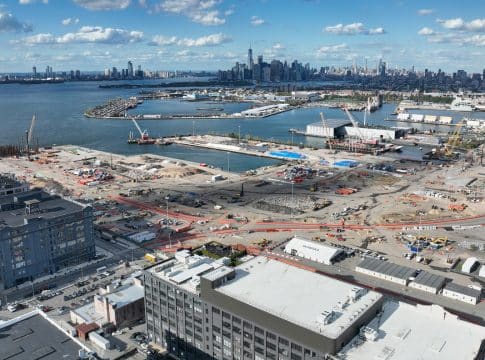
Empire Wind 1 will significantly boost local employment and infrastructure. The redevelopment of the South Brooklyn Marine Terminal as a state-of-the-art offshore wind hub will support over 1,000 union jobs during the construction phase.
On completion, the terminal will serve as the project’s operations and maintenance hub. It will also house the onshore substation connecting Empire Wind 1 to the New York City grid. This arrangement will make Empire Wind 1 the first offshore wind project to integrate directly into the city’s power network.
Molly Morris, senior vice president for Renewables in Equinor Americas said,
“Today’s financial close maintains our momentum toward bringing a significant source of power to the grid. Empire Wind 1 will strengthen US energy security, build economic growth and fuel a new American supply chain. Our redevelopment of the South Brooklyn Marine Terminal is already putting more than 1,000 people to work. Equinor is proud to play a part in advancing domestic energy solutions safely, efficiently, and for the long term.”
Strong Financial Backing
The financing package for Empire Wind 1 reflects strong lender confidence in the project’s viability. Furthermore, leading financial institutions showed keen interest that helped in achieving competitive terms.
The press release also mentioned that the final group of lenders included some of the most experienced players in the renewable energy sector, as well as several of Equinor’s long-standing banking partners.
Empire Wind Supporting New York’s Renewable Energy Goals
New York State has set ambitious renewable energy targets, and Equinor’s offshore wind projects are playing a pivotal role here. Empire Wind is being developed in two phases: Empire Wind 1 and Empire Wind 2. While Empire Wind 1 has a contracted capacity of 810 MW, Empire Wind 2 has the potential to generate 1,260 MW. Together, the two projects are expected to supply clean energy to more than one million homes.
Empire Wind 2 is currently being re-evaluated for future solicitations. Meanwhile, Empire Wind 1’s first power delivery is anticipated in the mid-2020s which will further advance New York’s transition to renewable energy.
History of Empire Wind
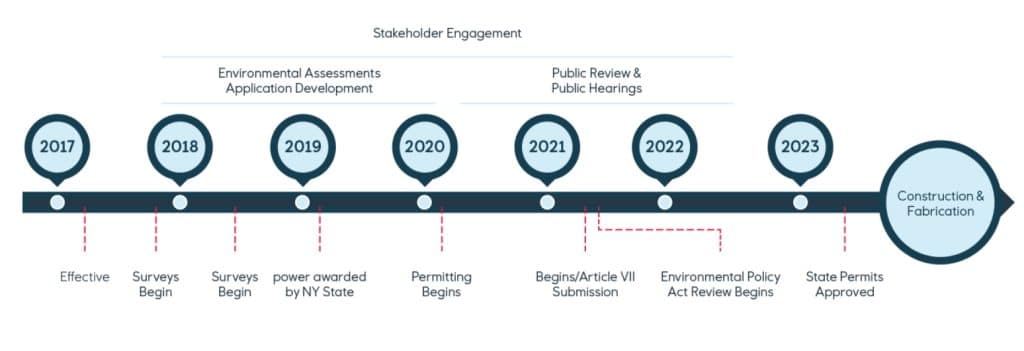
- 2017: Equinor acquired the Empire Wind lease area after the Bureau of Ocean Energy Management’s auction in December 2016.
- 2020: BP acquired a 50% stake in Equinor’s Empire Wind and Beacon Wind assets for $1.1 billion.
- 2022: Equinor signed an agreement to transform South Brooklyn Marine Terminal (SBMT) into a premier offshore wind hub.
- April 2024: Equinor assumed full ownership of Empire Wind projects, while BP took over the Beacon Wind assets, through a cash-neutral transaction.
- June 2024: Equinor secured the PSA with New York State for a 25-year power supply agreement at $155/MWh.
Source: Equinor: Empire Wind
South Brooklyn Marine Terminal: A Game-Changer for Offshore Wind
The South Brooklyn Marine Terminal is set to become the largest dedicated offshore wind port facility in the U.S. This redevelopment underscores Equinor’s commitment to fostering local economic growth and advancing renewable energy infrastructure.
The terminal will handle staging, pre-assembly, and long-term maintenance operations for Empire Wind 1. This will certainly solidify its support for New York’s clean energy transformation goals.
Future Prospects for the U.S. Offshore Wind Energy
NYSERDA President and CEO Doreen M. Harris noted in the earlier press release,
“Major renewable energy infrastructure projects such as Empire Wind 1 are a crucial component in reaching toward New York’s climate goals. NYSERDA applauds Equinor for its ongoing commitment to investing in New York’s green economy, including the redevelopment of South Brooklyn Marine Terminal, and helping to stand-up New York’s offshore wind industry one significant milestone at a time.”
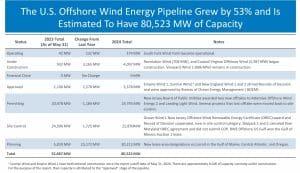
Thus, Equinor’s investment in Empire Wind aligns with the U.S. offshore wind industry’s growing momentum. The project’s integration into the New York City grid highlights its importance in meeting urban energy demands sustainably. By harnessing strong wind resources off Long Island’s coast, Empire Wind 1 is taking a huge step to decarbonize the energy sector.
 Source: National Renewable Energy Laboratory Offshore Wind Market Report
With a reliable financing backup and proper construction plans, Empire Wind 1 is all set to deliver renewable energy to New York. Equinor is hopeful that the project’s success could lead by example for future offshore wind initiatives across the U.S.
- INTERESTING: Gone with the Wind: Is This the End for Wind Energy?
The post Equinor’s $3B Financing Deal for Empire Wind 1 Project: A Turning Point for U.S. Offshore Wind? appeared first on Carbon Credits.

EU carbon credit claims changed on 27 September 2026, the day the Directive (EU) 2024/825 began to apply across the European Union. The change is narrow. It changes how a company can talk about the credits it buys. A product can no longer be called neutral on the strength of compensation alone; however, every specific, evidenced statement about what a company measured, reduced, and funded stays fully available.

The post Promoting Improved Cooking Practices in Nigeria appeared first on Terrapass.



-
Climate Change1 year ago
Guest post: Why China is still building new coal – and when it might stop
-

 Greenhouse Gases2 years ago
嘉宾来稿:满足中国增长的用电需求 光伏加储能“比新建煤电更实惠”
-
Greenhouse Gases1 year ago
Guest post: Why China is still building new coal – and when it might stop
-

 Climate Change2 years ago
嘉宾来稿:满足中国增长的用电需求 光伏加储能“比新建煤电更实惠”
-

 Renewable Energy12 months ago
Sending Progressive Philanthropist George Soros to Prison?
-
Climate Change2 years ago
Bill Discounting Climate Change in Florida’s Energy Policy Awaits DeSantis’ Approval
-
Greenhouse Gases1 year ago
嘉宾来稿:探究火山喷发如何影响气候预测
-

 Climate Change2 years ago
Analysis: China’s CO2 falls 1% in Q2 2024 in first quarterly drop since Covid-19