

Palantir Technologies (NASDAQ: PLTR) has partnered with The Nuclear Company to build NOS (Nuclear Operating System)—an AI-driven, real-time software platform designed specifically for nuclear reactor construction. This $100 million deal over five years will bring Palantir’s Foundry operating system into the heart of nuclear project delivery.
NOS will use tools such as digital twins, predictive analytics, compliance tracking, and supply chain optimization. These will help reduce construction delays, manage costs, and improve safety.
Palantir Brings AI and Analytics to Heavy Industry
Palantir is best known for its data integration and analysis tools used by the defense, finance, and healthcare sectors. With NOS, Palantir enters the nuclear infrastructure space for the first time. The platform will provide real-time insights across contractor schedules, material deliveries, safety checks, and regulatory milestones.
Mike Gallagher, Head of Defense at Palantir Technologies, stated:
“This partnership marks the first time Palantir’s software will be used to help power the next generation of nuclear energy infrastructure. By integrating our operating system with The Nuclear Company’s ambitious vision, we are laying the foundation for a new era of resilient, intelligent and secure energy systems in the United States and beyond.”
NOS is also part of Palantir’s internal “Warp Speed” initiative—a fast-track approach to deliver enterprise-grade software solutions for high-impact sectors. The company thinks energy and infrastructure will grow a lot. This is true as global power demand increases, especially for digital needs like AI data centers.
The Nuclear Company’s Vision for Modern Nuclear
The Nuclear Company aims to rebuild confidence in nuclear energy by modernizing how reactors are constructed. Its long-term plan supports U.S. policy goals to add 400 GW of nuclear capacity by 2050 and build at least 10 new reactors by 2030. The NOS platform is key to meeting those goals.
By using NOS, The Nuclear Company hopes to avoid the delays and cost overruns that have plagued previous nuclear projects. The platform will help contractors work together. It will also boost safety checks, make inspections easier, and simplify permits.
The Nuclear Company thinks NOS can make nuclear power cheaper, easier to scale, and more reliable for future needs.
Palantir’s Stock Surges on Nuclear Deal
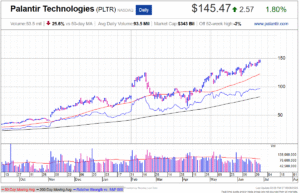
The announcement of NOS had an immediate impact on Palantir’s stock price, hitting a new record high. Shares rose by about 1.2% in after-hours trading, peaking at a record high of $147–148. This continues a strong run for the company. Its stock has surged nearly 95% in 2025 due to investor excitement about its AI and government-focused platforms.
Wall Street analysts say this deal shows Palantir can grow beyond defense and intelligence. It can also move into commercial sectors like energy and infrastructure.
Over 40 public and private U.S. agencies already use the Foundry platform, and they see energy as a valuable new revenue stream. Palantir’s stock trades at about 246 times projected 2025 earnings, suggesting high expectations but also valuation risk. Still, this recent development further solidifies nuclear energy’s comeback.
- RELATED: Palantir (PLTR Stock): AI for Carbon Neutrality – A Software Giant’s Sustainable Footprint in 2025
Atomic Revival: Why Nuclear Is Hot Again
Nuclear energy is gaining traction again. Governments and companies want reliable, low-carbon power. This is to meet the growing demand for electricity and achieve climate goals.
Today, more than 400 nuclear reactors run worldwide. They provide around 9% of global electricity. The sector is starting a new growth phase. Aging plants are getting upgrades, new builds are on the rise, and digital tools are modernizing project delivery.
Reactors Operating in the United States

Market research shows that the global nuclear construction industry will grow. It’s expected to rise from $7.7 billion in 2025 to $9.5 billion by 2034. This growth comes from new policies, concerns about energy security, and increased investment in carbon-free baseload power.
Small modular reactors (SMRs) are part of this growing trend. They provide compact and flexible nuclear options for specific markets. Their potential fits well with the bigger nuclear revival. It can even be better when combined with smart platforms like NOS, which simplify complex engineering and regulatory tasks.
How NOS Could Transform Nuclear Project Delivery
Historically, nuclear projects have struggled with delays, cost overruns, and complex regulations. NOS aims to address these problems through several key features:
- Digital twins: Virtual models of construction milestones that allow real-time progress tracking.
- Predictive analytics: Tools to identify delays and risks before they affect schedules.
- Automated compliance: Systems that support regulatory inspections and permit tracking.
- Supply chain optimization: Reduces downtime by improving delivery timing and inventory control.
These features work together to make nuclear construction faster, safer, and more cost-efficient. If proven widely, NOS could boost confidence for utilities, investors, and governments. This may lead to broader nuclear adoption, including SMRs.
AI-Powered Nuclear for the Energy Transition
The U.S. and other countries are seeing higher electricity demand. This rise comes from the growth of AI data centers and the electrification of industry. To meet this demand while cutting carbon emissions, policymakers are turning back to nuclear energy.

New tax credits and regulatory reforms are helping shift momentum from wind and solar to nuclear. In this environment, platforms like NOS are becoming more important. They ensure the reliability and control necessary for nuclear power to be a viable option again.
NOS presents a new way forward, despite major challenges like NRC licensing, uranium supply chains, and public opinion. By combining AI, data, and logistics, it enables smarter construction and risk management.
Palantir and The Nuclear Company’s NOS platform could mark a turning point for nuclear energy. It combines advanced software tools with real engineering needs. The goal is to lower costs, cut delays, and build nuclear plants more quickly and safely.
The $100 million investment signals a serious commitment. And the market’s response shows belief in Palantir’s ability to deliver. Now the challenge will be execution—proving that technology like NOS can turn vision into reality on the ground.
The post Palantir (PLTR) Stock Hits New Record with $100M Nuclear and AI Platform Deal appeared first on Carbon Credits.

Most businesses have a clear picture of what happens inside their own operations. They track energy consumption, manage waste, and monitor the emissions produced on-site. What they often cannot see is everything that happens before a product reaches their facility, and everything that happens after it leaves.

Carbon Footprint
Texas-Based EnergyX’s Project Lonestar™ Signals a Turning Point for U.S. Lithium Supply
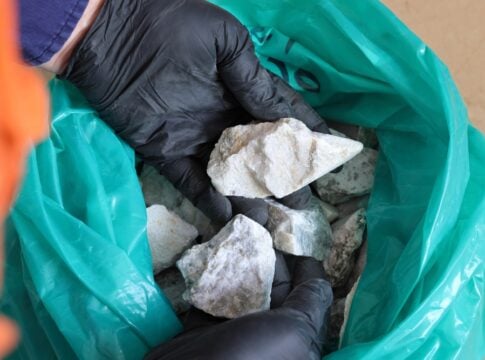
Energy Exploration Technologies, Inc. (EnergyX), led by CEO Teague Egan, has moved the United States closer to building a reliable domestic lithium supply chain. The company recently commissioned its Project Lonestar™ lithium demonstration facility in Texas, marking a key milestone in scaling direct lithium extraction (DLE) technologies.
This development comes at a time when lithium demand is rising sharply due to electric vehicles and energy storage systems. At the same time, the U.S. remains heavily dependent on foreign processing, particularly from China.
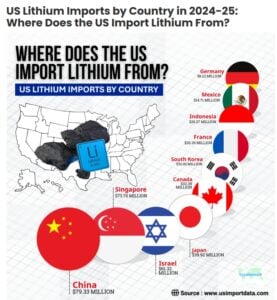
- According to the US import data and Lithium import data of the USA, the total value of US lithium imports reached $432.36 million in 2024, a 9% decline from the previous year.
- The total value of US lithium imports (cells & batteries) accounted for $205.29 million in the first 6 months of 2025.
Against this backdrop, EnergyX’s progress offers both technological validation and strategic value.
From Concept to Reality: How Project Lonestar™ Works
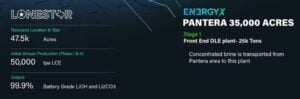
Project Lonestar™ is EnergyX’s first major lithium project in the United States and its second globally. The demonstration plant, located in the Smackover region spanning Texas and Arkansas, is now operational and uses industrial-grade systems rather than small pilot equipment.
- The facility produces around 250 metric tons per year of lithium carbonate equivalent (LCE).
While this output is modest compared to global supply, its importance lies in proving that EnergyX’s proprietary GET-Lit™ technology can efficiently extract lithium from brine. The plant processes locally sourced Smackover brine, a resource that has historically been underutilized despite its lithium potential.
Unlike traditional lithium production, which often relies on hard-rock mining or evaporation ponds, DLE technology directly extracts lithium from brine using advanced filtration and chemical processes. This reduces production time and may lower environmental impact.
- More importantly, the Lonestar™ plant can supply 5 to 25 tons of battery-grade lithium samples to customers.
This allows battery manufacturers to test and validate the material before committing to large-scale supply agreements.
Scaling Up: From Demonstration to Commercial Production
The demonstration plant is only the first phase of a much larger plan. EnergyX aims to scale Project Lonestar™ into a full commercial operation capable of producing 50,000 tonnes of LCE annually across two phases.
- The first phase alone targets 12,500 tonnes per year, which would already place it among the more significant lithium producers in the U.S.
- Significantly, the company has invested approximately $30 million in the demonstration facility, supported in part by a $5 million grant from the U.S. Department of Energy.
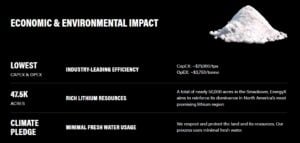
- For the full-scale project, EnergyX estimates total capital expenditure at around $1.05 billion.
Cost metrics suggest strong economic potential. The company estimates capital costs at roughly $21,000 per tonne of capacity and operating costs near $3,750 per tonne. If these figures hold at scale, the project could compete effectively with global lithium producers, particularly in a market where cost efficiency is becoming increasingly important.
Teague Egan, Founder & CEO of EnergyX, said,
“Bringing the biggest integrated DLE lithium demonstration plant online in the United States is a foundational milestone for EnergyX and for U.S. domestic lithium production in general. This facility not only validates the performance of our technology on an industrial scale under real-world conditions, but also establishes EnergyX as the lowest cost producer in the U.S. Ultimately this benefits all our customers who need large volumes of lithium for EV and ESS applications, as well as any lithium resource owners looking to implement best-in-class DLE technology whom we are happy to license to.”
Breaking the Bottleneck: Why U.S. Refining Matters
One of the biggest challenges facing the U.S. lithium sector is not resource availability but refining capacity. While lithium deposits exist across the country, most battery-grade lithium chemicals are processed overseas.
China dominates this segment, controlling roughly 70 to 75 percent of global lithium chemical conversion capacity. This concentration creates a structural dependency. Even when lithium is mined in the U.S. or allied countries, it is often shipped abroad for processing before returning as battery materials.
Project Lonestar™ directly addresses this gap. By integrating extraction and refining into a single domestic operation, EnergyX is working to build a complete “brine-to-battery” value chain within the United States. This approach could reduce reliance on foreign processing and improve supply chain resilience.
U.S. Senator Ted Cruz highlighted the project’s importance, noting that domestic lithium production supports both energy security and defense readiness, particularly for applications in advanced battery systems.
- CHECK: LIVE LITHIUM PRICES
The Current Landscape: Limited Supply, Big Ambitions

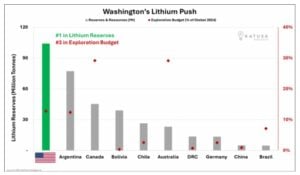
Investment is flowing into regions such as Nevada, North Carolina, and Arkansas. If even a portion of these reserves is converted into production, the U.S. could significantly reduce its reliance on imported lithium.
Active Resources and Future Potential
At present, U.S. lithium production remains relatively small. The only active large-scale operation is the Silver Peak Mine in Nevada, which produces between 5,000 and 10,000 tonnes of LCE annually, depending on market conditions.
However, several projects are in development that could significantly expand capacity. The Thacker Pass project, for example, is expected to produce around 40,000 tonnes per year in its first phase once operational later in the decade.
In addition, brine-based developments in the Smackover region aim to produce tens of thousands of tonnes annually, with long-term plans exceeding 100,000 tonnes across multiple sites.
These projects indicate a shift from a niche domestic industry to a more substantial production base. Still, timelines remain uncertain due to regulatory and financial challenges.
Demand Surge: Batteries Drive the Lithium Boom
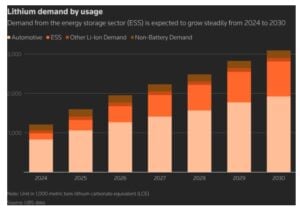
The urgency to expand lithium production is driven by rapid growth in battery demand. Electric vehicles, renewable energy storage, and grid modernization are all increasing lithium consumption.
According to S&P Global, U.S. lithium demand is expected to grow at an average rate of 40 percent annually between 2024 and 2029. Canada is projected to see even faster growth, albeit from a smaller base, with demand rising by around 74 percent per year over the same period.
Globally, battery capacity is forecast to approach 4 terawatt-hours by 2030. This expansion highlights lithium’s central role in the clean energy transition. Without sufficient supply, battery production—and by extension, EV adoption—could face constraints.
Why Progress Takes Time
Turning lithium reserves into operational mines and processing facilities is not straightforward. Projects often face long permitting timelines, environmental scrutiny, and legal challenges. Financing can also be difficult, especially in a volatile commodity market.
Local opposition can further complicate development, particularly in areas with high environmental concerns. These factors can delay projects by several years, slowing the pace of expansion.
To address these barriers, the U.S. government is increasing its involvement through funding, policy support, and efforts to streamline permitting. The Department of Energy’s backing of EnergyX reflects a broader strategy to accelerate domestic critical mineral development.
Conclusion: A Strategic Shift in Motion
Project Lonestar™ represents a meaningful step toward reshaping the U.S. lithium landscape. By proving the viability of direct lithium extraction at an industrial scale, EnergyX has laid the groundwork for larger, commercially viable operations.
The project also aligns with national priorities around energy security, supply chain resilience, and clean energy transition. While challenges remain, the combination of technological innovation, government support, and rising demand creates a strong foundation for growth.
As the world moves toward electrification, lithium will remain at the center of the transition. Projects like Lonestar™ show that the United States is beginning to close the gap between resource potential and real-world production—one facility at a time.
The post Texas-Based EnergyX’s Project Lonestar™ Signals a Turning Point for U.S. Lithium Supply appeared first on Carbon Credits.


Analysis: How ‘plug-in solar’ can save UK homes £1,100 on energy bills
Georgia’s New Public Service Commissioner Says She Will Put Affordability and Transparency First
What Nature Based Solutions Actually Mean for Corporate Climate Strategy
-
Climate Change8 months ago
Guest post: Why China is still building new coal – and when it might stop
-
Greenhouse Gases8 months ago
Guest post: Why China is still building new coal – and when it might stop
-

 Greenhouse Gases2 years ago
嘉宾来稿:满足中国增长的用电需求 光伏加储能“比新建煤电更实惠”
-
Climate Change2 years ago
Bill Discounting Climate Change in Florida’s Energy Policy Awaits DeSantis’ Approval
-

 Climate Change2 years ago
嘉宾来稿:满足中国增长的用电需求 光伏加储能“比新建煤电更实惠”
-
Climate Change Videos2 years ago
The toxic gas flares fuelling Nigeria’s climate change – BBC News
-

 Renewable Energy5 months ago
Sending Progressive Philanthropist George Soros to Prison?
-

 Carbon Footprint2 years ago
US SEC’s Climate Disclosure Rules Spur Renewed Interest in Carbon Credits