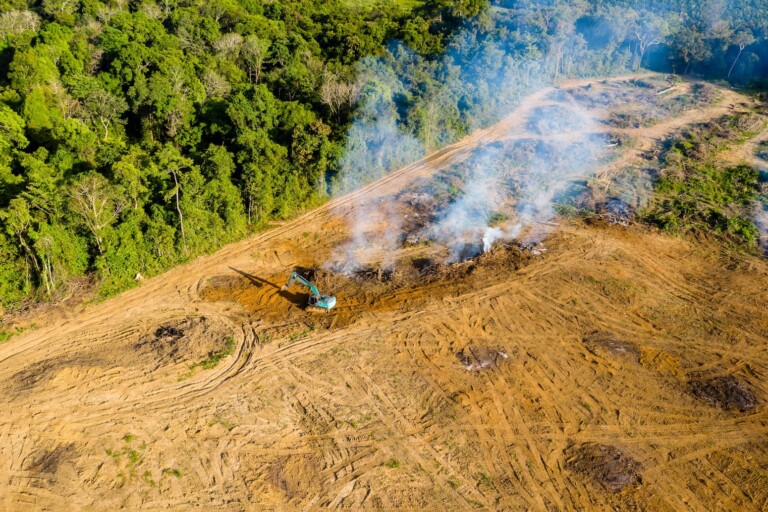
Resource-rich African nations risk missing out on the investment needed to extract and refine their mineral wealth into high-value products for the clean energy transition because they lack accurate information on what they have, experts are warning.
African countries have attracted huge interest as the world scrambles to access the minerals and metals needed for the energy transition and digital and military technologies, with investors from the US, China, the United Arab Emirates and Europe jostling to secure access to the continent’s resources.
But any knowledge of Africa’s mineral wealth is, at best, an estimate based on century-old-mapping and haphazard geological data, policy experts and investors told Climate Home News.
The United Nations says Africa is home to 30% of the world’s mineral reserves, including cobalt, copper, lithium and manganese, which are needed to manufacture batteries and other clean energy technologies.
But experts like Bright Simons, who tracks natural resource spending in Africa for the Ghana-based IMANI Centre for Policy and Education, said the 30% number is not backed by any “empirical, evidence-based assessment” of the continent’s mineral wealth. While some analysts like Simons think the figure could be an overestimate, others argue it is likely an underestimate of the continent’s mineral reserves.
Up-to-date and accurate data is critical for governments to negotiate better deals with prospecting mining companies and to help drive investment in mineral extraction and processing facilities that can add value to the continent’s resources.
But the lack of good mapping has negatively impacted the continent’s efforts to capture the economic benefits of booming mineral demand and to create jobs by extracting and processing raw materials into higher-value products before export, experts said.
Colonial maps
Under-exploration and scant information about Africa’s resources have made it challenging for states to attract investment and develop their resources, said Pritish Behuria, a political economist at the Global Development Institute at the UK’s University of Manchester.
“In many cases, former colonial powers retain more current knowledge of the kinds of mineral deposits that exist in African countries – and often, this has proven difficult to access for African governments,” he told Climate Home News.
Thabit Jacob, a researcher of extractive and energy resources at Roskilde University in Denmark, said many African countries “still rely on colonial maps”.
“There’s a growing realisation that Africa must know its true value in mineral richness and investment in geological mapping is crucial,” he added.
Mapping inequality
However, mapping investment is falling short. Africa’s share of global exploration investment has fallen in the last two decades, data shows.
In 2024 alone, both Canada and Australia received significantly more investment in geological mapping than the whole of Africa, even though the continent’s landmass is three times the size of the two countries combined, according to the Center for Strategic and International Studies.
Even in South Africa, a major mining destination, only 12% of the country has been mapped at a detailed level “which compares poorly with other popular mining destinations such as Canada and Australia where there is near complete coverage at similar scales”, explained Tania Marshall, of the Geological Society of South Africa.
Nigeria’s push to cash in on lithium rush gets off to a rocky start
To address the dearth in data, multinational institutions like the World Bank have provided African countries with finance for mapping, but have simultaneously encouraged them to liberalise and privatise their mining industries.
As a result, international investors prioritising project development have come to dominate the continent’s mining sector, crowding out state-sponsored initiatives with stronger incentives to invest in data-gathering, researchers have found.
Digging blind
Orina Chang, an investor leading geological mapping across Somaliland, which has reserves of copper and zinc ore, said she was surprised to find out that even countries attracting huge interest from institutional miners, such as the Democratic Republic of the Congo (DRC), do not have systematic up-to-date mapping.
Instead, mining firms rely on artisanal mining and surface signs, like exposed ores on the ground – and crossing their fingers, she told Climate Home News.
The mapping deficit means there is little certainty on the size and quality of mineral deposits and provides few incentives for miners to invest in processing plants, Chang explained.
“Without mapping, everyone is blindly digging and you just get people who are not interested in really investing in your country,” she said. “With mapping, you’re able to attract much better players and build plants, create jobs, drive economic growth, help the GDP.”
The rise of AI-driven exploration tools
Today, AI-driven mapping tools have created new opportunities to obtain high-precision information with less on-the-ground investment. Geophysical data and satellite imagery are fed into a model that creates a geological map which can help point to high-potential deposits.
Last year, California-based KoBold Metals, which is backed by US billionaires Jeff Bezos and Bill Gates, discovered a massive copper deposit in Zambia using AI-driven exploration. In July, the firm signed an agreement with the DRC to lead critical mineral exploration there.
But the technology is expensive and not widely available to governments.
Instead, in its 2024 Green Minerals Strategy, the African Union called for some of the revenues from mineral rents to be reinvested into mapping using low-cost techniques such as satellite imagery and drones, which are less precise.
The case for co-operation
For Gerald Arhin, a research fellow at University College London, greater regional collaboration and pooling resources could also help reduce the costs of mapping for individual governments. Last year, for example, South Africa signed an agreement with South Sudan to co-operate on mineral exploration.
“The sharing of data, industrial intelligence and technical expertise across borders could be transformative for African countries, as well as for developing countries in other regions,” Clovis Freire, who heads the Extractive Commodities Section at UN Trade and Development (Unctad), told Climate Home News.
Mapping, however, is only one element of a complicated equation when it comes to developing minerals for the energy transition, said Eszter Szedlacsek, who researches climate justice in the context of the green transition at the Vrije Universiteit Amsterdam.
“In the race for Africa’s critical minerals, deals hinge only partly on where resources are found, and more on geopolitics, investment conditions and longstanding trade ties,” she said.
The post Outdated geological data limits Africa’s push to benefit from its mineral wealth appeared first on Climate Home News.
Outdated geological data limits Africa’s push to benefit from its mineral wealth
Climate Change
UK halves Green Climate Fund contribution, as it spends more on security
The British government has notified the UN’s Green Climate Fund (GCF) that it will cut the contribution it pledged for 2024-2027 in half, a GCF spokesperson told Climate Home News.
The reduction, which is part of a wider UK shift from development aid to military spending, will restrict the GCF’s ability to fund projects that help developing countries cut emissions and adapt to climate change.
Harjeet Singh, director of the Satat Sampada Climate Foundation, called the UK’s decision “moral bankruptcy”, noting that Britain has a historical responsibility for climate change “as a nation built on fossil-fuelled industrialisation”.
Liane Schalatek, who observes GCF board meetings for the Heinrich Böll Foundation, said the UK’s move was “an unfortunate signal”, especially as it comes just before the GCF launches its next fundraising round.
She noted that the UK has been the biggest contributor to the GCF, and “with the UK halving – where doubling would be needed – this will give permission to others to do the same”.
There are fears that other countries could follow suit as governments in Europe trim their aid budgets, while the US has refused to deliver any further money under climate change-sceptic President Donald Trump and has also given up its seat on the GCF board.
The GCF was established in 2010, and has since funded over $15 billion of climate projects across the developing world. Its financing comes mainly from developed countries pledging money in regular replenishment rounds.
During the last GCF replenishment round in 2023, the UK’s previous Conservative government promised £1.622 billion ($2.18 billion) for the 2024-27 period, with then development minister Andrew Mitchell saying the pledge “underlines our sustained commitment to tackling climate change”.
But, as of March 2026, the UK had only handed over £655 million ($885 million) of that pledge, which is its third to the fund, and has now informed the GCF it will only deliver £815 million ($1.1 billion). The GCF’s total funding for the 2024-2027 period is $10.149 billion.
The UK’s Foreign, Commonwealth & Development Office has been contacted for comment.
Approved projects unaffected
A GCF spokesperson told Climate Home News that all current projects under implementation have guaranteed funding while the GCF is assessing what the cuts mean for the projects that are being prepared and are expected to come before the GCF board in 2026 and 2027.
“Our focus will continue to be delivering the greatest impact with the investments we make, working with the largest network of partners in the financial architecture and mobilizing the greatest amount of resources to fulfill GCF’s critical and unique mandate,” the spokesperson said.
Scientists warn El Niño could intensify climate extremes in 2026
In a separate email to GCF board members, seen by Climate Home News, the GCF’s executive director Mafalda Duarte warned that the cuts are “expected to have a material impact” on the fund’s work over the next two years.
Duarte said the cuts were part of the UK wider decision to reduce international development spending “and invest more in addressing growing security threats”.
Development to military
Announcing this decision in March, UK foreign minister Yvette Cooper said the cuts were a “hugely difficult decision” and “not ideological”, but necessary “to deliver the biggest increase in defence spending since the Cold War”. The US has been pressuring countries in the NATO alliance to boost military budgets as conflict surges around the world, from Ukraine to the Middle East.
Cooper reiterated Labour’s commitment to restore overseas development spending to 0.7% of gross national income (GNI) “when fiscal circumstances allow”, but did not provide a timeline when pressed by an opposition member of parliament. UK aid was reduced from 0.7% to 0.5% of GNI by the previous Conservative government in 2021, and is now set to fall further to 0.3%.
While the UK government has claimed it is only cutting international climate finance by around 13% compared to the previous government’s level of spending, analysis by Carbon Brief suggests that the real figure is close to 50% once inflation and accounting changes are considered.
The leadership of the UK is currently in doubt with several ministers from the ruling Labour Party calling on Prime Minister Keir Starmer to resign, with a challenge to his leadership of the party and country expected after poor local election results for Labour.
The post UK halves Green Climate Fund contribution, as it spends more on security appeared first on Climate Home News.
UK halves Green Climate Fund contribution, as it spends more on security
Climate Change
Webinar: From Santa Marta to Bonn – where next for the fossil fuel transition?
The Santa Marta summit moved beyond the blockages in the UN climate process, building a coalition of around 60 countries that want to tackle a shift away from fossil fuels. The host countries said the outcomes would feed into the voluntary roadmap on the energy transition being put together by COP30 hosts Brazil, which is due to be presented before COP31.
June’s mid-year climate talks in Bonn, followed by London Climate Action Week, will be key moments to reflect on the progress so far and work out ways to bring the strands closer together. How might that happen while fossil fuels remain the elephant in the UNFCCC room and there’s no formal place for a roadmap on the agenda?
Tune in to hear our expert reporters discussing this and other key topics set to headline at the Bonn session, both in the negotiations and on the sidelines! Questions and comments will be welcome from participants and used to inform our future coverage.
Note: This event is exclusively for free essential users and paid subscribers of Climate Home News. If you’re not yet signed up, you can join us by clicking the “Subscribe Now” button.
The post Webinar: From Santa Marta to Bonn – where next for the fossil fuel transition? appeared first on Climate Home News.
Webinar: From Santa Marta to Bonn – where next for the fossil fuel transition?
Climate Change
China Briefing 30 April 2026: Fossil fuel ‘strict controls’ | El Niño approaches | Why cleantech exports have surged
Welcome to Carbon Brief’s China Briefing.
China Briefing handpicks and explains the most important climate and energy stories from China over the past fortnight. Subscribe for free here.
Key developments
New documents ramp up pressure on coal
‘STRICTLY CONTROL’ FOSSIL FUELS: On 22 April, China issued a set of “guiding opinions” on energy conservation and carbon reduction that urged local governments to “strictly control fossil-fuel consumption”, according to the text published by state news agency Xinhua. Hu Min, director and co-founder of the the Beijing-based Institute for Global Decarbonization Progress, said in comments to Carbon Brief that the document was a clear signal of China’s political leaders’ desire to reduce the country’s coal usage and a “way to move things forward” until more specific policies are published. Government officials noted that the opinions are of “great significance for building broader and stronger consensus across society”, reported information platform Tanpaifang.
INCREASED OVERSIGHT: The next day, the government announced new evaluation criteria for judging provinces on their efforts to meet China’s climate goals, including on raising “clean-energy consumption” and limiting “use of coal and oil”, reported Bloomberg. The 14 indicators underscore China’s “key priorities” and encourage broader carbon reduction efforts, said energy news outlet China Energy Net. They build on China’s existing inspection system to create a “much stronger accountability and compliance system”, Qin Qi, China analyst at the Centre for Research on Energy and Clean Air, told Carbon Brief. For more detail see Carbon Brief’s Q&A on what the two policies mean for China’s energy transition.
‘RARE’ SIGNAL: Both documents were issued by the highest levels of the nation’s political system, which is “extremely rare” and “reflects the strategic importance” of China’s climate goals, Wu Hongjie, deputy secretary-general of the China Carbon Neutrality 50 Forum, told Jiemian News. In a comment article for finance news outlet Caixin, Chen Lihao – a member of the Jiusan Society, environment minister Huang’s political party – said the two documents “form the institutional foundation” for China’s “full-scale transition” to a “dual control of carbon” system.
Downpours in south China
‘RECORD-BREAKING’ RAIN: Heavy rainfall is hitting central and southern China, with Hunan, Guizhou and Jiangxi provinces reporting record-breaking levels of precipitation last week, reported the Communist party-affiliated People’s Daily. It added that the government is ramping up “flood control” measures in response. On 26-27 April, one part of Guangxi province received as much as 14cm of rain per hour, reported the state-supporting newspaper Global Times. Meanwhile, Chinese vice-premier Liu Guozhong met with the World Meteorological Organization secretary-general Celeste Saulo to discuss cooperation on global “meteorological governance”, said state news agency Xinhua, with the discussion touching on early warning systems and disaster relief.

EL NIÑO RISK: Officials at China’s National Climate Center (NCC) have said that an El Niño weather pattern is “likely to set in around May” and “intensify during the summer and autumn”, said China Daily. The state-run newspaper also quoted NCC chief forecaster Chen Lijuan saying it was “premature” to conclude that the El Niño could be at its strongest in 140 years, or that it could lead to record-breaking heat, although he added that the risks of such weather are “clearly increasing”. Wang Yaqi, a senior engineer at NCC, noted that the phenomenon “could hit hydropower-dependent regions hard, pushing them to burn more fossil fuels”, according to the Hong Kong-based South China Morning Post.
Solar capacity growth slows
CLEAN CAPACITY: China’s clean-energy grid capacity now exceeds 2,400 gigawatts (GW), as of March 2026, or 60% of the total power mix, said state broadcaster CGTN in coverage of comments from energy officials at a press conference. It added that, within this, total wind and solar capacity reached 1,900GW. Energy news outlet International Energy Net cited the officials saying that China’s operational capacity for “green hydrogen” stands at 250,000 tonnes, with another 900,000 tonnes under construction.
SOLAR SLOWS: However, a data release showed that China added 41GW of new solar capacity in the first three months of 2026, reported BJX News, down from 60GW of new capacity in January-March 2025. Bloomberg noted that new solar capacity additions “slowed sharply to hit a four-year low” in March, adding that wind and thermal capacity growth also both slowed.
-
Sign up to Carbon Brief’s free “China Briefing” email newsletter. All you need to know about the latest developments relating to China and climate change. Sent to your inbox every Thursday.
‘MOST AMBITIOUS GOAL’: In a separate press conference, Chinese officials confirmed to Bloomberg that a pledge in the 15th five-year plan to double “non-fossil energy” in 10 years referred to energy capacity – not generation or consumption – and would run from 2025-2035. These details were “unclear” in the five-year plan itself, the outlet added. The economic news outlet Economic Daily said that the doubling goal was “one of the most ambitious goals in China’s energy transition history”, adding that “accelerating” the energy transition would allow the country to both reduce its reliance on the international energy market and “seize the high ground in the global race” to develop low-carbon industries.
More China news
- NEW BLEND: China has begun a project to blend gas supplies with 10% hydrogen in a part of Shandong province, reported the South China Morning Post, which added that the shift could cut China’s annual carbon emissions by “roughly 30m tonnes”.
- SKY-HIGH: China launched a “high-precision” satellite to monitor greenhouse gas emissions, said Xinhua.
- SUNNY SPAIN: Chinese automaker SAIC plans to build an electric vehicle (EV) factory in Spain, reported Bloomberg.
- MING YANG: Bloomberg also said that wind turbine maker Ming Yang is considering Spain after plans for a factory in the UK were blocked.
- FORMAL COMPLAINT: China has “formally submitted a complaint” to the EU about its Industrial Accelerator Act, said China Daily.
- EU TARIFFS: China’s commerce minister said he reached a “soft landing” with EU officials on EU tariffs on imports of Chinese-made EVs, according to Reuters.
Spotlight
How war, silver and taxes propelled China’s cleantech exports
China’s export of clean-energy technologies surged in March, driven by a doubling in solar shipments, according to analysis by Carbon Brief of Chinese customs data.
The spike can be explained in part by the impact of the conflict in the Middle East, but analysts argue that a newly enacted solar export policy is also behind the figures.
In this issue, Carbon Brief explores the factors behind the export spike and whether or not it will be sustained.
China’s exports of the “new three” clean-energy technology surged by 70% year-on-year in March 2026, reaching $21.6bn, according to Carbon Brief analysis.
Exports of the three technologies – solar cells and panels, electric vehicles (EVs) and lithium-ion batteries – were also up 37% from February, the month before the Iran war.
The conflict in the Middle East is one explanation for the surge, as it has caused several countries to emphasise the need to increase non-fossil energy supplies.
However, there are also other important drivers, revealed by Carbon Brief analysis of customs data showing differences in exports between solar, EVs and batteries.
Solar exports were notably higher in March 2026 than in the previous two months, jumping 99.2% compared to February.
By contrast, neither batteries’ nor EVs’ March figures came close to the surge in solar cells.
China’s March exports of batteries rose 37% compared with the previous month, while month-on-month EV shipments increased just 1.4%.
(Figures from the China Passenger Car Association suggest a larger rise in percentage terms, but this is based on a narrower scope that does not capture all exports.)
This may be because both technologies saw strong export performance throughout the first quarter of 2026. According to the customs data, more than one million EVs were exported from China between January and March, up 73% compared with the same period last year.
These quarterly exports may have helped meet growing interest in EVs due to the conflict, with BloombergNEF estimating that sales of EVs rose to 1.1m – up 2% year-on-year – in March. (Bloomberg said, within this total, sales “cooled” in China and the US but “surged” in Europe and parts of Asia.)
Solar surge
The chart below shows the export volumes of solar cells, EVs and batteries in March 2025, plus the first three months of 2026.
March’s solar exports were capable of generating 68 gigawatts (GW), equivalent to Spain’s entire installed solar capacity, according to energy thinktank Ember.

The Ember analysis showed that 50 countries set all-time records for Chinese solar imports in March, with another 60 reaching their highest levels in six months.
Exports to Asia doubled to 39GW, while shipments to Africa surged 176% to 10GW. Combined, these two regions accounted for three-quarters of the overall increase in exports.
The Middle East conflict has boosted demand, but a domestic policy deadline was a more immediate driver, analysts told Carbon Brief.
The Chinese government removed export tax rebates for solar products on 1 April, prompting manufacturers to rush out shipments before the change took effect.
Qin Qi, China analyst at the Centre for Research on Energy and Clean Air, told Carbon Brief that such policy deadlines “can create a very sharp one-month jump in shipments”.
Batteries and EVs currently continue to receive export rebates.
Falling silver prices are another potential factor, as silver paste is used to make a key component in solar panels. The reversal of a recent price rally that had raised costs helped manufacturers make more panels ahead of the export switch, Marius Mordal Bakke, head of solar research at consultancy Rystad Energy told Reuters.
Temporary spike
Analysts predict that China’s April solar exports are unlikely to repeat March’s surge. Moreover, February exports were depressed by the Chinese New Year public holiday, making the March comparison unusually unfavourable.
“A month-on-month drop in April would not be surprising,” said Qin.
But she remains optimistic that global solar capacity additions outside China will continue to grow in 2026 due to energy supply concerns sparked by the Middle East conflict.
Dave Jones, chief analyst at Ember, said the removal of the export rebate will not “dramatically change demand”, especially as the conflict continues.
He argued that the policy could be positive, telling Carbon Brief: “This is what the global market needs: a more level playing field with China.”
This spotlight is by freelance China analyst Lekai Liu for Carbon Brief.
Watch, read, listen
TARGET ‘DIFFICULTIES’: Two researchers at the Energy Research Institute, a state thinktank, wrote in Economic Daily that China faces several “difficulties” in meeting its new carbon-intensity targets, including already-high renewable capacity installations and high levels of energy efficiency.
COMPARE AND CONTRAST: The US-China Podcast interviewed Prof Alex Wang on China’s approach to environmentalism and his view on the country’s energy transition.
GOVERNMENT CALLOUT: State broadcaster CCTV published a segment critiquing the massive investments and special treatment that local governments gave to their EV industries, fuelling intense competition.
‘THIN ARGUMENT’: A comment in Lawfare argued that the US should focus more on the “genuine geopolitical risks of climate change and [geoengineering] development”, rather than “thin” arguments around China weaponising weather modification technologies.
22.6%
The rate of “environmental health literacy” – or “recognition of the value of the ecological environment and its impact on health” – among China’s citizens, according to a government survey covered by Xinhua.
New science
- China will need to build more pipelines and push its carbon price above $100/tonne to make “green” ammonia a cost-competitive option for marine fuel | One Earth
- Carbon dioxide (CO2) emissions from China’s lakes increased from 41m tonnes to 51m tonnes of CO2 per year between 2000 and 2021, coinciding with “rapid lake expansion” across the country | Science Advances
Recently published on WeChat
China Briefing is written by Anika Patel, with contributions from Lekai Liu, and edited by Simon Evans. Please send tips and feedback to china@carbonbrief.org
The post China Briefing 30 April 2026: Fossil fuel ‘strict controls’ | El Niño approaches | Why cleantech exports have surged appeared first on Carbon Brief.
-
Climate Change9 months ago
Guest post: Why China is still building new coal – and when it might stop
-
Greenhouse Gases9 months ago
Guest post: Why China is still building new coal – and when it might stop
-
Greenhouse Gases2 years ago嘉宾来稿:满足中国增长的用电需求 光伏加储能“比新建煤电更实惠”
-
Climate Change2 years ago嘉宾来稿:满足中国增长的用电需求 光伏加储能“比新建煤电更实惠”
-
Climate Change2 years ago
Bill Discounting Climate Change in Florida’s Energy Policy Awaits DeSantis’ Approval
-
Renewable Energy7 months agoSending Progressive Philanthropist George Soros to Prison?
-
Carbon Footprint2 years agoUS SEC’s Climate Disclosure Rules Spur Renewed Interest in Carbon Credits
-
Greenhouse Gases10 months ago
嘉宾来稿:探究火山喷发如何影响气候预测