



- What timeline options were delegates debating?
- How did the timeline discussions unfold?
- What were the main points of disagreement?
- Why is the IPCC in a ‘serious funding crisis’?
- How have scientists reacted?
- What other issues remain unresolved?
- How are the IPCC AR7 reports progressing?
- How might the IPCC use AI and enhance gender inclusivity?

Veteran Bangladeshi climate scientist and campaigner Saleemul Huq died on Sunday at the age of 71.
After the think tank he directed announced his death, tributes poured in from climate campaigners, diplomats, scientists and others.
The head of the Climate Action Network, Tasneem Essop, described him as a “giant in our movement and an inspiration to many of us”.
Dear ICCCAD, my condolences on this devastating loss. I am so deeply saddened by this news. Saleem was a giant in our movement & an inspiration to many of us. He will be sorely missed. We will keep fighting to ensure that his life’s work to achieve climate justice is fulfilled https://t.co/DRKFfdvfgY
— Tasneem Essop (@TasneemEssop) October 28, 2023
German climate envoy and former Greenpeace head Jennifer Morgan said “Saleem has been a driving force for climate justice since the beginning of the climate debate.”
She added: “His brilliant mind, ability to say what has to be said and dogged determination have been beacons for decades.”
As a scientist, campaigner and adviser, Saleemul Huq championed developing countries and their calls for support tackling climate change and addressing its impacts.
The young botanist
Saleemul Huq was born in 1952 and moved to London in the 1970s to study plant biochemistry at University College London.
On his return to Bangladesh in the 1980s, he set up the Bangladesh Centre for Advanced Studies, the nation’s first think-tank on environmental issues.
With colleagues, he carried out some of the earliest scientific studies on sea level rise, showing the devastating effects that climate change would have on low-lying Bangladesh.
When the Intergovernmental Panel on Climate Change produced its first chapter on adapting to climate change in the 1990s, Huq was a lead author.
On later reports, he took a more senior role as co-ordinating lead author before making way for younger researchers.
Poorest countries champion
Alongside his science, Huq was a campaigner and advised the world’s least developed countries (LDCs) and the countries most vulnerable to climate change (V20).
In this capacity, he attended every single Cop summit from Cop1 in Berlin in 1995 to Cop27 in Egypt in Sharm el-Sheikh last year. He was an adviser to the Cop28 presidency and was planning to attend the talks in Dubai next month.
Over these decades, he relentlessly emphasised the importance of adapting to climate changes as well as reducing emissions.
What a loss. We first met in Dhaka in 1993 and then and now he was unwavering in his pursuit of justice. Tagore said “You can’t cross the sea merely by standing and staring at the water.” Saleem, quietly determined, drove the whole world forward. What a life. আমার গভীর সহানুভূতি https://t.co/nVxH8eOu2i
— Rachel Kyte (@rkyte365) October 28, 2023
As the impacts of climate change became clearer, he pushed too for the countries which predominately caused the climate crisis to help those suffering most from it.
That push culminated last year at Cop27, when governments agreed to set up a loss and damage fund.
After that agreement, he wrote in Climate Home that the committee tasked with setting up the fund need to show “urgency”.
“Please try your best to get something up and operational by Cop28 rather than Cop29 or Cop30” he pleaded. The committee is now working overtime to iron out differences before Cop28.
Tributes paid
Huq was the director of the International Center for Climate Change and Development. The organisation’s post on X (formerly Twitter) announcing his death was re-posted over 1,000 times and received hundreds of replies.
Acclaimed Indian author Amitav Ghosh was among those paying tribute, describing Huq as “one of the most important voices from the global south, tireless in his advocacy of climate justice”. Many of the respondents praised Huq’s good humour and his graciousness in giving time to young people at the start of their career.
My Tribute to Saleemul Huq
Saleem, your departure was far too soon. Our mission remains unfinished…
It’s hard to grasp that you won’t be at COP28, especially when you’ve attended all 27 preceding COPs.
Just yesterday, as I virtually attended the Loss & Damage session in… pic.twitter.com/RMEjIGHhhX
— Harjeet Singh (@harjeet11) October 29, 2023
Climate Action Network’s Harjeet Singh campaigned alongside Huq on adaptation and loss and damage.
He told Climate Home: “The ever-smiling Saleem exuded a calm that made everyone feel at ease when approaching him. Whether he was conversing with a young researcher or a minister, he consistently showed the same respect and humility.”
He added: “Despite his profound academic background and deep knowledge, he had an unparalleled ability to convey complex ideas in simple terms. His talent for turning an idea into reality was truly exceptional. He would patiently and tirelessly train students and young negotiators on the complexities of climate negotiations.”
The post Movement mourns ‘driving force for climate justice’ Saleemul Huq appeared first on Climate Home News.
Movement mourns ‘driving force for climate justice’ Saleemul Huq
Continue Reading
Three countries have been named by the Paris Agreement’s compliance committee for failing to submit a nationally determined contribution (NDC) and repeatedly snubbing offers of help with their climate plans.
After months of internal debate over whether to identify serial non-responders, the Paris Agreement’s Implementation and Compliance Committee (PAICC) named the three countries which have failed to engage with it over their NDCs on Friday.
It named Democratic Republic of Congo, Senegal and North Korea in a footnote of its annual report, adding that it decided to name them “with a view to facilitating engagement”, adding that representatives of the three nations had been invited to its meeting in early 2027 “with the purpose of identifying any challenges and constraints”.
“The Committee noted the importance of Parties engaging with the Committee in a timely manner, while noting that some delays may be due to the national capabilities and circumstances of the Parties”, the report said.
-
Under US pressure, World Bank says it will back gas “where appropriate”
The US wants the World Bank to expand its gas support while climate campaigners are pushing for it to end – its head spoke this week of limited backing for the fossil fuel -
IPCC scientists vow to press on with climate reports despite political deadlock
After governments again failed to agree a timeline, nearly 120 IPCC authors pledged to complete their assessment on time and with full scientific rigour -
Paris Agreement committee snubbed over missing NDC climate plans
Many governments have still not submitted a nationally determined contribution to the UN, breaching a key requirement of the Paris Agreement
In July, PAICC said 12 countries had ignored its repeated attempts to discuss why they had not published an NDC as required every five years under the 2015 Paris accord.
Members of the committee had been divided over whether to name them, but at a September meeting decided to do so in their annual report to the annual climate COP summit.
By the time the report was published on Friday, only Congo, Senegal and North Korea “had not communicated an NDC or submitted a [Biennial Transparency Report] and had not yet responded to any of the Committee’s notifications, despite several reminders issued by the Committee in this regard”.
Rainforest and renewable energy ambitions
The silence from Congo and Senegal is notable because the former is home to much of the Congo Basin rainforest while the latter has sought billions of dollars in climate finance to support its renewable energy ambitions.
After Brazil, Congo has more rainforest than any country in the world. This forest, and the country’s peatlands, absorb huge amounts of greenhouse gas but are fast being lost to expanding farmland, charcoal production, logging and mining.
Senegal signed a Just Energy Transition Partnership with Canada and wealthy European nations in 2023, to help it meet its renewable energy targets under the-then government of Macky Sall. It was chair of the Least Developed Countries group between January 2022 and December 2023.

Tejas Rao, who is researching the PAICC as part of a doctoral thesis at Cambridge University, said the governments of the three countries should engage with the committee.
“Engagement costs these governments very little and the committee has shown it will listen,” he said.
“Silence leaves the committee with no basis to help, and it leaves the [governments] exposed to the narrative that they are simply disengaged,” he told Climate Home News.
Paris Agreement requirement
The 2015 Paris Agreement requires all parties to publish an NDC every five years outlining their emissions reduction targets, with each plan meant to be more ambitious than the country’s last NDC.
The latest set – the third round of plans, with new targets for 2035 – was due in February 2025. While most countries missed this deadline, all but around 30 – mostly small emitters but including Egypt, Vietnam and Argentina – have now submitted them.
Over the year, the PAICC – which is made up of government climate officials from developed and developing countries – has been communicating with governments that have not submitted NDCs and trying to overcome barriers to them doing so.
Some nations have cited exceptional circumstances as the reason for not submitting an NDC, a process that requires a significant amount of work in tracking emissions and consulting on how to curb them across the economy. For example, a letter from a Sudanese official to the PAICC, seen by Climate Home News, said that the country’s civil war had led to the suspension of its NDC preparation.
-
IPCC scientists vow to press on with climate reports despite political deadlock
After governments again failed to agree a timeline, nearly 120 IPCC authors pledged to complete their assessment on time and with full scientific rigour -
Under US pressure, World Bank says it will back gas “where appropriate”
The US wants the World Bank to expand its gas support while climate campaigners are pushing for it to end – its head spoke this week of limited backing for the fossil fuel -
Who shapes climate science? The equity question facing the IPCC
Early completion of the next global climate science assessment reports risks excluding research from the Global South, which is key to ensuring the findings are fair
The US and Iran are not signed up to the Paris Agreement and so do not have active NDCs, nor does Taiwan, which is not a UN member state.
Rao said that because the PAICC is “facilitative and non-punitive”, naming the countries “is meant to open a door, not close one – the invited consultation is the point”.
“In recent months, governments that explained their constraints, whether capacity, finance or domestic process, have been met with follow-up and support rather than sanction, and the number of silent governments has fallen sharply,” Rao said.
The post Paris Agreement committee names three countries snubbing it over NDCs appeared first on Climate Home News.
Paris Agreement committee names three countries snubbing it over NDCs
Countries have failed – for the sixth time running – to agree on the timeline for publishing the Intergovernmental Panel on Climate Change’s (IPCC) next set of influential reports.
The IPCC’s 65th session (IPCC-65) was seen by many to be the final opportunity for countries to agree on a schedule where its seventh assessment report (AR7) would be published in time for the UN’s second “global stocktake” of climate action.
Before last week’s meeting in Addis Ababa, Ethiopia, IPCC chair Prof Sir Jim Skea had warned that releasing the reports in time for the stocktake in 2028 would depend on a timelines being agreed by the end of 2026.
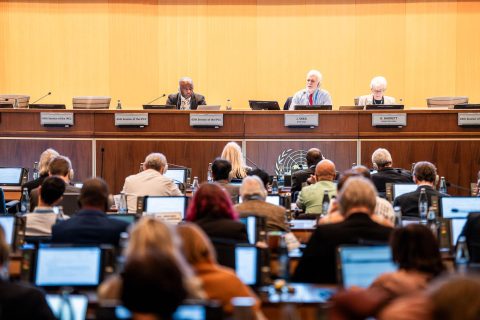
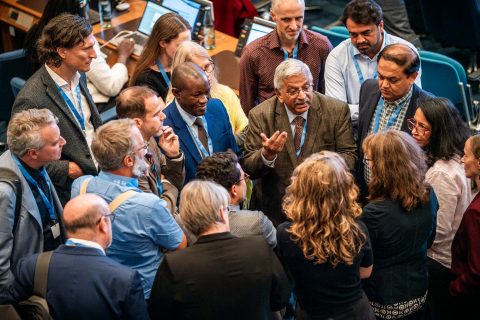
But the week-long meeting descended into fraught disagreements between governments, resulting in Skea “suspending” the talks on Friday evening with no decision made.
Countries were also unable to agree on the IPCC’s budget for the rest of the AR7 cycle, leaving the body with a “serious funding crisis”.
The IPCC has pledged to reconvene the meeting at the “earliest opportunity”; however, it has not yet given an indication of when this will be.
In his concluding remarks, Skea described the Addis Ababa summit as a “profound disappointment” and “among the most difficult IPCC meetings”, according to reporting from the Earth Negotiations Bulletin (ENB).
Some countries have reacted with dismay to the breakdown of negotiations, warning that a failure to have the IPCC’s latest assessments on climate adaptation and mitigation ready for the UN stocktaking exercise would undermine global climate action.
A climate envoy from a Pacific island state said it was a “travesty that a handful of countries continue to delay the IPCC’s reports – the science we need back home to help us save lives and livelihoods”.
Below, Carbon Brief explores the key developments, debates and disagreements at the IPCC meeting.
- What timeline options were delegates debating?
- How did the timeline discussions unfold?
- What were the main points of disagreement?
- Why is the IPCC in a ‘serious funding crisis’?
- How have scientists reacted?
- What other issues remain unresolved?
- How are the IPCC AR7 reports progressing?
- How might the IPCC use AI and enhance gender inclusivity?