

The global auto market grew by 25% in 2024, and nearly one in five cars sold globally is now electric. A record 1.3 million EVs were sold in the US, a 7.3% year-over-year increase that outperformed the 2% increase in nationwide sales of gas vehicles. Automakers are offering an increasing number of EV models to compete in this rapidly expanding global marketplace.
To ensure that American workers benefit from this global growth, Congress should preserve existing EV manufacturing and consumer tax credits and ensure that automakers build these EVs and batteries in the US. These credits have already unleashed over $215 billion in announced private-sector EV and battery investments and created 238,000 jobs.
If you think this economic boom doesn’t apply to the Southeast, think again. Over the past two years, the Southeast has emerged as the nation’s leading EV and battery manufacturing region, accounting for 38% of the nation’s investments and 31% of anticipated jobs. These investments deliver economic development and employment, especially to our region’s rural communities.
- Topping the list of rural economic development is Toyota’s $13.9 billion battery manufacturing facility in Randolph County, North Carolina. The facility is expected to create 5,100 jobs and is the nation’s highest clean energy investment.
- Hyundai has made the second-largest regional investment at its battery manufacturing and EV assembly plant in Bryan County, Georgia. That investment tops $6 billion and is expected to create 3,400 jobs. It has had a massive ripple effect, with Hyundai suppliers announcing more than $2.7 billion in investments and an anticipated 6,900 jobs across the state.

Manufacturing and Consumer Tax Credits Work Together
The manufacturing and consumer tax credits were designed to complement one another by expanding domestic EV and battery manufacturing, creating American jobs, securing domestic supply chains, and encouraging EV adoption.
Eliminating either the manufacturing or consumer incentives will undermine these goals.
Manufacturing tax credit incentivizes companies to expand and relocate operations in the US, securing domestic supply chains and creating American jobs. Consumer tax credits provide up to $7,500 for new and $4,000 for used EVs and help consumers and fleet operators switch to EVs. The critical hitch is this: Consumer credits are only good on EVs that meet domestic critical mineral, battery, and assembly requirements. This further incentivizes automakers and battery producers — both American and foreign — to build manufacturing capacity here in the United States.
Eliminating the manufacturing tax credit will create uncertainty and chill private sector investments in our region and nationwide. Similarly, if the consumer tax credit is eliminated, incentives for automakers to assemble EVs and source batteries in America, by American workers, will disappear.
Researchers from Princeton University’s REPEAT Project recently determined that without the consumer EV tax credit, “EV sales in the US could decrease 30% by 2027 and nearly 40% by 2030. Such a slowdown could lead to 100% of planned expansions of US EV assembly plants being canceled, and could make 29% to 72% of US battery-manufacturing capacity redundant, according to the study. Factories that are idled—or never built in the first place—mean fewer jobs. And based on the distribution of current EV-related manufacturing projects, red states could be hit the hardest.”
In the Southeast, Representative Buddy Carter in GA’s 1st District supports maintaining EV and battery manufacturing momentum. Hyundai’s plant is located in his district. Use the button below to tell Rep. Carter to keep fighting for advanced auto manufacturing jobs in Georgia and beyond.
Meanwhile, Chinese brands, which account for half of all EVs sold globally and 80% of the world’s lithium-ion battery production, would be thrilled to see the end of America’s EV and battery manufacturing renaissance.
Congress, particularly Republican senators and representatives from districts with investments and jobs at stake, must understand that eliminating the tax credits will weaken domestic EV and battery production and the domestic EV market, thereby delivering the global EV market to Chinese automakers and battery producers, and undercutting American workers and undermining America’s supply chain security.
Congress should prioritize strengthening the American auto sector’s ability to compete globally, securing America’s supply chains, and protecting American jobs. Federal tax credits are helping us catch up in the international EV race by incentivizing American automakers to expand EV manufacturing and global auto and battery manufacturers to invest in America. Killing the tax credits will all but ensure that Chinese companies win and American workers, including nearly 74,000 in the Southeast, lose.
The post Killing EV Tax Credits Will Hurt American Workers appeared first on SACE | Southern Alliance for Clean Energy.

 Yes, Hegseth and RFK, Jr. will be gone, but I think what’s going to happen first is the decapitation of the snake itself, i.e., the removal of Trump from the presidency.
Based on the news on social media, this could happen via the 25th Amendment, based on Trump’s mental deterioration. In my view, that’s a shame. If he’s not criminally prosecuted, this nation will be deprived of letting the American people and the rest of the world know that rule of law still matters in the United States.
Steve Bannon on the Consequences of a Blue Tsunami in November
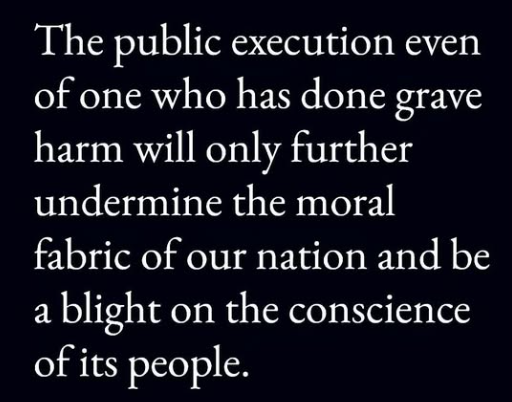 When I was young, I heard someone say, “The first execution this country televises will be the last one ever performed here.”
I think he was right at that time. You’d have millions of people watch that barbarism and realize that it was done in their name.
But today, we’re a far more insensitive, brutal, and stupid people that we were 50 years ago. If you doubt that, just look at the quality of the people at the top of the federal government–people like RFK, Jr., Hegseth, and Trump.
 As suggested at left, the world will never forget that the launch pad for all the destruction during Trump’s second term was our nation’s failure to prosecute the criminal sociopath for his attempted overthrow of the U.S. federal government on January 6, 2021.
Had these acts of treason been dealt with swiftly, all of this would have been avoided.


Steve Bannon on the Consequences of a Blue Tsunami in November

More on Televised Executions
“Sink or swim”: WA Gov hugely underestimating decline in regional gas demand while sleeping on green exports, new report finds
-
Climate Change1 year ago
Guest post: Why China is still building new coal – and when it might stop
-

 Greenhouse Gases2 years ago
嘉宾来稿:满足中国增长的用电需求 光伏加储能“比新建煤电更实惠”
-
Greenhouse Gases1 year ago
Guest post: Why China is still building new coal – and when it might stop
-

 Climate Change2 years ago
嘉宾来稿:满足中国增长的用电需求 光伏加储能“比新建煤电更实惠”
-

 Renewable Energy12 months ago
Sending Progressive Philanthropist George Soros to Prison?
-
Climate Change2 years ago
Bill Discounting Climate Change in Florida’s Energy Policy Awaits DeSantis’ Approval
-
Greenhouse Gases1 year ago
嘉宾来稿:探究火山喷发如何影响气候预测
-

 Climate Change2 years ago
Analysis: China’s CO2 falls 1% in Q2 2024 in first quarterly drop since Covid-19