

Every day, people are invited to buy products and services with supposed climate benefits – whether this be “carbon-neutral flights”, “net-zero beef” or “carbon-negative coffee”.
Such claims rely on “carbon offsets”.
Put simply, carbon offsets involve an entity that emits greenhouse gases into the atmosphere paying for another entity to pollute less.
For example, an airline in a developed country that wants to claim it is reducing its emissions can pay for a patch of rainforest to be protected in the Amazon. This – in theory – “cancels out” some of the airline’s pollution.
It is not just businesses that are relying on carbon offsets. Major economies, too, are investing in carbon offsets as a way to meet their international emissions targets – with offsetting becoming a major talking point at UN climate negotiations.
For its supporters, offsetting is a mutually beneficial system that funnels billions of dollars into emissions-cutting projects in developing countries, such as renewable energy projects or clean cooking initiatives.
But offsetting has also faced intense scrutiny from researchers, the media and – increasingly – law courts, with businesses facing accusations of “greenwashing” over their carbon-offsetting claims.
There is mounting evidence that offset projects, from clean-cooking initiatives to forest protection schemes, have been overstating their ability to cut emissions. One yet-to-be published study suggests that just 12% of offsets being sold result in “real emissions reductions”.
Projects have also been linked to Indigenous people being forced from their land and other human rights abuses.
Decades of countries trading carbon offsets has had a negligible impact on emissions and likely even increased them.
In this in-depth Q&A, Carbon Brief explains what offsets are, how they are being used by businesses and nations, and why they can be a problematic climate solution.
The article also explores whether a system, which one expert describes as “deeply broken”, could ever be effectively reformed.
Read the full article on the Carbon Brief website
The post In-depth Q&A: Can ‘carbon offsets’ help to tackle climate change? appeared first on Carbon Brief.
https://www.carbonbrief.org/in-depth-qampa-can-carbon-offsets-help-to-tackle-climate-change/

The Nepali government has requested $20m from the UN fund for “loss and damage”, following the devastating floods that hit the country in late August.
This amounts to just 0.7% of the $2.7bn it has estimated in “physical damage” to infrastructure and “economic losses” from the flooding, according to Carbon Brief analysis.
The $20m request would, nevertheless, make Nepal the fourth-largest claimant to the UN loss-and-damage fund, which is intended to help deal with climate-related disasters.
Developing countries have already made 176 applications to the UN fund for responding to loss and damage, requesting, in total, $2.8bn to help recover from a variety of damaging events, such as drought, floods and storms.
Yet, to date, predominantly developed nations have only pledged $0.8bn to support the fund.
This means requests to the fund are already three times larger than the total amount pledged, raising questions about its potential to respond to emergencies.
As yet, no funding has been paid out of the fund to developing countries grappling with intensifying and more frequent climate change-induced disasters since it was established in 2023.
Nepal’s needs
On 26 August, Nepal was hit by flash floods following a catastrophic rock-ice avalanche in the Himalayan border region. The flooding has killed more than 1,400 people, with thousands still missing.
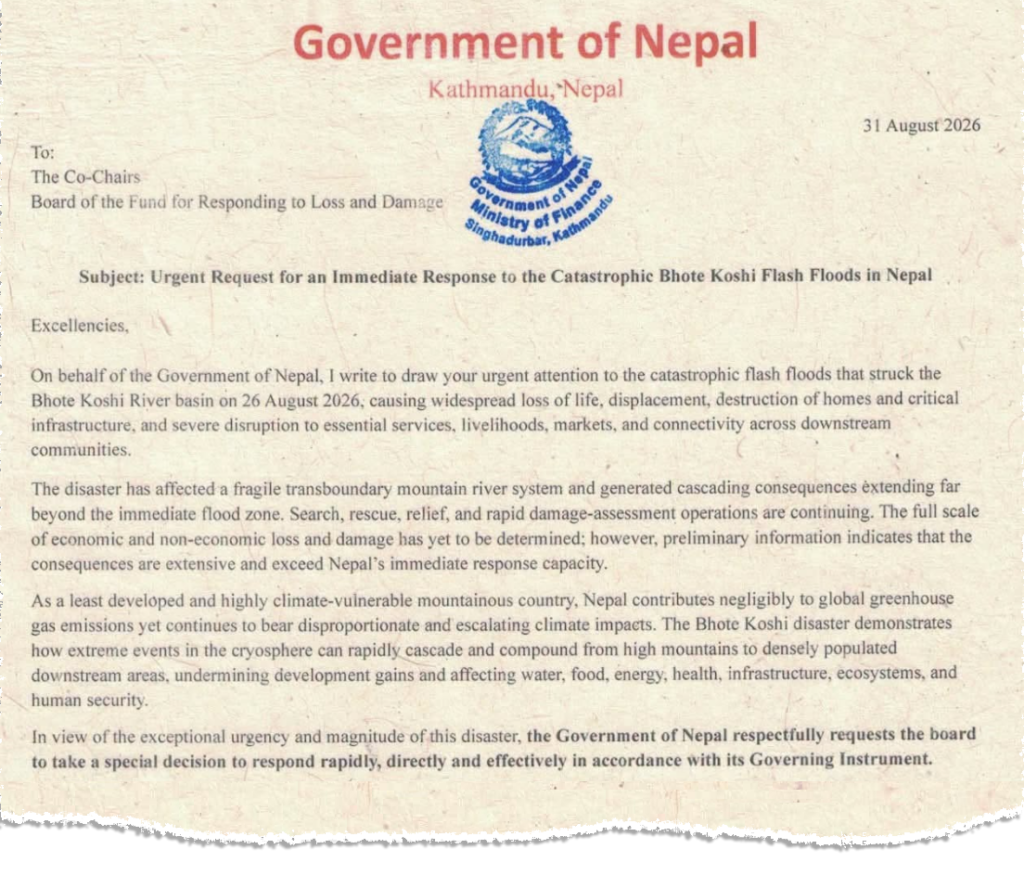
Days later, the Nepali government sought an “urgent response” from the board of the UN fund for climate-driven loss and damage.
It subsequently requested $20m in “financial compensation” from the fund. This is the maximum amount that can currently be requested for a single project.
“Loss and damage” is a term used to describe how climate change is causing serious and, in many cases, irreversible impacts around the world. Nations established the UN fund in 2023, after decades of effort by climate-vulnerable nations.
Nepal’s national disaster management authority has now released an extensive rapid preliminary assessment of “damage and needs” from the floods.
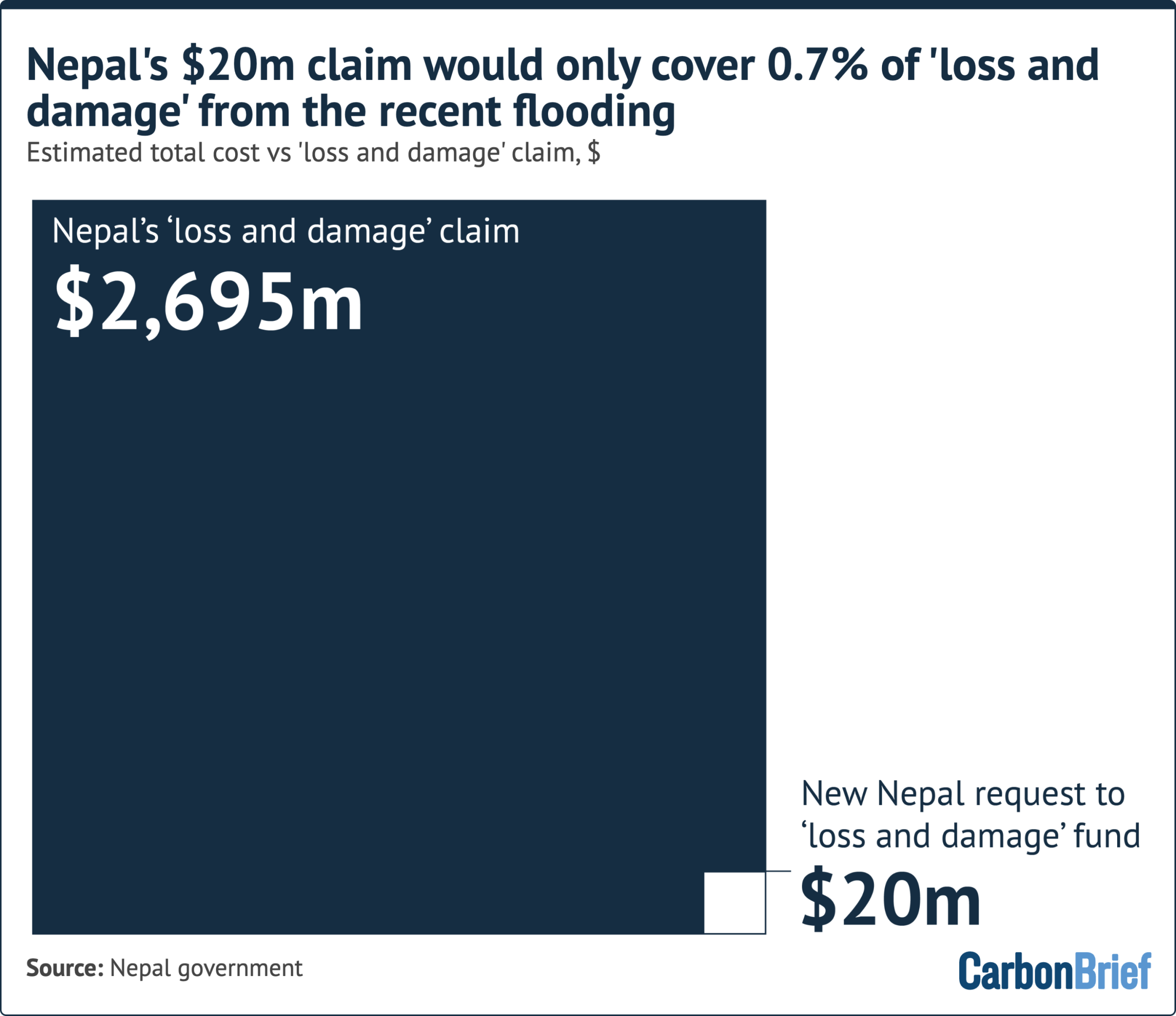
As the chart below shows, Nepal’s $20m loss-and-damage claim would only cover 0.7% of what authorities describe as $2.7bn in “total damage and loss” from the floods.
When accounting for another $4.8bn in “recovery and reconstruction” costs – part of how loss and damage is internationally defined – then Nepal’s $20m claim would be just 0.3% of the needs it estimates.
Reacting to the analysis, Nepal’s climate negotiator Raju Pandit Chhetri tells Carbon Brief that the country’s $20m request was for “rapid response”, adding:
“That money is going to be a peanut if it was to be invested into reconstruction.”
Requests vs pledges
Vulnerable, developing countries have long argued that developed nations should be held responsible for loss and damage, while countries such as the US have blocked moves that could have led to them being liable for climate-related damages
From December 2025 until July 2026, developing countries made 176 applications to the loss-and-damage fund, requesting over $2.8bn in assistance.
So far, predominantly developed countries have pledged only $822m to the fund. (Some nations that are not categorised as “developed” under the UN, such as the UAE and South Korea, have also committed funds.)
Funding requests from developing countries to date are, therefore, more than triple what has been pledged.
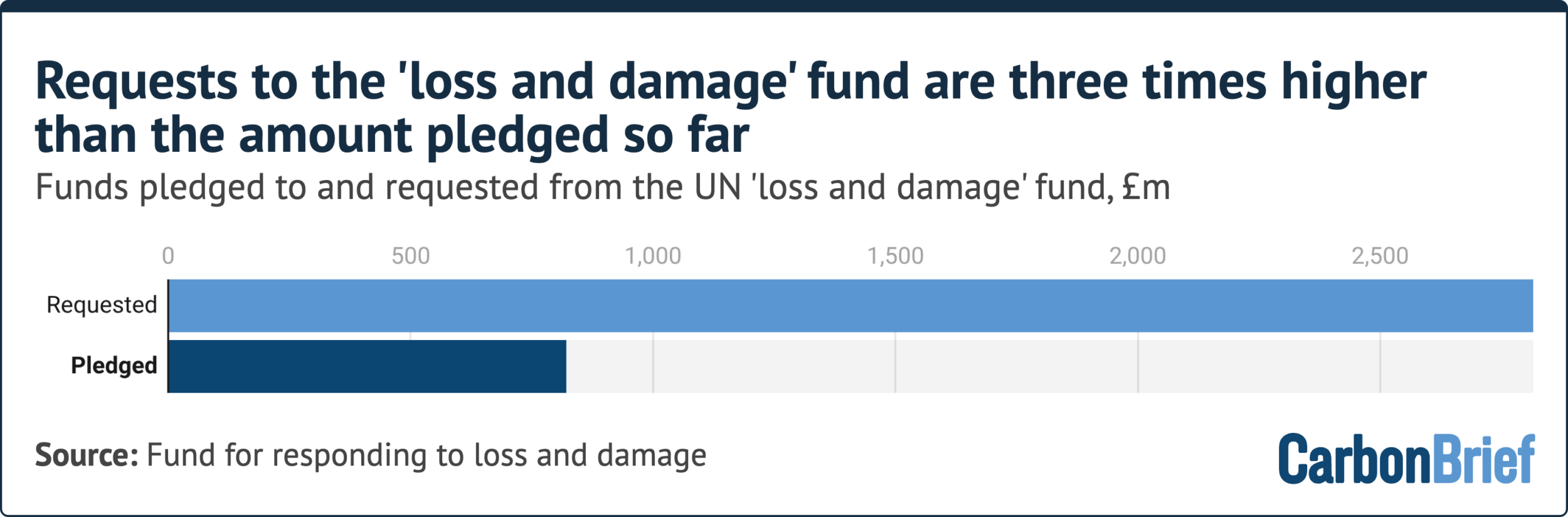
Moreover, only around half of the money pledged so far has been paid into the fund by donor nations, with large sums from France, Italy and the UAE still outstanding.
The fund has made $342m available in its initial funding round in July 2026. However, as of September, no money from the fund has been distributed to any countries facing climate-related disasters.
According to Carbon Brief analysis, off the 176 loss-and-damage fund requests received from 118 countries, more than 60% are from least developed countries – such as Nepal – and small-island nations. So far, each individual funding request is capped at $20m.
The flood-related request is Nepal’s fourth appeal to the fund and, as the chart below shows, this makes it the fourth-largest claimant overall.
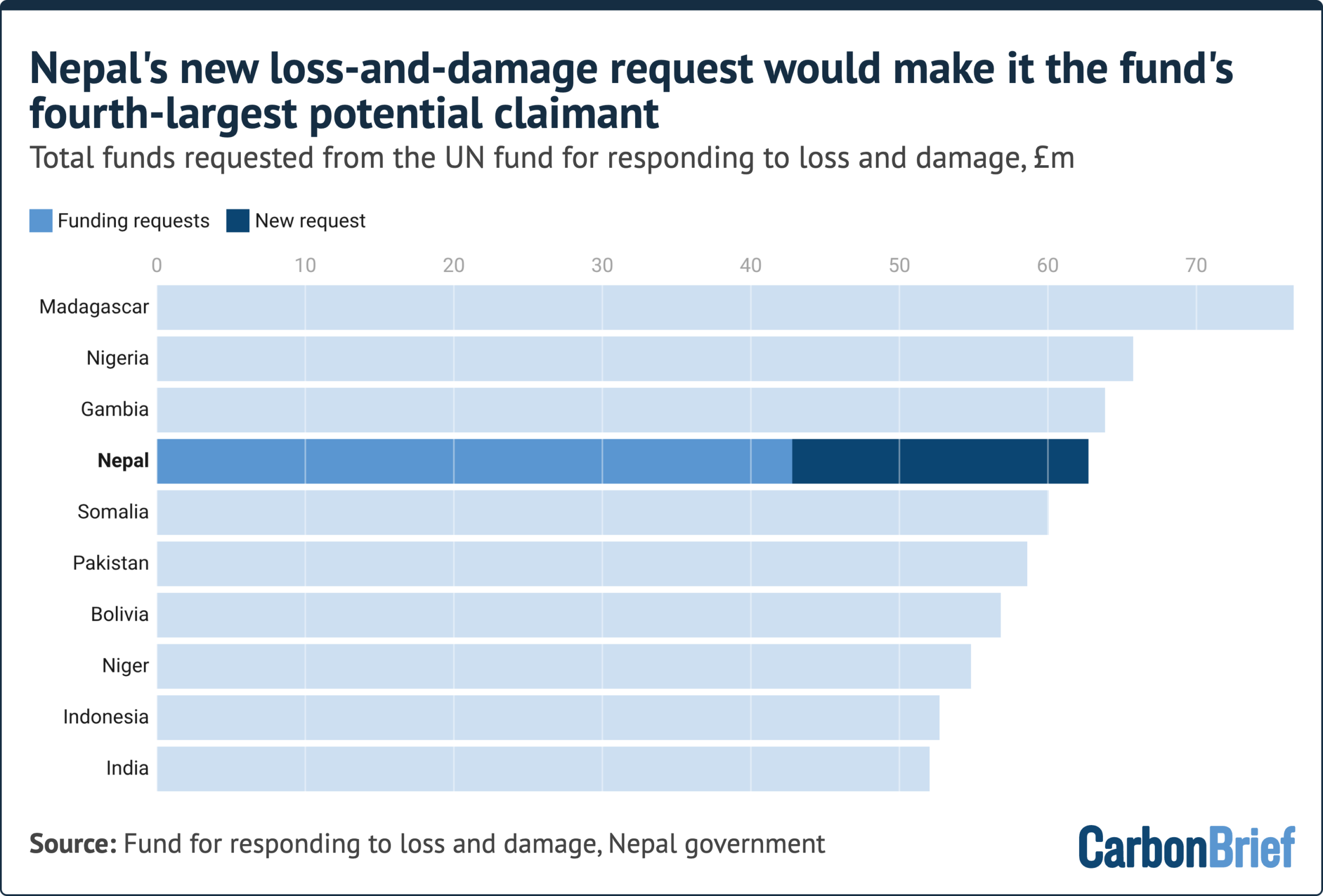
Nine other countries have made multiple requests to the fund. Madagascar – hit by back-to-back cyclones after a prolonged drought – has made six requests in total.
Drought-ravaged Suriname, Ecuador, Brazil and Barbados have specified that their funding requests are part of an “emergency response”.
‘Rapid response’
Nepal’s $20m claim has sparked a conversation on climate justice and the ability of the loss-and-damage fund to deliver, in the face of increasingly frequent extreme-weather events.
In a letter sent five days after the disaster, Nepal’s finance minister Dr Swarnim Wagle appealed to the fund’s board to mobilise an “urgent response” that would “signal” that the fund:
“[I]s capable of responding with humanity, speed, flexibility and solidarity when climate-vulnerable countries face losses and damages beyond their capacity to address alone.”
Board members from Asia-Pacific and African countries wrote a letter in support of the Himalayan country in crisis, urging the board to convene and “potentially agree to a provisional set-aside allocation of resources to support rapid response funding for Nepal”.
They pointed out that the board’s response to Nepal could offer “procedural lessons” in how to strengthen its “rapid-response” to sudden-onset extreme-weather events. Such support is explicitly part of the fund’s mandate.
On 14 September, developed-country members of the fund’s board wrote that they supported a “consultation” on Nepal, but made no commitments in terms of actual funding.
Harjeet Singh, loss-and-damage expert and global convenor of the Fill the Fund campaign, tells Carbon Brief that the fund’s board deals with most funding requests as regular projects, rather than emergencies. Singh continues:
“Developed countries gave a really cold response to Nepal’s request. They have not addressed it because they know that if this happens once, they are going to be under pressure all the time. This is unacceptable.”
Meanwhile, BBC News reported that Nepal plans to use climate attribution studies to strengthen its claim.
According to a rapid attribution study by World Weather Attribution and climate experts who spoke to Carbon Brief, factors such as glacial retreat and permafrost thaw that played a key role in the disaster have been linked to climate change. A full attribution study is pending.
Nepal’s prime minister Balendra Shah will address the UN general assembly on 24 September and is expected to raise issues around climate justice, loss and damage and the vulnerability of mountain countries.
The next board meeting of the loss and damage fund is on 15 December, two months from now, and a fortnight after the conclusion of COP31 in Turkey.
Pandit Chhetri tells Carbon Brief:
“It’s a shame that, until now, the fund has not been able to even give a penny to developing countries. And, starkly, the event in Nepal only demonstrates why this kind of fund is so important for highly vulnerable, poor, developing countries.”
Pandit Chhetri adds that, after nearly three weeks since the disaster, there is yet to be a decision on the request and that the country has “only received messages of solidarity”, with no assurance of rapid response funds. He says that it is “quite an interesting scene for [us] to observe”, adding:
“If the fund cannot respond in a crisis like this for a country like Nepal – when you have this massive destruction and devastation – then what is the use of the fund itself? That’s why it is a test for the fund, though the resources are limited.”
Related
Analysis: India’s power-sector emissions flat for two years due to clean-energy surge

World falling short on 22 of 23 nature targets for 2030, says draft UN report

Analysis: 84% of nations miss deadline to identify ‘nature-harming’ subsidies by 2025
Access to finance ‘strengthens climate resilience’ among sub-Saharan women
The post Analysis: Nepal’s $20m ‘loss-and-damage’ claim only covers 0.7% of flood costs appeared first on Carbon Brief.
Analysis: Nepal’s $20m ‘loss-and-damage’ claim only covers 0.7% of flood costs
Hi, I’m Daniel and I am the Chief Mate. Having worked at Greenpeace for over 31 years I often work as the Captain on all Greenpeace ships.
The oceans connect everyone. Our goal this trip is to turn visibility into accountability by documenting impacts, informing the public, and strengthening protections for Australia’s Commonwealth Marine Parks.
https://www.greenpeace.org.au/team/daniel/
Hello, I am Jimmy and the Captain of Oceania. I learnt to sail in my hometown of Hobart, Tasmania. I’ve spent years navigating Tasmania’s wildly spectacular coastline, and crossed Bass Strait many times, including the Sydney to Hobart yacht races. My first time sailing with Greenpeace was in 2017 as a volunteer on the Rainbow Warrior.
It is a privilege to be a part of the Oceania project, and I hope we can achieve many things with this beautiful ship.
https://www.greenpeace.org.au/team/jimmy/


-

 Greenhouse Gases2 years ago
嘉宾来稿:满足中国增长的用电需求 光伏加储能“比新建煤电更实惠”
-
Climate Change1 year ago
Guest post: Why China is still building new coal – and when it might stop
-
Greenhouse Gases1 year ago
Guest post: Why China is still building new coal – and when it might stop
-

 Climate Change2 years ago
嘉宾来稿:满足中国增长的用电需求 光伏加储能“比新建煤电更实惠”
-

 Renewable Energy11 months ago
Sending Progressive Philanthropist George Soros to Prison?
-
Climate Change2 years ago
Bill Discounting Climate Change in Florida’s Energy Policy Awaits DeSantis’ Approval
-
Greenhouse Gases1 year ago
嘉宾来稿:探究火山喷发如何影响气候预测
-

 Carbon Footprint2 years ago
US SEC’s Climate Disclosure Rules Spur Renewed Interest in Carbon Credits