

Perrine Fournier is a forest and mining campaigner at forests and rights NGO Fern.
Our fossil fuel addiction must end for humanity to have a livable future.
An important element in stopping this dependency is switching from vehicles that spew carbon dioxide into the atmosphere to electric vehicles (EVs), which pollute far less. Yet the path to a low-carbon world is full of potential pitfalls. A major one is the impact that mining for the critical materials needed to power EVs has on forests and peoples’ lives.
A new study shows that it doesn’t have to be this way.
According to researchers from the French think-tank négaWatt and the Vienna University of Economics and Business (WU Vienna), a combination of measures – including, crucially, using less mineral-reliant battery technologies – could avert the damage we’re already seeing unfold in the stampede to secure the materials required for EVs.
European v Chinese batteries
Battery technology plays a critical role in deforestation patterns – and the type of battery used in EVs significantly affects deforestation levels.
At present, the most common batteries used for EVs in Europe are NMC 811, which require substantial amounts of cobalt, copper and nickel – all linked to high deforestation.
In contrast, Lithium Iron Phosphate (LFP) batteries do not contain cobalt and nickel. Instead, they rely on materials which do not sit under tropical forests, such as iron.

Until now, the European Union (EU) has invested heavily in NMC battery technologies, while Chinese producers have honed and mastered LFP battery technology.
The researchers modelled – for the first time – the potential deforestation from future EU demand for EVs through to 2050.
Under a business-as-usual scenario and if high-deforestation NMC 811 battery technologies dominate, the EU’s future demand for electric vehicles could cause the loss of 118,000 hectares of forest by 2050 — that’s the equivalent of 18 football fields disappearing every day for the next 25 years.
This is only the tip of the iceberg.
While the study evaluated direct deforestation caused by mining for iron, bauxite, copper, manganese, nickel and cobalt, it did not address the vast indirect deforestation mining causes: including clearing forests for surrounding settlements and for infrastructure for energy and transport. A 2022 peer-reviewed paper found that industrial mining causes indirect deforestation in two-thirds of tropical countries.
Ways to avert disaster
Fossil fuel interests and climate change deniers use reports of the dark underside of mining for critical materials to try to frustrate the transition from petroleum-powered transport to EVs.
For instance, Indonesia is the world’s biggest producer of nickel, which is defined as a ‘critical mineral’ because it’s an essential component of EV batteries. But the rapid growth in nickel mining to meet rising demand is ruining local peoples’ lives and causing rampant deforestation.
A similarly depressing tale can be told of the Democratic Republic of Congo (DRC), the world’s number one supplier of cobalt, a metal that is also key for EV battery production. The impact of cobalt mining in the central African nation is well-documented, including forced evictions and other human rights abuses, as well as environmental pollution.
These are not isolated examples.
Indonesia turns traditional Indigenous land into nickel industrial zone
But rather than heeding the powerful forces trying to roll back measures to protect the planet, we must find ways to mitigate the damage.
The study outlines a credible way to do so: modelling a pathway for the EU’s EV sector which would decrease its projected deforestation footprint by 82%.
As well as adopting different battery technology, the researchers detail how the negative impact on forests could be further reduced by establishing national “no-go zones” for mining, favouring countries with lower deforestation risks, and enforcing strict due diligence.
As societies, we also need to use fewer resources and rethink what we truly need. In concrete terms, the researchers show this means adopting policies that reduce metal demand by promoting public transport, shared mobility and smaller vehicles.
In combination, these measures – improved battery technology, better sourcing of critical materials and more public services like trains and buses – could have a profound impact in helping protect the world’s forests from the ravages of mining, and ensuring that cleaner transport doesn’t have to cost the Earth.
The post How to make electric vehicles that don’t trash forests through mining appeared first on Climate Home News.
How to make electric vehicles that don’t trash forests through mining

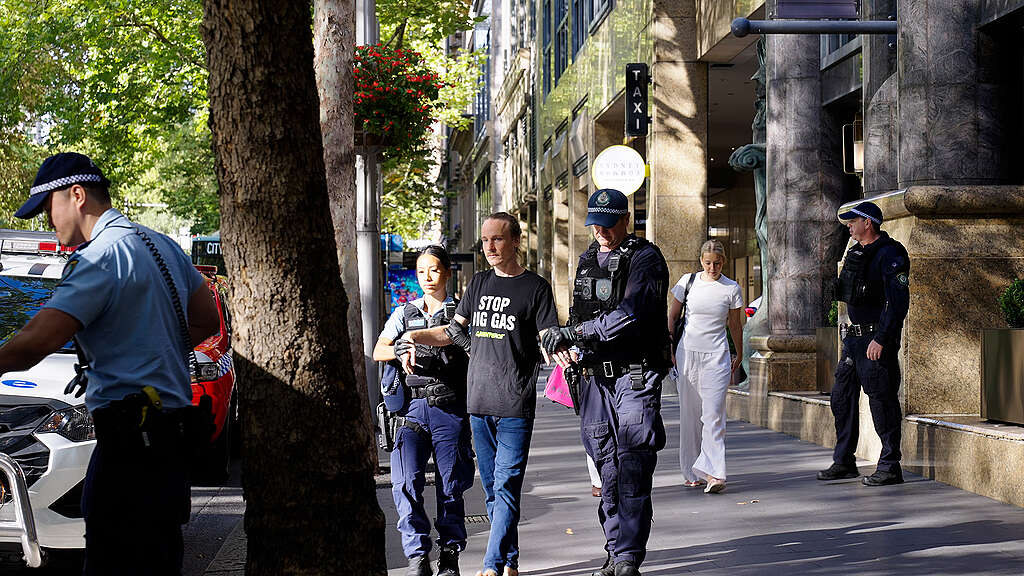
Greenpeace activists have been arrested after taking action at a major gas conference this morning in Sydney.
Earlier today, brave activists disrupted the Australian Domestic Gas Outlook conference at the Sheraton Grand Hotel, dropping a banner with a simple message: Gas Execs Profit. We Pay The Price.
They were also holding banners calling to Tax Gas Profits, making it clear that Australians have had enough.
Following the peaceful protest, two activists were arrested by police.
Watch and share the video to see what’s happening.
Why this matters
Gas corporations are raking in billions in profit from global crises – from Ukraine to Iran – while everyday Australians are left paying the price with higher energy bills and climate damage.
At the same time, these companies continue to avoid paying their fair share of tax.
That’s why Greenpeace activists took action.
A message from the activists
Alex Saurin, Greenpeace activist who dropped the banner, said:
“It feels powerful to take a stand against these gas corporations that have been trampling over the Australian people and our environment for far too long.
Gas giants like ExxonMobil and Santos have spent years blocking renewable energy and dodging fair taxes to protect their record profits. While families struggle to pay the bills and the climate crisis accelerates, these companies continue to demand free right to do whatever they want.
It is beyond time for our leaders to shake off the gas industry’s grip and start taxing these corporations fairly while clearing the path for the renewable energy we desperately need. They need to start making decisions for our people and our planet – not just for us now, but for the generations to come.”
These are ordinary people taking extraordinary action, standing up to an industry that continues to put profits ahead of people and the planet.
Standing up to Big Gas
Today’s arrests are a reminder of what it takes to challenge this industry.
As Greenpeace Campaigner, Solaye Snider, said:
“Gas corporations in Australia are ripping us off. From Ukraine to Iran, these corporations treat global conflict as an opportunity to line their pockets and drill for more gas – but while gas executives profit, we pay the price with more climate pollution, more environmental destruction, and soaring bills for Australian households.
“It’s in Australia’s interest to unhook from volatile, polluting and expensive sources of energy like gas. The fastest path to cheaper power bills and a safer climate is clear: start taxing gas exports properly and speed up the transition toward homegrown renewable energy.
“As long as we are dependent on fossil fuels like gas, our electricity bills and our climate are at the mercy of global instability and greedy corporations who put their profits over people and planet.”
What needs to happen now
Gas is expensive. It’s volatile. And it ties our energy system to global instability. But there is a better way.
The government is already considering introducing a tax on gas corporations before the May budget – now we need to make sure they follow through.
That’s an important first step, but it’s just the beginning.
Renewable energy is already cheaper, more reliable, and made right here in Australia. It’s the fastest path to lower bills, real energy security and a safer climate.
To invest in a better future, we need to:
- properly tax gas corporations and their exports,
- stop expanding gas, and
- speed up the transition to homegrown renewable energy.
This is just the beginning
This action, and the arrests that followed, are part of a growing movement to stand up to Big Gas and challenge the power it holds over our government and society. The Federal Government has a role to play – starting by taxing gas corporations properly and then accelerating the transition to homegrown renewable energy.
Together, we can show just how much support there is for change, and make it impossible for decision-makers to ignore.
What you can do
- Follow along on our social channels.
- Share the video far and wide to show your support.
- Sign the petition to tell Albo to stand up to Big Gas.
- Sign up to find out how you can become a volunteer and take action.
BREAKING: Greenpeace activists arrested after standing up to Big Gas in Sydney
Climate Change
Scientists Deploy First Satellite Tag on a Leatherback Sea Turtle in Ecuador to Better Reveal Gaps in Ocean Protection
Tracking the turtle’s movements could help identify where high-risk fishing areas overlap with the critically endangered species.
Just after 3 a.m. on a recent Friday morning, a 4.5-foot-long leatherback sea turtle covered her freshly dug nest with sand, sweeping and packing it into place with steady strokes of her flippers just above the high tide along a remote, rugged stretch of Ecuador’s Pacific coast.
The UN’s flagship climate fund has selected five locations for its new regional offices, a move aimed at bringing it physically closer to developing countries and making its finance easier to access.
After fraught discussions during a meeting last week, the board of the Green Climate Fund (GCF) decided in a secret vote on Saturday to open regional offices in Panama City, Amman in Jordan, Suva in Fiji, Nairobi in Kenya and Abidjan in Côte d’Ivoire. The African office will be split across two locations to better serve the continent with the largest number of countries and projects supported by the fund.
The decision marks a significant shift for the fund, which has operated from its headquarters in Songdo, South Korea, since its launch in 2013.
“This is a landmark moment for [the] GCF,” said the fund’s executive director Mafalda Duarte. “It has taken a lot of work, careful negotiation and persistent advocacy for a model that will bring us closer to the countries, to our partners and the communities we were created to serve”.
‘Less delay, more action’
The new offices are expected to act as the GCF’s front line, working more closely with governments, the private sector and civil society to improve access to climate finance and support the delivery of projects aimed at cutting emissions and strengthening resilience to climate impacts.
Welcoming the decision in a LinkedIn post, Fiji’s Permanent Secretary for the environment and climate change Sivendra Michael described it as “a win for the entire Pacific”, citing “long hours” and “tough negotiations” behind the outcome. “Less delay, more action — real support where it matters most,” he added.
-
Can new CEO steer Global Center on Adaptation back on course?
Madagascar’s Rindra Rabarinirinarison takes the helm of the troubled organisation promising to prioritise fundraising, rebuild trust with donors and hone its mission

A total of 43 countries applied to host the new offices, with 16 making a final shortlist after the GCF secretariat assessed bids on criteria including cost, connectivity and the ability to attract a “world-class workforce” through quality of life and access to international schools.
Panama emerged as the top-ranked location overall, according to a document seen by Climate Home News, while some selected hosts, including Amman and Abidjan, scored lower than rival candidates in their regions.
Establishing the new hubs is expected to cost an initial $6.5 million, but the fund anticipates these upfront expenses will be offset over time through operational savings, including lower staff and travel costs.
First Palestinian entity approved
The GCF board also accredited the first organisation in Palestine that will be able to directly apply for and access funding.
Created by the Palestinian Authority in the West Bank, the Municipal Development and Lending Fund supports local infrastructure projects and services. Working with partners, including the World Bank, it is developing projects to help communities cope with escalating climate risks such as drought and extreme heat.
In the West Bank, which is occupied by Israel, just under half of the population lives in areas classified as having high to very high climate exposure, according to a recent study.
The post Green Climate Fund picks locations for five developing country hubs appeared first on Climate Home News.
Green Climate Fund picks locations for five developing country hubs


BREAKING: Greenpeace activists arrested after standing up to Big Gas in Sydney
Scientists Deploy First Satellite Tag on a Leatherback Sea Turtle in Ecuador to Better Reveal Gaps in Ocean Protection

“Trump Is the Worst Idea that Ever Happened to America” — Bono
-
Greenhouse Gases8 months ago
Guest post: Why China is still building new coal – and when it might stop
-
Climate Change8 months ago
Guest post: Why China is still building new coal – and when it might stop
-

 Greenhouse Gases2 years ago
嘉宾来稿:满足中国增长的用电需求 光伏加储能“比新建煤电更实惠”
-
Climate Change2 years ago
Bill Discounting Climate Change in Florida’s Energy Policy Awaits DeSantis’ Approval
-

 Climate Change2 years ago
嘉宾来稿:满足中国增长的用电需求 光伏加储能“比新建煤电更实惠”
-
Climate Change Videos2 years ago
The toxic gas flares fuelling Nigeria’s climate change – BBC News
-

 Renewable Energy5 months ago
Sending Progressive Philanthropist George Soros to Prison?
-

 Carbon Footprint2 years ago
US SEC’s Climate Disclosure Rules Spur Renewed Interest in Carbon Credits