

Since arriving here at COP29, I’ve been thinking about the different reasons people come to this global stage.
There are delegations like ours that are justice-centered protesting, advocating, and uninvolved in direct policy negotiations. Some attend to network and shine a good light on their organization, without calling for much change, and then others come to explicitly further the interests of big oil. Corporations and government representatives give out free swag in one part of the conference while negotiating wonky policy in closed-door meetings. You can see these different segments of the conference very clearly, but what you can’t see as clearly is the way power weaves through it all, ever-present and dominating.

I’ve been inspired by my conversations with Indigenous climate leaders speaking truth to power, local educators finding sparks of connection, climate activists disrupting this conference to shed light on the genocide in Gaza, and panels that are challenging attendees to envision a just and adaptive future on a local level, all while national and international leaders refuse to step up and commit to substantive and necessary change.
Today I felt great discomfort and frustration bumping shoulders with greenwashers, oil lobbyists, and government officials from around the world who are spending millions on COP with two goals in mind: to lobby behind closed doors for inaction and inequity, and to craft a positive image of themselves to the climate world while they do it.
COP29 is a test to see if developed countries want a livable world by actually backing climate policies. Without finance, talk about climate action isn’t action. It’s just talk.
In college, I was in the Model United Nations club. I would attend conferences where college students in suits would animatedly debate complex international policies, which often took more than a month to study for. I’ll tell you a secret, though — the people who won the conferences weren’t playing a game that was about how well you understood the subject, but how much power you could build by manipulating the narrative or camouflaging distasteful details. It was never about the truth of the subjects we debated, but the power one could cultivate. Power came to those who knew the right maneuvering tactics, not those who knew the details of policy.


I’ve increasingly learned that Model UN is a scarily accurate microcosm of contemporary international politics. Rich countries are not taking the climate finance issue seriously. Instead of being willing to put forward the trillions of dollars needed in grant-based finance, they refuse to even approach the dollar amount needed, and claim that loans and private finance could fill the gap. Loans worsen the climate crisis, because countries prioritize debt repayment over climate action, and are pushed to pay back their debt by expanding fossil fuel exports. In short, developed nations and the slew of international corporations who attend COP are trying to turn the climate crisis into an investment opportunity for themselves.

Tonight as I walked out of the COP29 conference center, Grace Malie, Rising Nations Youth Delegate from Tuvalu’s words rang in my head:
“How many more COPs will it take to see an actual impact in my community? It’s all talk, and no action.”
Learn more about Grace here.
Zoe is a Climate Generation Window Into COP delegate for COP29. To learn more, we encourage you to meet the full delegation, support our delegates, and subscribe to the Window Into COP digest.

Zoe Redfern-Hall is the Senior Communications and Marketing Manager at Climate Generation and YEA! Alumni. She graduated from Clark University in 2021 with a degree in Political Science. Upon returning home to Minnesota, she became deeply involved with organizing against the Line 3 oil pipeline. Last year, more than 2,000 oil lobbyists were allowed to attend COP, impacting the negotiations, stories, and transparency of the conference. She is excited and honored to join the Climate Generation delegation of climate leaders, educators, and activists calling for real change and ambition for a just cultural, economic, and energy transition away from fossil fuels.
The post How Many More COPs Will It Take? appeared first on Climate Generation.

Amira Odeh Quiñones is a hydrologist and Caribbean organiser for the 350.org climate campaign group
El Niño, likely to be one of the strongest in modern history, has arrived on Caribbean shores.
Drought is slowly creeping up on our islands. But unlike the fiery wildfires ravaging parts of Europe, there’s no smoke signalling the damage being done, no sirens to warn of the danger. Only announcements from public health officials to stay indoors and remain hydrated — as if outdoor workers and farming communities have the luxury to heed such advice.
During El Niño, strong atmospheric winds alter rain patterns and trap heat across the Caribbean. But while we have experienced El Niño many times before, it has become very visible in recent years how climate change is making this natural phenomenon worse.
Across the Greater Antilles, temperatures are soaring past 38°C (100°F), with real-feel indexes reaching a gruelling 43°C in parts of Puerto Rico where I live. Cuba has it worse. Widespread power outages mean that methods for cooling down are unavailable for most of the day, leaving millions of vulnerable people at risk of heat stroke when temperatures hit 38°C.
Santa Marta coalition tested as co-chair Colombia turns back to fossil fuels
During the last strong drought a decade ago, I had water only two days a week in my home. Today, there are many families whose taps are about to run completely dry. Water authorities have already begun strict rationing in some municipalities, with more on the list scheduled for rationing if conditions don’t change.
Water rationing is far more than an inconvenience; it is an immediate health risk. This means thousands of people need to constantly haul heavy buckets up flights of stairs just so they could bathe, cook, stay hydrated – the basics of survival.
Heat causes health problems
Puerto Rico is home to roughly 300,000 elderly residents. Many live alone, isolated and without support. They risk severe physical injury when carrying heavy water containers, and are wont to suffer from silent heat exhaustion in unventilated rooms.
Furthermore, when water shortages force residents to store water in open household containers, it inadvertently creates breeding grounds for Aedes aegypti mosquitoes. Paired with scorching temperatures that tend to shorten the mosquito breeding cycle, the region is facing explosive outbreaks of dengue fever that endanger our most vulnerable: children and the elderly.
The economic fallout is equally devastating. Dry fields mean millions of dollars in lost crops, forcing small agricultural businesses to collapse, needing urgent government relief to survive. Extreme fuel shortages have already paralyzed Cuba’s agricultural sector, cutting food output by 60% – the El Niño dry spell threatens to decimate it.
At sea, warmer ocean waters fuel massive influxes of sargassum seaweed. Rotting sargassum chokes our beaches, destroying the local tourism industry that so many working families rely on. Tangled seaweed also damages nets and boat engines, slashing fish catches and driving up equipment costs for local fishers.
In the south of Puerto Rico, the coastal town of La Parguera is currently witnessing a historic amount of sargassum on its shores. This has halted most of the boating activity in the area, which is the seaside town’s main tourist draw and economic driver.
All over the Caribbean, from town halls to local group gatherings, the story I hear is always the same: constant headaches, lost work hours, failing health, and a sense that quality of life is silently being stolen. The compounding effects of heatwaves, drought, and marine destruction are exhausting our people, our islands.
Climate change to blame
Climate change makes each El Niño year hotter and more damaging. Higher baseline global temperatures increase the energy and moisture available for extreme weather. Latest projections show that El Niño may push the monthly global average temperature past 2°C of warming for the first time in early 2027. In the Caribbean islands, that will not just be breaking records – it’ll be breaking lives.
Recently, I had the opportunity to share a panel with climate scientists behind what is known as the field of “attribution science” – or the science that compares today’s climate conditions to what the Earth’s climate would be like without human activity, particularly burning fossil fuels. They’re unequivocal: it’s no longer a question of whether extreme weather is caused by climate change, it’s just a question of how much.
-
Southeast Asia’s fragile grids threaten billions in clean energy investment
Renewables developers need reliable electricity infrastructure and stable policies to help the region meet climate goals and surging demand for power -
Quarter of countries still missing UN climate plans 18 months after deadline
Egypt, Vietnam, Argentina and the Philippines are among the 45 nations which have breached the Paris Agreement by not submitting their climate plan to the UN -
China’s coal power rebounds as record clean energy goes to waste
Long-term contracts guarantee coal plants buyers regardless of demand, crowding out renewables, report finds

Attribution science recently got a boost from the U.S.’ top scientific advisory body. The National Academies of Sciences, Engineering and Medicine recognized that researchers’ methods have advanced considerably in recent years, resulting in better assessments on how much extreme weather can be attributed to human-caused climate change. It noted that attribution findings could be relevant in some types of legal cases, including those seeking damages from oil companies for climate impacts.
This crisis, which is already taking a heavy toll on our communities’ survival, needs real, urgent, and structural action that goes beyond aid. With similar droughts now gripping parts of Asia and Africa, we’re falling into the familiar narrative of treating the looming humanitarian crisis as if no one was to blame, as if it is being caused solely by a natural phenomenon we can’t control.
It’s not. The world was already on fire before its regular visitor, El Niño, came. While we need humanitarian action, we need climate action too, in order to permanently put out the flames.
The post When taps run dry in the Caribbean, it’s not enough to blame El Niño appeared first on Climate Home News.
When taps run dry in the Caribbean, it’s not enough to blame El Niño
China has released a five-year plan dedicated to addressing climate change.
The 15th five-year plan for a national response to climate change is the latest in a series to outline in-depth climate and energy targets for the 2026-2030 period.
These include five-year plans for “building a Beautiful China”, developing a “new-type energy system” and developing renewable energy.
There are also separate “action plans” for the 2026-2030 period, such as for peaking carbon emissions.
China has pledged to peak its emissions before 2030 and reach carbon neutrality before 2060.
The new plan does not include any major new targets, instead consolidating and reaffirming existing policies.
Nevertheless, it includes significant signals on key policy areas, such as non-carbon dioxide (CO2) greenhouse gases, global climate governance and carbon markets.
Below, Carbon Brief examines some of the notable elements in the latest five-year plan and what it reveals about China’s policy direction through to 2030.
What does the climate plan cover?
The Ministry of Ecology and Environment (MEE) released the plan in late July, in unison with 18 other government departments. These include the National Development and Reform Commission (NDRC), China’s top economic planning agency, and the National Energy Administration.
The document covers a range of topics, including CO2 emissions, other greenhouse gases (non-CO2 GHGs), carbon markets, carbon footprints, climate adaptation and international cooperation on climate change.
For the first time at the five-year plan level, the plan creates a comprehensive target system covering all areas of climate policy, say officials in a MEE Q&A.
They describe it as “the main policy instrument” for advancing China’s climate action during 2026-2030.
China rarely issues high-level multi-year policies dedicated to “responding to climate change”. In 2014, the NDRC published a plan on the topic running through to 2020, but this was not linked to a five-year plan period.
Qin Yan, principal analyst at ClearBlue Markets, tells Carbon Brief that the plan shows that China’s climate governance has reached “an unprecedented strategic level”.
She adds that the plan creates an “all-encompassing target system” to support China’s Paris Agreement climate pledges for 2030 and 2035.
In its 2030 pledge, China aimed to peak emissions “before 2030” and reduce carbon intensity – its emissions per unit of GDP – by more than 65% from 2005 levels.
Last year, president Xi Jinping personally announced China’s 2035 pledge to cut China’s greenhouse gas emissions to 7-10% below peak levels by 2035, while “striving to do better”.
The five-year plan marks a new phase in China’s climate policy, according to researchers at CIB Research, an economic research body affiliated with the Industrial Bank, whose largest shareholder is the Fujian provincial government.
Their analysis adds that the plan represents a broad effort to strengthen China’s climate-governance system, implementation mechanisms and underlying capacity.
Nevertheless, several headline targets and policies in the document simply reiterate already established plans.
These include:
- Cutting carbon intensity by 17% across the five years
- Reducing carbon intensity per product in industries under China’s carbon market by 3%
- Substituting fossil fuels with renewables
- Strengthening climate adaptation
- Supporting the “free flow” of cleantech
What does the plan say about non-CO2 GHGs?
The plan also goes into detail on China’s approach to non-CO2 GHGs. This includes reaffirming a target of an emissions “reduction capacity” from these gases totalling 30m tonnes of CO2 equivalent (MtCO2e) by 2030, although the baseline is unclear.
The target previously appeared in the overarching five-year plan, as well as the plan for building a “Beautiful China”.
The goal refers to emissions reductions, which can be realised through implementing current non-CO2 emissions reduction policies and projects, says Chen Meian, programme director and senior analyst at the Institute for Global Decarbonization Progress (iGDP).
She adds that it is “relatively achievable”, with sources including increasing the number of coal-mine methane utilisation projects.
She points to an MEE explanatory note for a draft methodology under the China Certified Emission Reduction (CCER) scheme, China’s voluntary carbon-credit market. Chen says the note suggests that projects using ventilation air methane and coal-mine methane with concentrations below 8% alone could deliver around 20MtCO2e of reduction by 2030.
The note states that, currently, such projects are estimated to be able to “generate annual emission reductions of approximately 4.5MtCO2e”.
In addition, Chen says, measures targeting industrial nitrous oxide (N2O) and hydrofluorocarbons (HFCs) could help make up the remainder needed to meet the target.
According to iGDP analysis of biennial reports submitted by China to the UNFCCC, China emitted around 14,000MtCO2e of GHGs in 2021, excluding land use, land-use change and forestry (LULUCF).
Non-CO2 GHGs accounted for around 2,700MtCO2e, or 19%, of the total, the majority of which was methane, as shown in the figure below.
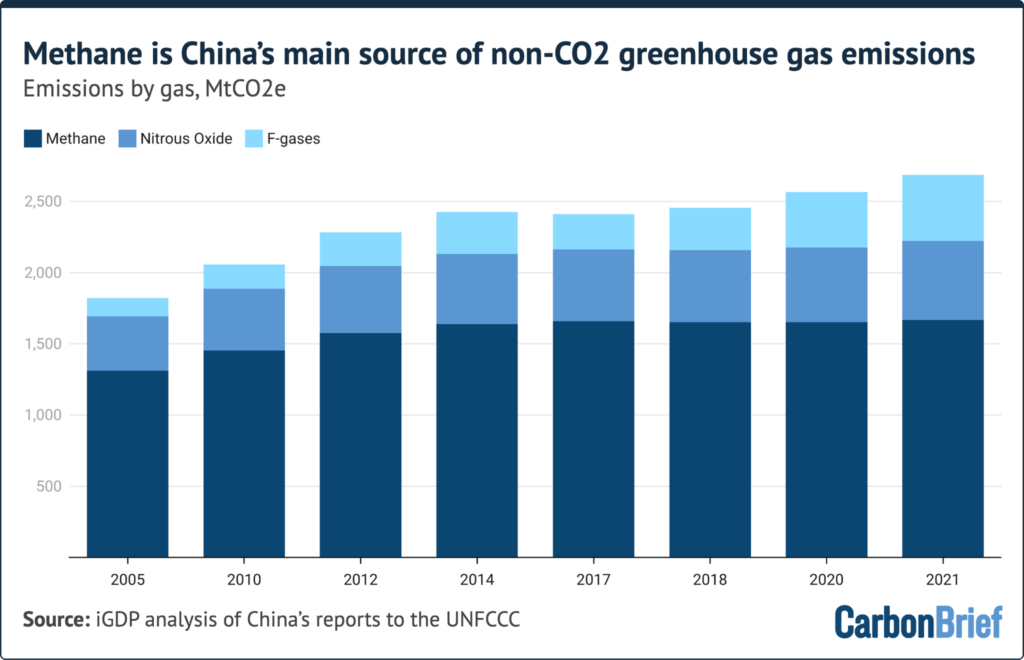
China’s plans to curb these super-pollutants in the five-year period include coal-mine methane utilisation projects, end-of-pipe destruction technologies for HFCs and guidance on the use of catalysts to reduce N2O emissions.
The plan also calls for the recovery and replacement of sulphur hexafluoride (SF6) in power equipment.
For Chen, the plan’s focus on SF6 control is particularly noteworthy. She says the gas is “finally receiving policy attention” and that proactive action is “timely and will help avoid future emissions growth” as China’s power system expands.
What does the plan say about global climate governance?
One of the plan’s clearest objectives for international cooperation is for China to play a more active role in global climate governance.
By 2030, it says China should markedly increase its “influence, guiding power, shaping power and moral appeal” in this area.
It says China’s climate action could also feed into the Global Governance Initiative, a policy initiative aimed at reforming the global governance system.
China will also aim to “build a new narrative on climate governance”, it adds.
Prof Thomas Hale, a professor in public policy at the University of Oxford’s Blavatnik School of Government, writes on LinkedIn that the plan “marks a major rhetorical shift” towards China being increasingly willing to “lead and shape” global climate action.
Another clear focal point for international cooperation is in carbon markets.
The plan calls for China to expand the global influence of its carbon market, such as through international rule-setting, cooperation on standards and by hosting the China Carbon Market Conference.
Qin says China’s more active role in global carbon pricing is already evident in the launch of the open coalition on compliance carbon markets with the EU and Brazil. This coalition is expected to adopt a work plan at the China Carbon Market Conference in September.
Qin also notes that China “could become the world’s largest [carbon] offset buyer” as its energy transition progresses.
The country would, therefore, “benefit from helping shape global rules under the Article 6 framework [for carbon trading under the Paris Agreement]”, she adds.
Related
Interview: Dr Sun Yixian on his new database tracking Chinese climate ‘leadership’

Q&A: What do China’s provincial five-year plans say about climate and energy?
Analysis: China’s new carbon metric leaves Germany-sized gap in its emissions
Q&A: China’s leadership calls for ‘strict control’ of fossil fuels
The post Q&A: What is in China’s new five-year plan for climate change? appeared first on Carbon Brief.
Q&A: What is in China’s new five-year plan for climate change?
About a quarter of the countries signed up to the Paris Agreement are still breaching its rules by failing to submit a new national climate plan, 18 months after the February 2025 deadline.
Forty-five nations had not submitted a plan known as a nationally determined contribution (NDC), according to the Paris Agreement Implementation and Compliance Committee’s (PAICC) newly-published report of its 7-10 July 2026 meeting. One, Oman, has published it since the meeting.
Twelve countries ignored the committee’s repeated attempts to find out why they had not yet produced a climate plan, the report said. They will be invited to the committee’s next meeting, from September 1-4, so it can identify the challenges and constraints they face.
Members of the committee are divided, as they were at their last meeting, on whether to name those countries publicly and will debate the question again in September.
The PAICC does not have any power to punish governments, as building these powers into the Paris Agreement was thought to be so controversial that it could have stopped some governments from joining, experts have previously told Climate Home News.
A key requirement of the landmark 2015 Paris Agreement is that governments publish a more ambitious NDC every five years, setting targets to reduce their planet-heating emissions and outlining their policies to adapt to climate change, in order to meet the accord’s goals on limiting global warming and protecting people from its effects.
The latest set – the third round of plans, with new targets for 2035 – was due in 2025.
Some medium-sized emitters
Countries without an updated NDC include Egypt, Vietnam, Argentina and the Phillippines, all of which rank among the world’s 40 largest greenhouse gas emitters. The rest of the countries are smaller, poorer nations, with many in Africa or the Caribbean.
Some nations have argued that they cannot put together an NDC – which requires a significant amount of work in tracking emissions and consulting on how to curb them across the economy – because of exceptional circumstances. For example, a letter from a Sudanese official to the PAICC committee, seen by Climate Home News, says that the country’s civil war has led to the suspension of its NDC preparation.
-
Southeast Asia’s fragile grids threaten billions in clean energy investment
Renewables developers need reliable electricity infrastructure and stable policies to help the region meet climate goals and surging demand for power -
Santa Marta coalition tested as co-chair Colombia turns back to fossil fuels
Despite a leadership gap, outgoing environment minister Irene Vélez Torres says the anti-fossil fuel coalition can “live without Colombia” -
Egypt seeks to unlock renewable potential to power regional clean energy hub
Europe is investing in Egypt’s bid to position itself as a clean electricity exporter to reduce its emissions and generate a new source of income

The US and Iran are not signed up to the Paris Agreement, although the US submitted a 2035 NDC under the Biden administration before Donald Trump pulled the US out of the UN climate accords.
The committee also expressed concern that the UN’s NDC registry continued to label the climate plans of countries that are no longer party to the Paris Agreement as “active”, according to its report. The US submission has since been archived.
Since the last PAICC meeting in March, ten countries have published NDCs. The committee did not name them but they include India, Algeria, Cameroon and Guyana.
The post Quarter of countries still missing UN climate plans 18 months after deadline appeared first on Climate Home News.
Quarter of countries still missing UN climate plans 18 months after deadline



-
Climate Change12 months ago
Guest post: Why China is still building new coal – and when it might stop
-
Greenhouse Gases12 months ago
Guest post: Why China is still building new coal – and when it might stop
-

 Greenhouse Gases2 years ago
嘉宾来稿:满足中国增长的用电需求 光伏加储能“比新建煤电更实惠”
-

 Climate Change2 years ago
嘉宾来稿:满足中国增长的用电需求 光伏加储能“比新建煤电更实惠”
-
Climate Change2 years ago
Bill Discounting Climate Change in Florida’s Energy Policy Awaits DeSantis’ Approval
-

 Renewable Energy10 months ago
Sending Progressive Philanthropist George Soros to Prison?
-

 Carbon Footprint2 years ago
US SEC’s Climate Disclosure Rules Spur Renewed Interest in Carbon Credits
-
Greenhouse Gases1 year ago
嘉宾来稿:探究火山喷发如何影响气候预测