

Weather Guard Lightning Tech
How Low Cost CMS Stops Catastrophic Damage
We discuss how using continuous monitoring systems (CMS) can prevent catastrophic blade damage from transportation and lightning. We also share insights from GE Vernova CEO Scott Strazik on potential industry growth. And TPI Composites has hit the milestone of manufacturing their 100,000th blade.
Fill out our Uptime listener survey and enter to win an Uptime mug!
Sign up now for Uptime Tech News, our weekly email update on all things wind technology. This episode is sponsored by Weather Guard Lightning Tech. Learn more about Weather Guard’s StrikeTape Wind Turbine LPS retrofit. Follow the show on Facebook, YouTube, Twitter, Linkedin and visit Weather Guard on the web. And subscribe to Rosemary Barnes’ YouTube channel here. Have a question we can answer on the show? Email us!
Allen Hall: On this week’s Uptime Wind Energy Podcast, we discuss how continuous monitoring systems could prevent catastrophic blade damage due to transportation issues and lightning strikes. And that’s a good discussion. GE Renova, CEO Scott Straza sees a soft entree wind market through early 2025, highlighting potential growth in Repowering projects.
TPI composites manufactures their 100,000th blade. Congratulations. And our wind farm of the week is the Jericho Rise Wind Farm in upstate New York.
You’re listening to the Uptime Wind Energy Podcast brought to you by bill turbines.com. Learn, train, and be a part of the Clean Energy Revolution. Visit build turbines.com today.
Now here’s your hosts, Allen Hall, Joel Saxum, Phil Totaro, and Rosemary Barnes.
Allen Hall: in his first appearance at Barclays Conference. Since GE Vernova’s spinoff, CEO Scott Strazik offered a sobering assessment of their wind business while highlighting some positive developments. Now, Strazik, uh, described the onshore wind market.
Is currently very soft, quote unquote, with weak order expectations for the first half of 2025, though he noted opportunities in Repowering projects and certain international markets that could, uh, at least partially offset North American weakness. Now, one of the things that was mentioned during the Scott Straza, um, conference or discussion was that they are doing internal inspections and a lot of them using crawlers, which I, I believe is are from Aeros, where they’re looking at.
Uh, the blades at the factory internally after transportation, and then once they’re up on tower trying to capture any defects that are happening. And this, at, at, when I saw this, I thought, oh, it goes back to Phil’s comment that a lot of damage is actually happening during transportation. And that there maybe they’re trying to, uh, work on that transportation piece or at least be able to make some claims that their blades have been damaged during transportation.
That’s a unique piece ’cause I don’t know any other. OEM that is doing that many inspections at the moment. Joel, do you know any of
Joel Saxum: others that are doing that? I know they should be. Uh, but, but, uh, yeah, same page. I don’t know anybody that actually is. I think it’s a, a bit of a. It’s good market response, to be honest with you, from my opinion, because I mean, you know, we’ve, we’ve seen so many blades that are brand new or within warranty having issues.
Well now you can trace them back. If you get that inspection done at the factory, you put in a, uh, basically a, a. Data point of traceability. If it was good then and it got to site and then all of a sudden there’s a damage, well that happened during transportation and handling. So you can start to say, that was your fault.
This is who should pay for this. These are the things that are being traced. Right. Um, and we did see in a presentation, uh, just yesterday or two days ago from Arons that they were putting statistics to the findings of their internal crawlers. And one of them was rad at like that. 70% from root to tip mark where that handling happens.
There was a spike in damages that they’re finding. And it was mostly all related to handling, so I don’t know of any others. I know it’s actually kind of hard to get anybody as, even as an operator, get any of these OEMs or blade manufacturers to agree to get inspections done of the factory.
Allen Hall: Joel, do you think that some of the damage is caused by the cradles or the saddles that are used during transport, or is it more about just the roughness of the roads and the, the trucks that are used to move the
Joel Saxum: blades around?
Well, it’s ha, it’s handling. Uh, for the most part because if you can eliminate how many times you have to handle anything, you can avoid damages. This is why offshore wind farms have a, a problem as well, because if you’re going to move, even if the factory is key, the factory’s close to keyside for those blades, you still have to get them out of the factory, into the lay down yard to the key, and then craned onto the vessel, and then crane, you know, moved on the vessel and then craned off the vessel.
And if you’re in that Jones Act situation, like we are here in this. States, you’ve got to move them twice offshore. That’s just not good, right? Uh, you don’t want to be, you want to handle these things as minimal amounts as possible, because at the end of the day, they’re fragile. How many blades Allen have we seen where like the trailing edge has like a little.
Crunch in it, you know, a lot too, way too many.
Allen Hall: Rosemary. Is there a lot of structural reinforcement that happens on these longer blades for the lifting points and the transportation points?
Rosemary Barnes: No, they don’t. Uh, I, I mean they definitely, um, consider that, uh, as a potential failure mode, but they’re not.
Necessarily trying to reinforce a blade as they are trying to make the cradle so that it won’t damage the blade and put it in a location where there is some, um, reinforcement there. I’m not a hundred percent sure that it’s like purely one way direction. They might, you know, know where the cradles roughly have to go and make sure that there is, you know, like a bulkhead or something there that can, um, stiffen, stiffen up that area a bit locally.
But they’re definitely, they definitely don’t want, you know, a bunch of extra weight added purely for the. Point of transportation, because then it’s up there on the turbine weighing more than it needs to for 20, 30 years. And that affects every, every other component. The, you know, bearings, the. Um, drive, train the tower.
The foundations all need to be beefed up a little bit extra because of the extra weight.
Allen Hall: Phil, what is the cost to the industry due to transportation damage? I think that number’s big.
Phil Totaro: Yeah. It’s, it’s in the millions and we’ve actually been rerunning our calculations, um, recently. So, um, blade transportation damage is actually now number three.
Um, lightning damage to blades has actually overtaken it as being the number one issue. Um, which may or may not be a good thing, I guess, depending on what area of the business you’re in. Certainly if you’re selling people lightning protection technology, uh, maybe that’s good. Um, but, uh, blade root cracking, uh, is also now a big issue.
But all three of those, so. Lightning damage, blade root cracking and transportation damage are like your top three, uh, issues. And it’s all well into the hundreds of millions of dollars a year, uh, in annual, um, operations and maintenance expenditure just for the US market alone. Unfortunately, we don’t have data on, um, the faults and failure rates in other countries yet.
Um, but based on recent conversations, uh, with my new friends in Australia that. Uh, it looks like we may get some data.
Allen Hall: Alright, so after the break, I want to highlight what Phil was discussing here about the hundreds of millions of dollars in transportation expenses do to damage and what we’re doing about it or what we can do about it.
Don’t let blade damage catch you off Guard the logics. Ping sensors detect issues before they become expensive, time consuming problems. From ice buildup and lightning strikes to pitch misalignment in internal blade cracks. OGs Ping has you covered The cutting edge sensors are easy to install, giving you the power to stop damage before it’s too late.
Visit eLog ping.com and take control of your turbine’s health today. Okay, Phil. If there’s so much damage happening from transportation and lightning, by the way, it does seem like CMS should be used to detect it. Now it looks like GE is actually gonna use the internal rovers from Aeros to inspect them, but are there any CMS systems on a.
Truck or on the cradle when blades are being transported at the minute?
Phil Totaro: No. No way. That’s that’s way more sophisticated than this industry would ever employ. And way more expensive than anything we would ever choose to do if we can’t even get people to put CMS systems on turbines. Um, you know, even 4, 5, 6 megawatt turbines, then we’re not gonna have, you know, any kind of, uh, fault and failure detection on the, the transportation systems themselves.
Not to say that that wouldn’t probably catch certain issues and, you know, you can certainly put like strain gauges and accelerometers on the truck, uh, or on a cradle. Um, and some people may in rare occasions use things like that. Um, but it’s not standard
Joel Saxum: for sure. Yeah, Phil, I was gonna mention that. Not standard as well, right?
So in Hamburg, two years ago, I ran into a company that was doing just this. They had a sensor that was about the size of a cell phone, and it’s really basic sensor, to be honest with you. It’s just GPS communications, a battery, and then an accelerometer and a gyro inside of it. And they were, it’s the same kind of stuff that’s used to track fleet vehicles, right?
Like, oh, this is this vehicle, this is, so, you can see where it is if they hit the brakes hard, these kind of things. But they were wanting to put them, that was their goal. We’re gonna put ’em on turbine blades from the factory. So locationally geographically, we can track them, uh, wherever they go. And then also if they hit a bump hard, if they do something, if they get dropped or whatever, you can see the different G-forces on the blades themselves.
But. You know, when I was speaking with him, I was like, that’s cool. I said, probably the locational part, because at the, to be honest with you, you’d have to put a half a dozen of these things on different parts of the blade to start to see if the root bending moments moved a bunch or something of that sort.
And at the end of the day, you’re not gonna get, like, blades don’t show up cracked in half, you know what I mean? Mostly it’s lifting damage or something like that. So the accelerometer thing, I don’t know if that’s really a valid, but people have tried to do it. It just has never, could, never caught on.
Allen Hall: Okay, Rosemary, when a CMS system should be installed, there must be some sort of criteria here, and I want, I want to get your thoughts about this because there is a lot of discussions about CMS and monitoring of blades and monitoring of gear boxes, and there’s a spec gonna come out in the next, I don’t know, it’s a couple of weeks, I suppose, and.
There is so much discussion about it, but I want to hear some sane thoughts about when you should use a CMS system.
Rosemary Barnes: You know what? I think that it’s got a lot to do with, um, the amount of. Um, spare time that your operators have on their hands, people that working in operations and maintenance and, um, all of those sort of, you know, like afterwards things, um, they’re so pressed for time.
They do not have enough time to do all of the things that they already know they have to do. They kind of don’t want to know about additional things. And so when you say how much should you have, they should have that CMS because it will ultimately make their job smaller. Right? That, um. You that that will instead of.
Having to replace, you know, some gearbox component or some bearings that means, you know, like a shutdown of a turbine for a long time and all of a sudden an emergency to, you know, get this fixed quickly. Instead of that, they would be able to, you know, monitor across the fleet. They would know, okay, we’ve got a few that are coming up and we’ll need to be replaced soon, so we’ll make a campaign and we’ll get them all together.
But, um, yeah, so that’s, that’s what should be happening. The industry would work much smoother, but I know that the reality of it is that people are too pressed to start thinking about stuff like that.
Allen Hall: Phil, what are the top four or five money losers? On turbines at the minute?
Phil Totaro: Uh, well, generally blades, I mean, I can’t, you know, again, I can’t really categorize everything, um, specifically ’cause we don’t have enough information about all the faults and failure modes, but blades number one, uh, gear boxes, particularly bearings and anything having to do with kind of the drivetrain overall, uh, main shaft, et cetera.
So that’s all kinda lumped in there. Um. Jaw bearing and pitch bearing. Those are, those are kind of your top three or four.
Allen Hall: Okay. Let’s look. Let’s look at sources of problems. It was lightning’s number one, right? In terms of sources of problems
Phil Totaro: for
Allen Hall: blades? Yes.
Phil Totaro: And for tower. And for tower collapses, potentially, yes.
I mean,
Allen Hall: right tower collapses. Catastrophic lightning has gotta be close to the top. The insurance companies will tell you that.
Phil Totaro: Uh, yeah. Again, I don’t have the data to say that if an insurance company will tell you that, then I’ll believe it because that seems logical that, you know, I mean, how a blade is even able to strike the tower to kind of knock it down is if the blade’s got some kind of damage and there’s a load imbalance, um, it’s hard to just get a load imbalance from some other.
You know, like you’re not gonna get a load imbalance from leading edge erosion, let’s put it that way. I mean, you’d have to have ridiculous leading edge erosion to have a load imbalance on the blade or the rotor
Allen Hall: catastrophic. The things that will take down turbines today are light. It gotta be lightning.
It’s gotta be number one. It’s not even a close second to that, I don’t think. Some sort of serial defect in blades. De bonding. Yeah, de bonding, right. Something that’s just. Almost immediate, but uh, but, but a structural problem, right? A structural problem that’s probably a factory issue, a quality issue.
After that, it gets pretty consistent, right? You’re talking about gearbox failures, which are really. Time driven, some sort of bearing failure
Rosemary Barnes: loose bolts in the tower. Right? Haven’t we seen a few of, a few of those
Allen Hall: root blade root cracks, which are a manufacturing issue and yeah. The tightening of bolts.
Rosemary Barnes: Yeah. Root inserts,
Allen Hall: right Root inserts,
Rosemary Barnes: detaching. Also foundation problems can cause it. Um, and, uh, could I just, uh, go off on a, a tiny tangent that you said, you know, lightning obviously I was talking to somebody recently, um, ’cause there was a, a tower collapse in Australia and they’re saying it was probably lightning.
And anecdotally in the Australian wind industry, people are rolling their eyes going, oh, come on. As if that’s the case. So I don’t think it’s necessarily obvious. Um, I mean, I, I know that we all, we all know. That anything that can damage a blade so much that it, you know, falls in half or folds in half, or, um, you know, gets a big crack so it hits a tower, then you’ve got a big enough imbalance that your tower’s gonna start wobbling around like a noodle and then it’s gonna, you know, it’s gonna fall over.
Right. Um, so it doesn’t, it’s not that the lightning. Struck the tower down, you know, even though, I mean, lightning can do that, we’ve all seen trees fall down right. From being struck by, struck by lightning. So I guess it, it, it could happen, but that’s not what the failure modes we’re talking about, right?
It’s, it’s any, anything that can make the blades, um, damage, get damaged so much that they have strike the tower or a big chunk falls off and sets the, sets the tower wobbling.
Allen Hall: I, I totally agree. And if those are the big money losers. The why are they’re not CMS systems installed to protect against the million two, four, $5 million loss.
We’re focused on, weirdly enough gearbox monitoring, which is great, you know, but it, it is a time, long time derivative problem. It’s gonna degrade slowly. And we know what those curves are like, is just like leading edge erosion, right? So why wouldn’t you do the simplest. One first lightning transportation lifts.
Then you’re looking at sort of serial defects. I think if, you know you got a, a root cracking issue in a particular kind of blade, then we put a CMS on it. But the, the gearbox monitoring and the oil monitoring all great, but are they, they’re not, wouldn’t be top priority in terms of money. Saved. Right.
Rosemary Barnes: But I think it’s in terms of how easy it is to monitor these things, because I mean, maybe there are blade monitoring solutions today, I, I, maybe I’m not a hundred percent up to date, but at least until recently, there were ways to monitor it, but not cheap and not.
Easy to actually monitor. You know, like it’s really hard to say, like, you know, um, wind turbines are, are, are cracking and stuff all the time. It’s like impossible to say, when is a crack gonna turn into something that I need to worry about? And unless you’ve got strain sensors like covering a blade like a net, you’re not actually gonna be sure that you’re gonna catch every single big crack that might happen.
So I think that that one. Hard. Lightning I know is easy, but I don’t think it’s well understood how easy it is to monitor for lightning.
Allen Hall: It’s a couple hundred dollars per turbine, right? Today. It’s cheap compared to a drone inspection, but I don’t think that’s
Rosemary Barnes: well
Allen Hall: known. Rosie would, would you say that the, all the cracks and the leading edge erosion and even some of those serial defects, because we’ve have drone inspections happening in some cases mandatory quarterly, quarterly.
Yeah, quarterly. Would you, would you put a CMS system in, or we just rely on the internal external drone inspections as your quote unquote CMS?
Rosemary Barnes: Well, I, I mean, I don’t think, I think you might end up with a false of a sense of false security by putting CMS to monitor cracks that were identified in drone inspections.
I mean, if it’s a big enough crack to be worried about, it needs to be getting repaired right away. Um, it, and then there’s the next category down where. You wanna monitor it and see how it grows, then? Yeah. I mean. I dunno, it’s hard to say. I can see CMSI, I don’t know if even know if it counts in CMS ’cause CMS to me sounds like a, you know, like a monitoring while normal operation is happening.
But when you know you’ve got a bad crack or maybe you’ve got like a serial defect issue and you know you’ve got 10 affected turbines in your site and it’s, you know, taking your long time to get, maybe you need even replacement blades or you know, you need to take them down and do a month long repair on each one.
Um, sometimes you would really like to keep badly damaged blades operating. If possible, and then I can definitely see a case for you, you know, you’ve got an, a specific area that you’re monitoring, put some, there are systems that you can put in place to monitor a known one location of a, a crack. And then yes, definitely then you can, you know, run, you don’t have to be as cautious about shutting down your whole potentially affected, um, you know, uh, uh, population of, of turbines and, and blades.
But beyond that, I actually, I don’t think that. Drone inspections are good enough and definitely not on their own. I mean, they don’t capture all of the inside stuff. Even the internal inspections don’t capture all of the inside stuff. I just think that you’re not actually like, you’ll get a little bit closer.
Um, to knowing what’s going on with your blades, but not close enough to not have to worry about it.
Joel Saxum: Yeah. I think that there’s a, there’s a couple of new advancements in, in CMS for blade cracks as well, so of course there’s, there’s multiple of these solutions actually out there, right? Uh, we have, we have a good friend of the show that’s installing cameras inside of.
Blades to monitor cracks right now too. Uh, but also Aeros was doing that. They talked about it at Blades USA this week, uh, putting cracks in or cameras into monitor specific cracks. But there’s also been advances in CMS at that really minute level of ac accelerometers and vibration where, so a blade is inherently stiff, you know, the frequency of vibrates that if you start to get a crack in it.
It reduces the stiffness, so the frequency changes in the whole blade. So it’s one of those things where like, if that happens, then it’s a flag come and look at me, I think. But, but I think where we’re at here now is this, Alan, you raised a great point with this conversation because if you were to ask Phil, Phil, what are the numbers for failures in the most expensive ones?
10 years ago, it would’ve been gear boxes. So in, in response to that, the industry was like, we need to monitor gear boxes. We need to monitor oil, we need to monitor all this stuff. And we have solved that. Not solved, but we have greatly reduced the cost of that problem as an industry. I. Right. So now we’re at the next stage.
It’s like the industry has forgot that that’s how we solve that problem. And now we have the next iteration of problem, which is blades, and we have solutions for it, but nobody’s implementing them.
Phil Totaro: Well, and the other, the other real issue for blades was about 15 years ago when a lot of companies were developing very sophisticated.
You know, blade monitoring systems. They had, you know, fiber Bragg sensors that they wanted to put into everything. And I mean, but these, these systems were all so fantastically expensive and unfortunately unreliable, particularly as it, as these systems and the sensors on the blades interacted with lightning.
Um, you know, you, you end up with. Uh, you know, a boondoggle that doesn’t really pay for itself. Uh, and so a lot of companies were just like, you know what, we’ll rely on drones. Which, you know, even again, going back 10 years, were cheap and still relatively are, um, to, to do that kind of an inspection as opposed to having a full fledged CMS system integrated into the blade as CMS technology gets cheaper.
That increases the rate of adoption. Um, the reality is that the industry still needs solutions, but it needs more cost effective and targeted solutions. It sounds like
Allen Hall: That’s what I’m saying is that I can go back to Phil’s point. You gotta have RROI, high, ROI on any kind of CMS. You put on your most expensive.
Losses are catastrophic. Go cover those at a minimum. And the cost of those sensors to catch the catastrophic before they turn catastrophic are incredibly low. They’re in the hundreds of dollars well below a thousand dollars. Lightning ones are about $250 at the minute. They’re crazy low, they’re way less expensive than pretty much any other CMS on, on the turbine right now.
Put them on, at least you’re gonna. Protect your
Joel Saxum: huge downside loss. Yeah. Think about the simple math on that one. Alan. 250 bucks a turbine for lightning sensors so you know exactly when a tower got struck. And if you use them properly in operations, you can, you can instrument a thousand turbines. For the cost of one insurance deductible.
Allen Hall: As Wind energy professionals staying informed is crucial, and let’s face it difficult. That’s why the Uptime podcast recommends PES Wind Magazine. PES Wind offers a diverse range of in-depth articles and expert insights that dive into the most pressing issues facing our energy future. Whether you’re an industry veteran or new to.
Wind, PES Wind has the high quality content you need. Don’t miss out. Visit PES wind.com today. CPI composites, A major supplier in the wind energy industry has celebrated the production of its 100,000. Uh, the milestone highlights the company’s longstanding role in supporting the growth of wind energy through, uh, blade manufacturing across multiple global facilities.
So, you know, obviously you do the math. 100,000 divided by three is like 33. Thousand turbines plus. That’s a lot of wind turbines. I was trying to do the math on where most of those blades were built. That, my guess is that a significant portion were built or, or are built right
Joel Saxum: now down in Mexico. Right?
Yeah. Everybody you talked to is like that. Yeah. That factory. That factory in Mexico. I think there’s three factories in Mexico. Two. I know there’s two. I think there’s three, but to me that seems, doesn’t that I, I honestly con congrats to TPI for the a hundred thousand to play, but. 30. Then when you do the math, Alan, you said 33,000 turbines.
There’s almost 500,000 turbines in the world right now. That seems low. I would think that TPI would have a larger share.
Allen Hall: Yeah, it does seem low. I, I would say they would have a lot more, so the a hundred thousand doesn’t make sense except that they were kind of, Johnny come lately in a sense that, that they were doing small production runs for a while.
Mostly in the States when they started, they were making blades, I think in Rhode Island for a while. And then once it got to scale mostly in Mexico and Turkey and some other places, then it really picked up, right?
Phil Totaro: Yeah. And then, but then they mothballed the, the Newton, Iowa factory in 2021 to shift production down to Mexico and India, where it was cheaper cost of labor and, um, you still had access to, to raw materials.
Um, but. They’re now talking about, in part because of the, the threat of tariffs that are to be imposed on, on Mexico, potentially. They’re talking about restarting the, or accelerating the restarting of the Newton, Iowa factory, um, specifically to meet the demand for GE
Joel Saxum: Renova. Oh, that’s cool. I mean, ge like the, the article you said today, Alan Scott Straza said a softening of the market there, but they still have order book.
They still gotta create a lot of blades. I mean. They’re we’re, we’re, we’re built. Just think about the Sun Zia project. They’ve got hundreds of turbines just for that one project that they’ve gotta build. So, uh, yeah, I think maybe the TPI thing in my mind about why I thought it would be a bigger market share is just because a lot of the projects that, uh, that Alan, you and I, or our compadres in the industry work on.
I have TPI blades in ’em. So maybe that’s just why my mind was going that way.
Allen Hall: Well, and our friends at Vestas have opened up another presence in the United States. They opened some offices in Houston, Texas to much a great fanfare. Uh, they used to have an office in Houston years ago, as Phil has pointed out before we started recording today.
Uh, but they’re back at it and it looks like they’re trying to get more of a foothold into the United States. They have about. 500 employees in Texas at the minute, but it does seem a lot of the manufacturing and production is coming out of Colorado. And obviously as Joel pointed out, you know, sun Z is a big project that Vestas is also involved with.
Uh, so what does the growth outlook look like for Vestas and why the move right
Joel Saxum: now? I, I don’t know what the growth outlook looks like, but I do know that being a person who lived in Houston and works and plays there still. There’s so many good engineers in Houston, and it’s not just mechanical electrical engineers.
It’s every sort of engineer you can imagine, and a lot of it from that oil and gas world, right? So Houston as the. Energy capital of the world for oil and gas. Now that city is starting to rebrand itself as the energy transition capital of the world. They’re all the trade organizations are trying to do this.
They’re grabbing people at oil and gas to be engineers. So there’s a lot of really good, smart people that understand the energy industry in Houston. If you’re gonna put an office in the United States and as a wind company, it’s a good place to be or or to do an event. Uh, this week’s wind farm of the week is the Jericho Rise Wind Farm.
It’s an EDPR wind farm and it’s really close to the Canadian border, so it’s up in the northern part of New York state. And we’ll do a little bit of a wind farm, uh, by the numbers this week for the wind farm of the week. So, uh, this wind farm 37 S-G-R-E-G 1 14 2 0.1 megawatt machines, uh, that creates a total of 77.
Point seven megawatts, uh, coming outta this wind farm. But the scope of work for some of the build out was, is kind of interesting. 55, 50 5,000 linear feet of access. Roads, 175,000 tons of sub based placed for roads and pads, 3.6 million pounds of rebar. Procured and installed for foundations. 23,300 cubic yards of concrete.
Procured and installed 60,000 cubic yards of backfill, a hundred acres of trees. Uh, $132 million. Went into this wind farm with, uh, 76 construction jobs and six jobs created locally. So it gives you a little bit of the scale of what it takes to. Build one of these wind farms, uh, and this is 37 turbines, right?
We’re seeing wind farms a hundred, a hundred fifty, two hundred, three hundred, even more than that for wind turbine numbers. So the, the size and scale of these things is, is growing and growing. So Jericho Rise Wind Farm, up at upstate New York by the Canadian border from EDPR, you are the Wind Farm of the week.
And that’s gonna
Allen Hall: do it for this week’s Uptime with Energy podcast. Thanks for listening. Give us a five star rating on your podcast platform and subscribe it in the show notes below to Uptime, tech News or Substack Newsletter. And if you haven’t joined us on YouTube yet, we’re getting close to a million subscribers.
So you. Better click in there before we cross that magic number. We have to have some sort of giveaway at a million if we can figure out who that person is. That would be kind of cool. So we’ll see you here next week on the Uptime Wind Energy Podcast.
https://weatherguardwind.com/low-cost-cms-damage/

 Have you ever wondered why every dictator in human history follows the exact same playbook? Check this out
Plato nailed this 2400 years ago, and it’s been on “rinse/repeat” ever since.
 On average, I meet perhaps 50 K-12 teachers each year, and I often ask them: What is the biggest challenge you face that impacts your ability to connect with and educate your students?
Here’s a rough tabulation:
Screen time, how it robs kids of their ability to pay attention, impedes social interaction, and makes parenting more difficult: 80%
Everything else combined: 20%
Maybe this is a cynical viewpoint, but it seems like that world of today revolves around the mega-corporations profiting by punishing their customers.
In this case, we have the tech giants ruining the lives of our children. Elsewhere, we have healthcare industry driving people into bankruptcy, Big Oil ruining our planet, the gun lobby murdering our kids, and, of course, an ultra-corrupt government looting our treasury to pay off billionaire donors.
Note that this wasn’t the case when we boomers were growing up 60 years ago. This is a distinctive shift from the 1960s when corporate America was focused on things like color TVs and the Ford Mustang.
Renewable Energy
Is a Team of Is a Bunch of MAGA Thugs Beating the Snot Out of a Woman a New Low, or Is it What We Now Need to Expect?
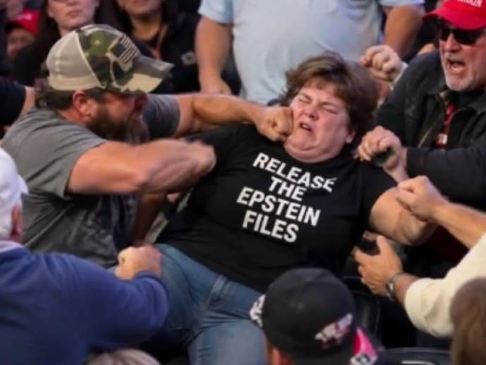 Just when we think there is a bottom, the United States sinks just a bit lower. It’s our brand nowadays.
That’s quite a left cross this thug delivered to this helpless female protestor.
It wasn’t too long ago that beating up women was taboo in America. My 11-year-old, sixth-grade son saw a male classmate of his badly bruise a girl by pushing her hard down to the ground–and proceeded to punch him in the mouth. A fellow father witnessed the scene and told me, “Your son’s fist was in that kid’s teeth within a fraction of a second.”
I had brought him up to avoid violence and achieve peaceful resolutions to conflicts, but I couldn’t fault him here.
What a disgusting bunch of turds we’ve become.

Greenpeace delivers 47 metre-long petition with half a million signatures to Woodside HQ following major gas protest

