

Connect with us

Published

on

Australia is quickly becoming a leader in renewable energy, and one primary reason is the growth of commercial solar power systems 

These systems help businesses get clean, renewable energy while cutting costs and benefiting the environment. A commercial solar installation guide can help businesses get further into the journey.  

They come in different sizes and setups, but their main goal is to help businesses switch to solar energy and get good returns on their investment.   

More Australian businesses are investing in solar energy because it lowers electricity costs, reduces greenhouse gas emissions, and reduces dependence on the primary power grid.  

The installation process has also become more manageable, and different financing options are available to suit other businesses.   

Key Points to Remember

  • Commercial solar is an essential part of Australia’s renewable energy push.   
  • It includes solar panels, inverters, mounting systems, and monitoring tools.   
  • Businesses benefit from lower energy costs, reduced pollution, and more energy independence.   

Understanding Solar PV Technology

Solar photovoltaic (PV) technology allows homes and businesses to turn sunlight into electricity. As solar PV systems become more affordable and effective in saving energy and protecting the environment, more businesses are using them.   

Commercial solar systems are more significant than home solar systems so that they can produce more energy.  

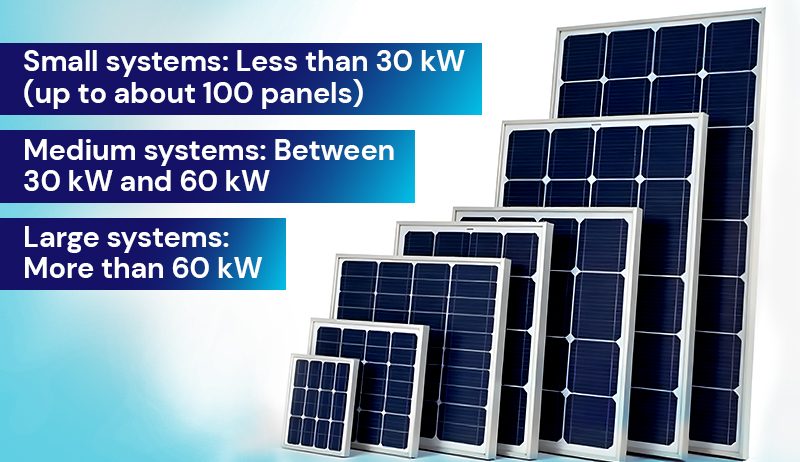
For example, a typical home system in 2025 is around 6.6 kW, with about 18 panels. Business systems, however, can be much more significant and fall into three categories 

solar installation

  1. Small systems: Less than 30 kW (up to 100 panels)  
  2. Medium systems: Between 30 kW and 60 kW 
  3. Large systems: More than 60 kW

Since commercial solar systems are more significant, they need more panels and can produce more power.  

This is useful for companies with high energy needs or large roof spaces. However, they also come with extra costs and engineering requirements, especially when connecting to the power grid.   

Solar technology has significantly improved, making commercial solar panels more efficient. Ten years ago, the best commercial solar cells were 14–16% efficient.  

Still, Australian companies have since developed even better technology, allowing businesses to generate more power from the same amount of sunlight.   

To make smart decisions about solar power, businesses need to understand how solar PV works, how commercial systems differ from home systems, and how technological advancements can help them save money and support sustainability. 

How Commercial Solar Works| Main Components of a Commercial Solar System

Solar Panels

Solar panels are the most essential part of a commercial solar system. They turn sunlight into electricity using a process called the solar effect. There are two main types of solar panels used in businesses:   

  • Monocrystalline panels: These are more efficient but usually more expensive.   
  • Polycrystalline panels: These are more affordable but slightly less efficient.   

Choosing the right type of solar panel depends on budget, energy needs, and location. Picking the best option can help businesses save money and get the most energy from their system.   

Inverters

Inverters are essential because they convert the electricity generated by solar panels from direct current (DC) into alternating current (AC), which can be used by appliances and sent to the power grid. There are two common types:   

  • String inverters: These are affordable and best for large systems with even sunlight.   
  • Microinverters: These are more efficient and ideal for setups where some panels get shade at different times. 

Battery Storage

Adding battery storage is not required, but it can make a solar system more efficient and help businesses use more solar power.  

Batteries store extra energy from the solar panels so companies can use it later, such as at night or during peak hours when electricity prices are higher. Choosing the right battery depends on energy needs, budget, and warranty options.   

A well-designed commercial solar system can lower electricity costs, reduce carbon emissions, and increase property value.  

To get the best results, businesses should choose the right solar panels, inverters, and batteries and work with a trusted solar installer for long-term efficiency and reliability. 

Must-Read Commercial Solar Installation Guide

In recent years, more and more businesses have started looking for ways to reduce operational costs while making environmentally conscious choices.  

One of the most effective solutions is solar energy. Let’s look at how businesses can leverage this with a commercial solar installation guide:  

Assessing the Business’s Energy Needs

Before any physical installation begins, a detailed assessment of the business’s energy consumption is essential.  

Solar experts, like Cyanergy, evaluate a company’s peak electricity consumption and the amount of energy that can be replaced with solar power.  

The roof’s structural integrity is essential in determining whether it can support solar panels. Engineers inspect the available space and check for issues, such as nearby trees or buildings that may create shade and reduce the panels’ efficiency.  

These early evaluations help decide the size of the solar system and whether additional reinforcements are necessary to support the installation.   

Designing a Custom Solar System

Once the assessment is complete, installers begin designing a solar system tailored to the business’s needs.  

Every commercial building has a unique layout, so a one-size-fits-all approach does not work. Instead, experts create a custom design that ensures the solar panels receive maximum sunlight exposure throughout the day.   

The engineers also consider the visual aspect of the installation. While functionality is the primary concern, aesthetics also play a role, especially for businesses that want to maintain a professional or modern look.  

Additionally, all designs must comply with Australian energy and safety standards, ensuring the system meets regulatory requirements.   

If the business is interested in energy storage, this is the stage where battery options are considered. Batteries allow businesses to store excess energy for later use, providing a backup power source during high-demand periods or at night when solar panels are inactive.  

Navigating Permits and Regulatory Approvals

The transition to solar energy involves more than just technical planning—it also requires meeting various legal and regulatory requirements.  

Businesses must obtain several permits before proceeding with installation. These include approvals from local councils, permissions for grid connection from energy providers, and compliance with safety regulations.   

Handling this paperwork can be overwhelming for business owners, but professional solar installation companies often handle these requirements on their behalf.  

Their experience in dealing with local authorities ensures that all necessary permits are obtained efficiently, avoiding potential delays in the installation process.   

Selecting the Right Solar Equipment

With permits in place, the next step is choosing the best components for the solar system. The market offers various solar panels, inverters, and battery storage solutions, each varying in efficiency, durability, and cost.   

Australia’s climate plays a key role in this decision. The state experiences a mix of sunny and cloudy days throughout the year, making selecting high-quality solar panels that can perform well even in less-than-ideal conditions essential.  

Equally important is selecting the right inverter, the device responsible for converting the direct current (DC) electricity generated by the solar panels into alternating current (AC) electricity, which is used to power business operations.  

Choosing the right inverter ensures that the solar system operates at peak efficiency. Cyanergy offers the best solar packages for your business. Get a free solar quote! 

The Installation Process

Once everything is planned and approved, the actual installation process begins. Professional solar installers mount the panels onto the roof, positioning them at the optimal angle to capture as much sunlight as possible.   

After securing the panels, electricians handle the wiring and install the inverter. If the business has opted for battery storage, this is also set up at this stage.  

Safety is a top priority during installation, and strict guidelines must be followed to prevent electrical hazards.   

Inspection and System Activation

Before the system can officially go live, it must pass a final inspection. Once it does, an Electrical Safety Certificate confirms that it is safe to operate.   

After approval, the system is connected to the grid, and the business can begin using solar energy to power its operations.  

solar energy

Ongoing Monitoring and Maintenance

Even after installation, maintaining the solar system is crucial for long-term efficiency. Modern solar systems have digital monitoring tools that allow businesses to track their energy production and consumption in real time.  

These tools provide insights into the amount of power generated, its use, and whether adjustments are needed.   

Regular maintenance is also necessary to keep the system running at peak performance. This includes periodic inspections to ensure the panels remain clean and free from dirt or debris that could block sunlight.  

Investing in a commercial solar power system offers numerous benefits beyond reducing electricity bills. By relying on renewable energy, businesses can significantly lower their carbon footprint, contributing to a cleaner environment.  

Solar-powered businesses also gain greater energy independence, protecting themselves from fluctuating electricity prices and potential power outages.   

Moreover, a solar energy system can increase the overall value of a commercial property. Buildings equipped with solar power are often more attractive to buyers and tenants, making them a long-term investment.   

Switching to solar energy is a big step for any business, but with Cyanergy’s support, you can expect a smooth transition.  

Your Solution Is Just a Click Away

The post A Must-Read Commercial Solar Installation Guide in Australia appeared first on Cyanergy.

https://cyanergy.com.au/blog/a-must-read-commercial-solar-installation-guide-in-australia/

Continue Reading

Renewable Energy

MotorDoc Finds Bearing and Gearbox Faults in Minutes

Published

on

Weather Guard Lightning Tech

MotorDoc Finds Bearing and Gearbox Faults in Minutes

Howard Penrose of MotorDoc joins to discuss current signature analysis, uptower circulating currents wrecking main bearings, and full drivetrain scans in minutes. Reach out at info@motordoc.com or on LinkedIn.

Sign up now for Uptime Tech News, our weekly email update on all things wind technology. This episode is sponsored by Weather Guard Lightning Tech. Learn more about Weather Guard’s StrikeTape Wind Turbine LPS retrofit. Follow the show on Facebook, YouTube, Twitter, Linkedin and visit Weather Guard on the web. And subscribe to Rosemary Barnes’ YouTube channel here. Have a question we can answer on the show? Email us!

Howard Penrose: [00:00:00] Welcome to Uptime Spotlight, shining light on wind energy’s brightest innovators. This is the progress powering tomorrow.

Allen Hall: Howard, welcome back to the program.

Howard Penrose: Hey, thanks for having me.

Allen Hall: It’s about time everybody realizes what motorDoc can do. There’s so much technology, and I’ve been watching- Yeah … your Chaos and Caffeine podcast on Saturday morning, which are full of really, really good information about the motorDoc as a company, all the things you’re doing out in the field, and how you’re solving real-world problems, not imaginary ones- Yeah

real-world problems. Oh, yeah. Yeah, and

Howard Penrose: whatever annoys me that week. Exactly. And, and whatever great coffee I’m trying out. Yes. Except for a few. We’ve had the ReliaSquatch down our- Yes … um, a couple of times. Uh, yeah, no, I, I enjoy it, and we gotta get you on there sometime. I don’t do- I, it- … a lot of interviews other than an AI character we put in.

Allen Hall: It’s a very interesting show because you’re [00:01:00] getting a little bit of comedy and humor and s- Yeah … and a, and a coffee review, which is very helpful because I’ve tried some of the coffees that you have reviewed, that you’ve given the thumbs up to. But if you’re operating wind turbines and you’re trying to understand what’s happening on the drivetrain side, on the generator, everything out to the blades even, main bearings, gearboxes- Yeah

all those rotating heavy, expensive parts, there’s a lot of ways to diagnose them-

Howard Penrose: Yes …

Allen Hall: that are sort of like we can look at a gear, we can look at a joint, we can look at roller bearings, whatever, but motorDoc has a way to quickly diagnose all of that chain in about- Yeah … 15 seconds.

Howard Penrose: Well, a little longer than 15 sec- more like a minute.

A minute, okay. It feels like paint drying. But- Uh, in any case, yeah. Uh, uh, and, and what’s kind of funny is, um, back in the ’90s, uh, EPRI actually accidentally steered the technology away from its [00:02:00] core purpose, which was in 1985, um, NAVSEA, the US Navy, had done research on using current signature analysis for looking at pumps, fans, and compressors, the bearings, the belts, the components, all the rotating components using the motor as the sensor.

Not too much different than we are now. I mean, mind you, we got better resolution now, we’ve got, uh, more powerful– I mean, I look at my data from the ’90s, and now it’s completely different. Um, and then Oak Ridge National Lab, same thing, bearings and gears in motor-operated valves. So in 2003, we were the first ones to apply electrical and current signature analysis to some wind turbines in the Mojave Desert.

Wow. Yeah. So, um, nobody had tried it before. Everybody said it couldn’t be done. And, uh, that was a bad thing to say to me because- … it meant I was gonna get it [00:03:00] done. Right. At that time, um, we were looking at bearing issues and some blatant conditions with the, um, with the, uh, generator using a technology called Altest, ’cause I was with Altest at the time.

And, uh, I had taken an EMPath software and blended it with a, a power analyzer, and they still have that tool to this day. I was using that technology all the way through 2015. 2016, I should say. And then- And then switched over to the pure EMPath, which was more of an engineering tool. And then more recently, in 2022, uh, made the decision to ha- to take all the work we’d done on over 6,000 turbines, uh, looking at how we were looking at the data and what we were doing on the industrial side, and took a, uh, created a current signature analyzer that would do one phase of current to analyze the entire powertrain.

Allen Hall: So when you tell [00:04:00] operators you can do this magic, I think a lotta times they gotta go, “

Howard Penrose: What?” Oh, yeah, yeah. They don’t understand it because they’re used to vibration- Right … which is a point analysis system. Right.

Allen Hall: Vibration at this- Yeah … particular location. Yeah. One spot- Even if it’s- … or a couple

Howard Penrose: spots

triax, they’re reading through material, up through a transducer. Hopefully, they put it above the bearing and not in the middle of the machine like everybody is now, because everybody’s trying to sell a sensor. Right. True. They’re not selling a- they’re not selling accuracy. They’re just selling sensors.

Right. So, um- Yeah … you know, uh, I, I’ll, I’ll even talk about one of the companies here. We’ve got Onyx here, and they do it right. I mean, they’ve been doing it right pretty well because we’ve been doing some of the same towers they’re on, and we can match the data they’re getting. Oh, good. Right? Yeah. Uh, so but they get it in multiple spots, and there’s areas they can’t quite reach, so we’ll detect those areas as well.

So it’s a good melding of two technologies.

Allen Hall: Oh, sure. Sure,

Howard Penrose: sure. You know what I mean? Yeah, yeah, yeah. So when you have electrical signature and you have vibration, but in [00:05:00] cases if you don’t have vibration, we’re a direct replacement.

Allen Hall: Because the generator- I

Howard Penrose: dare say that.

Allen Hall: Yeah. Whichever–

Howard Penrose: I dare say that, um, with- Well, the

Allen Hall: generator is acting as the sensor.

Howard Penrose: The air gap. The air gap in the generator s- specifically, yes. Yeah. Generator, motor, transformer. Right.

Allen Hall: Yeah. So any of those- Mm-hmm … you can clamp onto, look at the current that’s on there. Everything that’s happening on the drivetrain, in the gearbox, out on the rotor- Yep … main bearings, all of that creates vibration.

Creates a torque. T- a, a torque. Yeah. Yes, more exactly a torque. Yeah. And that’s seen in the generator, in the current coming out of the generator. Yes. So those signals, although minute, are still there. Yes. So if you clamp onto that current coming out of the generator, you’ll see the typical AC sine wave sitting there.

But on top of that- Is all the information about how that drivetrain is doing

Howard Penrose: Absolutely, and everything else. Anything electrical comes through [00:06:00] that. So what you do is just like vibration, you do a spectral analysis. So every component has a frequency associated with it, just like vibration. It’s, as a matter of fact, I, I keep having to try to explain to people electrical and current signature analysis is no different than vibration analysis.

It’s the same concept. We use the same tools. The signature looks just a little different. It’s a little noisier, um, but you need that noise in order to see everything. But we have a time waveform, and instead of, um, inches per second or millimeters per second, whatever, you know, uh, velocity, acceleration, and displacement, uh, what we end up with is decibels is the optimal method.

You can look at straight voltage signatures at those points or, or current signatures, but the values are so small that you have to look at it from a logarithmic standpoint. Right. There are some benefits to it versus vibration, and there’s some things that aren’t as good as vibration. [00:07:00] So, you know, we, we do…

You have to… Any technology is gonna have their strengths and weaknesses. Sure. So we will see everything all at once. Load doesn’t matter. Right. Speed doesn’t matter. It’s… Only reason speed matters is the location of the frequencies. Uh, so the higher the resolution, meaning the longer you take data, the less chance you have on a lightly lo- loaded machine of blending the peaks together.

Right. Um, on the flip side, if I have two bearings turning at the exact same speed, I couldn’t tell you which one it is. Because they’re the same. Right.

Allen Hall: And the mechanical features of that bearing is w- what creates the signal that you’re measuring. Exactly. So if a bearing has five rollers versus 10, just imaginary thing.

Yeah, yeah. Five rollers versus 10 has a different electrical signature, so you can determine, like, that bearing, that 10 roller bearing- Yes … has the problem, the five is fine. Yes. Yeah. That’s the magic, and I think people don’t translate the mechanical world into the electrical world. That that’s what’s [00:08:00]happening.

They,

Howard Penrose: they don’t because, because what’s happening is they named it wrong.

Allen Hall: Yes.

Howard Penrose: A majority of our users are mechanical folks. Sure. Our vibration analysts and stuff like, ’cause they know how to look at the signatures. Right. Everybody tries to force it on their electrical people, and electrical people go, “We don’t know what this is.”

Yeah. And it’s, it’s, it’s a matter of that training and, and, you know, in the electrical world, you’re not taught to look at that. Right. Yeah. It doesn’t matter. Mechanical world, you’re taught to look at that. So our intern, we were trying to bring in electrical engineering interns and found out that just wasn’t working.

So last year, I brought in my first, uh, intern that’s, you know, he’s been with us now since I brought him in. Okay. Uh, and, uh, Amar, and, uh, you know, he’s helped us develop our vi- uh, vibration software to go along with it. Guess what? It’s the same thing. It’s the exact same sy- system Um, but we just take in a vibration signal instead.

But he picked up on it immediately as a [00:09:00] third-year college student. I can take somebody with a decade as an electrical engineer with a PhD and they can’t figure it out.

Allen Hall: Well, because you’re, you’re taking real- Because it’s different. Yeah. It’s r- well, it’s real-world components-

Howard Penrose: Yeah …

Allen Hall: creating electrical signals.

That’s hard- Well, you have- … to process for a lot of people. Yeah,

Howard Penrose: yeah. It’s

Allen Hall: just not

Howard Penrose: something that we do every day. But that’s… If they, i- if we sa- i- i- if you’re looking at vibration and you start looking at the sensor, it gets complicated too, ’cause guess what? It’s an electrical signal. Right. It’s, it is technically electrical signature now.

It’s converting a

Allen Hall: mechanical signal- Right … into an electrical signal, which is what’s happening in the generator anyway. Yeah.

Howard Penrose: Whether it’s a piezoelectric cell that’s generating a small signal- Yeah … on top of a small waveform that you then take out, you demodulate, uh, or it’s, uh… So you take that carrier frequency out, or it’s a MEMS sensor, which is the same thing.

You know, the, it just sees some slower s- It, it does more of a digital output. So you, you, you know, you have those, or you [00:10:00] have this, which just basically uses a component of the machine to, to, as its own sensor. There is one other difference between them, too, and, uh, I find this very useful when I’m going out troubleshooting something that other people can’t figure out, uh, ’cause we use all the technologies.

So in this case, it would be, uh, the structural movement. Okay? So, so say I have a generator and there’s something wrong with the structure, and the whole machine is vibrating. So y- well, if I put a transducer on it, they might think that’s vibration or something else. We don’t see it. Right. We only see directly exactly what’s happening with the machine.

Sure. So a lot of times when we go in to troubleshoot something that people have done vibration on and everything else, it’s been pro- a, a problem for them for years. We walk in, and all of a sudden we’re identifying whether it’s the machine or it’s something else right off the bat. Then we can take a look at the vibration data and [00:11:00] say, “Okay, it wasn’t the bearing or the bearing, um, structure.

It was, you know, the mounting.” Right. It wasn’t

Allen Hall: fastened

Howard Penrose: down properly. Yeah,

Allen Hall: yeah. Right.

Howard Penrose: Go tighten that bolt. Right, exactly.

Allen Hall: Well, I mean, that’s the cheap answer. Yeah. I’d rather tighten a bolt than rip apart a motor or a generator- And, and- … every day …

Howard Penrose: and that’s the whole point. Now, there are other strengths that go with it.

So for instance, on the powertrain of a wind turbine, I can tell you if you’ve lubricated the bearings correctly. Wow. Because part of what we do is we do take those electrical signatures, and we convert those over to watts. Watts is an energy conversion. Sure. So you see that as heat or some type of loss.

So whatever, whatever’s being lost there is not being sent to the customer. To the outside. Right. Making money. So, um, if I’m taking a look at, say, a main bearing, I might see watts or kilowatts of losses. So you’re gonna have some ’cause you have friction, right? But when we see it increase on, say, a roller, [00:12:00] or the rollers, or, or the cage, that’s usually an indicator that I have a lubrication issue.

Or if we only see it on the outer race, that means that they didn’t clear out all the old grease when they were lubricating it, ’cause the rollers then have to ride across it- Right … ’cause it dries up.

Allen Hall: Sure.

Howard Penrose: Uh, and will carry contaminants. So if you see that, you go up, clean it up, you’ll extend the life of the bearing.

Absolutely you will. Without having to do a lot of work. So, uh, we, we look at our technology as more so early in the, in the stage of a condition. I don’t wanna call it failure, ’cause it’s not a failure. It’s something that’s mitigable. And I made that word up. You can mitigate it. Meaning you can go up and correct it and extend the life of that component.

Sure. Uh, in gearboxes we’ll see problems with, um… Well, the, the one we’re talking about here a fair amount is all the circulating currents going on uptower. We did that research. The current signature analyzer we have is a direct result of doing wind turbine [00:13:00] research just on circulating currents uptower, ’cause we conferred everything over to, to sound at 48 kilohertz.

And so that gives me a 24-kilohertz signal. That high-frequency stuff, which we’re researching in CGRE, and IEEE, and IEC, is called supra harmonics, which I– we talked about that before. Yes, we have. Yeah. And, uh, so when you start seeing that in the, in, in the current that’s circulating uptower because the ground that goes from the top of the tower down is for- DC

lightning protection. And lightning protection, yeah. It’s not meant for, um- Not for

Allen Hall: high frequency- Yeah …

Howard Penrose: currents. Yeah. Uh, we, when we measured it, when we mapped out dozens of towers of all different manufacturers, we found that the impedance about halfway down the tower is where it ends. Sure. The, the resistance.

And then the increased, uh, the high-frequency noise turns any of your shaft brushes into resistors. And at about 15 kilohertz, no current is [00:14:00]passing through them. It’s all passing the bearing, which becomes more conductive the higher the frequency. So with 60% of main bearings failing due to electrical currents, it’s actually currents that are circulating uptower.

It’s not static. There is some static up there, but it’s not static. It’s coming from the controls, the, the generator, and everything else. Inverters,

Allen Hall: converters.

Howard Penrose: And we’ve seen up to 150 amps passing through a, through a bearing.

Allen Hall: So I– We run across a lot of operators who have been replacing main bearings, and they don’t know the reason why.

Yeah. And I always say, “Well, call Howard at MotorDoc because I would almost bet you you have the f- high frequency running around uptower in the nacelle- And the next main bearing you put in there is gonna go the same way as the- Yeah … first one you put in there. Until you cut off that circulating current and then the cell, you’re just gonna continue with the problem.

Then you haven’t eliminated the problem, you’re just fixing the result of that problem. Yes. But it takes- Yeah, you’re, you’re- How, [00:15:00] how, well, how long- You’re replacing

Howard Penrose: a fuse.

Allen Hall: Right, you’re replacing a fuse. Yeah. How long does it take you to s- to determine- An expensive fuse. Yeah. Yeah. Oh, yeah, ’cause you’re taking the rotor down.

Yeah. Well, how, how fast can you determine if you have harmonics uptower that are gonna be causing you problems? 120 seconds.

Howard Penrose: Okay.

Allen Hall: So that’s the thing. I think a lot of- I mean,

Howard Penrose: that’s of the actual data collection time. So you clamp on uptower, uh, and then you can… Well, the way we have it set up now, you just tell it you wanna collect data every five s- uh, five minutes, and then you go downtower, let it collect its data, go back up, grab it.

Um, it’s like…

It’s huge. It’s this size. So, um, and then you connect- It plugs into a laptop. Yeah. Plug it into a laptop or any type of tablet. Um, it, it’s Windows now. I’m trying to get away from Windows. We’re gonna have Linux systems, uh, as well. Uh, and then you use that to, um, just collect that data, and then you press another button.

Now it pops up, and it tells you if you’re in danger or not, [00:16:00] the amount of current passing through the bearing, and the frequencies all the way out.

Allen Hall: So the ideal is you’re gonna have this kit with you in the truck. Yeah. And as you see these problems pop up, you’re gonna clamp on uptower. Yep. You’re gonna measure these circulating currents, and you’re gonna know immediately if you have another mechanical issue, a, a lubrication issue- Oh, yeah.

It’ll look at- … some kind of alignment issue, or- You’ll get all

Howard Penrose: of this information at once. So you- Right … if you go on the power side. So certain turbines, like anything that has the transformer downtower, you don’t have to climb. Right. GE. I mean, I don’t climb. So, uh, uh, you know, th- and that was part of the, the concept behind when we started down this path because I’ve been in the wind industry since 1997.

So one of the things I always saw was, and, and we talked about even, you know, here when it was called AWEA, and we were talking always on the health and safety side about wearing out the technicians. Um, so we discovered that, you know, what was it? Almost 60% of the [00:17:00] turbines you didn’t have to climb. Right.

Oh, yeah. And even the ones you do, you go up, you set it up, and it’ll tell you where you need to focus. The other thing in the powertrain, let alone the generator, when we do a sweep of a site– Now, if we do a straight electrical signature analysis, I’d term that one as a technician’s tool. Sure. That’s more of an engineer’s tool.

Uh, a lot more data, a lot harder to set up. But even though I’m saying harder to set up, it’s still pretty easy. It’s still minutes. Right. Yeah. Most technicians will collect data with, like, a couple hours worth of training. Yeah. You g- You basically gather that data, and if you’re getting a site, so we’ll go out– I love going out in the field.

So we’ll go out in the field, especially if it’s a tower we don’t have to climb I’ll knock out, uh, well, let’s just say I’ll, I’ll, I’ll name one. Say a GE 1.6. I’ll knock out one of those every eight to 11 minutes, depending on how you get to the tower.

Allen Hall: So that’s a full diagnosis of drivetrain- Yeah … plus anything odd happening- Yep

with circulating currents and all that [00:18:00] can- Oh, no, no. Circulating- Or just- … current, that’s a- That’s a separate thing at tower … separate study that- Okay … you have to do that uptower. But anything, anything drivetrain-wise, you can be in and out- Yeah … in a couple of minutes. Yep. Okay. So there’s a lot of operators that have end-of-warranties coming up, right?

Yes. There’s been a lot of developments, so they’re kind of running into the end-of-warranty, and they don’t know the health status of their drivetrain. Same thing for a lot of operators that are in- Yep … full service agreements, and they’re questioning whether they’re getting their money’s worth or not.

Yes. I always say, “Call Howard at Motordoc. You guys can have a whole site survey done maybe in a couple of days, and you will know all the problems that are on site for the lowest price ever”. Yeah. It’s crazy how fast you can do it and how accurate it is. I talk to operators that use your system, so I hear you.

Yeah. Your podcast, listen to your podcast, I’m calling your customers to find out what they say, and they love it. Oh, yeah. They can’t believe how accurate it is. Yeah. Well, the thing about that is we as an industry need to make sure that our turbines are operating at [00:19:00] maximum efficiency. Yep. And if a simple tool like the Motordoc EMPath system exists, we need to get customers, operators in line to start doing it worldwide.

Australia- Oh … Europe-

Howard Penrose: Yeah. We- … Canada. Australia, we’re trying to get into, but right now we even have OEMs using it through North- That’s good … and South America, Asia. Good. Uh, Middle East, um, and, uh, and some of Europe. Good. So it’s, it’s, it’s really taking off. Uh, I’d say probably our biggest market right now is Brazil.

Sure. They’re going crazy. Well, the, the turbines are- They’re having a lot of problems. Yeah.

Allen Hall: Right. And the, well, those turbines have a h- high usage, right? So because- Oh, yeah … the winds are so good, they’re operating at, like, capacity factor is above 50%. Yes. It’s insane. Yeah. So there’s a lot of wear and tear.

There’s no downtime for those turbines.

Howard Penrose: Yeah. Well, and, and people think it’s all the starting and stopping. It’s not. No. It’s a grid-related issue. So we have- Sure … we have a low frequency. And you know some of the stuff I volun- I, I’m, I’ve been volunteered for- [00:20:00] Yeah … uh, including the CIGRE thing. Um, so I get to sit in the grid code committees for IEEE and put my, and our input into that, uh, and kind of watch the back of the IBR industry, right?

Mm-hmm. ‘Cause there’s a definitely bias against our industry. Um, and I also, uh, get to hear what’s going on in the grid side of things from CIGRE worldwide, and it’s all very similar, and it has to do with low-frequency oscillating currents- Yes … called subsynchronous currents- Yes … which are low enough not to damage large synchronous machines.

And they thought, and there’s books written on this, by the way, multiple books written on wind turbine impact- Uh, and they’re seeing now, um… Well, we detected it first, along with Timken. Hank, uh, and, and I went out to a site, and we detected for the first time, because of how they wanna do the testing and where the site was located, we saw the oscillating torque [00:21:00] in the air gap, ’cause that’s one of the things the technology does.

It actually measures the torque, air gap torque. Sure. So we were watching the oscillating torque as a tower started up. And so we did, we went through the rest of that site looking at the same stuff in the same way. It increased our time and data collection, and time on site. But then we started looking for it at other sites, and going to pass data because I don’t have to go back and retake data.

Right. And we’re like, “Oh my God. It’s everywhere.” 16 hertz, 21 hertz, and 50 hertz. And we found a paper that specifically identified that as the sub synchronous frequencies for 60 hertz. So we know what they are also for 50 hertz. Once we identified that and we saw how much the torsi- torque was oscillating, we worked with Shermco, who got us some information on Y-rings that were failing.

Yeah. And they were all failing… When the metallurgy was done, they were all failing from fatigue. And you’re like, fatigue how? What’s fatiguing these connections? [00:22:00] Well, the fatigue is that air gap torque- Exactly … because you’re basically causing the, the, everything to oscillate a little bit, and that causes the windings to move slightly.

It’s a living,

Allen Hall: breathing machine-

Howard Penrose: Exactly … this generator

Allen Hall: is.

Howard Penrose: Yeah.

Allen Hall: It’s not

Howard Penrose: static. It’s definitely not sta- no electric machine is static. No. Even a transformer’s not static. Right.

Allen Hall: So- There’s a little

Howard Penrose: bit of wiggle going on there all the time All the time. And it’s minute, so it takes a long time. Right. And what, uh, uh, everybody…

Well, first people thought it was a particular manufacturer, which it wasn’t. Turned out every defig’s failing the same way. Sure. You’re fatiguing it. Yeah. Every bearing is failing the same way, even in the gearbox, main bearings, and everything else. Right. All of these conditions are happening across all the OEMs, but they’re not allowed to talk.

Well, this is, this is the thing that

Allen Hall: I like watching your podcast.

Howard Penrose: Yeah.

Allen Hall: The Chaos and Caffeine. It comes out Saturday mornings. It’s on YouTube. If you haven’t- Yeah … clicked into it, you should click into it

Howard Penrose: because a lot of these issues are discussed there. It’s definitely, um… [00:23:00] Let’s just say I’ll speak Navy quite a bit.

Allen Hall: It’s a great podcast, and I think what you’re doing with the EMPath system- Yes … at motor dock is really a game changer. Yeah. I’m talking to everybody, all the operators I know. I keep telling them to call you and to try the system out because it’s so inexpensive and it does the work quickly and efficiently, and it’s been proven.

There’s no messing- Oh, yeah … around when you’re talking to MotorDoc. I…

Howard Penrose: Somebody dared tell me that there’s no standard for it. There’s ISO standards for it. Yes. There’s IEEE 1415- Yes … which I chair. Uh, and there’s other standards coming out- This is- … associated with it. And there’s a document that I also chair for Sea Gray- Called A178, which is the practical application of the technology.

So it’s well-documented. There are traceable standards for it. I need more

Allen Hall: operators to call you- Yeah … and to talk to you and get systems in the back of the trucks that they can use to check out the health of their gear boxes and their drive trains and their generators. How [00:24:00] do they do that? Where do they go?

Where, where’s, what’s- Well- … the first place they should look for?

Howard Penrose: Uh, info@motordoc.com. Okay. I get all, I get all of those as well, so do my people. Um, or, uh, LinkedIn. LinkedIn’s really good.

Allen Hall: Look up anything. Yeah.

Howard Penrose: Yeah, yeah. So, so either the company at Motordoc, or, uh, I’m, I sh- I’ll show up either searching for my name or, uh, linkedin.com/in/motordoc.

Come straight to me ’cause I’ve been in, on LinkedIn forever, so- Right, just- … I got to do that … look up

Allen Hall: Howard Penrose, P-E-N-R-O-S-E. Yep. Or go to motordoc.com is- Yep, motordoc.com … the website address.

Howard Penrose: Yep. There’s a lot of great information there. And we have partners, and we have people. We’re growing the company.

You know, talk to me. I, I’ll- Yes … I like answering the phone and talking. It’s, it’s a thing. My people go, “Can we answer the phone one?” No. Um, but, but yeah, we, we, y- when you call us, you’re not just dealing with a single person. Right. The Motordoc is far more expansive. Right now, we [00:25:00] just got our partnership with, uh, Hitachi and, and Juliet- Yeah, that’s great

and stuff like that. Uh, we’re helping them with certain things. Uh, we’re partnered with some of the big OEMs, almost all of them, um, you know, helping identify the issues, you know. And, and when users contact us, often they’ll tell us what’s going on, and we’ll, we can, uh, sometimes say, “Yeah, it’s this, and here’s how we prove it.”

Allen Hall: Yeah. That’s the, that’s the beauty- Yeah … of calling Motordoc. So I need my operators that, that watch the show- Yeah … worldwide, go online, go on LinkedIn, get ahold of Howard, get ahold of Motordoc, and get started. Yep. Howard, thank you- And- … so much for being on the podcast. Yeah. This is fantastic. I love talking to you because-

it’s, it’s like talking to, you know… Uh, no, really, it’s talking like someone who’s a real good industry expert, who’s been there a long time, and understands- Yeah … how this

[00:26:00] works.

MotorDoc Finds Bearing and Gearbox Faults in Minutes

Continue Reading

Renewable Energy

The Fine Art of Appealing to Idiots

Published

on

The fascism of the early 20th Century taught us all the key elements of the playbook (see below).

In particular, when a leader identifies an enemy like Islam as a grievous threat and pledges eliminate it, one might think that such a position would generate suspicion, rather than adoration.

No so here in the United States, where tens of millions of uneducated Americans would happily elect Trump an absolute leader for life, in the way of Putin and Xi.

The Fine Art of Appealing to Idiots

Continue Reading

Renewable Energy

Raising Children

Published

on

In addition to all the sane, honest, and compassionate people in the U.S., I’m sure there are many Trump supporters who would agree.

Rich people may love the tax breaks, but very few of them want their kids to become criminal sociopaths.

https://www.2greenenergy.com/2026/05/20/raising-children/

Continue Reading

Trending

Copyright © 2022 BreakingClimateChange.com