

Some governments have backed using Brazil’s voluntary roadmaps on fossil fuels and deforestation to inform the next UN assessment of global climate action, a key process that concludes in 2028, the COP30 presidency told Climate Home News.
Brazil published the roadmaps on transitioning away from fossil fuels and on halting deforestation by 2030 this week, after failing to secure an agreement in Belém to make them part of formal negotiations. The documents set out a menu of policies countries could use to start acting on both issues straight away.
At their launch, Brazilian top climate officials argued the roadmaps could feed into the second stocktake negotiations. Through that process, due to start at this year’s COP, countries are meant to take stock of collective progress on climate action and decide on a plan to ramp up ambition in future policies.
In an interview with Climate Home News in London, COP30 president André Corrêa do Lago said that “some European governments” had signalled their support for the Brazil-led roadmaps to inform the global stocktake negotiations.
“I hope that there will be many other countries that may support this,” he said. “It’s not that you have to take the entire package, because who are we to come up with the solution? But some elements of the roadmaps may be useful.”
-
Brazil’s fossil fuel roadmap sketches out first global timetable
The COP30 presidency’s voluntary timetable asks countries to plan first, then build up clean energy – only turning to oil and gas supplies from 2031 -
COP30 roadmap says faster use of existing tools can halt forest loss by 2030
The plan launched by Brazil to help the world end deforestation charts a path to meeting the global goal, but requires national efforts and finance to be stepped up, experts say -
COP31 Briefing: What to expect from the Antalya climate summit?
Electrification, the fossil fuel transition, adaptation to rising impacts, climate science and trade are key themes as governments gather for COP31 in Türkiye



Corrêa do Lago cautioned that countries might not publicly come forward to champion the lengthy documents at COP31, because “governments have to read [the roadmaps] and they have to be very careful”.
The fossil fuel roadmap invites countries to draw up their own domestic plans to cut fossil fuel use and production and build clean energy systems by 2028, while putting the main push on cutting coal, oil and gas supply after 2031. The deforestation roadmap urges countries to use existing tools to ramp up finance and forest monitoring, and to tackle harmful trade incentives, among other measures.
Santa Marta coalition could put roadmap to use
As his presidency draws to a close, Corrêa do Lago said Brazil would keep championing the roadmaps but that “others will decide” whether they are taken up in the formal UN negotiations. Those talks, where decisions require consensus among nearly 200 countries, might not be the best venue, he added.
He suggested a potential home for the fossil fuel roadmap, outside of the UN negotiations, could be the Santa Marta process. A group of nearly 60 governments met for the first time in April in Colombia to discuss how to wean their economies off fossil fuels.
Countries in Santa Marta signalled their interest in developing national roadmaps away from fossil fuels, as well as building trade systems that favour renewable energy and reforming global finance to remove barriers to the energy transition.
Corrêa do Lago said the coalition “can have a very important role” in putting the fossil fuel roadmap to use, because its members are already focused on implementation and could use the roadmap and “even perfect it”.
Clean power shields China from oil shock more than any other country
UK says there’s no time to waste
Speaking alongside the COP30 president at an event in London, UK climate envoy Rachel Kyte said the transition away from fossil fuels was “in danger of becoming just a slogan”. She praised Brazil for “helping us turn it into a planning principle” despite the lack of consensus in the formal UN talks.
But Kyte added that the speed at which countries constrain fossil fuel supply was “critical”. Pointing to soaring oil and gas prices, which have put energy policy at the centre of debate in countries such as the UK, she said: “I don’t think we got time to wait until the early 2030s.”
Brazil is among the countries still planning an expansion of oil and gas exploration, with recently re-elected President Lula da Silva saying recent discoveries near the Amazon river could be “a passport to the country’s future”.
Kyte added that the UK “would come right behind this roadmap and agree that you have done something diplomatically that we needed”, and said it is important for COP31 co-presidencies Australia and Türkiye, as well as COP32 president Ethiopia, to “find a way to move this forward”.
The post European nations signal support for fossil fuel roadmap, says COP30 president appeared first on Climate Home News.
European nations signal support for fossil fuel roadmap, says COP30 president

In the wake of its recent glacial flooding disaster, Nepal and the kingdom of Bhutan have proposed a new agenda item on mountains and climate change for the COP31 summit which opens on Monday in the Turkish city of Antalya.
In a submission addressed to the COP31 presidency and the head of the UN climate secretariat (UNFCCC), Nepal said the agenda item, entitled “1.5°C Warming in Mountains”, is an effort to strengthen the response of the international community to the climate risks facing the world’s mountain regions.
The item proposes that mountain issues should become a regular part of the formal UN climate change process, with a focus on scientific assessment of the risks associated with warming overshooting 1.5C, an annual high-level dialogue, a dedicated work programme and improved access to climate finance.
Maheshwar Dhakal, chief of the climate change management division of Nepal’s Ministry of Agriculture, Forests and Environment, told Climate Home News that Himalayan countries face similar problems such as collapsing glaciers and flooding from glacial lakes.
“We are trying to bring all Himalayan countries together under this agenda item,” he said.
COP31 Briefing: What to expect from the Antalya climate summit?
At this year’s UN General Assembly, Nepal’s Prime Minister Balendra Shah called for strong global action to ensure climate justice and proposed creating a Himalayan Climate Resilience Mechanism led by India, China and Nepal. It would share satellite data, monitor glacial slopes and lakes, strengthen early warning systems and coordinate cross-border disaster response.
Nepal has experienced significant infrastructure losses and human casualties from flooding every year since 2020. In late August, the collapse of a glacial slope on the border with Tibet caused a torrent of water and debris to course down the Bhote Koshi River, leaving more than 6,000 people dead or missing.
According to a government needs assessment, the disaster caused an estimated $2.7 billion in physical damage and economic losses, while around $4.8 billion will be required for recovery and reconstruction.
More research needed on threats
Although high mountain regions are known to be fragile ecosystems, especially as global warming accelerates glacier melt, the extent of their vulnerability is still not fully understood. When the devastating Bhote Koshi floods hit, it opened the eyes of the world to the risks.
Dhakal said the Bhote Koshi floods “have proved the impacts of climate change in the Himalayan region”, which were linked to rising temperatures by scientists with the World Weather Attribution group. “Therefore, Nepal wants scientific studies, research and political discussions on mountain climate risks to receive greater attention at international climate conferences,” he added.
Nepal has been making efforts on this front since 2009, when it held a cabinet meeting at Kalapatthar near Mount Everest. Since COP28 in Dubai, Nepal has organised high-level events and dialogues on mountain issues at COPs and is co-hosting one at COP31 with Bhutan, Pakistan, Kyrgyzstan and Tajikistan.
Editor’s Desk: Nepal’s disaster has laid bare the world’s adaptation accountability gap
Dhakal said the dialogues held so far have raised awareness, but mountain concerns must become part of the formal UN climate process to unlock climate finance and technical support that can bolster countries’ capacity to tackle climate threats.
If specific indicators and priorities are developed for mountain regions, vulnerable developing countries like Nepal would have better access to finance to help them adapt to the climate warming they have done very little to cause, he added.
More detailed data would enable them to prepare stronger project proposals for international climate funds, including the Green Climate Fund (GCF). In 2025, the GCF backed a project to protect livelihoods from climate-induced flooding in Nepal but it took seven years to get approval.
Sindhu Dhungana, an alternate board member at the GCF, said the problem is becoming more widespread and urgent for the Hindu Kush Himalaya region.
“The economies, cultures and almost everything in Himalayan countries depend on mountains,” he explained. “For us, climate change is mountain change… [it has] affected everything, including the economy and biodiversity.”
Destroyed development projects
Nepal wants the UN climate process to address mountain risks both before and after disasters. Countries need better research, technology, early warning systems and other adaptation measures to protect people and infrastructure. But even when countries take precautions, loss and damage is likely to occur and will require international support to address it.
Nepal has been provisionally allocated $21.6 million from the United Nations’ new Fund for Responding to Loss and Damage (FRLD) to help with the aftermath of the Bhote Koshi disaster, but this is just a fraction of needs and the money will come only months after it made an initial request.
Dhakal pointed to the damage caused by floods to infrastructure built with loans, such as the Melamchi Drinking Water Project, which received $312 million from the Asian Development Bank but was destroyed by a major flood in 2021, shortly after it began operating. The recent Bhote Koshi disaster wiped out a dozen hydropower facilities, as well as solar energy systems.
Nepal flood destruction shows “limits to adaptation”, scientists say
Nepal wants international discussions on what should happen when climate-related disasters destroy development projects built using credit, and how the loans should be treated afterwards.
“Climatic disasters wash out… projects, but the burden of loan is still paid by Nepal,” Dhakal said.
For now, it remains unclear whether the opening session of COP31 will consider or adopt the proposed agenda item on mountains and climate change, with consultations on how to respond still underway among governments and the COP31 co-presidencies.
“If countries agree to discuss the proposal and include it in the agenda, that would be another step forward,” Dhakal said. “Further discussions in the coming years could gradually give the mountain agenda a stronger shape.”
The post Nepal seeks stronger recognition of mountain issues in UN climate process appeared first on Climate Home News.
Nepal seeks stronger recognition of mountain issues in UN climate process
The ongoing “super El Niño” is likely to peak at the end of 2026 and push average global temperatures to record levels next year.
That is according to Carbon Brief’s latest “state of the climate” update, which analyses El Niño forecasts from more than a dozen climate models, as well as six global temperature datasets.
Dr Zeke Hausfather, Carbon Brief’s climate science contributor, described this year’s El Niño as “simply staggering” when answering questions from CB+ members during a CB Connect “ask me anything” session.
El Niño is a naturally occurring climate pattern in the tropical Pacific that releases heat from the ocean into the atmosphere and temporarily boosts global temperatures.
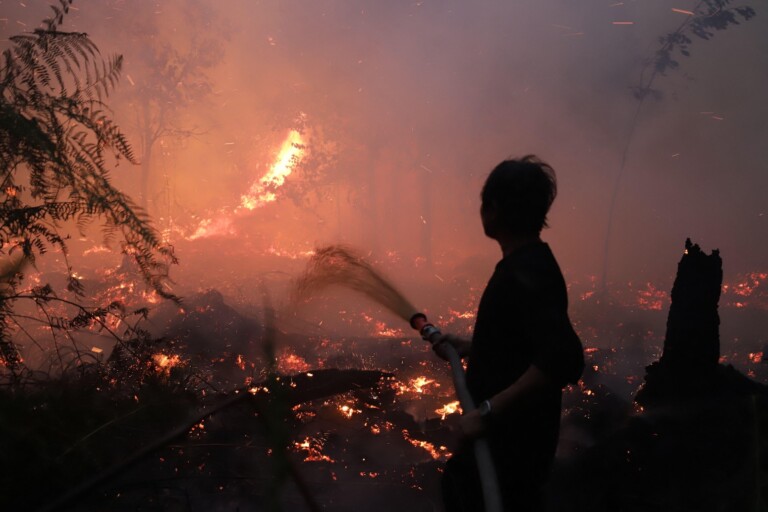
This year’s El Niño event – which has been underway since June – has already broken a number of records and reshaped the world’s weather, fuelling fires in Indonesia and “super typhoons” in the west Pacific.
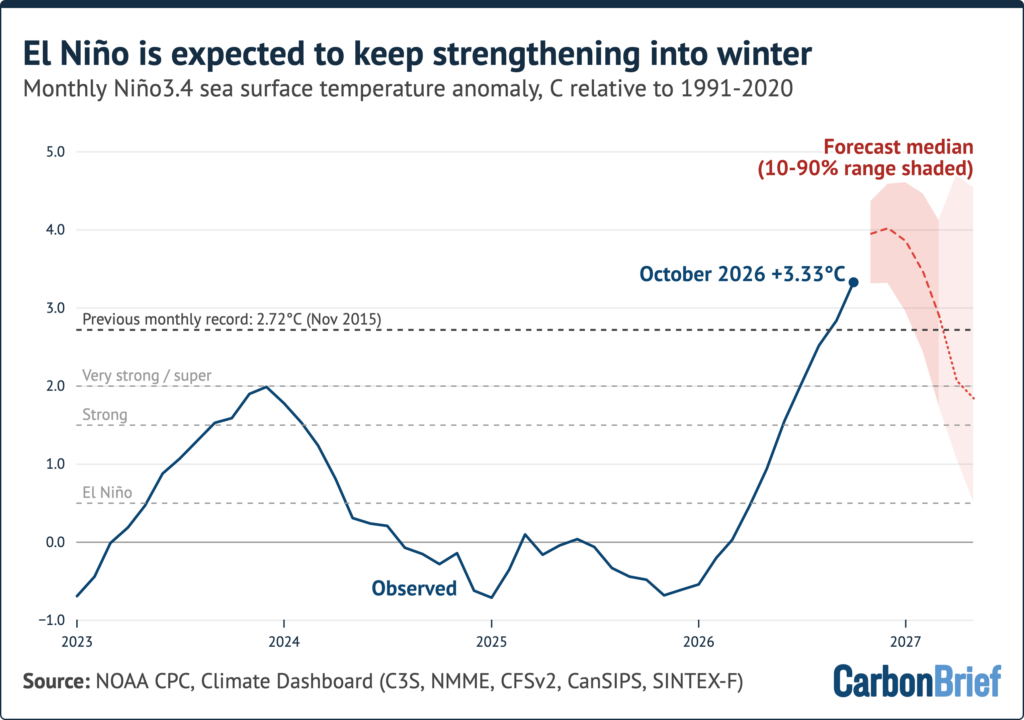
The strength of an El Niño is tracked using the “Niño3.4 anomaly”, which is a measure of how much warmer sea surface temperatures are than average in a section of the central Pacific.
Analysis of more than 600 forecasts from 14 different climate models by Hausfather for Carbon Brief’s “state of the climate” update shows how models project this year’s El Niño will peak with an anomaly of around 4C. This would be more than a degree above the previous record in 2015-16.
Writing on CB Connect on 5 November, Hausfather wrote:
“This El Niño event is developing so quickly and is reaching sea surface temperatures so warm that it’s simply staggering. We haven’t seen anything like this in the historical record and it may end up being the strongest El Niño event in the past millennium.”
This year’s El Niño has already chalked up a number of milestones.
On 18 September, the daily anomaly in the Niño3.4 region broke the satellite-era record set in 2015 when it reached 3.11C.
Meanwhile, September as a whole recorded the highest monthly Niño3.4 region temperature anomaly – 2.84C – since sea surface temperature records began in the mid-1800s.

Membership
Support award-winning climate journalism
Hausfather wrote on CB Connect that this year’s El Niño had been “running well above any prior El Niño event since June, at times by a full degree [Celsius]”.
Carbon Brief’s “state of the climate” analysis indicates that El Niño is set to continue to intensify into December, with 10 out of 14 models expecting temperatures in the Niño3.4 region to peak in the final month of this year. The remainder anticipate a November peak.
While human emissions of greenhouse gases are responsible for almost all of long-term global warming, temperatures in specific years are strongly influenced by El Niño events.
The “state of the climate” analysis explains that this year’s El Niño event will have its largest effect on global temperatures in 2027. This is because global temperatures typically lag warming in the tropical Pacific by around three months.
Carbon Brief projects that the 2027 average global temperature will reach around 1.74C above pre-industrial levels. It calculates a 96% chance that next year will be the warmest on record.
This projection is based on the historical relationship between year-on-year temperature changes and El Niño conditions the preceding autumn. It also factors in uncertainty around how global temperatures will develop across the remainder of 2026.



The post ‘Simply staggering’: Rapidly developing ‘super El Niño’ on track to peak in December appeared first on Carbon Brief.
‘Simply staggering’: Rapidly developing ‘super El Niño’ on track to peak in December