

At the start of 2024, China introduced a new system of “capacity payments” designed to help coal-fired power stations shift into a supporting role, alongside low-carbon sources.
In theory, the payments should make it financially viable for coal plants to operate less frequently, switching off unless there is insufficient output from renewables and nuclear.
However, new Global Energy Monitor (GEM) analysis finds that, despite channeling 107bn yuan ($14.9bn) to China’s coal-plant owners during its first year, there is no clear evidence that the scheme has reduced the amount of hours during which coal plants are operating.
Moreover, the analysis shows that some 70-100% of China’s coal plants received payments, depending on the province, boosting their revenues by around 5-8%.
As such, the way the mechanism has been implemented continues to raise questions about its effectiveness in supporting renewable growth and China’s wider energy-transition targets.
Rather than encouraging operators to reduce operating hours and emissions, the loose application of eligibility “guardrails” means it could be prolonging coal-plant lifetimes instead.
A ‘supporting’ role for coal
Like many other countries, China faces the complex challenge of how to decarbonise its power sector while keeping the electricity grid reliable.
Following widespread power outages in 2021 and ongoing debates over how to manage the transition, the National Development and Reform Commission (NDRC), China’s powerful central planner, announced a new coal capacity payment mechanism in late 2023.

The policy, which took effect in January 2024, aims to maintain grid reliability, while supporting coal-fired power plants as they shift from a primary electricity source to a “regulating and supporting” role in China’s power mix, according to Han Xue, associate researcher at China Development Research Centre of the State Council.
The mechanism provides what is essentially a monthly “standby” payment to eligible public coal plants (see below). The payments are designed to help cover fixed operating costs during periods when coal plants’ output is low, often as a result of high renewable generation. They are also intended to ensure that coal plants are available to switch on during peak demand periods.
The national framework sets payment levels at either 30% or 50% of a benchmark coal plant’s total fixed costs, which the NDRC determined to be 330 yuan ($45.8) per kilowatt (kW).
The higher 50% rate applies in provinces where the role of coal power supply is transitioning rapidly, such as Chongqing and Sichuan in southwest China as well as Hunan in the south. However, from 2026 the rate will increase to at least 50% of the fixed costs nationwide.
To illustrate the mechanism’s impact, consider a 600 megawatt (MW) coal plant running at China’s 2024 average rates. It would be operating for 4,628 hours a year and selling electricity at 0.452 yuan ($0.063) per kilowatt-hour (kWh). This plant’s annual revenue would stand at about 1.2bn ($174m) yuan.
If it receives a 30% capacity payment, roughly 59.4m yuan ($8.2m) would be added to its bank account, driving up the revenue by 4.7%. If the rate is at the 50% level, the bump rises to 7.9%.
Capacity market criticism
From the outset, the policy drew questions and criticisms. Capacity markets in other countries have also sparked debate, including in the UK, Chile and Spain.
Early in the first year of implementation of China’s capacity payments, energy media outlet China Energy News quoted experts saying that the mechanism would gradually change the coal producers’ mindset of “the more they generate, the more they earn”.
However, other “restrictions” of the mechanism, such as the 330 yuan pay rate being “too low”, would “limit” its “effect” on transition, according to the outlet.
-
Sign up to Carbon Brief’s free “China Briefing” email newsletter. All you need to know about the latest developments relating to China and climate change. Sent to your inbox every Thursday.
Energy research institute the Regulatory Assistance Project (RAP) had pointed out that the mechanism is restricted to coal, excluding the “participation of alternative resources” able to offer similar services, such as energy storage or demand response.
Issues with the policy meant that it could encourage older coal plants to remain online, as well as potentially “exacerbating” the continued construction of new capacity, according to RAP.
After one year of China’s programme, GEM’s analysis finds that, while the policy has contributed to coal power plant revenue, there is still little definitive evidence to show that it is shifting coal to a “supporting” role, as intended.
This raises continued questions about the mechanism’s design, its implementation and whether it aligns with China’s long-term climate and energy objectives such as the “dual-carbon” goals.
Adding to the complexity, Lauri Myllyvirta, lead analyst at thinktank the Centre for Research on Energy and Clean Air, highlights a regional divide in China’s power mix from 2020 to 2024 in an article for Dialogue Earth.
He says that northern provinces have made more progress towards integrating clean energy than the southern regions, which have been “complacent” due to rich hydro resources. In contrast, others have invested more in wind and solar capacity, as well as in coordinating grid operation with neighbouring areas so as to better manage variable renewable output.
These regional disparities complicate any assessment of the capacity mechanism’s impacts.
Capacity payments ‘top 100bn yuan’
Only 12 provincial governments have released lists of qualifying plants, providing rare insight into how the capacity payment policy is being implemented.
These provinces represent just 38% of the country’s total operating coal capacity, meaning most of the national implementation remains undocumented in the public domain.
This partial picture makes it difficult to assess the policy’s broader outcomes, particularly as provinces appear to apply eligibility and enforcement criteria differently.
Based on the national policy’s payment levels and the 12 provincial recipient lists, the capacity payments in these provinces alone was more than 40bn yuan ($5.5bn) in the first year of the scheme, as shown in the figure below.
Combining the total operating capacity and payment numbers from the 12 provinces that have published data with GEM’s most recent national capacity figures, our analysis estimates that the total national payout in 2024 was approximately 107bn yuan ($14.8bn).
(This figure is uncertain. Greater transparency would help clarify how the mechanism is functioning and its role in shaping the future of coal in China’s power system.)
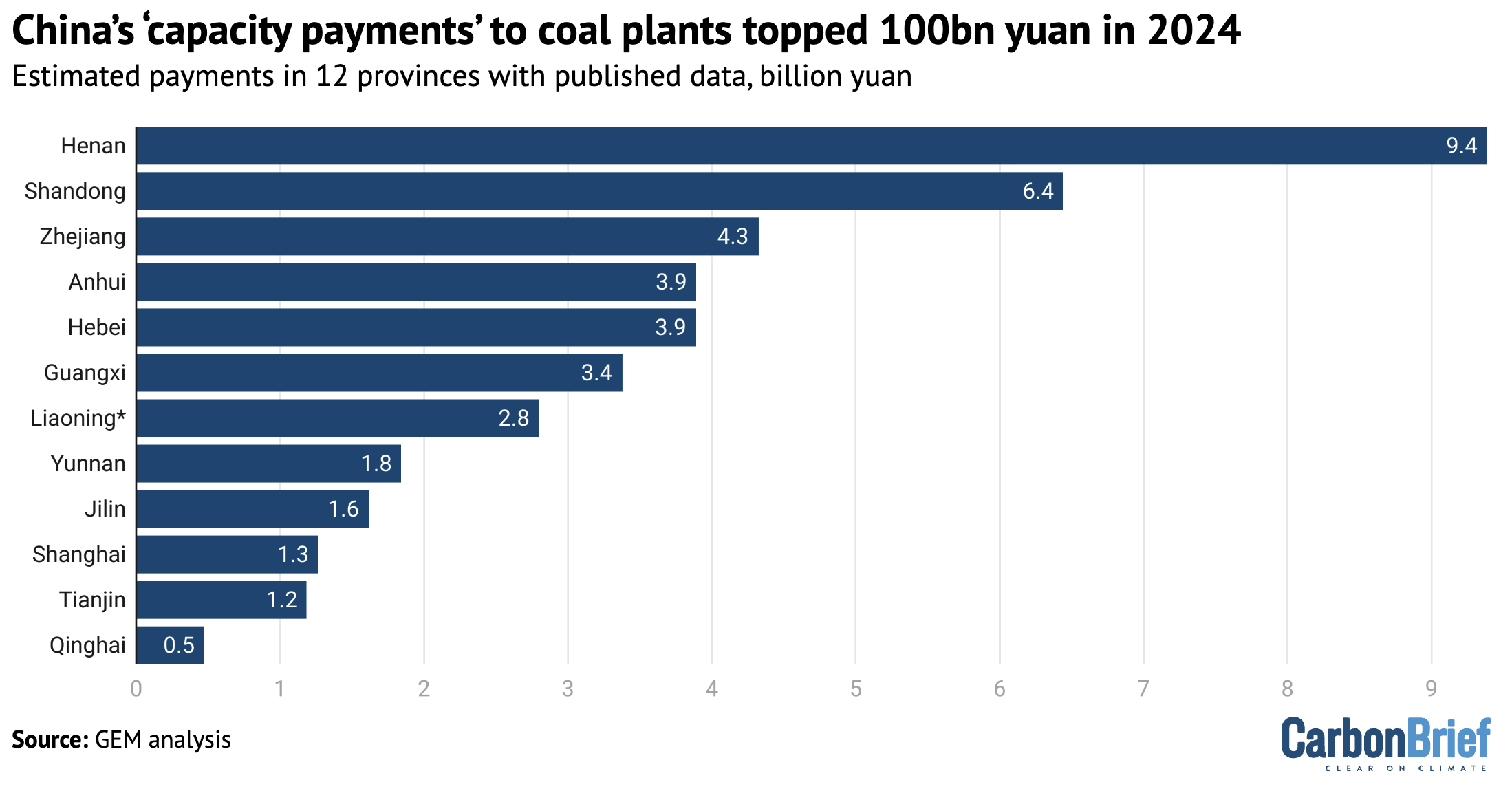
As shown in the figure above, capacity payments vary significantly across provinces. Of those 12 provinces with detailed published data, Henan in central China received the largest share, totaling approximately 9.4bn yuan ($1.3bn), driven by both its large eligible capacity of 56.9 gigawatts (GW) and the high payment rate (50% level).
Among the 12 provinces, Guangxi (20.5GW) and Yunnan (11.2GW) in southwest China, as well as Qinghai (2.9GW) in northwest China also applied the 50% payment rate, but their smaller eligible coal capacity resulted in comparatively lower total payments.
Broadly, the rankings of total capacity payments align with those of total operating coal capacity by province, which is expected given the direct link between capacity and payment eligibility.
However, the alignment is not exact. Yunnan, for example, ranks 11th out of 12 provinces in terms of operating capacity but 8th in total capacity payments.
This reflects how provincial differences in payment rates and eligibility shares, not just installed capacity, are shaping the financial impact of the policy.
Despite restrictions, most coal capacity is eligible
By cross-referencing provincial recipient lists with GEM’s Global Coal Plant Tracker (GCPT), it is possible to estimate the share of each province’s coal capacity receiving payments.
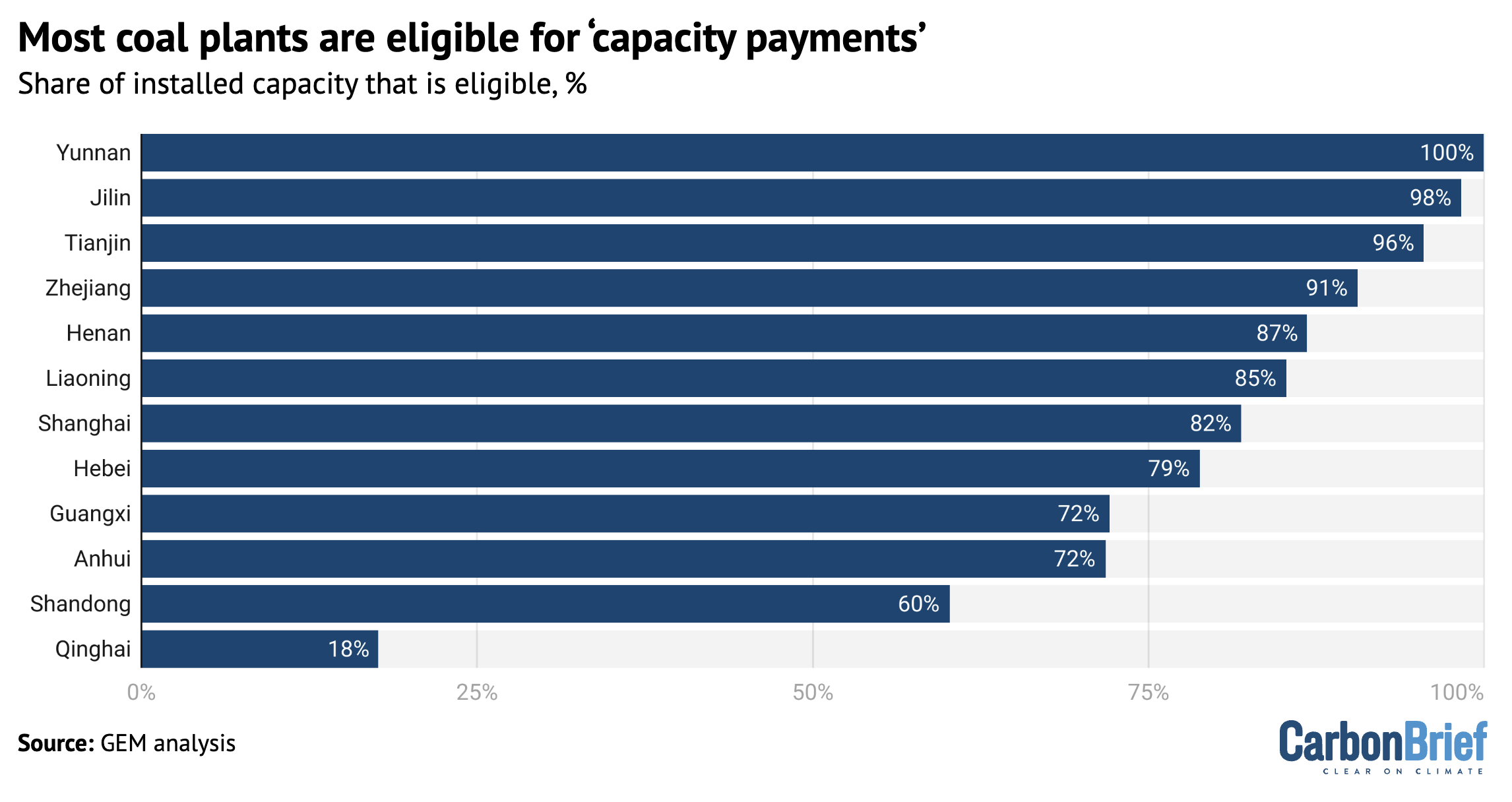
In almost all of the 12 provinces that published recipient lists, a large majority of coal capacity is eligible for payments, as shown in the figure below.
The NDRC national guidelines published alongside the policy announcement stipulate that only “compliant, public operating coal units” are eligible for the capacity payments. The guidelines identify three categories of coal-fired power plant units that are excluded:
- “Captive” units, which exclusively serve specific industrial or commercial entities and operate independently from the public power grid;
- Units failing to meet energy efficiency, environmental performance, or operational flexibility standards;
- Units not compliant with the broader “national plan”, a criterion that is not further clarified in the guidelines.
Despite these restrictions, most provinces with available data include between 70% and 100% of their total coal capacity under the mechanism, as the chart above shows.
In some cases, this appears inconsistent with the eligibility criteria. For example, the Mancheng Mill power station in Hebei in northern China has two 35MW combined heat and power (CHP) units, which started operating in 2018 to provide heat and power exclusively to a pulp and paper industrial park. This appears inconsistent with the “captive unit” exclusion.
In line with concerns raised by RAP, some newly built coal power plants were included in the initial provincial recipient lists, or added at a later date. For example, Beihai Bebuwan power station Unit 4 in Guangxi began operating in March 2024 and was added to the recipient list in September 2024. The inclusion of such projects could be interpreted as an incentive for new coal capacity, under the banner of grid reliability.
Although plant age is not explicitly disqualifying, coal power plants in China generally have a 30-year design lifespan. Yet older units are included in recipient lists in multiple provinces.
Shenhua Panshan power station Units 1 and 2 in Tianjin in northern China, for instance, began operating in 1994 and were retrofitted in 2023. Their continued inclusion raises questions about whether the policy supports transition, or extends the operational life of ageing assets.
It also highlights uncertainty around how retrofits will be treated, if undertaken after the policy entered force at the start of 2024, and whether such units will be firmly excluded from eligibility.
Finally, several provincial lists include smaller units, which may have limited ability to contribute to peak demand management. For example, five 57MW units from Shaoxing Binhai power station in Zhejiang, southeast China, built to provide heat demand for local dyeing and printing industries, were accredited for capacity payments.
Their actual contribution to evening peak load, when generation from solar and wind is low, is unclear from the list or other available provincial assessments.
More questions than answers?
There was only two months between the announcement of coal capacity payments and their implementation, leaving no time for pilot programmes or detailed feedback. This may help explain the ambiguities that have emerged during the provincial execution process.
Our analysis of the first year of the scheme suggests that provincial discretion has played a major role, with national criteria loosely applied in practice.
Moreover, there is no clear evidence to date that the mechanism has led to reduced coal utilisation hours, or significantly increased solar and wind generation.
While electricity generation from coal decreased in northern provinces during 2024, our analysis found that this was not the case in southern regions.
Different factors contribute to these regional differences, such as power demand and clean-energy resources. With only one year of data from the capacity payment scheme, it is not possible to attribute these changes solely to the capacity payment scheme.
To better align the mechanism with its stated goals, future adjustments could consider specifying coal-plant eligibility criteria more clearly and transparently.
Expanding the scheme to non-coal resources, such as energy storage, demand response or energy efficiency, could help it contribute to wider system flexibility and transition objectives.
Finally, ongoing monitoring of provincial implementation and energy trends will allow for a clearer assessment of how the policy evolves in the coming years.


The post Guest post: China’s ‘capacity payments’ boosted coal-plant revenue by up to 8% appeared first on Carbon Brief.
Guest post: China’s ‘capacity payments’ boosted coal-plant revenue by up to 8%

Cleaner cooking projects in the UN carbon market will have to set aside a share of their credits to insure against the risk that the trees they save are lost to fire, drought or logging, after the market’s regulator rejected calls to exempt the sector.
The requirement is part of a new rulebook that the Paris Agreement carbon market regulator – the Article 6.4 Supervisory Body – approved last Friday for programmes that aim to cut emissions by distributing new and cleaner cookstoves in regions that still burn wood or charcoal for cooking.
These are the UN mechanism’s first rulebooks for cookstoves, one of the carbon market’s most popular credit types and also one of its most criticised for overstating climate benefits.
They consist of two methodologies: one for programmes that aim to cut greenhouse gas emissions by distributing more efficient cookstoves that burn less wood or charcoal, and a separate methodology for projects shifting households to lower-emissions cookers running on electricity or liquid petroleum gas (LPG).
Mkhuthazi Steleki, the South African chair of the Supervisory Body, said “this decision gives cleaner cooking projects a new pathway under the UN carbon market, with clear rules to ensure that each credit represents a real and credible emission reduction”.
Industry and NGOs lobby to weaken UN carbon credit rules in “coordinated” push
In copycat submissions and a private briefing to government officials, the groups have opposed a proposal to tighten safeguards for emissions offsetsLaunch of Africa Energy Bank delayed again in blow to oil and gas hopes
Repeated delays are raising questions about the bank’s momentum and whether it can mobilise investment to finance Africa’s oil and gas ambitions in an era of energy transition


Exemption push rejected
More efficient cookstove projects earn credits based on the amount of carbon they save by preserving trees that would have otherwise been cut down and burned for fuel. But if those trees later burn in a wildfire or are logged, the carbon stored would be released anyway, erasing the climate benefits of the credits.
Several carbon credit developers, conservation NGOs and the UN Environment Programme (UNEP) disputed that cookstove projects face this risk, in what critics described as a “coordinated lobbying campaign”.
They argued that, unlike forest protection schemes, this type of credit represents a “flow” of avoided emissions rather than a “stock” of stored carbon that can be released. They also warned that requiring a buffer would impose disproportionate costs and undermine the financial viability of these activities.
But the UN carbon market regulator was not persuaded by the argument. It decided that projects would have to protect against this reversal risk by handing over a percentage of credits to a so-called “buffer pool” instead of selling them.
‘New paradigm’
The amount of credits to be given up is calculated by applying different methods for natural risks, like wildfires, droughts or hurricanes, and human-caused ones, such as logging or land clearing.
For natural risks, project developers will need to apply local risk values derived from new modelling published by a group of independent scientists.
Campaigners have broadly welcomed the decision. Federica Dossi, an expert at Brussels-based advocacy group Carbon Market Watch, said it sets a new paradigm for calculating reversal risk based on empirical data. “This approach is grounded in science and we hope to see this now being adopted by other carbon crediting mechanisms in the voluntary market,” she added.
Backers claim this method is more rigorous than current practice in the voluntary carbon market, which largely relies on expert guesswork.
Pre-COP draws attention to Pacific’s climate plight and 1.5C goal
Pushback over science
As Climate Home News previously revealed, the same industry and NGO groups that sought an exemption from the “buffer pool”, along with some corporate buyers, criticised the use of a study backed by the UN carbon market’s experts that recommended the new risk assessment approach.
The groups pushed for more flexible rules that would have allowed natural risk values drawn from other sources, including national databases, or from the project developers themselves.
While the Supervisory Body rejected this approach, it gave project developers and countries the option to propose alternative values that would first need to be vetted by the mechanism’s expert panel and then approved by the regulator.
A carbon market expert told Climate Home News that, while it is too early to say how this provision will be used, they expect requests will have to be backed up with solid scientific evidence, lowering the risk of unfounded claims.

Policy discounts questioned
To guard against human-caused risks, projects will need to apply a flat 20% value set by the Supervisory Body, at the bottom of the 20-45% range recommended by its technical experts ahead of last week’s meeting.
That value can be further reduced by up to two-thirds if the host country has an emission-reduction plan covering forests, a long-term climate strategy and a framework for the UN’s REDD+ forest protection scheme.
Injy Johnstone, senior research fellow at the Munich-based Max Planck Institute, said that, while these are important governance measures, their existence does not necessarily demonstrate that the underlying risk of forest carbon loss has been reduced.
“It is important to distinguish between evidence of actual risk reduction and assumptions about the effectiveness of policy commitments,” she added.
Moving target
A UN source told Climate Home News that, under the approved formula, improved cookstove projects must set aside at least 9% of credits linked to saved wood if they operate in the lowest-risk areas and the host country can claim all available discounts. The share of credits rises significantly in regions with high natural risk values, such as Guyana, Sri Lanka and Timor Leste, or that do not have REDD+ programmes.
These factors could change in the future as the Supervisory Body asked its technical experts to recommend revisiting the risk values “should credible new evidence arise”.
Climate change is likely to make forest destruction events, such as wildfires or hurricanes, more frequent and more severe in certain regions. Meanwhile, national policies on forest protection can shift significantly depending on government changes.
Johnstone said the UN carbon market needs periodic reassessment to respond to new evidence showing that previously assumed levels of risk were too low.
“The integrity of credits is not guaranteed simply because a reversal risk tool exists,” she added. “The real test will be whether the mechanism provides equivalent atmospheric protection over time, rather than simply introducing another layer of accounting requirements”.
The post UN carbon market forces cookstove projects to protect against forest loss appeared first on Climate Home News.
UN carbon market forces cookstove projects to protect against forest loss
Next week, diplomats from around the world will descend on Yerevan, Armenia, to negotiate a series of decisions under the UN Convention on Biological Diversity (CBD).
Between 19 and 30 October, 196 parties will gather to hammer out the precise wording of the dozens of legal texts that make up the decisions under the Conference of the Parties (COP) to the CBD.
This year’s summit is particularly significant, as it marks the halfway point between the agreement of the Kunming-Montreal Global Biodiversity Framework and the deadline for achieving its targets.
The CBD has found that countries are currently n