

The Iran war has triggered another fossil-fuel energy crisis, with surging global prices and increasing concerns over energy security.
In the UK, many newspapers, opposition politicians and other public figures have used the crisis to argue in favour of issuing more licences for oil and gas drilling in the North Sea.
These arguments have also been amplified in AI-generated posts on social media, shared by fake accounts that usually post anti-immigrant and anti-Muslim content.
However, many of these arguments rest on false or misleading claims about the impact that further drilling could have on the UK’s bills, energy security, emissions and tax revenue.
The North Sea is a “mature basin” where production has been falling for decades, because most of the oil and gas it once contained has already been extracted.
While it would be possible to slow the rate of decline in oil and gas output from the North Sea, the quantities that would be economic to extract are disputed.
Overall, the transition to clean-energy supplies is expected to be far more effective at boosting UK energy security and reducing reliance on imports.
Moreover, the climate-change arguments for limiting fossil-fuel production, which have been made by scientists, the UN secretary general and even the Pope, remain as valid as ever.
Below, Carbon Brief factchecks some of the most common claims about North Sea oil and gas.
- FALSE: ‘Reopening the North Sea would lower bills’
- MISLEADING: ‘Energy from the North Sea generates a lot less CO2’
- FALSE: ‘Britain is a resource-rich nation that has chosen dependency’
- FALSE: North Sea is ‘best way to protect us from volatility and provide energy security’
- MISLEADING: ‘The head honchos of the green lobby say we should drill’
- FALSE: ‘The UK is the only country in the world banning new oil and gas licenses’
- MISLEADING: ‘With new North Sea licences would come thousands of jobs’
- MISLEADING: North Sea drilling ‘would secure a rush of revenue into the Treasury’
- FALSE: Ed Miliband is an ‘anti-North Sea’ climate change ‘fanatic’
FALSE: ‘Reopening the North Sea would lower bills’
Many right-leaning newspapers and commentators have falsely argued that opening up new oil and gas fields in the North Sea would lower energy bills in the UK.
There is no evidence to support such claims. Indeed, numerous experts have explained that new drilling would make no difference to bills in the UK.
For example, the Daily Express carried fact-free assertions from the hard-right, climate-sceptic Reform party on its frontpage under the headline: “Get drilling to stop bills soaring.” Despite the UK not using oil to generate power, it claimed:
“Open[ing] up the UK’s biggest oil field [would] stop power bills soaring.”
At the beginning of March, US president Donald Trump told the Sun that his advice to UK prime minister Keir Starmer would be:
“Open up the North Sea. Immediately. Your energy prices are through the roof.”
In the Daily Telegraph, an “energy consultant” called Kathryn Porter, who has authored “papers” for climate-sceptic lobbyists, listed why she thinks more drilling could cut energy bills under the headline: “Reopening the North Sea would lower bills.”
On Twitter, Reform said the Labour and Conservative governments had “failed the British people” by “refusing to drill in the North Sea”. It added that more drilling would make “Britain energy independent once again” and “bring down bills”.
Contrary to these claims, numerous experts have said that further drilling in the North Sea would do nothing to cut bills, because UK energy prices are set on international markets.
In 2022, the Climate Change Committee (CCC) wrote that increased UK extraction was not expected to “materially affect global oil or gas prices, as the UK energy market is highly connected to international markets and the potential supply [is] relatively small”.
It added that, even if all proven UK reserves and resources of gas from new fields were extracted, this would only meet about 1% of European demand each year up to 2050.
Jack Sharples, senior research fellow at the Oxford Institute for Energy Studies (OEIS), tells Carbon Brief that “you’re not going to bring prices down versus the current level, because you’re not going to be able to produce very much more [from the North Sea]”.
The Labour government has made similar arguments, saying in a “factsheet” on the Iran crisis that the UK is a “price-taker…not [a] price-maker”. It said:
“Future exploration in the North Sea is too marginal to make a difference to the overall supply in an international market…New licences to explore new fields wouldn’t make any difference to the prices set by international markets and paid by UK billpayers.”
Even shadow energy secretary Claire Coutinho, who has advocated strongly for further drilling, admitted in 2023 that new licenses “wouldn’t necessarily bring energy bills down”.
The North Sea is a “mature basin”, with around 90% of what it contained “already drained dry”. Most of what is produced for the basin is now oil, around 80% of which is exported.
In addition, oil and gas reserves are owned by private companies once licences are issued and the fuel is sold at international rates. Therefore, whether it is produced in the North Sea or elsewhere, its price is driven by the global market.
Moreover, the limited quantity of gas left in the ageing North Sea basin would do little to impact international markets and, thus, little to impact international prices.
Climate YouTuber Simon Clark discusses whether more North Sea oil and gas drilling could lower energy bills in the UK.
Recent analysis by the Smith School at the University of Oxford found that, even if the UK maximised North Sea oil and gas and used all revenues from the sector to subsidise lower energy bills, the impact would be limited. Under this unlikely scenario household bills could fall between £16 and £82 per year, or 1-4.6% a year.
The fact that further oil and gas production in the North Sea would have a limited impact on energy bills has been noted repeatedly, even by those in favour of drilling in the North Sea.
For example, in a separate comment piece in the Daily Telegraph calling on the UK to “max out on both renewables and North Sea oil and gas”, world economy editor Ambrose Evans Pritchard wrote:
“Reopening the North Sea would not make any difference to the current crisis, nor any difference to gas and petrol prices in the UK, since the volumes are too small to shift the traded global market.”
As such, the UK Energy Research Centre (UKERC) explained in a recent note:
“Squeezing additional oil and gas production from the UK may be technically possible, but it will have [a] negligible impact on the UK cost of living”.
MISLEADING: ‘Energy from the North Sea generates a lot less CO2’
Many North Sea advocates argue that drilling more in the basin would mean lower carbon dioxide (CO2) emissions, due to the high emissions from imported fossil fuels.
This is a line often used by the oil-and-gas industry itself, with the trade body Offshore Energies UK (OEUK) stating that “North Sea gas has a lower emissions footprint than liquified natural gas (LNG) from overseas”.
Additionally, it is an argument that is sometimes used by commentators who – in other circumstances – would not be making the case for low-carbon policies.
For example, in a Mail on Sunday column, the climate-sceptic journalist Andrew Neil wrote that “giving the North Sea a new lease of life” would:
“Even lower carbon emissions (because piping in energy from the North Sea generates a lot less CO2 than importing it).”
Conservative shadow energy secretary, Claire Coutinho, has also used this approach to question the government’s supposed opposition to North Sea drilling, writing in the Daily Telegraph:
“Doing so in the name of climate change when our own gas has four times fewer emissions than the LNG we’ll need to import instead? Unforgivable.”
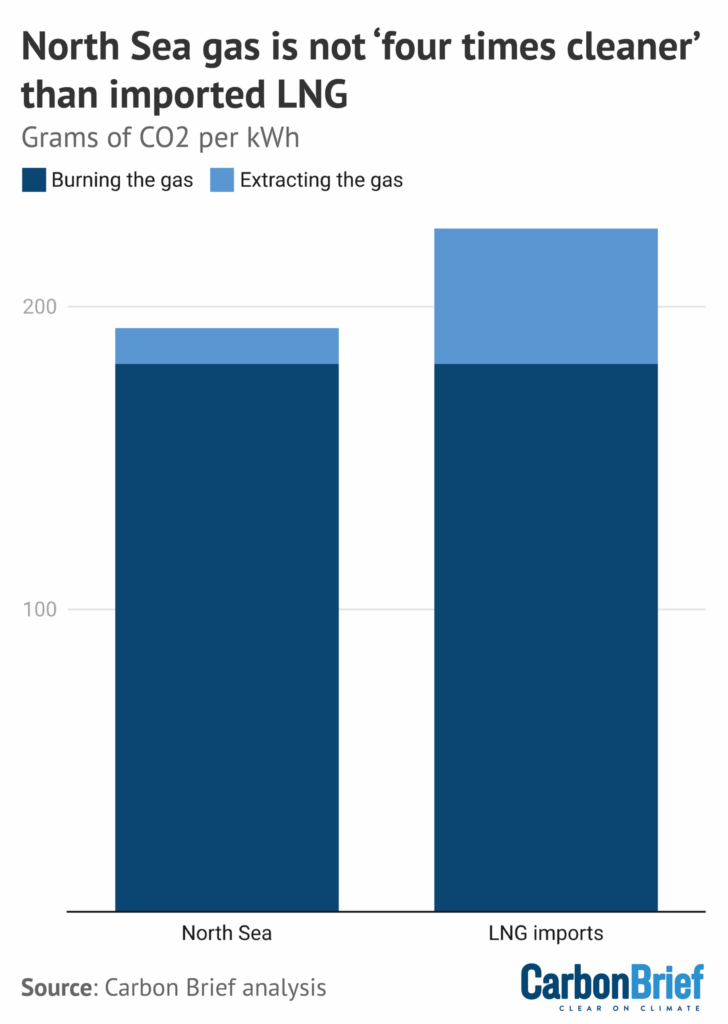
The claim that UK gas from the North Sea produces “a lot less CO2” – and particularly the commonly cited “four times fewer emissions” figure used by Coutinho – is misleading.
It references the fact that imported LNG has higher overall emissions than North Sea gas, due to the energy-intensive processes needed to liquify, transport and regasify it.
However, as the chart below shows, the vast majority of emissions from gas result from burning it to produce energy.
When CO2 from gas combustion is taken into account, LNG emissions are not four times lower than North Sea gas emissions, but 15% lower.
The UK is reliant on LNG imports from a handful of countries, notably the US and Qatar. However, at present these imports make up only around 15% of the UK’s gas.
Of the remaining gas used in the UK, roughly half is produced domestically and the rest comes via pipeline from Norway. Norwegian pipeline gas has even lower emissions than UK supplies.
More broadly, analysis by the Climate Change Committee in 2022 found that, despite the small “emissions advantage” of UK domestic production replacing imports, this could be wiped out if increased UK production led to more fossil-fuel production overall.
FALSE: ‘Britain is a resource-rich nation that has chosen dependency’
One frequent false claim is that the UK has “chosen” to become reliant on fossil-fuel imports, as a result of policy decisions made by successive governments.
In fact, import dependency has primarily increased because most of the oil and gas in the North Sea has already been used up. It is a “mature basin” with falling output.
In the Daily Telegraph for example, Diana Furchtgott-Roth, former climate director at the Heritage Foundation, a US-based climate-sceptic lobby group, stated that the UK has “chosen dependency”. She wrote:
“[The UK] is not a resource-poor nation forced to depend on foreign suppliers. It is a resource-rich nation that has chosen dependency through planning rules, regulatory obstruction and a net-zero framework that treats domestic oil and gas production as a moral failing rather than a strategic necessity.”
It is true that the UK has become increasingly reliant on fossil-fuel imports. The country was a net energy exporter in 2000, but, by 2010, was dependent on imports for 30% of its energy supplies. On the same metric, the UK’s net import dependency reached 44% in 2024.
This is largely because UK fossil-fuel production peaked decades ago. Gas production in the North Sea fell by 74% between 2000 and 2025, while oil output fell by 75%.
Gas production is set to fall to 99% below 2025 levels by 2050 and oil is set to fall 94%, according to the government’s North Sea Transition Authority (NSTA). Even with further drilling, the NSTA expects gas output to fall by 97% and oil by 91%, as shown below.
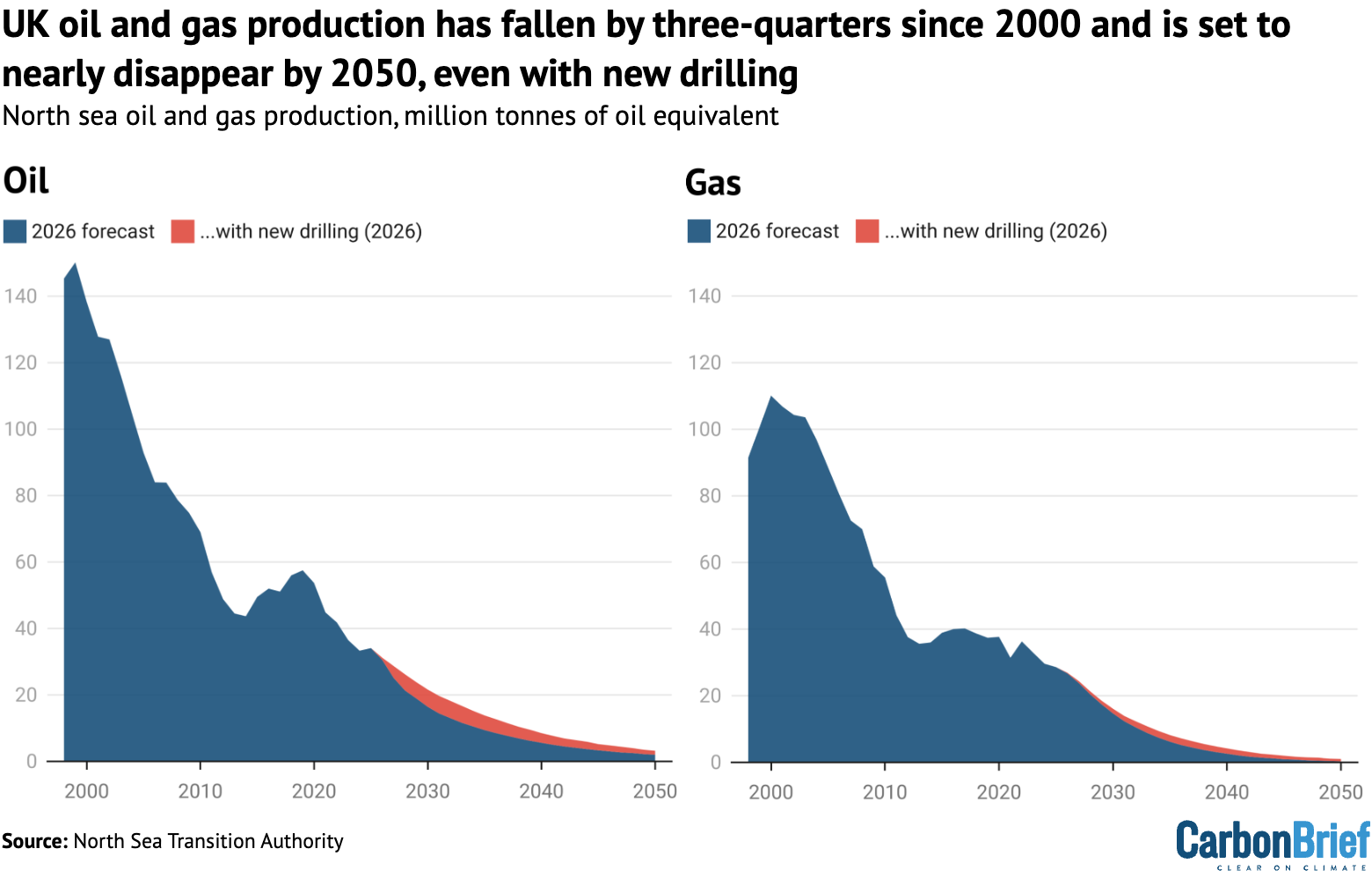
Production has been in an inexorable decline for decades despite strongly supportive government policy through most of the period, including tax breaks and new licensing.
Contrary to the narrative that rising import dependency has been a policy choice, the main reason why production is falling is that the North Sea is a “mature basin”. In other words, most of the oil and gas it once contained has already been extracted and burned.
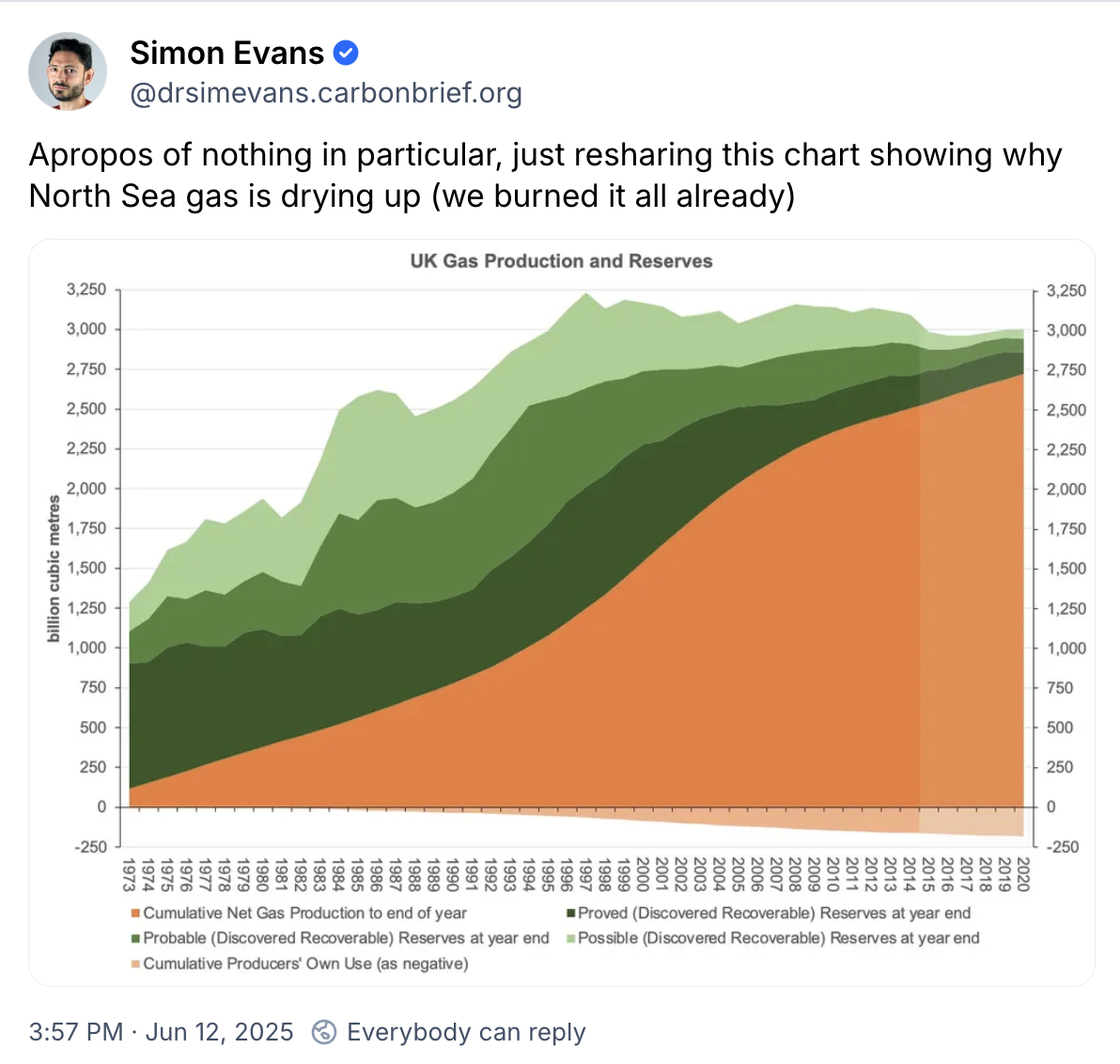
According to the thinktank Energy and Climate Intelligence Unit (ECIU), around 90% of the oil and gas that is likely to be produced from the North Sea has already been burned.
A related argument, aired on Sky News in mid-March 2026, is that the NSTA projections have been revised downwards over time, as a result of government policy. The idea is that there is more oil and gas available, but the government has “chosen” to ignore it.
Yet for gas, there is little difference between the NSTA projections published before and after the government’s 2024 election win and its decision to ban new licensing, as shown below.
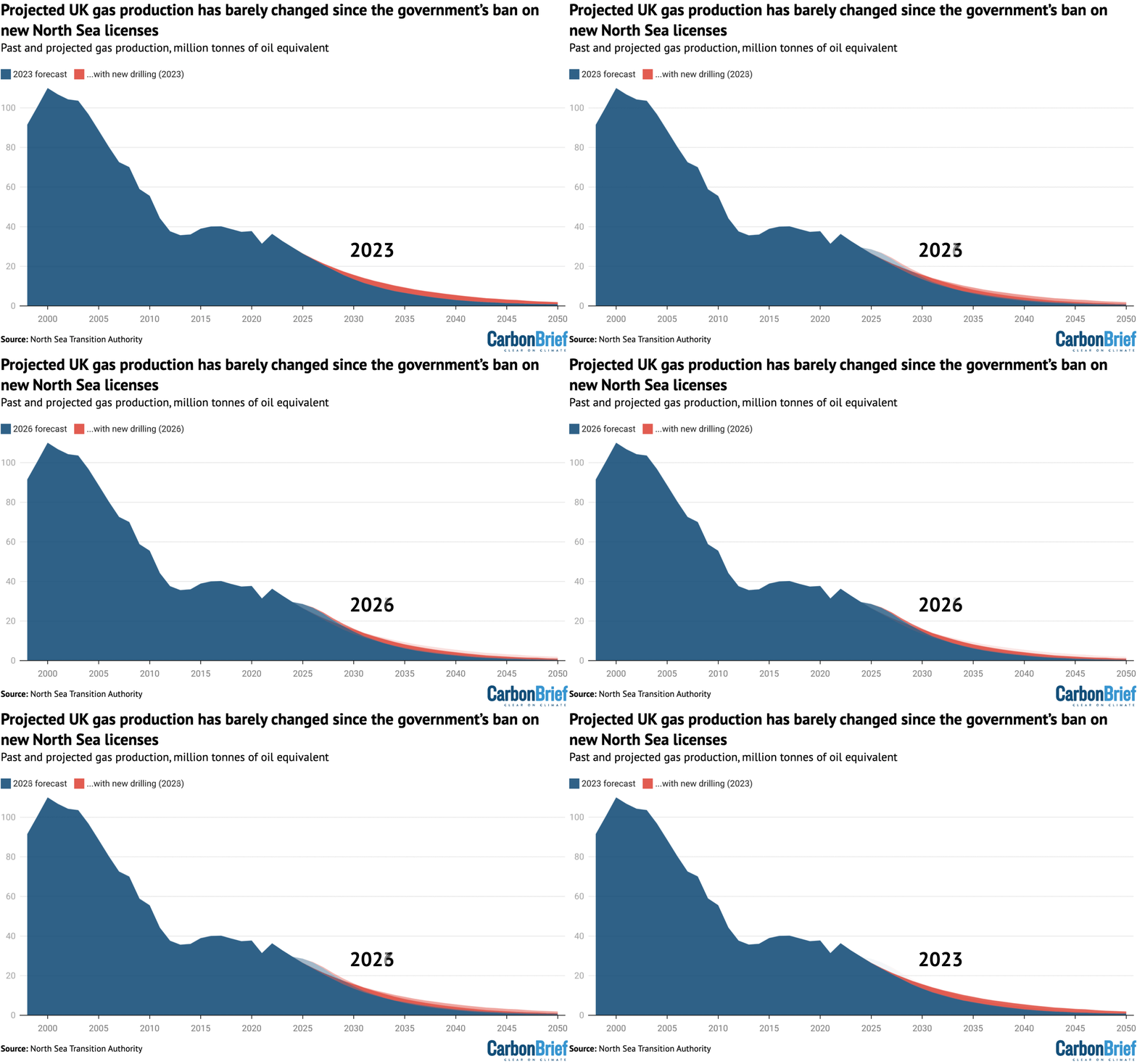
While the NSTA projections for oil have shifted more noticeably between 2023 and 2026, this largely relates to output from existing fields, rather than the potential from new drilling.
There are a variety of other reasons why the NSTA projections have changed, notably including the economic viability of North Sea production.
Until the recent Iran war, UK oil prices had been declining steadily since the highs seen in the wake of Russia’s invasion of Ukraine in 2022.
This will have eroded the economics of North Sea production, particularly as the cost of extraction has gone up by roughly 40% since 2019.
A final claim relating to government policy choices is that the UK has, in the words of a recent Sun editorial, become “heavily dependent on imported energy because of unreliable wind and solar, and the government’s obsession with net-zero”.
This makes no sense – it is the opposite of the truth. Wind and solar generated more than 100 terawatt hours (TWh) of electricity in the UK last year, meeting a third of total demand.
Carbon Brief analysis shows that generating the same electricity from gas would have required around 200TWh of fuel, equivalent to three-quarters of UK imports of liquified natural gas (LNG).
In other words, without its fleet of what the Sun calls “unreliable wind and solar”, the UK would have needed to nearly double its LNG imports.
FALSE: North Sea is ‘best way to protect us from volatility and provide energy security’
The effective closure of the Strait of Hormuz has triggered the worst energy crisis since the 1970s and has reignited debate over how best to ensure the UK’s energy security.
Many politicians, newspaper editorials and comment articles have argued that getting more oil and gas out from under the North Sea would cut UK fossil-fuel imports and boost energy security.
Some have gone so far as to argue that the North Sea is the “best way” or “the” answer to ensuring UK energy security. This is clearly false. So too is the idea – promoted by the hard-right, climate-sceptic Reform party – that the UK could become “energy independent” by expanding North Sea production.
For example, Conservative leader Kemi Badenoch wrote a comment piece for the Sunday Telegraph under the headline: “Drilling the North Sea is the answer to the energy crisis.”
Meanwhile, Enrique Cornejo, energy policy director at North Sea industry trade association Offshore Energies UK (OEUK), told the Times:
“Current events demonstrate that the best way to protect us from volatility and provide energy security is to maximise our homegrown energy resources.”
The potential for extra oil and gas output is disputed, but not even the North Sea oil and gas industry claims that it could reverse the decades-long decline in production.
Analysis by the National Energy System Operator (NESO) shows that the transition to clean energy would boost UK energy security by significantly reducing fossil-fuel imports. In contrast, it says that imports would rise if the UK boosts domestic oil and gas production but fails to decarbonise.
The UK has been increasingly reliant on energy imports since 2003. This is because UK oil and gas production from the North Sea has fallen by roughly three-quarters since 2000. (See: FALSE: “Britain is a resource-rich nation that has chosen dependency.”)
The UK’s reliance on fossil-fuel imports is set to increase even further, as North Sea production continues to decline. The NSTA says oil output will fall to 94% below 2025 levels by 2050 – or 91% with new drilling. For gas, the figures are 99% and 97%, respectively.
OEUK and other advocates for the oil and gas sector dispute these figures, claiming that higher production would be possible if there are changes in government policy.
For example, a report commissioned by OEUK put forward a “high case” for North Sea production over the coming decades, predicated on what it calls “significant changes to tax, licensing and regulatory approvals”. Notably, this still showed steep declines in output.
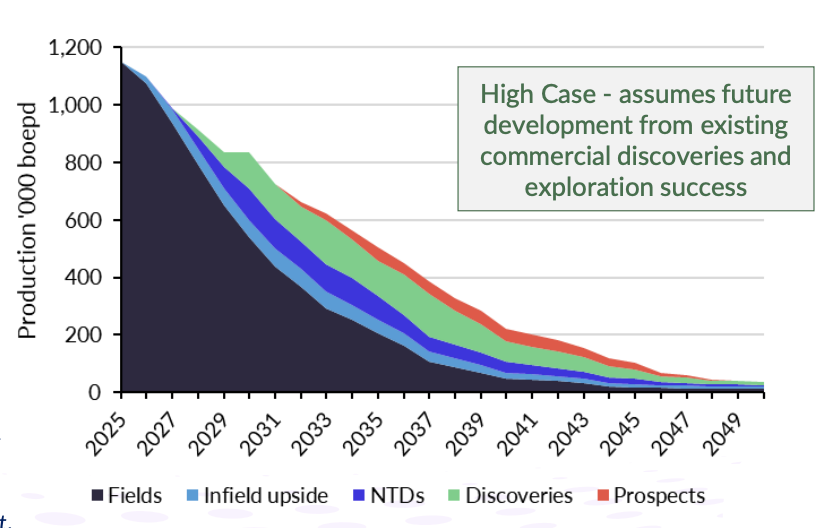
The OEUK-commissioned report also looked at an even more optimistic “no constraints” case for higher North Sea. However, the report authors, consultancy Westwood Energy, described this as “beyond realistic assumptions”. It said:
“The ‘no constraints’ case is considered to be beyond realistic assumptions given the current regulatory and fiscal conditions and investor sentiment. For this case to be realised, major industry change would be required.”
Similarly, OEUK has published a scenario for North Sea gas production that it calls “upside potential”, in which output is held close to current levels for the next decade.
It has used these scenarios to argue that the decline in North Sea gas output is “not inevitable”. However, the details behind these claims are opaque.
The “upside potential” scenario is based on what OEUK describes as “data provided by OEUK members” and it assumes that the government immediately scraps the “energy profits levy” (EPL, known as the windfall tax, see below).
OEUK claims that this scenario is “not speculative” and that it “clearly demonstrate[s] that the decline in potential supply indicated by NSTA forecasts is the result of policy choices”.
On this point, it is worth reiterating that the NSTA forecasts for gas barely changed in response to the election of the current government in 2024, as illustrated above.
Ultimately, while it is clear that most of the oil and gas that was once under the North Sea has already been burned, significant resources do remain.
The key question is how much of this remaining oil and gas is both technically and economically recoverable under current policies and prices – and if policies were changed.
OEIS’s Jack Sharples tells Carbon Brief that the North Sea is a “very mature basin” and that “nobody’s talking about increased production versus current levels”. He continues:
“Even if licences were to be made available for further exploration and production, that would result in a little bit of extra supply over the next 12 months, let’s say, but obviously not a huge amount…We’re just talking about slowing down the rate of decline.”
Sharples adds that, nevertheless, he thinks it is “worth maximising whatever we can produce in the North Sea”.
Recent Carbon Brief analysis found that expanding clean-energy supplies would have a larger impact on UK gas imports than an increase in North Sea drilling, as shown below.
(This analysis was based on NSTA projections of possible extra North Sea gas output, which amounted to 16TWh in 2030. If the OEUK “upside potential” scenario could be realised, the extra gas would amount to further 108TWh, equivalent to around 90 LNG tankers.)
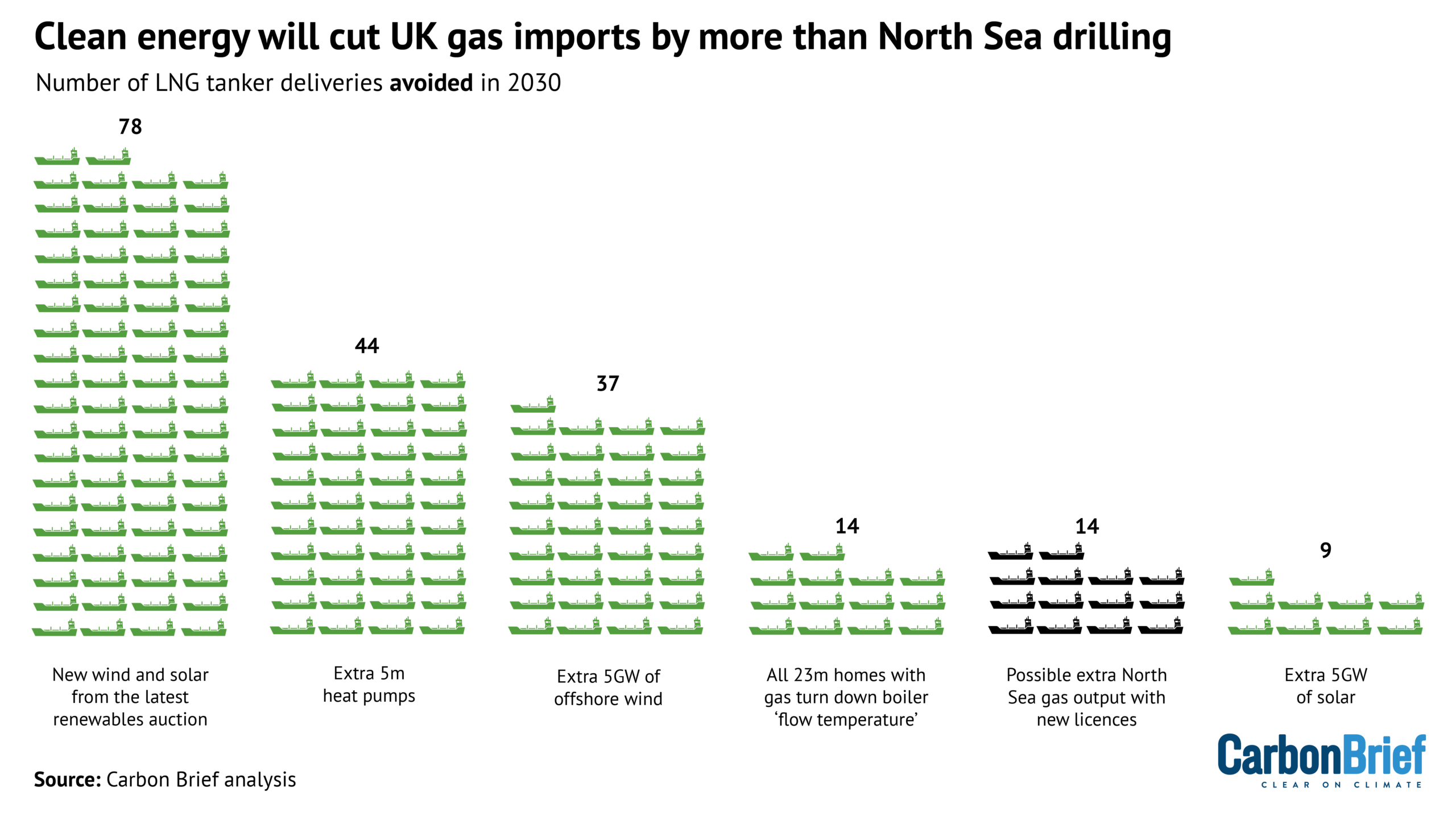
An additional aspect to this relates to timescales. It takes an estimated 28 years for new licenses to result in new oil and gas production, according to official figures.
The industry says fields that already have licenses, such as Rosebank and Jackdaw, could be developed more quickly, if they receive planning consent. The previous Conservative government had consented to these fields being developed, but this was overturned in the courts. The Labour government is in the process of considering whether to approve them.
(The new wind and solar projects from the latest renewable auction, which concluded in February 2026, are set to be operating by or around 2030.)
In a March 2026 note, the UK Energy Research Centre (UKERC) said that drilling for oil and gas “will not reduce bills or deliver energy security”. Instead, it said that “demand reduction should be a core focus of UK gas security”.
In the longer term, the National Energy System Operator (NESO) says that meeting the UK’s net-zero target would cut the country’s dependency on imported gas to 78% below current levels, whereas failing to decarbonise would see imports rising by a third as production falls.
At a recent parliamentary hearing, Miliband told MPs that this illustrated why “decarbonisation is essential for energy security”. He added that turning away from net-zero would leave the UK “really, really exposed”.
Octopus boss Greg Jackson said in a recent government press release: “Every solar panel, heat pump and battery cuts bills and boosts Britain’s energy independence.”
MISLEADING: ‘The head honchos of the green lobby say we should drill’
Numerous media outlets have picked up on supportive comments from what the Daily Telegraph has called “net zero’s champions”, backing the use of North Sea oil and gas.
Writing in the Daily Telegraph, shadow energy secretary Claire Coutinho said:
“From the wind lobbyists at RenewableUK to the chair of Great British Energy (Miliband’s ‘clean energy’ propaganda outfit), the head honchos of the green lobby say we should drill.”
This point was similarly made in an editorial in the Sun, which stated that “Octopus energy chief Greg Jackson…and even the head of RenewableUK have called for North Sea reserves to be reopened urgently”.
These comments were in reference to a handful of specific interventions that, in reality, were far more nuanced than simply calling for more drilling. Indeed, some of the so-called “net-zero champions” have clarified that they are not calling for new licenses at all.
In the Daily Telegraph, Tara Singh, chief executive of RenewableUK, wrote that “it is entirely sensible to support continued domestic oil and gas production in the North Sea”.
Similarly, Jackson wrote in the Daily Telegraph that “we should use what’s available from the North Sea”.
The Daily Telegraph published news stories to accompany both of these articles with the headlines “wind industry chief urges Miliband to restart North Sea drilling” and “Miliband must reopen the North Sea, Octopus boss says”.
On LinkedIn, Juergen Maier, chair of the government’s publicly owned, clean-energy company Great British Energy, set out several arguments in favour of more North Sea production.
These included slowing job losses in the region, the lower carbon intensity of North Sea oil and gas compared with imports and extra production supporting tax revenues.
His comments were picked up by the Financial Times and the Daily Telegraph, with the latter saying the comments from “Miliband’s clean-energy tsar” will “raise eyebrows”.
However, neither Singh, Jackson nor Maier called for new oil and gas licences – and they stressed that North Sea oil and gas will not bring down energy bills.
In fact, their position is similar to that of the UK government, which sees domestic fossil fuels playing an “important and valuable role” into the future.
Singh wrote: “Being serious about the UK’s important role in gas also means being honest about its limitations. The North Sea is a mature basin, not a limitless national asset.”
She added that politicians should not imply that more domestic drilling would bring down energy bills, as “it will not”. Instead, she wrote that new renewable generation offers “better value” for consumers, both when gas prices are normal and at “crisis levels”. (See: FALSE: “Reopening the North Sea would lower bills.”)
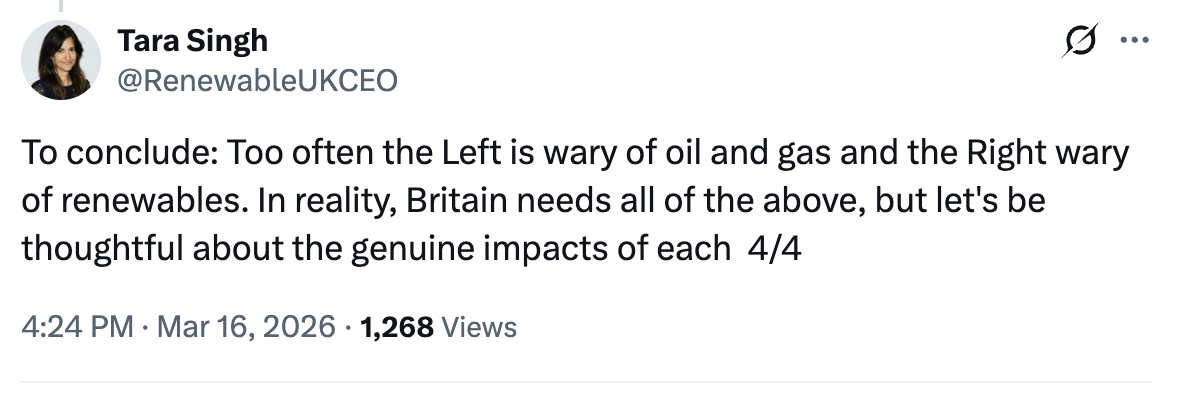
Expanding on her piece on Twitter, Singh clarified “we don’t represent the [oil and gas] sector and we’re not arguing for or against new licences”, adding:
“Before anyone gets too excited: I’m calling for a depoliticised conversation about energy in the UK – not an overhaul of policy to favour oil and gas.”
In his comment for the Daily Telegraph, Jackson added:
“We’re kidding ourselves if we think this is a panacea – it’s 20 years since the North Sea could meet all our needs – we’ve depleted the most abundant reserves and the remainder will be less productive and more expensive. But it makes sense to use what we have whilst we’re so dependent on gas.”
His article, titled “My plan to safeguard Britain’s energy supplies”, only briefly mentioned the North Sea and stressed the importance of “reduc[ing] our dependency on gas”.
He continued to set out other potential steps for increasing energy security and bringing down bills, including building nuclear efficiently, cutting energy waste, reforming the electricity market, rolling out domestic renewable generation and breaking the link between gas and electricity that “lets global chaos dictate our prices”.
In a follow-up interview with Jackson in the Independent, which emphasised these alternatives, he added that the UK was “deluding” itself if it thinks it can “get enough out of the North Sea and in a market where the price is set internationally”.
For his part, Maier clarified on LinkedIn that he was a supporter of a “ managed energy transition” making use of all available energy sources, but adding that this includes “the end game being mostly renewable energy generation”.
He also explicitly rejected the notion that more North Sea oil and gas would bring down bills, noting: “It doesn’t; indeed, energy costs are rising at this very moment because of fossil fuels.” Again, this mirrors the view expressed by government ministers.
Maier also subsequently pushed back against the media coverage of his original comments, writing in a follow-up post on LinkedIn that the claim he was pressuring Miliband over North Sea drilling was “wrong” and that he is “fully supportive of the government position”. He added:
“I see this as consistent with an ‘all energy’ approach to the transition. That the end game is renewables and that we need to give supply chain companies enough time to transition. I have said this numerous times in many speeches and posts here.”
FALSE: ‘The UK is the only country in the world banning new oil and gas licenses’
On LinkedIn, Conservative politician and shadow energy secretary Claire Coutinho claimed that the “UK is the only country in the world banning new oil and gas licenses”.
Her comment was made in response to a post about Denmark, which, in 2020, made a landmark decision to stop issuing new oil and gas licences and end all fossil-fuel extraction by 2050.
The post noted that Denmark is now considering “extending one or more production licenses” in the Danish North Sea, in response to the energy crisis.
However, as Coutinho surely knows, this is not the same as issuing new licences – and is more comparable to Labour’s move to allow some additional “tieback” drilling at existing fields, announced in 2025.
Denmark and the UK are not the only countries to end new oil and gas licences. Other nations to do so include Ireland, France, Portugal and Colombia.
In fact, there is an international coalition of nations that have pledged to end new oil and gas production, known as the Beyond Oil and Gas Alliance (BOGA).
This group is helping to convene the first meeting of nations that want to take immediate action to phase out fossil fuels, which is taking place in Santa Marta, Colombia, in April. Around 40-80 nations are expected to attend.
Carbon Brief understands that the UK will have a senior representative at the conference.
Despite showing its support for BOGA, the UK is currently not a member. A senior official once told Carbon Brief that this is because the UK does not currently meet the required end date for stopping all fossil-fuel production.
MISLEADING: ‘With new North Sea licences would come thousands of jobs’
Addressing parliament in March, Nigel Farage, the leader of the hard-right, climate-sceptic Reform UK party, claimed that with new North Sea oil and gas licences “would come thousands of jobs”, according to the Herald.
As noted above, the issuing of new exploration licences would only make a small difference to future production in a basin that is in irreversible decline.
Official statistics show the decline of the basin caused direct jobs in oil and gas production to fall by a third between 2014 and 2023. Indeed, according to the government, more than 70,000 jobs have been lost in the last decade alone.
This decline has occurred despite the previous Conservative government, which was in power from 2010-24, holding six new licensing rounds and issuing hundreds of new licences.
The Norwegian oil-and-gas company Equinor has claimed that, if approved, its large oil project, Rosebank, could create up to 1,600 jobs while at the height of its construction phase. (Rosebank has a licence, but has not yet obtained final consent from the government.)
However, analysis by the North Sea non-profit Uplift says that this figure is “inflated” and that the project would only create 255 jobs over its lifetime.
As part of its “North Sea future plan” announced in 2025, the current Labour government has pledged to establish the “North Sea jobs service” – a national employment programme offering support for oil and gas workers seeking new opportunities in clean energy, defence and advanced manufacturing.
However, campaigners have warned that the plan does not go far enough.
In 2023, the UK’s Climate Change Committee (CCC) published an analysis of how jobs might change as the country strives for its legally binding net-zero target.
Its review of available data suggested that the gradual phase-down of high-emitting sectors, such as oil and gas production, could lead to there being 8,000-75,000 workers “whose jobs cannot continue in their current form”. (It notes that the wide range is due to “much uncertainty in these estimates”.)
But it added that this would be outweighed by “extensive job creation”. It estimated that there could be between 135,000-725,000 new jobs created by the transition to net-zero, in sectors such as renewable energy generation, retrofitting and electric vehicles.
This job creation is not “guaranteed” and is dependent on the government implementing measures to support and upskill its workforce on the journey to net-zero, the CCC noted.
A report published this week by the Renewable Energy Association, the UK’s largest renewables trade body, found that jobs in renewable energy in the UK now outstrip those in oil and gas.
According to the figures, there were 145,000 jobs in the renewable energy sector in 2025, compared with 115,000 in oil and gas.
MISLEADING: North Sea drilling ‘would secure a rush of revenue into the Treasury’
One common argument in favour of more North Sea drilling is that the sector provides an important source of tax revenue for the government.
An editorial in the climate-sceptic Daily Telegraph claimed that “tapping” new North Sea oil and gas “would not resolve the problem of high energy prices”, but would “secure a rush of revenue into the Treasury and provide households and businesses struggling under current circumstances with a helping hand”.
The tax revenue argument is often made by North Sea proponents who try to position themselves as being even-handed and moderate, as illustrated in recent columns in the Guardian and Observer.
However, the idea that new projects would usher in significant revenue is highly misleading.
The Office of Budget Responsibility (OBR), the UK’s independent fiscal watchdog, in March forecast that total UK oil and gas venues are expected to fall from £6bn in 2024-25 to just £0.1bn by 2030-31. (This is at baseline prices that do not consider the current energy crisis.)
Part of this decline comes from the expected end of the windfall tax, a levy first introduced by the Conservative government in 2022 in response to soaring oil-and-gas company profits fuelled by the end of Covid restrictions and Russia’s invasion of Ukraine.
(Many proponents of North Sea oil and gas have repeatedly called for an end to the windfall tax, while also frequently talking up the tax benefits from oil-and-gas production.)
However, the downgraded OBR forecast also reflects the decline of production in the basin as resources dry up, a shrinking tax base and falling prices, says Daniel Jones, head of research, policy and legal at the campaign group Uplift. He tells Carbon Brief:
“Even the windfall receipts generated during a genuine price crisis are temporary and price-dependent. At normal prices, the basin contributes very little. The structural decline continues regardless of the spike.”
As old oil and gas assets reach the end of their lives, the companies behind them are able to access significant tax relief for decommissioning costs, “further reducing the net contribution to the public finances”, says Jones.
(In some years, this tax relief has meant that far from being a source of revenue, certain oil and gas companies have been paid money by the exchequer.)
In addition, new developments “tend to be smaller and more expensive than the fields they replace”, Jones says, leading to the government offering large tax deductions for exploration, drilling and construction costs from 2014 onwards. He continues:
“These deductions can wipe out any taxable profit for years, meaning the Treasury collects nothing until investment costs have been fully offset. By the time a new field generates net tax receipts, it may be well into its production life – if prices and production hold up long enough to get there at all.”
An analysis by Uplift and NGO WWF Norway in 2025 found that the Rosebank oil field currently seeking development consent from the government could, in a “base-case scenario”, lead to £258m in net losses for the UK, due to the reasons set out above.
FALSE: Ed Miliband is an ‘anti-North Sea’ climate change ‘fanatic’
A huge amount of the criticism of the UK government’s position on North Sea oil and gas has been personally levelled at one man: Ed Miliband.
The energy secretary has been repeatedly labelled by opposition politicians and their media allies as “dangerous” and a “fanatic” with a “cult-like conviction”, because of his reported opposition to more drilling in the North Sea.
Miliband’s Conservative counterpart, Claire Coutinho, wrote in the Daily Telegraph:
“As the world gets more dangerous, [Miliband’s] anti-North Sea fanaticism is making Britain weaker and poorer.”
As with much of the criticism aimed at Miliband in right-leaning media, these attacks are often highly personal. The Sun’s US editor-at-large, Harry Cole, referred to Miliband as a “Greta [Thunberg]-loving Marxist, who has never seen a market he doesn’t want to destroy”.
In fact, Miliband is simply the energy minister in a government that has explicitly prioritised climate policies and transitioning away from fossil fuels.
Labour’s 2024 manifesto for the general election in which the party won an overwhelming victory and, hence, mandate stated:
“We will not issue new licences to explore new [North Sea] fields because they will not take a penny off bills, cannot make us energy secure and will only accelerate the worsening climate crisis.”
While the government has repeatedly ruled out new licences, it is considering approving several new projects at sites that have already received licences, but not consent to begin development.
It has also announced new “transitional energy certificates”, which will allow new oil and gas production at or near existing sites.
As for Miliband, his views are far more moderate than the “fanatical” ones portrayed by his detractors.
The energy secretary has been clear that he expects the UK to continue producing oil and gas even as it transitions to net-zero, writing in a recent Observer article:
“As we build our clean-energy future, North Sea production continues to play an important and valuable role, which is why we are keeping existing oil and gasfields open for their lifetime.”
Arguing against more expansion, Miliband noted that the North Sea is a “maturing basin” and that “new exploration licences are simply too marginal to have a meaningful impact on levels of oil and gas production”.


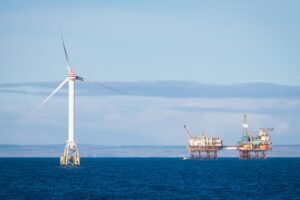
The post Factcheck: Nine false or misleading myths about North Sea oil and gas appeared first on Carbon Brief.
Factcheck: Nine false or misleading myths about North Sea oil and gas

India has unveiled long-awaited climate goals that aim to cut the carbon intensity of its economy, plant trees and expand clean electricity capacity.
The targets, approved by India’s government on Wednesday, will form the basis of the country’s nationally determined contribution (NDC), which it failed to submit by last year’s deadline.
The headline target to reduce greenhouse gas emissions per unit of GDP by 47% by 2035 from 2005 levels, represents only a slight improvement on India’s previous goal to reduce its carbon intensity 45% by 2030.
The government also set a goal for non-fossil fuels to account for 60% of electricity generation capacity by 2035, and approved targets for carbon sinks.
Reactions from analysts were generally positive. Avantika Goswami, climate lead at the Centre for Science and Environment think tank, said that the targets show “India is pulling more than its weight given its minimal historical contribution to emissions” despite “backtracking” from developed countries.
But Lauri Myllyvirta, lead analyst at the Centre for Research on Energy and Clean Air, said the targets are too easy to meet as they “underestimate the country’s potential for transformative clean energy growth”.
Emissions intensity target
Most countries set targets to reduce their absolute emissions levels by a certain percentage by a particular year. But several major developing countries – like China and India – aim instead to reduce their emissions per unit of economic activity, allowing the economy to grow without making the target harder to meet.
In its statement, the government said that India had reduced its emissions intensity by 36%, from 2005 levels, by 2020. It aims to build on this by setting a target to reduce intensity by 47% by 2035.
Myllyvirta warned that the target allows for India’s emissions growth to accelerate compared with past rates if the country achieves its GDP growth projections. But he added that “India’s booming clean energy industry is highly likely to deliver much faster progress than policymakers were prepared to commit to today”.
Clean electricity target
The government set a target for non-fossil fuels to provide 60% of the country’s electricity generation capacity by 2035.
Railways minister Ashwini Vaishnaw acknowledged that the 60% non-fossil capacity target was “very easily” achievable, noting that India had already reached 52%. Myllyvirta agreed, predicting the threshold would be crossed by 2030, five years early.
Ulka Kelkar, executive programme director at World Resources Institute India, said it was “heartening” that India’s domestic electricity plan has a more ambitious target – 70% by 2035 – than it is committing to internationally.
Wind and, particularly, solar power have boomed in India over the last decade, while hydropower and, to a lesser extent nuclear energy, continue to provide a steady level of electricity.
The fossil fuel half of India’s electricity capacity is overwhelmingly provided by coal-fired power stations, tapping into the country’s abundant domestic coal reserves. Gas provides a much smaller share of electricity.
Carbon sink target
The third target approved on Wednesday is to increase India’s carbon sink, through trees and forests, by 3.5-4 billion tonnes of carbon dioxide equivalent by 2035 from 2005 levels.
The government said the sink had already grown by 2.29 billion tonnes by 2021. This means the target could be met even if the pace of increase slows.
Aarti Khosla, director of Indian research and consultancy group Climate Trends, said this target “reinforces the country’s commitment to nature-based solutions”.
Souparna Lahiri, from the Climate Land Ambition and Rights Alliance, told Climate Home News that the target was “not unexpected” as India has always had “massive” forest-growing programmes as well as social forestry.
He highlighted the CAMPA mechanism, which requires developers who clear forests in one area to plant replacement trees elsewhere, as a key driver of new planting, but cautioned that plantations must be monitored to ensure the trees actually survive.
Other NDCs still outstanding
The approval of the targets comes at the same time as the Paris Agreement’s Implementation and Compliance Committee meets in Bonn to discuss how to encourage governments to submit their overdue NDCs. India was the biggest-emitter yet to do so.
Harjeet Singh, director of the Satat Sampada Climate Foundation, said that “while the global community has waited with bated breath for this announcement, the result is a clear signal of integrity and commitment”.
“As a global economic powerhouse, India can further accelerate its domestic efforts if the developed world meets its obligation to provide adequate climate finance, ensuring that India’s success becomes the world’s success”, he added.
The post India sets achievable green electricity and emissions instensity targets appeared first on Climate Home News.
India sets achievable green electricity and emissions intensity targets
Limiting warming to 2C above pre-industrial temperatures may not be enough to prevent “extreme global climate outcomes”, according to research published in Nature.
The authors simulate climate extremes – such as drought in breadbasket regions and flooding in populated areas – under a 2C warming scenario using a range of different global climate models.
They find that the “worst-case” model projections in a 2C warmer world are often more severe than the “average” scenarios in a 3C or 4C warmer world.
An author on the study tells Carbon Brief that, for policymakers planning around risk, it is “really important” to account for these potential extremes at 2C.
The findings are “sobering” and “demonstrate that the risks at 2C of global warming may be significantly higher than previously thought”, according to one scientist who was not involved in the study.
He adds that the methods used in the research would “offer a very useful contribution” to any future “global assessment of avoidable climate-change risks”.
High-risk scenarios
As the planet warms, climate extremes such as floods and droughts are becoming more intense and frequent. For policymakers to effectively plan and adapt to upcoming changes, they need to understand how severe these events could become.
Scientists routinely use global climate models to simulate how extremes may change over the coming decades. One well-established way to present these results is to run simulations using multiple models, then take the average of these results.
This average is known as the “multimodel mean”. Model results typically cluster around the mean, giving scientists more confidence in these results, but there are often also individual projections that sit notably higher or lower.
Prof Erich Fischer is a lecturer in environmental systems science at ETH Zurich and an author on the paper. He tells Carbon Brief that focusing on the multimodel mean is a “very valuable” communication tool for climate scientists, providing a “simpler” message than showing the full range of results.
For example, he tells Carbon Brief that the Intergovernmental Panel on Climate Change (IPCC) – the world’s most authoritative source on climate change – uses the multimodel mean to produce many of its maps.
However, Fischer warns that from a “risk perspective”, focusing solely on the multimodel mean could give a “misleading picture”. For example, he adds, the changes that specific regions may see could be “much, much higher” than the global average.
He tells Carbon Brief that for policymakers planning around risk, it is “really important” to account for more extreme cases too.
To demonstrate this, the study authors select 42 models from the Coupled Model Intercomparison Project 6 (CMIP6). These are the models that are used most widely in the latest set of IPCC reports.
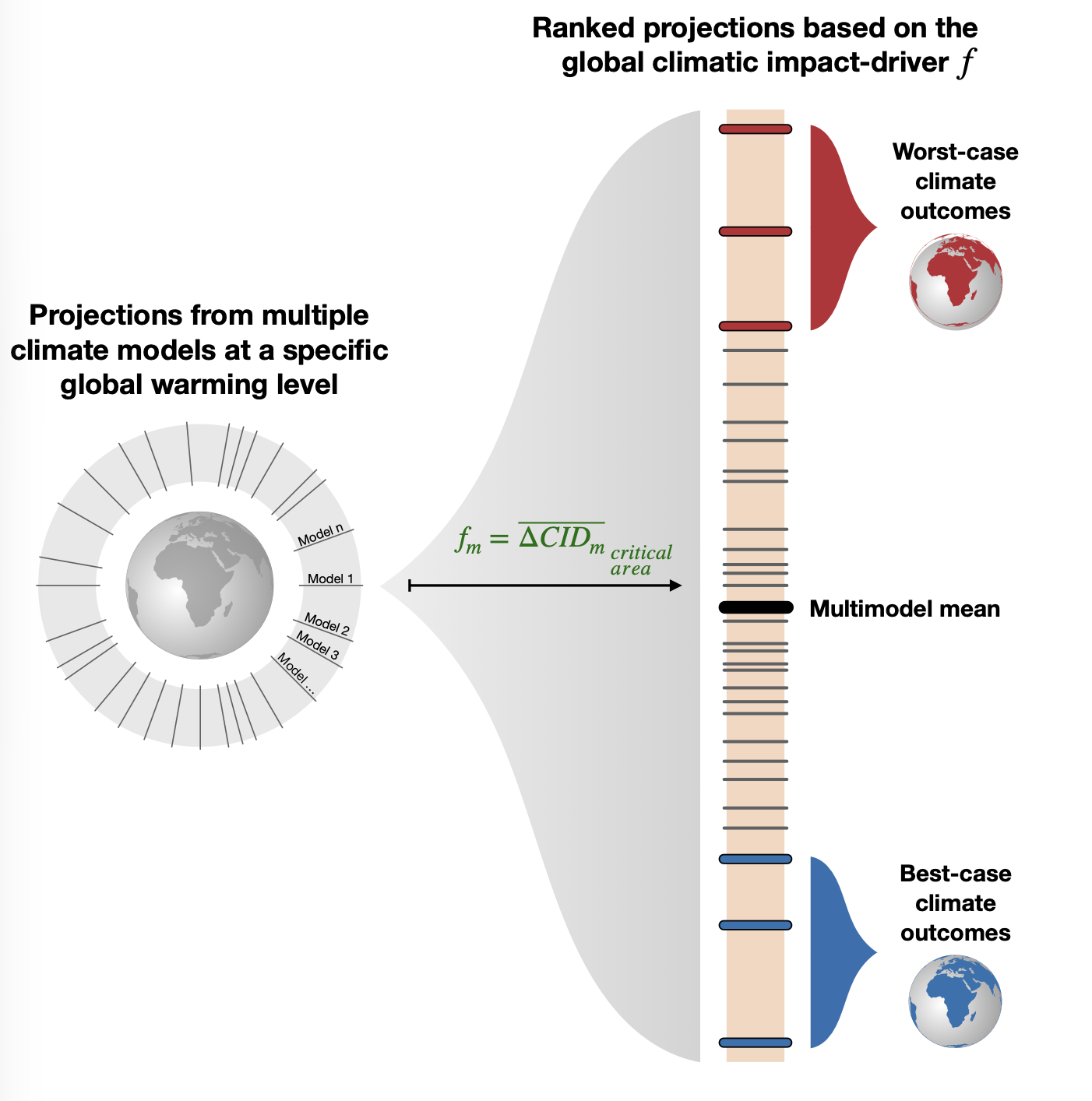
Their approach is illustrated in the diagram below. Note that this illustration is not based on real model runs, but is intended to give an example of what a set of results could look like.
The beige strip on the right shows the spread of results, where each horizontal bar indicates a different model. The models simulating the “worst-case” outcomes (red lines) are at the top and those showing the “best-case” climate outcomes (blue lines) are at the bottom. The majority of models are clustered towards the centre of the bar, close to the multimodel mean (thick black line).
The authors selected three types of events to analyse:
- Rainfall extremes in highly populated areas, which may induce flooding
- Concurrent droughts in global breadbaskets, which threaten food security
- Fire weather extremes across the world’s forests
For each event type, the authors assess the spread of results. They rank the model outputs by the severity of each type of event and compare these to the multimodel mean at different levels of warming – including 2C, 3C and 4C above pre-industrial temperatures.
In many instances, the “worst-case climate outcomes” in a 2C world are more severe than the multimodel mean in a 3C or 4C world.
Prof Rowan Sutton, director of the Met Office Hadley Centre, who was not involved in the study, tells Carbon Brief that the study’s findings are “sobering”. He adds that the paper “demonstrates that the risks at 2C of global warming may be significantly higher than previously thought”.
In its latest assessment report, the IPCC projected that, under current policies, the world could reach 2C of warming between 2037 and 2084, with a central estimate of 2052. (For more on when the IPCC says warming thresholds will be passed, read Carbon Brief’s explainer.)
Breadbasket drought
The analysis of drought in key breadbasket regions provided the “most striking results”, Dr Emanuele Bevacqua, a researcher at the Helmholtz Centre for Environmental Research and lead author of the study, tells Carbon Brief.
To assess the worst-case scenario, the authors simulated drought frequency in “critical breadbasket areas across the world”, he explains.
These are the regions where most of the world’s maize, wheat, soybean and rice is grown, including regions of northern and southern America, Europe, south-eastern Asia and Australia.
The spread of model results is shown below.
The vertical bars indicate the percentage change in average drought frequency between a pre-industrial and 2C warmer world, where more-frequent drought is at the top of the bar and less-frequent drought is at the bottom.
On the left bar, each horizontal line indicates one model. The models showing the “worst-case climate outcomes” are highlighted at the top of the bar. On the right bar, the horizontal bars show the multimodel means for warming levels of 2C, 2.5C, 3C and 4C.
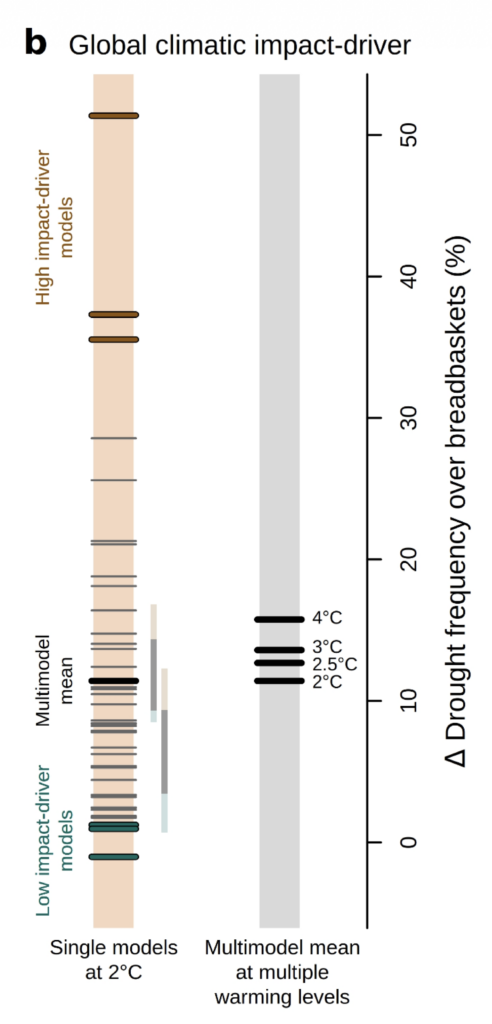
The percentage change in drought frequency in key breadbasket regions between a pre-industrial and 2C warmer world. On the beige bar (left), each horizontal line indicates a model. On the grey bar (right), the horizontal bars show the multimodel means for warming levels of 2C, 2.5C, 3C and 4C. Source: Bevacqua et al. (2026)
They find that 10 of the 42 models simulate a level of drought frequency at a 2C warming level that is higher than the multimodel mean at 4C warming.
(Some models also project a lower level of drought frequency at 2C warming than the multimodel mean. However, the focus of the study is to capture the most severe risks, which are particularly relevant for risk management.)
Bevacqua tells Carbon Brief that this result “makes it very clear that even if we stop [warming] at 2C, we cannot rule out the fact that we might end up in a worst-case outcome”.
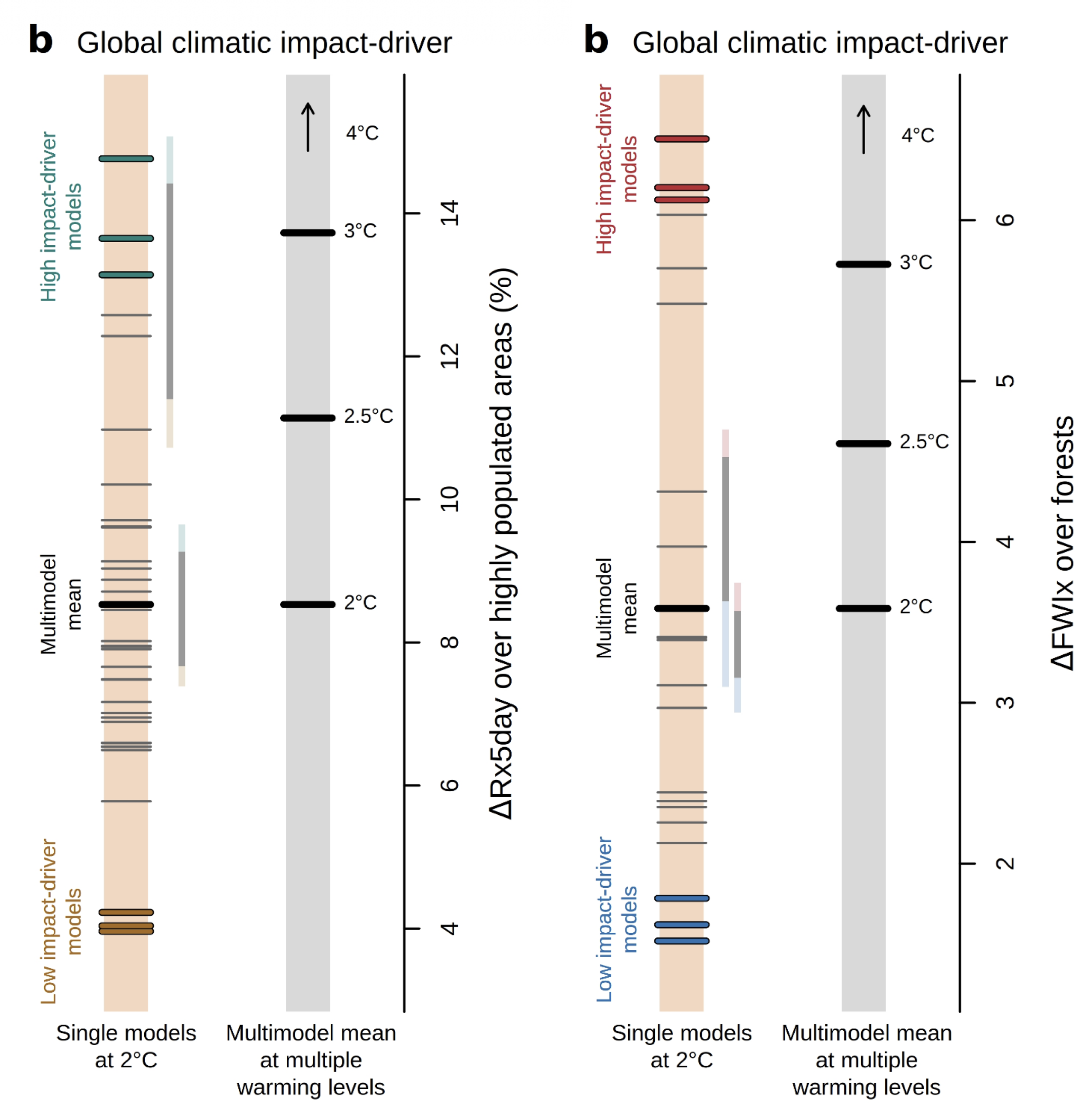
The authors also conduct their analysis for extreme rainfall in populated regions. Although they find a wide range of model results, none of the simulations of extreme rainfall at 2C are higher than the multimodal mean at 4C.
Meanwhile, analysing the risk of wildfires to the world’s forests reveals that four of the models simulate more severe fire risk at 2C than the multimodel mean at 3C and none simulate more severe fire risk at 2C than at 4C.
The spread of model results for rainfall (left) and wildfire (right) are shown below.
Dr Karen McKinnon is an associate professor in statistics and the environment at the University of California, Los Angeles. McKinnon, who was not involved in the study, tells Carbon Brief that the study highlights that “risks are obscured when considering averages across multiple climate models”.
‘Worst-case scenarios’
The authors find that the ranking of models was different across the three case studies. In other words, the same models did not produce the “worst-case” climate outcomes in every type of event.
When assessing the impact of future extremes, the findings emphasise the need to select models that “sample the full range of possible climate outcomes”, the paper says. It adds:
“Currently, large-scale initiatives such as the latest protocol of the Inter-Sectoral Impact Model Intercomparison Project (ISIMIP) rely on a limited subset of climate models that likely omits the best- and worst-case climate models.”
ISIMIP is a global modelling effort to project the impacts of climate change across different sectors. Bevacqua notes:
“[O]ur results suggest that ISIMIP-based simulations probably underestimate the range of possible global impacts at a fixed global warming level of +2C.”
He adds:
“This is worrying and calls for new approaches that can somehow lead to accounting for this.”
The study also shows that many “best-case” model outcomes for a 2C world project a lower level of risk than the multimodel mean. However, Fischer notes that “even the best-case scenario” shows that extremes will become more severe with warming.
Fischer says that the study authors are not “doomscrolling” and notes that “landing somewhere in the middle is still the more likely outcome”. However, he emphasises the importance of considering the high-impact model outcomes for planning around risk.
Communicating risk
Climate scientists and policymakers have been discussing how best to assess and communicate climate risk for decades.
Dr Robert Vautard – senior climate scientist at France’s National Centre for Scientific Research at Institut Pierre-Simon Laplac, who was not involved in the study – tells Carbon Brief that the study provides “very insightful examples of outcomes for communicating risks”.
However, he questions whether the “global indices” used in this study would be relevant for developing “regional” adaptation plans, noting that worst-case impacts in the model “may not be the most problematic locally”.
Last month, a group of leading climate scientists published a comment article – also in Nature – calling for a global climate risk assessment that identifies the “worst-case scenarios” and helps societies to prepare for them.
The article says:
“Global assessments made by IPCC have played, and continue to play, a crucial part in assessing the evidence about climate change. But the IPCC produces science assessments, rather than risk assessments. Its main focus has been to set out what is known with the greatest confidence.
“A climate risk assessment offers different information – it makes clear the scale and severity of risks, to inform judgments about the priority to be given to avoiding or mitigating them.”
Sutton, the Hadley Centre director, is an author on the article. He tells Carbon Brief that “from a policy and decision-making perspective, climate change is a problem of risk assessment and risk management”.
He says that the methods used in this study “offer a very useful contribution to a global assessment of avoidable climate-change risks”.




The post Limiting global warming to 2C would not ‘rule out’ extreme impacts appeared first on Carbon Brief.
Limiting global warming to 2C would not ‘rule out’ extreme impacts
Climate Change
Cropped 25 March 2026: Seabed mining talks stall | ‘Blueprint’ for land use | India feels Iran war impacts
We handpick and explain the most important stories at the intersection of climate, land, food and nature over the past fortnight.
This is an online version of Carbon Brief’s fortnightly Cropped email newsletter.
Subscribe for free here.
Key developments
Seabed mining talks stall
UNFINISHED BUSINESS: The International Seabed Authority (ISA) ended a two-week meeting in Kingston, Jamaica, without agreement on the “long-delayed” code for deep-sea mining, which “remains both unfinished and deeply contested”, said Oceanographic. Several countries raised “fundamental scientific, environmental and governance gaps” in the draft regulations, it added. CBC News reported that although the ISA’s executive secretary, Leticia Carvalho, had previously said she “hoped a mining code could be finalised this year”, she “did not provide a new timeline” following the most recent talks.
DOUBLE TROUBLE: Meanwhile, federal regulators in the US have announced that they have identified nearly 70m acres (283,000 square kilometres) of seabed off the Northern Mariana Islands “that could be open to mineral leasing”, reported E&E News. The outlet noted that this recommendation was nearly double the government’s initial area under consideration, announced last autumn.
-
Sign up to Carbon Brief’s free “Cropped” email newsletter. A fortnightly digest of food, land and nature news and views. Sent to your inbox every other Wednesday.
PROCESS PROBLEMS: The CBC News article noted that 40 member countries now support a moratorium on deep-sea mining, but the ISA has “faced mounting pressure in recent months after the US…moved to begin approving mining outside the ISA process”. In the Conversation, an international-law expert from Duke University wrote: “The Trump administration’s attempt to unilaterally exploit the seabed resources of the global commons will severely undermine part of the rules-based international order that the US built and of which it has been the main beneficiary.”
England’s new ‘blueprint’ for land use
‘BLUEPRINT’: The UK government released its “long-awaited and much-delayed” land-use framework, detailing how England can optimise its land for food, housing, climate and nature, reported Carbon Brief. The “blueprint” found that “England has enough land to meet all of its objectives, if land is used efficiently”, the outlet added. The Guardian said that “farmers and campaigners broadly welcomed the framework”, with the president of the National Farmers’ Union saying that implementation “will require clear guidance, the right policy framework and incentives to avoid unintended outcomes”.
PRACTICAL MATTERS: Alongside the framework, the Environment, food and rural affairs committee of the UK parliament “launched a major inquiry into how England’s land is used”, reported FarmingUK. The inquiry will focus on how the land-use framework “works in practice”, it added. The outlet said: “Looking ahead, the committee will scrutinise how government policy [on land use] is coordinated across departments.”
SLOW PROGRESS: Meanwhile, the National Audit Office found that nature-restoration progress across England has “slowed due to ‘recent funding uncertainty’”, reported Agriland. The office examined the Nature for Climate Fund, a programme under the Department for Environment, Food & Rural Affairs, which was established in 2020 and “led to a substantial increase in tree-planting and peatland restoration”, the outlet said. However, the report also found that “targets in England will continue to be missed” without substantial changes, said the Forestry Journal.
News and views
- PROTECTED WATERS: On 10 March, outgoing Chilean president Gabriel Boric signed a decree to expand and “fully protect” two marine protected areas that “harbour the highest concentration of marine species found nowhere else on Earth”, Island Conservation reported. The new administration told the Guardian that its “intention is not to eliminate protections” and, barring legal and technical issues, it will allow the areas “to go forward as planned”.
- BUSINESS CLASH: Following “clashes” with the agribusiness sector, Brazil launched its new climate plan, which calls for a 49-58% reduction in greenhouse gas emissions from 2022 levels by 2035, reported Folha de Sao Paolo. Meanwhile, Climate Home News wrote that the “Tropical Forest Forever Facility” – which Brazil championed – is “unlikely to make payments to rainforest countries until at least 2028”.
- SAVE THE FISHES: A new UN report identified 325 freshwater fish species “requiring coordinated international conservation action” to address declining populations due to overexploitation, habitat degradation and other compounding pressures, said Down to Earth. The report was launched at the 15th Conference of the Parties to the UN Convention on the Conservation of Migratory Species of Wild Animals, which began on Monday in Campo Grande, Brazil.
- FACE PALM: A Climate Home News and SVT investigation found that Neste – the world’s largest producer of sustainable aviation fuel (SAF) – was sourcing “key ingredients from an opaque supply chain” that allowed “fresh palm oil to be passed off as waste”. Neste said it would look into the outlets’ findings, adding that it was “currently not aware of any verified cases of fraud” in its raw-materials sourcing.
- CRITICAL HABITAT: The US government plans to approve the country’s first critical-minerals mine in Patagonia, Arizona, even as locals warn of potential water and biodiversity impacts, Inside Climate News reported. The project site – which holds “one of the largest undeveloped zinc resources in the world” – borders “one of the most important biodiversity hotspots in North America”, which is home to 12 endangered species, including jaguars and Mexican spotted owls, the outlet added.
- RE-PEAT OFFENDERS: More than 370,000 tonnes of peat were exported from Ireland in 2025, with revenues totalling around €40m – “despite there being no known legal commercial peat extraction operation in the country”, said the Irish Times. This represents a higher volume than was exported in 2023 or 2024, but a decrease from the nearly one million tonnes exported in 2020, it added.
- ‘FIELDS OF IRON’: Rural voters in Denmark have begun to “sour” on solar power, with one populist leader in 2024 saying “no to fields of iron!”, said the Guardian. Danish PM Mette Frederiksen “failed to secure a majority” in the country’s general election on Tuesday, where the climate footprint of agriculture has been a concern for voters, reported BBC News.
Spotlight
Plate half full
This week, Carbon Brief looks at the impact of the US-Israel-Iran war on India’s kitchens, restaurants, workers and farmers – and what it means for the climate.
On 23 March, two Indian-flagged tankers made their way through the mine-laden Strait of Hormuz, hugging Iran’s coastline.
The ships are carrying more than 90,000 tonnes of liquefied petroleum gas (LPG), equivalent to roughly one day of the country’s cooking gas consumption.
In India – the world’s second-largest LPG importer – gas is intrinsically tied to food security.
With 60% of these imports sourced from Gulf countries, the war’s immediate impacts have been acutely visible in India’s kitchens and restaurants.
Lunch on the move
Since 10 March, many Indian cities and towns have seen snaking queues and skirmishes breaking out as India’s poor rushed to refill gas cylinders in the heat of an early summer.
As the government prioritised the 340m households that use LPG over commercial establishments, restaurants have faced “catastrophic closures”.
Ashok Vada Pav – birthplace of Mumbai’s vada pav, or potato burger, which has been described as the “soul of the [city’s] working class” – has shut its doors. Ramashraya – serving south Indian breakfasts since 1939 – had to turn away customers who have been coming there for decades.
However, hot lunches – cooked at home or purchased from the city’s many canteens – continue to travel the length of Mumbai in tiered steel tiffins carried by the iconic dabbawallahs.

Ramdas Karwande, president of the Mumbai Tiffin Box Suppliers Association, told Carbon Brief that, of the 80,000 lunches that dabbawallahs carry across the city each day, 40% are typically from caterers. That number has halved in the past weeks, he said.
Karwande explained:
“People who come to this city from places far away have no choice but to eat canteen food. But home food is still on the move, because everyone needs to eat somehow.”
Fuel to firewood
In an address to parliament on Monday, India’s prime minister Narendra Modi likened the fallout of the war to that of the Covid-19 pandemic – a comparison that has drawn criticism.
The cooking gas shortages have prompted an exodus of migrant workers leaving cities for their home states, where biomass cooking remains accessible.
Cities, such as Delhi and Mumbai, have put a pause on emissions curbs for dirtier fuels since 14 March, as poorer families facing soaring black-market gas prices turn to wood, kerosene and coal.
While government gas and biogas schemes have led to a decrease in firewood usage in many states over many years, analysts have said the current crisis “offers a critical moment to rethink India’s cooking energy mix”.
In Mumbai’s wealthy suburb of Khar, induction stoves have been “flying off shelves”, Jaffair Sheikh, who sells appliances at an upmarket electronic retail store, told Carbon Brief. He added:
“We’re selling 20 units a day, when we used to sell almost zero before this war.”
However, only 5% of India’s households have access to electric cooking devices and the country’s grid is still largely powered by coal.
Away from the cities, there is a looming fear of the war’s impact on agriculture, given India’s dependence on the Gulf for fertiliser imports.
Siraj Hussain, India’s former agriculture secretary, told Carbon Brief:
“Gas is the main raw material for urea – and urea stocks are grossly insufficient to meet even kharif season (May to July) demand. But if the government can reduce supply to states where excessive fertiliser is used and increase supply to states where consumption is low, to some extent, this deficit will not be as harmful as it would be otherwise.”
Crop stock and biofuel fears
Punjab’s farmers, meanwhile, were already worried about the impact of an early summer on wheat production.
However, Hussain told Carbon Brief that India’s food security in terms of wheat and rice “will not be affected too much” because the country is “sitting on” excessive stocks. He added that he hopes the war will “persuade the government” to reduce its use of rice for ethanol production.
Still, food inflation is already being felt across the country. Karwande added:
“Everyone is tense. The monthly payments we get are going down and running a house is now difficult: the same problems we had during lockdown are back. Oil, sugar, everything has become expensive. This is not just our problem; this is everybody’s problem. The government has to do something.”
Watch, read, listen
FARMERS’ FUTURES: High Country News explored how farmers in the Colorado River basin are dealing with water shortages “amid deep political divisions about the river’s future”.
FOOD SHOCK: Experts on Al Jazeera’s Counting the Cost podcast looked at whether the US-Israel war on Iran could “trigger the next global food shock”.
LYNX IN BIO: BBC News featured the winning images from the Wildlife Photographer of the Year People’s Choice Award. The photos will be on display at London’s Natural History Museum until 12 July.
ECO BREAKDOWN: Mongabay detailed the causes of the “mental health crisis” impacting conservationists, including biodiversity decline, climate change, low wages and burnout.
New science
- Less than half of the Amazon rainforest that was affected by the 2023-24 drought is “expected to recover to pre-drought conditions” within seven years | Proceedings of the National Academy of Sciences
- Beavers can turn the ecosystems surrounding streams into “persistent” sinks of carbon that can sequester an order of magnitude more than non-beaver-modified ecosystems can store | Communications Earth & Environment
- Climate change-induced heat could result in half a trillion hours of lost productivity by 2055 in a low-emissions scenario, disproportionately impacting low-income countries and agricultural workers | GeoHealth
In the diary
- 23 March-2 April: Third meeting of the preparatory commission for the High Seas Treaty, New York
- 24-27 March: 64th session of the Intergovernmental Panel on Climate Change, Bangkok
- 26-29 March: 14th ministerial conference of the World Trade Organization, Yaoundé, Cameroon
Cropped is researched and written by Dr Giuliana Viglione, Aruna Chandrasekhar, Daisy Dunne, Orla Dwyer and Yanine Quiroz. Please send tips and feedback to cropped@carbonbrief.org

The post Cropped 25 March 2026: Seabed mining talks stall | ‘Blueprint’ for land use | India feels Iran war impacts appeared first on Carbon Brief.


-
Greenhouse Gases8 months ago
Guest post: Why China is still building new coal – and when it might stop
-
Climate Change8 months ago
Guest post: Why China is still building new coal – and when it might stop
-

 Greenhouse Gases2 years ago
嘉宾来稿:满足中国增长的用电需求 光伏加储能“比新建煤电更实惠”
-
Climate Change2 years ago
Bill Discounting Climate Change in Florida’s Energy Policy Awaits DeSantis’ Approval
-

 Climate Change2 years ago
嘉宾来稿:满足中国增长的用电需求 光伏加储能“比新建煤电更实惠”
-
Climate Change Videos2 years ago
The toxic gas flares fuelling Nigeria’s climate change – BBC News
-

 Carbon Footprint2 years ago
US SEC’s Climate Disclosure Rules Spur Renewed Interest in Carbon Credits
-

 Renewable Energy5 months ago
Sending Progressive Philanthropist George Soros to Prison?