


Rob Hopkins, a founder of the Transition Town Movement
Episode 95: Rob Hopkins on the Role of Imagination in Climate Change Solutions
In this month’s Citizens’ Climate Radio episode, Rob Hopkins, one of the founders of the Transition Town movement, shows us how playful imagination can lead to real-world solutions, and you will discover how a life-sized whale made of plastic bags brought a community together to pass groundbreaking legislation. Artist Carrie Ziegler shares her extraordinary project that mobilized hundreds of schoolchildren to make a powerful statement about plastic pollution. In the Nerd Corner, Dana Nuccitelli tackles the big question: is a carbon price still effective in a post-Inflation Reduction Act world?
Rob Hopkins, Time Traveler and Creative Climate Change Campaigner
Rob Hopkins, co-founder of the Transition Network and Transition Town Totnes, and author of several influential books, including “The Transition Handbook” and “From What Is to What If: Unleashing the Power of Imagination to Create the Future We Want,” believes that playful imagination is crucial for tackling climate change. An Ashoka Fellow with a PhD from the University of Plymouth and two honorary doctorates, Rob encourages communities to adopt sustainable practices that promote self-sufficiency and environmental stewardship. “My work is about finding positive solutions to climate change,” says Rob, who also engages in printmaking in his spare time. His approach to climate activism is deeply rooted in the power of imagination, urging people to envision a future where collective action has transformed our world for the better.
 One of Rob’s most innovative techniques involves time travel exercises, where he guides participants to imagine themselves in the year 2030 or beyond, a time shaped by years of dedicated environmental efforts. “I always remind people, ten years is actually a long, long time in terms of things that can happen,” he explains. Participants universally envision a cleaner, more content, and more connected world through these exercises. Rob’s ability to inspire others by helping them create a “new north star” in their lives, where a low-carbon future feels “delicious and irresistible,” makes his perspective both inventive and motivating. As he puts it, “We need to cultivate and nurture in people the most profound longing for a low-carbon future.”
Rob Hopkins hosts the podcast From What If to What Next, which explores imaginative solutions to some of the world’s biggest challenges. You can learn more about Rob, his books, and the Transition Town movement by visiting his website. You can watch the film, Transition 2.0 for free on YouTube. It is “an inspirational immersion in the Transition movement, gathering stories from around the world of ordinary people doing extraordinary things.” Additionally, check out his latest projects, the Ministry of Imagination Manifesto and Field Recordings from the Future. Rob’s forthcoming book, “How to Fall in Love with the Future,” is set to be released next year. In November 2022, Rob was honored as an Honorary Citizen of Liège in Belgium. Connect with Rob and explore his innovative approaches to climate activism at robhopkins.net.
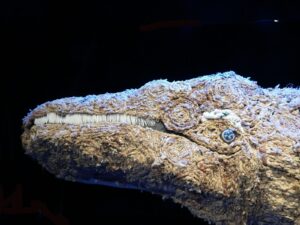 Collaborative Art Meets Activism: Carrie Ziegler’s Whale Project Sparks Change
Carrie Ziegler is a collaborative artist based in Olympia, Washington, whose passion lies in creating large-scale art projects that inspire positive change. By working with schools, nonprofits, and local governments, Carrie brings together hundreds, sometimes thousands, of individuals to address environmental and social justice issues through art.
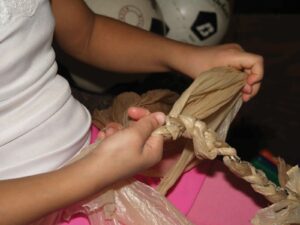
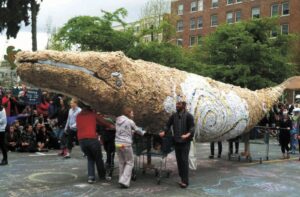 One of her most impactful projects involved creating a life-sized gray whale made entirely of plastic bags and trash, engaging over 900 children and adults. “I decided to do a project around that,” she explains, reflecting on her mission to end the use of single-use plastic bags. “We created this whale, this life-sized gray whale out of plastic bags and other trash.” This incredible undertaking educated participants about marine biology and plastic pollution and became a powerful symbol in the community, helping to shift public opinion and inspire legislative change.
 Carrie’s work is a testament to the power of art in activism. The whale, modeled after a real whale found with plastic in its stomach, was publicly unveiled at the annual Procession of the Species celebration, where thousands witnessed its impact. “There were actually council members who invited me to bring the whale to their city council meetings,” Carrie recounts, highlighting the project’s role in successfully implementing plastic bag bans across local jurisdictions. However, her work’s true success lies in the personal empowerment it fosters. “There were kids, particularly middle school kids, who talked about how they felt personally responsible for that ban on plastic bags,” she shares. Carrie’s projects provide participants with a sense of ownership and accomplishment, proving that collaborative art can indeed change the world.
Visit Carrie Ziegler’s website to learn more about her inspiring projects, read her journal, and watch videos. For images of the whale project and additional information, check out the show notes at cclusa.org/radio.
Take a Meaningful Next Step
Each month, we will suggest meaningful, achievable, and measurable next steps for you to consider. We recognize that action is an antidote to despair. If you are struggling with what you can do, visit our Action Page.
Listen Now!
The Nerd Corner: Carbon Fee & Dividend in a Post-IRA World
 Dana Nuccitelli, CCL Research Coordinator, explores whether a carbon price remains the best climate policy in a post-Inflation Reduction Act world. “Putting a price on carbon pollution would impact almost every sector of the economy,” Dana explains, emphasizing its cost-effective impact on emissions. Visit the Nerd Corner to join the conversation. You can also read some of Dana’s articles in The Guardian.
Good News
Citizens’ Climate Lobby volunteers nationwide achieved the goal of having over 30,000 climate conversations. By breaking the silence and discussing climate change with friends and family, they made the issue more real and paved the way for action.
Listener Survey
We want to hear your feedback about this episode. After you listen, feel free to fill in this short survey. Your feedback will help us make new decisions about the show’s content, guests, and style. You can fill it out anonymously and answer whichever questions you like. You can also reach us by email: radio @citizensclimatelobby.org
You can hear Citizens’ Climate Radio wherever you get podcasts.
We Want to Hear from You
- Email: radio @ citizensclimate.org
- Text/Voicemail: 619-512-9646
Special Thanks to the following people and groups for the ways they promote us through social media:
Reverend Doctor Jane Ellingwood, James Bradford III, Michael Cooper, Bill Nash, Wharton Sinclair, Sari Fordham, Karina Ramirez 1.5, and CCL Chapters in Arkansas, Boulder, Colorado, San Diego, Alameda, and Silicon Valley North in California
Production Team:
- Written and produced by Peterson Toscano and the CCR team
- Technical Support: Horace Mo, Erika Valdez, Ricky Bradley, and Brett Cease
- Social Media Assistance: Flannery Winchester
Music is provided by epidemicsound.com
Social Media:
Follow us on X, Instagram, LinkedIn, Facebook, and TikTok.
Read the Transcript
Rob Hopkins on the Role of Imagination in Climate Change Solutions
SPEAKERS
Carrie Ziegler, Dana Nuccitelli, Horace Mo, Erica Valdez, Peterson Toscano, Rob Hopkins
Peterson Toscano 00:00
Welcome to Citizens Climate Radio, your climate change podcast.
Peterson Toscano 00:04
In this show, we highlight people’s stories, we celebrate your successes, and together we share strategies for talking about climate change. I’m your host, Peterson Toscano. Welcome to Episode 95 of Citizens Climate Radio, a project of Citizens Climate Education. This episode is airing on Friday, May 24 2024. Erica Valdez and Horace Mo are very busy working on next month’s episode. I hope to check in with them before the show ends though. In the Nerd Corner, Dana Nuccitelli answers a very important question. Is a carbon price still the most effective policy in a post-Inflation Reduction Act world? Carrie Ziggler joins us to share an extraordinary community art project that resulted in the passage of meaningful legislation. She engaged hundreds of schoolchildren to use plastic bags to send a big message to lawmakers. Carrie demonstrates how art and artists can help us convince the public and policymakers to make the right choices.
Peterson Toscano 01:20
But first, I want to immerse us in a world of imagination. Some may think that playful imagination is a helpful escape from real world problems, my guest begs to differ, he sees our imaginations as the essential tool for addressing these problems. My first guest is a time traveling do gooder in England. Now, it’s not Doctor Who.
Rob Hopkins 01:50
So I’m Rob Hopkins, I am the founder of the Transition Movement. My work is about finding positive solutions to climate change. And in my spare time I do printmaking. So it’s normally easy just to say I’m an I’m an author and an activist really saves a bit of time.
Peterson Toscano 02:09
The Transition Town Movement is a community-led initiative that aims to promote self-sufficiency and reduce the impact of peak oil, climate change, and economic instability. It encourages communities to take control of their own future by adopting sustainable practices that are kinder to the environment. Rob and his colleagues have successfully implemented innovative approaches to change the way certain towns operate. I recommend you watch the documentary Transition 2.0, you’ll learn about inspiring stories of communities working together for self-sufficiency, and sustainability. It features innovative ideas like printing local money, growing food locally, and setting up community power stations. But I didn’t invite Rob Hopkins to our show to discuss the transition movement. Instead, I requested him to share the tools, techniques and strategies he uses to think outside the box. And this includes time travel.
03:15
And so when the time machine, I would say to people to close their eyes and imagine that we’re going to travel to 2030. And I have different techniques that I use to do it and make it quite theatrical, you know. And then I say, with the 2030 we’re traveling to isn’t a utopia. It’s not a dystopia, either. But it’s the result of us having spent those years between now and then doing everything we could possibly have done. And I always remind people that 9/10 years is actually a long, long time in terms of things that can happen. It took 10 years for Rosa Parks to refuse to give up her seat on the bus for the Civil Rights Act to be passed in America. 10 years from the first international sanctions on South Africa, to the new constitution being created in South Africa. 10 years after the first iPhone, half the people in the world have a smartphone, and maybe that’s not such a good one. But you know, things change really, really fast. So I asked people to close their eyes and to imagine that they’re moving through time, and then they’re being dropped into that 2030, And then just to take a walk around, using all their senses, what does that world smell like feel like tastes like.
Rob Hopkins 04:17
I’ve done that exercise now with 1000s of people. And I’ve done it with 10 people in a workshop. I’ve done it with one and a half 1000 people in a hall in Belgium. And what’s so fascinating to me about that activity is that no one ever says we’ve got a new IKEA, which is four times bigger than the one we had in 2022. No one ever says, Oh, my iPhone 28 can give me real tattoos or something. You know, it’s like, actually, everybody says, the air smells cleaner. The birdsong is louder. There are less cars, people seem more content, and they spend more time with their families. They don’t work so much. Their work is more meaningful, and so on and so on. You know, It’s universal. So then I always think, Well, why do we not start there and work backward? We start with how we are going to achieve that. What would that look like? And that’s why, in the podcast that I do, every episode starts with us doing some time travel. So if we’re talking about universal basic income, we don’t debate whether it’s a good idea or not, we say we’ve had a universal basic income now for eight years. How does the world taste differently? How does it sound differently? For me, there’s something about helping people to create a new North Star in their life. Like, I want that.
Peterson Toscano 05:40
Rob Hopkins’s podcast is called From What is to What If, and it’s named after his 2020 book about unleashing the power of imagination to create the future we want.
Rob Hopkins 05:52
I feel like there are some people like me who can read terrifying, depressing climate papers and somehow translate that transmute that into doing something for a lot of people. They just get really stuck and really paralyzed. And I think if all of our narrative is just about extinction and collapse, we don’t offer anything. You know, the poet Rilke said something like, “The future must enter into a long time before it happens.” So beautiful, you know, and if we don’t allow the future to enter into people, if we don’t cultivate and nurture in people, the most profound longing for a low carbon future, if the way we talk about a low carbon future doesn’t make it sound, delicious, and irresistible, and abundant and gorgeous, then why is anyone going to want to do that? We’re only going to go there if it feels like we’re moving towards something irresistible rather than being dragged away from something irreplaceable. So how do we do that? So for me, I use that idea of time travel in lots of different ways.
Peterson Toscano 07:06
Rob has often said, climate change is the greatest failure of the imagination in the history of humanity.
07:13
The big challenge that we have is that there are so many people in positions of power who should be reimagining everything. I mean, you know, just to put it in context, you know, the United Nations said staying below 1.5 degrees was beyond us unless we were to see the rapid transformation of societies, is what they called it. So, loads of people, all the headlines are saying, well, 1.5 degrees beyond us now; maybe that’s the wrong way of looking at it. Maybe the question is, how do we create a rapid transformation of societies if that’s our only option? Like death, or rapid transformation of societies? I think we should put a bit more effort into that rapid transformation in societies but myself, you know, thinking outside the box here, Mariame Kaba, who’s a great hero of mine, amazing prison abolition activist in the US, she said, we live in a system that has been locked into a false sense of inevitability. I love it. So many diff, and so many of the people who are holding on to those positions just can’t imagine anything else. The people in the Department of Transport, can’t imagine a future without cars, and the people in the Department of Energy can’t imagine a future without fossil fuels.
Peterson Toscano 08:22
I am not at all surprised that important business and government leaders have not reached the point where they can imagine big systemic changes. They take themselves very seriously. And so much creativity and fresh ideas come through cultivating a playful attitude.
08:45
When I do workshops and trainings with people, a lot of it is about play, and just getting people to play again. And so whenever I do workshops, even with the most serious, uptight people who often come with lots of baggage around being right, and not wanting to make a fool of themselves and not wanting to take any risks and having to get everything right, is I put them into groups of five or six people. I give them a potato each, and I give them a bunch of cocktail sticks. And I say you can go outside you can add anything to this that you want. But I want you back here in 25 minutes with a creature, and I want to know its name. I want to know its mating call. And I want to know what his diet is. And they just go off, and you watch them go, and they just giggle for about 25 You just hear them go rugger. Oh, and the beautiful thing about it is you can’t make anything out of potatoes. That isn’t ridiculous. Even even if you’re the most perfectionist engineer, you can’t make something out of potatoes. That doesn’t look really stupid. And it’s a really nice way of just getting people freed up a bit.
Rob Hopkins 09:48
When I do public talks as well. They become more and more like workshops and we do an exercise called yes and and yes, but which is what you learn in improv. You know the difference between Yes, But Yes And. which is really important because all of us, as activists, have experienced everything we encounter being yes. But yes, but all yes, but there’s, there’s no money for that. There’s no whatever, there’s no time we tried that before, it didn’t work, all that kind of stuff. When I design a two-day workshop, I’m going to be running in Belgium in a couple of weeks. And we spent half of the first day in the forest, using a set of exercises, which allowed adults to see the world to see the forest like they saw it when they were a child. That kind of shift in our thinking is really, really powerful, too. So in terms of an exercise, there’s something that was developed by Transition Network working with encounters to an amazing community arts organization, and it’s called Transition Town Anywhere. So the idea is you get about between two and 400 people, you need a big space, you start with doing some time traveling, and stepping into the future that we could still create. And then you think, Well, what am I doing in that future? What’s my role? What’s my job, what’s my work, then you meet other people who were thinking along the same lines, you design a project together, something you’re doing, maybe you’re running the bank, maybe you’re running the energy company, maybe or whatever. But then you literally build it with cardboard boxes, bamboo sticky tape string and pens; you create this three-dimensional version of that future that you then live in and inhabit and play in. And it’s one of the most magical, magical things I’ve ever been part of. I think we need to find a lot more things like that, and our activism needs to feel a lot more like play.
Peterson Toscano 11:40
Rob reminds us that speaking about climate change is significant climate work. How we speak about it, though, can make all the difference.
11:49
It’s really important that we have conversations with everybody we know about climate change and the situation that we’re in. You know, when people say, Well, why do you do this? It’s like, it’s one thing to say because I’m terrified about the future and climate change. Then maybe we could flip that and say it’s because I am so longing for a world where the birdsong is louder than the traffic. I’m so longing for a world where the rivers and our cities are so clean that people can swim to work. As the world grew warmer, we realized that the tarmac was killing people. Concrete was killing people. And so we took up 80% of it. And now our cities are full of wildflowers and plants, and I so long for a world where when you go to visit the theater, they’ve covered the outside of that building, with bird boxes and insect hotels. So when you approach the theater, it’s more alive with wildlife than visiting a jungle or something. Give people that longing. Cultivating longing is the most important thing, and I think that we can be doing it as activists. And we can’t do that. Without artists, storytellers. musicians, poets, film writers, novelists. We need everybody because we have to bring this alive. There’s a beautiful quote by Arundhati Roy. She says, what lies ahead, reimagining the world. Only that.
Peterson Toscano 13:30
That was Rob Hopkins, host of the podcast from what is to what if? Learn more about him his book and the Transition Town movement at his website, Rob hopkins.net. And while you’re there, definitely check out his newest projects. The Ministry of imagination manifesto and field recordings from the future.
Peterson Toscano 14:02
Coming up, Dana Nuccitelli will answer the question is a carbon price still the most effective policy in a post inflation Reduction Act world? Carrie Ziegler, an artist on the West Coast of the USA tells us about a community art project that changed a law and I have a good news story about a successful campaign that got a lot of people talking about climate change, stay tuned.
Peterson Toscano 14:53
When we want elected officials to change policy, we have many ways to reach them and build political will We write letters to the editor and op ed pieces, we start petitions, we sent messages to our lawmakers and even show up at their offices to compel them to vote for an environmental and climate friendly policy. We need to be heard above all the other voices. Without a big public relations budget. What can we do? That’s when we can turn to our friendly neighborhood artists.
Carrie Ziegler 15:34
My name is Carrie Ziegler. I am a collaborative artist living here in Olympia, Washington. And what I love to do more than just about anything else is to work with hundreds, sometimes 1000s of individuals with schools, nonprofits, and local government to create these multifaceted, large-scale collaborative art and action projects around different environmental and social justice issues. With the goal of inspiring positive change in our world. I went on a journey, you know, through a life journey for many years trying to figure out how to bring art and science together. I did that in so many different ways. I worked as a naturalist and environmental educator for a long time. So, I’ve worked with people a lot, and I would often bring art into that work. It took a long time for me to figure out what collaborative art was; for me that really came together.
Carrie Ziegler 16:32
About 10 years ago, when I was working for my county, Thurston County, as an environmental educator, I had the opportunity to create some programming for youth and my supervisor was very open-ended about it. During that time, we were going through a process in our county to decide whether or not the public was ready to want it to ban single use plastic bags. And since I was really passionate about that idea, I wanted to end the use of single-use plastic bags, so I decided to do a project around that. But as I started thinking about it, as often happens for me, my ideas they just kind of grow and get bigger. And so I thought, hey, why not create a life-sized plastic whale out of plastic bags and other trash? Amazingly, my supervisor said, Okay, go for it. You don’t get any money. We’re not giving you a budget for this. But you can go and do this wild idea.
Carrie Ziegler 17:31
I ended up working with over 900 Kids and adults in classrooms and community spaces, teaching them about marine biology, the impacts that plastic bags have on our environments, and talking about solutions to that. And then, together with all these different people, we created this whale, this life-sized gray whale, out of plastic bags and other and other trash. And so each individual who was part of that project, got to do a piece of this work. Younger kids, elementary school-aged kids, they would bring their plastic bags in from home. We all used to have this giant bag full of plastic bags just stuffed under our counter, in the closet, or somewhere. And so they would bring in these bags full of bags, and we would pull them out and create this mountain of plastic trash in the middle of their classroom or the school gymnasium. And we use that to help us understand how many plastic bags are used daily. In our school in the city. You know, throughout the world. It was really, really powerful.
Carrie Ziegler 18:39
They cut and braided plastic bags, but they loved it. I must have taught 500 kids how to braid that winter. Some of them got so into it, they would just they wouldn’t stop they would have these long braids spread all the way across gymnasium floors. It was really incredible. So the whale was modeled after an actual whale that had washed up on shore in Seattle the previous year and that whale, and when the scientists did the necropsy, they found, amongst other things, they found a bunch of plastic bags in its stomach. That’s why we chose the gray whale. The whale was 32 feet long, about the size of a juvenile gray whale. This project was so impactful, because the students and the people who worked on it, only got to see the beginning of it.
Carrie Ziegler 19:31
But then I ensured that the whale was in a very public place when it was all completed. We unveiled the whale, if you will, at our annual Procession of the Species celebration. It was in this parade where 1000s upon 1000s of people got to see it and then it was on display in the Washington Center for the Performing Arts, and everyone was invited to come and see it. People got to see the impact of it. But the thing that’s really important about this project is that whales help shift public opinion in my county. There were actually council members who invited me to bring the the whale to their city council meetings to talk to their constituents about the importance of reducing the use of plastic bags. In part because of that project, all four of our local jurisdictions implemented a ban on plastic bags. That was incredibly powerful.
Carrie Ziegler 20:27
But you know what, it was more powerful than that. Some kids, particularly middle school kids, talked about how they felt personally responsible for that ban on plastic bags. That’s one of the things that collaborative art is so important for; it’s so powerful because it allows people to create something way larger than they ever could have on their own. And to be a part of something so much bigger and take ownership of it like those kids felt like they changed our government and did. When I think about collaborative art, they think about how it opens heart, how it breaks down barriers, and how it creates an opportunity for the people involved to have a story to tell about something that they are passionate about that can help them to connect with others and create change.
Peterson Toscano 21:26
That was Carrie Ziegler, an artist-activist, and so much more. Learn about her other projects, read her journal, and see videos on her website. That website is Carrieziggler.com Ziegler spelt Z I E G L E R. See our show notes for images of the well project. Visit CCL usa.org/radio.
Peterson Toscano 21:54
Now it’s time for the nerd corner hosted by Dana Nuccitelli citizen climates or research coordinator.
Dana Nuccitelli 22:02
Hi, I’m Dana Nuccitelli, CCL research coordinator, and this is the Nerd Corner.
Dana Nuccitelli 22:16
I’m here to highlight some interesting new climate research for the nerds out there and make it understandable for the nerd curious. In this episode, we consider the question: Is a carbon price still the best climate policy in a post-Inflation Reduction Act world?
Dana Nuccitelli 22:45
Research has long shown that putting a price on carbon pollution in combination with some other complimentary climate policies, cut emissions enough to meet America’s Paris commitments. That’s what studies were finding 10 years ago and five years ago, but what about today, Time keeps marching relentlessly forward, and in 2022, America passed its largest-ever climate bill in the Inflation Reduction Act or IRA. Since then, we nerds have been waiting for some researchers to evaluate how effective carbon price and other climate policies would be in today’s post-IRA 2024 world, and we finally got our wish.
Dana Nuccitelli 23:28
The Hamilton Project at the Brookings Institution brought together some top-notch economists to examine seven scenarios. Those scenarios centered mainly around four big climate policies. First, they looked at repealing or keeping the EPA’s various climate regulations. Second, they considered expanding or keeping or repealing the IRA. Third, they simulated implementing a clean electricity standard, requiring electrical utilities to get a certain percentage of their electricity from clean sources by a certain date. And fourth, they looked at what would happen if we put a modest price on carbon pollution. Expanding the IRA didn’t have much of an effect on climate pollution. Because the existing laws aren’t investing a lot of money in clean technologies. The clean electricity standard didn’t fare much better because it would only affect the power sector. But the clean energy tax credits in the IRA are already working to quickly decarbonize our electricity. But putting a price on carbon pollution would impact almost every sector of the economy. So, it had the biggest and most cost-effective impact on emissions. It turns out that a carbon price is still the single best climate policy.
Dana Nuccitelli 24:45
Overall, the study found that adding a modest carbon price on top of the IRA and EPA regulations would nearly meet America’s Paris commitments. It’s fair to say that adding clean energy permitting reform to maximize the eye Ra’s potential and implementing a more ambitious carbon price like that in CCL Staver bill, the Energy Innovation Act, would meet our goal of cutting America’s climate pollution in half by 2030. We know what to do now, so we just have to go out and make it happen. I’m Dana Nuccitelli. With the nerd corner. Thank you for being curious and for your commitment to climate progress. To join the discussion about climate science, technology, Economics, and Policy with CCL research team, check out the nerd corner at CCL usa.org/nerd-corner That CCL usa.org/nerd-corner. I hope to see you there.
Peterson Toscano 25:52
Thank you so much for that, Dana. If you have a question for Dana, email us radio at citizens climate.org. We will make sure he gets your message.
Peterson Toscano 26:03
Our good news story today is about many people talking about climate change. Climate communication expert Dr. Katharine Hayhoe has said no one does anything unless it feels important. And if no one talks about it, how important can it be? And quote, okay, challenge accepted. Last month, Citizens Climate Lobby asked volunteers nationwide to have open and honest conversations about climate change. Talk with friends, family and communities. Here is the good news. We achieved our goal of 25,000 climate conversations, we broke the silence about climate change, got practice talking about it and paved the way for action. When we talk about climate change with our friends and family, it becomes more real and relevant. And that makes it more likely that we can move from just talking to acting. That is one of many monthly actions that we do if you want to find out about these monthly actions visit CCL usa.org/action. And if you have good news you want to share in our program, email, radio at citizens climate.org. That’s radio at citizens climate.org.
Peterson Toscano 27:24
Hello, Horrace? Erica.?
Peterson Toscano 27:26
Hey, Peterson.
Peterson Toscano 27:28
Hey, I hope I didn’t interrupt you recording
Erica Valdez 27:30
No, we are all good. Okay, good.
Peterson Toscano 27:32
Well, I’m just finishing up the episode and wondering what’s happening next month, you and Horace are doing the entire episode from start to finish? What should we expect for episode 96.
Horace Mo 27:45
So I did an interview with Ann E Burg, and really entertaining and fully engaged interview about a newly published book, force of nature. And that book actually talks about Rachel Carson’s life, but it’s quite different from other books you would read about Rachel Carson, like the biography ones. I’m so excited to have in our upcoming episode 96. Excellent.
Peterson Toscano 28:11
And what about you, Erica? What do you bring to the episode?
Erica Valdez 28:15
I cover a story about fossil fuel divestment, and how students are organizing and empowering themselves, to get their institutions to divest from fossil fuels. I happen to be a part of my group at my university. So I bring some of their voices into the story as well.
Peterson Toscano 28:30
Wow, that’s great. You’re totally immersed in the story, like an embedded journalist.
Erica Valdez 28:35
Yeah. Very exciting.
Peterson Toscano 28:39
I know that you, too, are working on personal stories that have nothing to do with climate change.
Horace Mo 28:45
Yeah. Thanks to you. Peterson, actually. it’s also my first time writing a personal story in a very creative way. I wrote something about my high school experience, which greatly impacted me even now. And I think it will actually impact me for the rest of my lifetime. It’s a story, you know, simply about friendship and assimilating into a new community, which I was not familiar with at first. And then I kind of went through a personal growth period, and then got too used to it. I mean, I was grateful that I can kind of relate that personal story to climate change. But I will tell you how I did that. Unless you listen to our upcoming episodes. So you should sign up for that. And stay alert.
Peterson Toscano 29:32
Nice teaser. And Erica, your personal story is also about friendship and high school.
Erica Valdez 29:38
Yeah, my stories actually have a lot of common themes. In my story, I talk about how I tried to support my friend through a very difficult time in her life. I won’t tell you what it’s about, but it is about being in a new place and supporting those around you while they’re going through that, and how that connects to climate change as well in ways that I couldn’t even see before.
Peterson Toscano 30:00
I’m excited about this, because here at Citizens Climate Radio, we’ve been talking about telling new types of climate stories that are really out of the box. Totally different ways of doing this. And this is the time, so I’m so glad you’re gonna model this for folks with a story that doesn’t seem to have anything to do with climate change. And then you will apply the magical climate hibbott, which I’m super excited about. So that’ll happen in an upcoming episode. But next month for episode 96. We’re going to hear about Rachel Carson, we’re going to hear about divestment and you’re going to run the whole show. I’m so excited about it. Thanks so much for doing that.
Erica Valdez 30:39
Yeah, we’re excited too.
Horace Mo 30:40
Yeah, we’re ready to get started.
Peterson Toscano 30:43
I will let you get back to work.
Horace Mo 30:44
Thanks for showing up.
Peterson Toscano 30:52
We would love to hear from you about your experiences, telling climate stories, and how you have used imagination to communicate climate change. Or maybe you just want to say hi; podcasting can be lonely, so it’s nice. Getting a high every now and then. We want to hear from you. Feel free to send us an email radio at citizensclimate.org And you can also text or leave a voicemail at the following number: 619-512-9646. Listen in next month and you might just hear your message, send a text or leave a voicemail at 619-512-9646.
Peterson Toscano 31:40
Before we close the show I want to give some shoutouts to people and groups who have shown us a lot of love on social media. Many thanks to Rev. Dr. Jane Ellingwood, James Bradford III, Michael Cooper, Bill Nash, Wharton Sinkler, Sari Fordham, Karina Ramirez, 1.5, and CCL chapters in Arkansas, Boulder Colorado, San Diego, Alameda, and Silicon Valley North in California. Thank you.
Peterson Toscano 32:13
Thank you for joining me on episode 95 of Citizens Climate Radio. If you like what you hear and you want to support the work we do, visit Citizens Climate education.org You will learn how you can make a tax-deductible contribution. Here’s Citizens Climate Education, we want you to be effective in your climate work. So we provide training, local meetings, and many resources that are all designed to help you build the confidence and skills to pursue climate solutions. Find out how you can learn to grow and connect with others engaged in this meaningful work. Visit CCL usa.org.
Peterson Toscano 32:56
Citizens Climate Radio is written and produced by Peterson Toscano and the CCR team, Horace Mo and Erica Valdez, Ricky Bradley, and Brett Cease provide other technical support. Flannery Winchester provides social media assistance, and Madeline Para provides moral support.
Peterson Toscano 33:15
The music on today’s show comes from epidemic sound.com. Please share Citizens Climate Radio with your friends and colleagues. You can find our show wherever you listen to podcasts. If you listen on Apple podcast, please rate and review us which will make us stand out among the many climate change podcasts. You can now follow us on a variety of social media outlets Twitter or X, Instagram, LinkedIn, Facebook and TikTok. You could always call or text our listener number 619-512-9646, plus one if you’re calling from outside the USA. That number again is 619-512-9646. Visit CCL usa.org/radio. There you will see our show notes the transcripts, and find links to our guests. Citizens Climate Radio is a project of Citizens Climate Education
The post Episode 95: Rob Hopkins on the Role of Imagination in Climate Change Solutions appeared first on Citizens' Climate Lobby.
Episode 95: Rob Hopkins on the Role of Imagination in Climate Change Solutions