

“Unprecedented” ocean warming could make key habitats “inhospitable” for critically endangered angelsharks, according to new research.
The study, published in Global Change Biology, finds an “abnormal absence” of female sharks in a marine reserve near the Canary Islands throughout the 2022 breeding season.
This occurred during “unusually high” sea surface temperatures across the north-east Atlantic Ocean.
The study notes that the number of days with sea surface temperatures above 22.5C in the reserve nearly tripled over 2018-23.
This is significant, the authors say, because 22.5C is a “possible upper thermal threshold” for female angelsharks to tolerate.
The authors warn that ocean warming has “already altered” angelshark breeding behaviour, adding that the findings show that the species is “more acutely vulnerable” to climate change than previously thought.
Ocean warming
Angelsharks are flat-bodied, ray-like predators that can grow up to 2.4 metres in length.
They are typically found submerged in sandy habitats in the coastal waters of the north-east Atlantic Ocean and Mediterranean Sea.
They are listed as critically endangered on the International Union for Conservation of Nature’s (IUCN) red list of threatened species.
The authors note that the angelshark population has “declined substantially” due to “overexploitation” and “coastal habitat degradation”.
In the study, the researchers focus on the La Gaciosa Marine Reserve in the Canary Islands – Spain’s largest marine reserve.
The study notes that the Canary Islands are an “especially important region” for the angelshark and are at the “southernmost” boundary of the species’ distribution. As a result, angelshark populations around the islands have a “possibly lower tolerance for environmental change”, it states.
The researchers add that the north-east Atlantic Ocean is “undergoing rapid warming, characterised by exceptionally high temperatures and record-breaking marine heatwaves”.
As the climate continues to warm, extreme conditions are expected to occur more frequently and for longer, causing disruption to marine life.
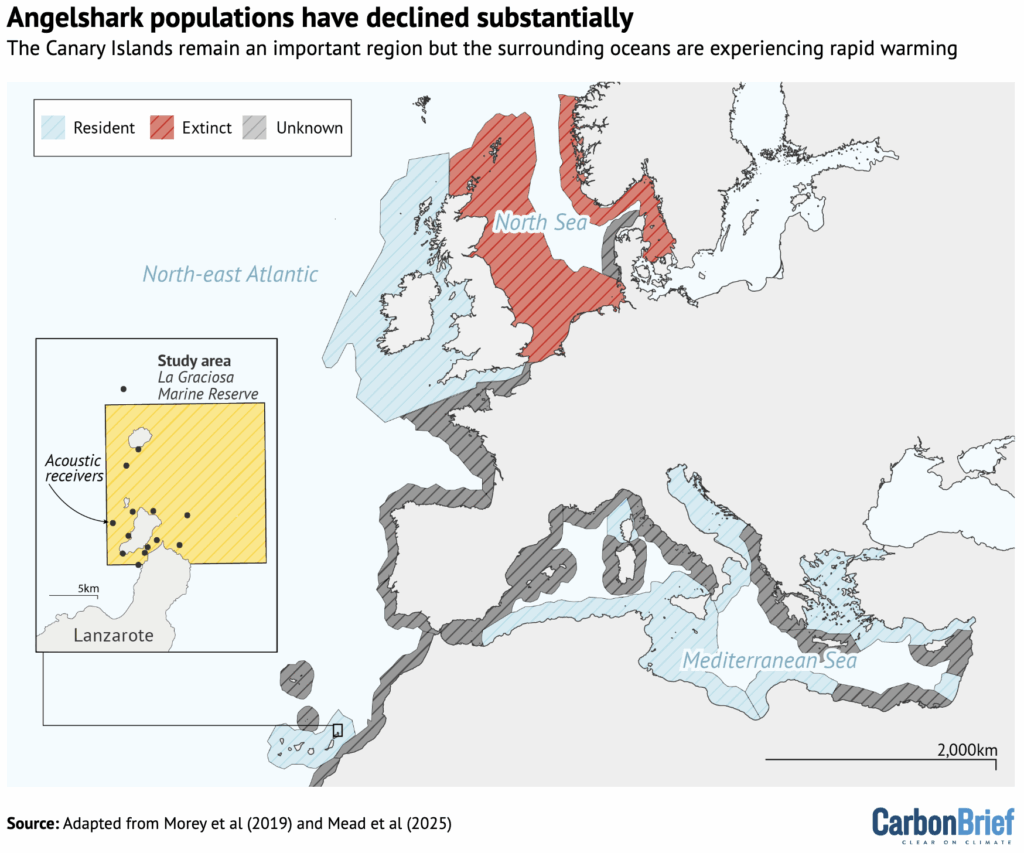
The map below shows the historic and existing range of angelshark populations, as well as the locations of the acoustic receivers used to detect angelsharks in the study area.
To explore how climate change in the region is impacting the angelsharks, the researchers focus on “range shift”.
Range shift is when a species migrates to either remain in ideal conditions or avoid sub-optimal environments, according to what they can withstand as the climate changes.
It is one of the most “pervasive” consequences of ocean warming, the study authors say.
Tracking angelsharks
To track the movements of angelsharks, the researchers tagged the fins of 112 animals – 38 males and 74 females – over 2018-22.
These “acoustic tags” emit sound that enabled the researchers to remotely track angelshark locations.
The researchers then used this acoustic data to investigate seasonal and annual changes to angelshark presence at the study site, taking into account the contrast between male and female behaviours.
The researchers also modelled changes to the environment over 2021-23 using a range of variables. These included sea surface temperature (SST), salinity, surface wind speed and SST anomaly – a measure of how temperatures differ from the long-term average.
They also looked at concentrations of chlorophyll a and dissolved oxygen, as well as two variables that act as an indicator for levels of desert dust in the air.
The latter were used to incorporate into their model the effect of Calima events – hot and dusty winds that reach the Canary Islands from the Sahara Desert, which raise overall air temperatures.
This “environmental model” allowed the authors to investigate the relationship between angelshark presence within the reserve and changing environmental conditions.
‘Marked absence’
Previous research has linked seasonal angelshark behaviours – such as movement and presence in a certain habitat – to the breeding cycle and, sometimes, environmental factors.
The new study finds that angelshark presence in the study area varies seasonally for both sexes, peaking in November and December. It notes an additional peak in June for female angelsharks, which were also more “consistently present” in the study area throughout the year than males.
Author Dr David Jacoby is a lecturer in zoology at Lancaster University. He explains to Carbon Brief:
“Females will often avoid males outside of the breeding season as mating is pretty violent and energy expensive in sharks. Females consequently are more likely to occur in shallow water [since] males [are more likely to be found] in deeper water.”
The charts below show the relative influence of different environmental variables on predicting male and female shark presence in the study area.
The chart on the left shows how the day of the year has the biggest influence on male angelshark presence, followed by salinity. The chart on the right shows that for female angelsharks, SST – followed by SST anomaly – was the most significant predictor.

The “crux” of the study, according to Jacoby, is that in 2022 – when peak SSTs were higher and those conditions lasted longer – female angelshark numbers were “consistently low”. He tells Carbon Brief:
“The fact that there was this significant warming event in the north-east Atlantic was opportunistic from a research perspective at least, because it provided a natural experiment in which to directly compare behaviour under ‘normal’ versus ‘extreme’ conditions.”
This “marked absence” was especially noticeable during the angelshark breeding season in mid-to-late autumn, the data shows. In contrast, the behaviour of the male sharks did not change.
The charts below illustrate how, in 2022, daily counts of female angelsharks (orange bars in the middle panel) dropped in the unusually warm conditions, while daily counts of male angelsharks (turquoise bars in the bottom panel) remained consistent with previous years.
In the top panel, orange regions indicate periods in which SSTs are between 20.7C and 22.5C and red regions show periods of SSTs above 22.5C.
According to the authors, the presence of female sharks in the study site decreases “rapidly” at SSTs above 20.7C, while the “probability of female presence” is below zero above around 22.5C.
The dotted line at 19.6C shows the temperature of peak female angelshark presence.
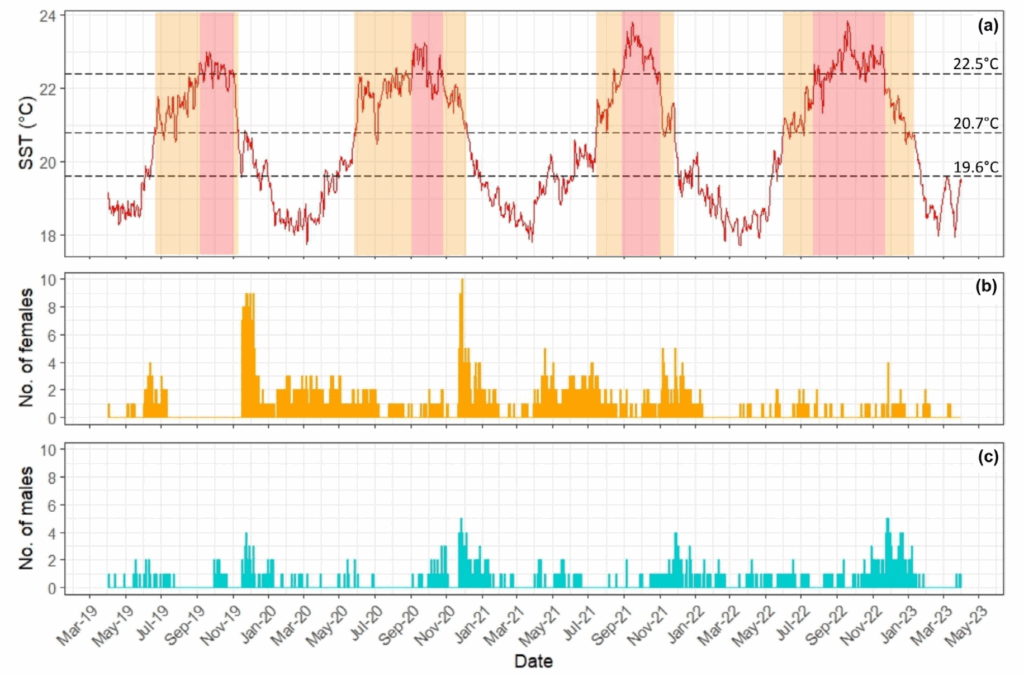
The researchers say their findings “strongly” indicate that the low numbers of females during the breeding season in 2022 were linked to the “thermal extremes” that year.
They point to an “upward trend” in peak temperatures and longer duration of hotter periods in their dataset, noting that the number of days where SSTs reached 22.5C more than doubled over the study period.
As a result, the authors identify 22.5C as the “possible upper thermal threshold” for female angelsharks – meaning that the animals will not move into an area at this point.
They warn that regular temperatures of 22.5C could “disrupt” the timing of “key biological events”, such as breeding.
The “unusual” findings, recorded as “disrupted” thermal cues, may be a “window into future climate change impacts”, suggest the authors.
Conservation measures
The authors highlight the need to prioritise further “species-specific” studies that incorporate “real-time environmental and behavioural data” and explore climate impacts by sex.
Improving scientific understanding and prediction of how marine species and ecosystems respond to climate change are “urgent priorities”, they say.
Jacoby adds:
“Angelsharks [are among] the most threatened fishes in the world. Because they rely on the ocean floor to rest and hunt, they are extremely attuned to their local environment. [Ocean warming] could lead to the [local extinction] of this species from the archipelago in a very worst case due to the fact that they are already at their thermal extreme in this location…
“We still don’t really know how warming could impact the complex web of interactions within these coastal ecosystems. It is so hard to engage with a problem if you can’t see it for yourself.”
Dr Hollie Booth is a postdoctoral researcher in the department of biology at the University of Oxford and was not involved in the study. She tells Carbon Brief that although the negative impacts of climate change are “concerning”, overfishing remains “the greatest direct threat” to angelshark populations.
She adds:
“It is good to see empirical evidence of the impacts of climate change on threatened marine species. [The study] indicates how we need to make sure that contributors to climate change are also held accountable for mitigating [these] impacts.”
The post Endangered angelshark faces ‘inhospitable’ breeding sites as ocean warms appeared first on Carbon Brief.
Endangered angelshark faces ‘inhospitable’ breeding sites as ocean warms

Meena Raman is deputy director at Third World Network (TWN), a public interest lawyer and an expert on international climate negotiations. Leon Sealey-Huggins is senior campaigner in global climate justice and just transition at War on Want. Both organisations are members of the Global Campaign to Demand Climate Justice (DCJ).
The world urgently needs the next assessment of climate science. But speed cannot be the only consideration. Equally important is whose research informs it, whether scientists from developing countries can participate meaningfully, and how its findings shape global climate policy.
The timeline of the IPCC’s Seventh Assessment Report (AR7) is a major point of contention at its sixty-fifth meeting in Addis Ababa this week. Since early 2024, it has been contested principally between developed countries and Small Island Developing States (SIDS) seeking earlier completion, and many developing countries calling for more time.
-
Global deforestation slowed in 2025 but Brazil’s election could undo “fragile” gains
Countries remain 70% off track to meet a goal to end deforestation by 2030, as progress in Latin America offset by failures in Africa

Many developed countries, SIDS and some Least Developed Countries (LDCs) want the AR7 Working Group reports completed by 2028, to inform the second Global Stocktake (GST2) of the Paris Agreement. IPCC assessment cycles have generally taken five to seven years.
But the IPCC’s findings would remain relevant after 2028. Reports completed in 2029 could inform countries’ next nationally determined contributions (NDCs) in 2030. The stocktake assesses collective progress, rather than prescribing individual emissions targets.
More time needed for input from developing countries
Between IPCC60 and IPCC65, developing countries – including Algeria, Burundi, Burkina Faso, Bolivia, China, Egypt, Ghana, Guinea, India, Iran, Iraq, Indonesia, Jordan, Kenya, Libya, Malaysia, Morocco, Mozambique, Saudi Arabia, South Africa, Syria, Tanzania, Tunisia, Turkmenistan, Venezuela, Yemen and Zimbabwe – have raised concerns over an earlier AR7 timetable and its impact on inclusivity. Russia and Belarus have expressed similar concerns. An earlier completion date could also affect the scientific integrity and robustness of the AR7 assessments, they argue.
Developing countries have emphasised equity in the IPCC’s work, both in process and substance. Their emphasis on a six-to-seven-year assessment cycle is linked to ensuring that the reports reflect scientific literature from the Global South, including research led and funded by institutions in developing countries.
Who funds research, where institutions are based, which questions receive attention and whose work is assessed shape the IPCC’s evidence base. Scientists in developing countries face unequal access to funding, institutional support and international collaboration.
Extending a deadline alone cannot resolve these inequalities. The timetable must be designed alongside measures to strengthen research capacity and enable meaningful participation, otherwise existing inequalities risk being reproduced in successive assessments.
Timeliness doesn’t guarantee political action
Equity is not only about who participates. It also concerns the assumptions behind scientific models, the development pathways they describe and how their findings are subsequently used. Consider mitigation scenarios assessed in the IPCC’s Sixth Assessment Report (AR6). The IPCC itself acknowledges that most do not explicitly incorporate assumptions about global equity, environmental justice or income distribution within regions.
These scenarios draw on assumptions about development, technology and mitigation, and can shape climate policies. The IPCC calls them projections, not predictions or forecasts. Yet when global emissions pathways become reference points in UN climate decisions, the distinction between projected outcomes and an equitable distribution of responsibilities can blur.
Timely science does not guarantee political action. The IPCC’s Fourth Assessment Report in 2007 identified emissions reductions of 25–40% below 1990 levels by 2020 for developed countries as a group, under a particular scenario. Yet Canada withdrew from the Kyoto Protocol, while Japan and Russia declined new commitments under its second period.
Comment: Governments that support climate science must stand firm against naysayers
The first Global Stocktake in 2023 recognised the need to reduce global greenhouse gas emissions by 43% by 2030 and 60% by 2035 relative to 2019, and reach net-zero carbon dioxide emissions around 2050 to limit warming to 1.5°C with no or limited overshoot.
These benchmarks were highlighted in AR6’s mitigation report. However, the report had an important caveat, that most modelled pathways do not explicitly account for global equity and are projections, not forecasts. But when the 43% figure entered the Global Stocktake decision, it did so without this caveat. This was a fatal omission, given that Article 14 of the Paris Agreement requires Global Stocktake be conducted in the light of equity and the best available science.
Including findings from such models in international climate decisions without their caveats is problematic. Such assumptions affect how future energy use, emissions reductions and development opportunities are distributed across regions.
Emissions-cutting pathways put burden on Global South
A 2024 peer-reviewed study by Indian scientists, published in Climate Policy, examined 556 mitigation scenarios. The researchers found that global inequalities in income, energy use and emissions were projected to persist until 2050, raising questions about whether these pathways reflect equity.
In the scenarios underlying the 43% global reduction figure, sub-Saharan Africa is projected to reduce emissions by 80% by 2030, against 50% in North America and Europe. Developed countries are projected to retain higher per-capita fossil fuel consumption in 2050, while developing countries reduce consumption from already low levels. These pathways place a disproportionate mitigation burden on developing countries, despite developed countries’ historical responsibility.
As science comes under attack at UN talks, climate movement splits over how to respond
Some of the severest projected restrictions on energy use are in sub-Saharan Africa and South Asia, home to many Least Developed Countries (LDCs), where essential infrastructure is yet to be built, even as climate impacts worsen. Yet these scenarios constrain energy consumption and development prospects.
The scenarios also rely on large amounts of land-based carbon dioxide removal, with more than 70% projected in Latin America and the Caribbean, Asia and Africa. This has implications for food security, livelihoods and biodiversity, placing burdens on communities most vulnerable to climate change and least responsible for it.
The IPCC’s findings carry considerable scientific and political weight. Its assessments must uphold the highest standards of scientific integrity, inclusiveness and equity, both in process and substance. There must be no shortcuts for political expediency.
The post Who shapes climate science? The equity question facing the IPCC appeared first on Climate Home News.
Who shapes climate science? The equity question facing the IPCC
A first set of biodiversity plans filed by countries to reverse nature loss are “insufficient” to meet this decade’s global targets, including a landmark goal to protect at least 30% of the world’s land and marine ecosystems by 2030, a landmark UN report warned on Thursday.
The State of Biodiversity Action, put together by a panel of technical experts for the UN Convention on Biological Diversity (CBD), was released in Yerevan, ahead of the COP17 nature talks starting on Monday in the Armenian capital.
Over the next two weeks, governments will for the first time take stock of progress towards the Global Biodiversity Framework (GBF) agreed in 2022 – a set of 23 targets also known as the “Paris Agreement for nature” – and will decide on policy guidelines for ramping up ambition before the 2030 deadline. The UN report will be the main basis for these negotiations.
At a press conference in Armenia, UN Secretary-General António Guterres highlighted that, while there has been some progress on the GBF, the “bad news” is that less than half of country plans are on track to meet its targets.
If current commitments are met by the end of the decade, only 26% of land ecosystems and 12% of marine ecosystems will be protected – falling “real short” of the 30% target agreed in Montreal in 2022, Guterres said. “The war on nature has not yet ended,” he added.
UN Environment chief Inger Andersen said the report “sets the tone for the focus, ambition and urgent action we need to deliver” in Armenia, including by reducing subsidies that harm nature and mobilising new finance for biodiversity. “All leaders and all negotiators must respond to these findings,” she emphasised.
Andersen added that climate change amplifies threats to biodiversity, which makes protection all the more important as global warming is now almost certain to rise above a key threshold. “Exceedence of 1.5C increases the likelihood of forest diebacks, phenological shifts, warming oceans that become more inhospitable to species, irreversible tipping points and so much more,” she said.
-
Global deforestation slowed in 2025 but Brazil’s election could undo “fragile” gains
Countries remain 70% off track to meet a goal to end deforestation by 2030, as progress in Latin America offset by failures in Africa -
Carbon capture industry faces tough future, as UK raids green spending
Despite a spate of projects getting underway, the mood at an industry conference in London this week was low with government subsidies set to shrink -
World Bank and IMF should lead the financial system in responding to the climate crisis
Multilateral development banks have a vital role to play in delivering on donors’ climate finance promises and protecting the most vulnerable


Progress on land but ocean lags behind
The report shows that if countries meet all the biodiversity targets in their plans, this would protect about 27% of the world’s land and sea by 2030, a fivefold increase in the span of ten years.
Progress has been uneven, with most conservation efforts focused on terrestrial ecosystems. The report suggests that currently about 19% of land ecosystems are protected, up two percentage points from 2020, which UN authorities welcomed but said is not a fast enough pace.
However, the real gap is at sea, where only about 10% of the global ocean has some sort of protection. Coastal areas under national jurisdiction have done better, as currently 23% of this marine territory is protected, but the report shows most of the deep ocean is not.
Brian O’Donnell, director of Campaign for Nature, an advocacy group, said the new High Seas Treaty – which entered into force this year and will allow for the creation of Marine Protected Areas in the deep ocean – represents an opportunity, as only about 1.5% is under protection so far.
A group of environmental NGOs including WWF and Bloomberg Philanthropies has issued a call for governments to scale up ocean conservation and to designate $16 billion annually for marine protection measures, up from $1.8bn now.
SE Asia speeds up plan for connected clean power grid after oil shock
Some countries did not set a conservation target at all for both land and sea, the report says, blaming technical challenges like how to account for overlapping protected areas, difficulty recognising protections for private land and land-accounting methodologies changing over time.
A separate report by Campaign for Nature suggests that the 30×30 goal could still be met with “increased ambition and commitment”, and says that around 50 countries have already protected about 30% of their land.
A group of environmental NGOs has warned that, beyond the 30% headline figure, protected areas need to be “high integrity” and recognise the stewardship of local communities and Indigenous peoples.