

Weather Guard Lightning Tech

Empire Offshore Progress, New RWE Offshore Farm Approved
Allen covers forecasts for 46 GW of new US wind capacity by 2029, driven by data centers and reshoring. Plus Equinor’s Empire Wind project stays on track for late 2026, RWE gets approval for the Five Estuaries offshore wind farm in the UK, and a Scottish startup raises funding for modular multi-rotor turbines.
Sign up now for Uptime Tech News, our weekly Substack newsletter on all things wind technology. This episode is sponsored by StrikeTape by Weather Guard Lightning Tech. Follow us on YouTube, Linkedin and visit Weather Guard on the web. And subscribe to Engineering with Rosie on YouTube! Have a question we can answer on the show? Email us!
There is an old saying about the wind. You cannot see it. You cannot hold it. But you can harness it. And right now, people around the world are doing exactly that.
After years of sluggish growth, American wind power is waking up. Wood Mackenzie reports the United States will add more than seven gigawatts of new wind capacity in 2025. That is a thirty-six percent jump from this year. And by 2029? Forty-six gigawatts of new capacity coming online.
Why now? Because after a decade of flat electricity demand, America is hungry for power again. Data centers. Electric vehicles. Factories returning home. Demand is growing three percent annually now, up from less than one percent before.
Out West, they are leading the charge. Wyoming. New Mexico. Colorado. Pattern Energy’s three-point-five gigawatt SunZia project in New Mexico alone will make them the top wind installer in 2026. And Invenergy’s Towner Energy Center in Colorado? Nine hundred ninety-eight megawatts. The single largest project expected to come online in 2027.
But here is where it gets interesting. Off the coast of Long Island, a different kind of story is unfolding. The Empire Wind project. Eight hundred ten megawatts of offshore wind power. Enough to power half a million homes in Brooklyn. Norwegian energy giant Equinor is building it. And despite the political headwinds blowing against offshore wind, New York is standing firm. First electricity expected by late 2026.
Across the Atlantic, Britain just gave the green light to something bigger. The Five Estuaries offshore wind farm. Seventy-nine turbines off the coast of Suffolk and Essex. At least twenty-three miles from shore. German energy company RWE is building it. When complete, it will power one million British homes. One million.
Meanwhile, Europe is putting its money where the wind blows. Austria’s Erste Group just signed a two hundred million euro deal with the European Investment Bank. Part of an eight billion euro program to strengthen European wind turbine manufacturers. As Karl Nehammer, the bank’s vice president, put it: Europe is serious about keeping wind manufacturing jobs at home.
Now… You might think wind power is all about going big. Massive offshore farms. Turbines taller than skyscrapers. But in Stirling, Scotland, three entrepreneurs have a different idea. Adam Harris. Paul Pirrie. Peter Taylor. They founded a company called Myriad Wind Energy Systems.
Their invention? Small modular wind turbines. Multiple rotors mounted in a framework. No cranes needed. No special roads. Install them on a farm. On a factory. On a remote site where traditional turbines could never go. This week, they secured eight hundred sixty-five thousand pounds in seed funding. Led by Tricapital Angels. Their first prototype? A fifty-kilowatt unit scheduled for 2026.
From Wyoming to New York. From Essex to Austria. From the North Sea to the Scottish Highlands. Wind energy is not waiting for permission. It is happening. Forty-six gigawatts in America alone by decade’s end. Billions of euros flowing in Europe. Innovators in Scotland proving that sometimes, smaller is smarter.
You cannot see the wind. But you can see what it is building.
That’s the wind industry news for the 22nd of December 2025. Happy Holidays folks, wherever you may be.

 At left we have John Fetterman talking to people so stupid they’ll believe that it would have been wrong for the British colonists to oppose King George III in the late 18th Century, or for the people of Germany and Italy in the 1930s to stand up against Hitler and Mussolini. What about the people in today’s dictatorships, i.e., the people in Russia, China, North Korea, or any of the other 50+ authoritarian regimes around the world?
Morons tend to agree with the loudest, most aggressive voice of nationalism, regardless of how little sense it makes.
It’s a great moment of opportunity for Fetterman.
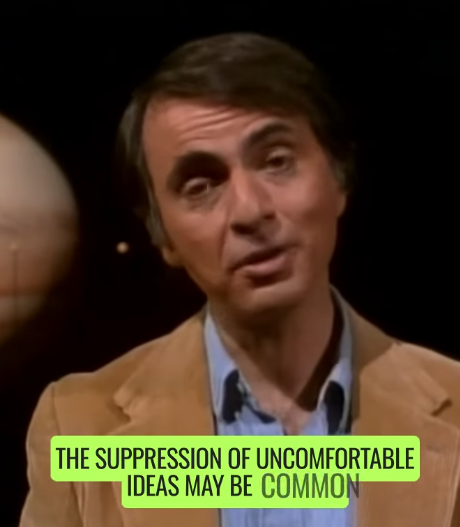 Seminal astrophysicist Carl Sagan explains why uncomfortable ideas may be banned in religion, they must not be shunned in science.
This is an important concept in American life today, as conspiracy theorists are convinced that climate change denial cannot be considered in scientific circles.
I happened to bring this up in my interview with Dr. V. Ramanathan of the Scripps Institution, who has been amassing data on global warming since the 1970s. He laughed, and explained, “If I could prove that human activity was not causing temperatures to rise, I’d be be one of the wealthiest and most famous scientists in world history.”
 As suggested at left, a great deal of the hardship that has befallen the U.S. was simply bad luck. Al Gore came within a whisker of victory in 2000, a win that would have forever changed the course of our nation in terms of energy policy, education, healthcare, and international affairs.
If Bernie had become the 2016 nominee, we wouldn’t have had Hillary Clinton telling our country’s most mean-spirited and least-educated people that they were “deplorables,” ushering a criminal sociopath into the White House.
We Came Incredible Close to Averting the Disaster that Is Donald Trump



-
Climate Change1 year ago
Guest post: Why China is still building new coal – and when it might stop
-

 Greenhouse Gases2 years ago
嘉宾来稿:满足中国增长的用电需求 光伏加储能“比新建煤电更实惠”
-
Greenhouse Gases1 year ago
Guest post: Why China is still building new coal – and when it might stop
-

 Climate Change2 years ago
嘉宾来稿:满足中国增长的用电需求 光伏加储能“比新建煤电更实惠”
-

 Renewable Energy1 year ago
Sending Progressive Philanthropist George Soros to Prison?
-
Greenhouse Gases1 year ago
嘉宾来稿:探究火山喷发如何影响气候预测
-

 Climate Change2 years ago
Analysis: China’s CO2 falls 1% in Q2 2024 in first quarterly drop since Covid-19
-

 Climate Change1 year ago
嘉宾来稿:探究火山喷发如何影响气候预测