

Welcome to Carbon Brief’s DeBriefed.
An essential guide to the week’s key developments relating to climate change.
This week
Balmy new year
NEW RECORD: Last month was the warmest January recorded on Earth, the Financial Times reported, based on data from the EU’s earth observation agency. This “surprise[ed] scientists who expected the cooling La Niña weather cycle in the tropical Pacific to slow almost two years of record-high temperatures”, the newspaper said. January 2025 was also the third-hottest month ever recorded.
2C ‘DEAD’?: The aim to limit global temperature rise to “well below” 2C is “dead”, said veteran climate scientist Prof James Hansen, after publishing an analysis on “underestimated” warming, the Guardian reported. The analysis focused on areas of “deep scientific uncertainty”, Carbon Brief science contributor Dr Zeke Hausfather told the newspaper, and, in his opinion, “represent[s] something closer to a worst-case opinion”.
NORTH POLE: A separate Guardian article noted that temperatures north of Svalbard in the Arctic Ocean soared more than 20C above average last Sunday. This put “actual temperatures close to ice’s melting point of 0C”, the newspaper said. Mika Rantanen, a scientist at the Finnish Meteorological Institute, told the newspaper that it was “probably not the most extreme ever observed, but still at the upper edge of what can happen in the Arctic”.
Trump tariffs and funding cuts
TRADE THREATS: US president Donald Trump sent ripples through global markets by adding a 10% tariff on goods imported from China, CNN reported. China retaliated with 10% tariffs on US “crude oil, agricultural machinery, large-displacement cars and pickup trucks”, plus 15% tariffs on coal and liquefied “natural” gas, Sky News said. Trump’s tariff threats against Mexico and Canada were paused for 30 days, the Associated Press noted.
CHANGES: Trump nominated Neil Jacobs, an ally previously “cited for misconduct”, as the new head of the National Oceanic and Atmospheric Administration (NOAA), NPR reported. Elsewhere, 168 employees working on environmental justice programmes at the Environmental Protection Agency were placed on administrative leave, Reuters reported. Separately, the Guardian found that mentions of climate change were removed from the websites of “several major” US government departments.
FUNDING CUT FALLOUT: Hundreds of climate programmes funded by the US government “risk disappearing” after the Trump administration’s “attack” on the US aid agency, Climate Home News reported. USAID is a “major provider of grant-based finance for climate action in the global south”, the outlet noted. Amid the continued fallout from other federal funding cuts, Science reported: “Many scientists remain in limbo at thousands of academic institutions and nongovernmental agencies that rely on federal research grants.”
Around the world
- LATE PLANS: Major polluters such as India and the EU are expected to miss the UN deadline to submit climate plans for 2035 by 10 February, the Financial Times reported. UN climate chief Simon Stiell said latecomers must submit plans “by September”.
- QUEENSLAND DOWNPOUR: Up to 1.5m of rain fell in Queensland, Australia last weekend in a deluge likely to have been exacerbated by climate change, the Sydney Morning Herald said. Scientists linked the rain to a “prolonged marine heatwave in the Coral Sea”, but noted that an official attribution study has not been carried out.
- UPHEAVAL: Indonesia’s special envoy for climate and energy said the Paris Agreement is “no longer relevant” for the country, Antara News said. Argentina is analysing the impact of withdrawing from Paris and other agreements after announcing it will follow Trump in exiting the World Health Organization, Ámbito said.
- OIL AND GAS: The Guardian reported on “growing internal backlash” against UK prime minister Keir Starmer’s potential plans to approve the controversial Rosebank oilfield. Starmer allegedly assured executives at energy company Equinor, Rosebank’s lead developer, of his support for the project, according to the Daily Telegraph.
- ROLLBACK: Equinor announced plans to halve renewable investment and increase oil and gas production by 10% over the next two years, BBC News said.
- COLLABORATION: An editorial in the Global Times, a major state-supporting newspaper in China, said that the nation and the EU should “strengthen cooperation” on climate change and “lead the rest of the world on a cooperative path of green development” in light of Trump’s withdrawal from the Paris Agreement.
$158
The usual price for a night in an apartment in Belém, Brazil.
$15,266
The currently offered “surreal” price for this November when the city will host COP30, the Associated Press reported.
Latest climate research
- Rat numbers are on the rise in cities such as Washington DC, New York and Amsterdam due to climate change and other factors, according to a Science Advances study.
- Analysis in PLOS Climate found that some of the countries most vulnerable to climate change received disproportionately less adaptation-focused global government aid over a recent 10-year period.
- Strategies around energy demand could reduce emissions from buildings by 51-85% and transport by 37-91% by 2050, compared to a “current policies scenario”, research in Nature Energy said.
(For more, see Carbon Brief’s in-depth daily summaries of the top climate news stories on Monday, Tuesday, Wednesday, Thursday and Friday.)
Captured
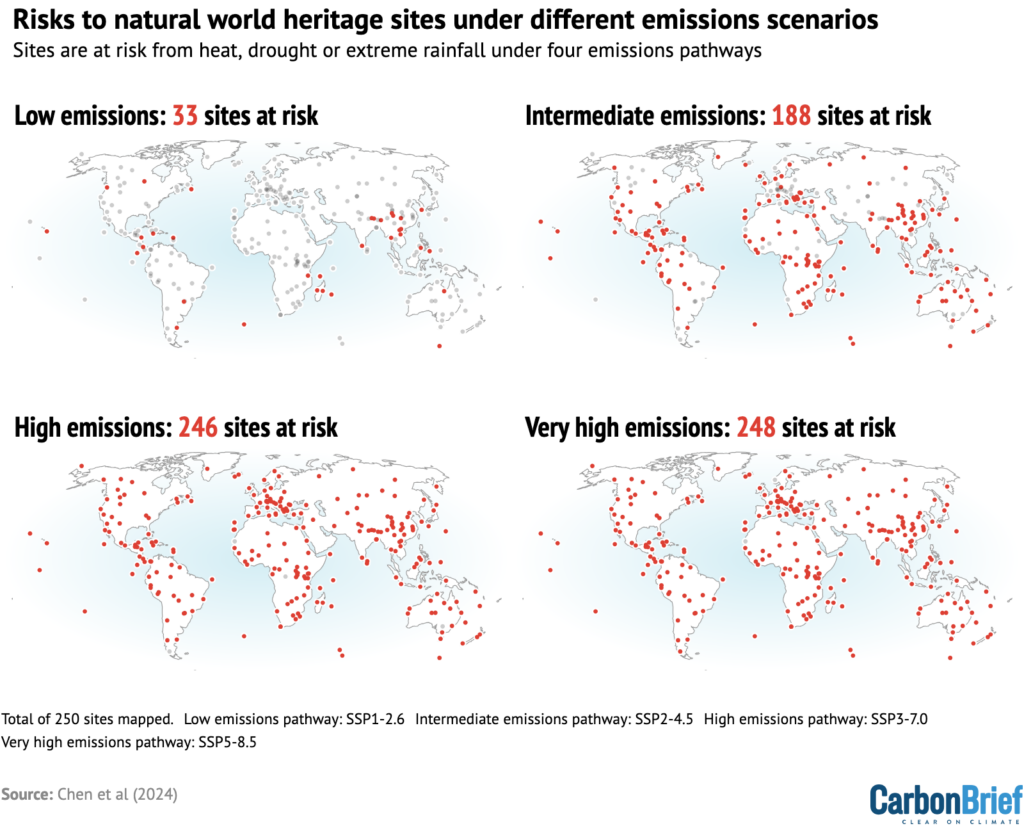
“Natural” world heritage sites, such as the Galápagos Islands, Serengeti national park and the Great Barrier Reef, could be exposed to multiple climate extremes by the end of the century, a new study covered by Carbon Brief found. The maps show which sites will face climate impacts under low (top left), intermediate (top right), high (bottom left) and very high (bottom right) warming pathways. The dots are coloured red if the site will face climate impacts from heat, drought or extreme rainfall by the year 2100.
Spotlight
Climate negotiations in the West End
This week, Carbon Brief speaks to the writers of Kyoto, a new London play dramatising the signing of the first global agreement to cut greenhouse gas emissions at COP3.
Carbon Brief readers are likely all-too familiar with the annual climate COP summits, where delegates from almost every country in the world negotiate on climate action.
In 1997, for the first time, developed nations agreed to set binding targets to reduce their greenhouse gas emissions. Now, a play in London’s West End delves into how this deal – the Kyoto Protocol – came about.
It was written by Joe Murphy and Joe Roberston, the playwrights behind The Jungle, a hit show set in a refugee camp in Calais, France.
Kyoto emerged from a desire to write about climate change in a “compelling way that would engage people”, Robertson told Carbon Brief:
“We had been talking a lot about the disagreeable nature of society at the moment and so we were looking for stories of agreement. The question of how to write about climate, and the search for a story of agreement, sort of fused together in finding and diving into the world of Kyoto and the protocol.”
Murphy said this kicked off two years of research and discussions with people involved in the Kyoto talks. He added:
“[We] spoke to incredible diplomats and delegates and scientists and lawyers and world leaders who, almost unanimously, were desperate to talk about this time and spoke with such emotion and pride.
“As artists trying to grapple with a subject that often despairs people, or disempowers people, or disengages people, we realised this was a route into the subject that could actually genuinely be dramatic, could genuinely have jeopardy.”

Kyoto – whose lead character is oil lobbyist Don Pearlman – is not short on drama as delegates fight about the placement of brackets and commas in the negotiating text to the bitter end. In one chaotic scene, translators go home after talks run too late, leaving negotiators in a mess of language.
The show also highlights how the real COP3 chair, Raúl Estrada-Oyuela from Argentina, “went out of his way to talk to everyone” in search of agreement, Robertson said:
“He understood that there are all sorts of influences on the conference floor…He would talk about the zone of agreement. With certain people, the zone of agreement was tiny, almost invisible…But you can expand out once you’ve established something that’s commonplace.”
The writers are working on two more COP plays – focused on Copenhagen in 2009 and Paris in 2015. Robertson said they are “really excited to think about how to represent those two very different conferences – each a stepping stone, it feels, to where we are today”.
Murphy added that they want to see more collaboration between science, activism, politics and arts to “tell these stories in really exciting ways”, saying:
“It’s thrilling and I think there’s so much more to do.”
Kyoto runs until 3 May 2025 at Soho Place in London.
Watch, read, listen
SPOKEN WORD: The Third Pole Podcast from Dialogue Earth explored the impact of climate change on Indigenous languages in Pakistan’s remote mountain communities.
CRITICAL MINERALS: Issues around mining for cobalt – a mineral “essential to decarbonisation” – in the Democratic Republic of the Congo employ “new forms of old colonial practices”, researchers wrote in the Conversation.
CLEAN POWER: The head of the UK’s mission control for clean power, Chris Stark, discussed the UK’s energy and climate goals on the Bloomberg Zero podcast.
Coming up
- 9 February: Ecuador general election
- 10 February: Deadline for countries to submit new nationally determined contributions to the United Nations Framework Convention on Climate Change
- 14-16 February: Munich Security Conference, Germany
Pick of the jobs
- The Guardian, environment desk work experience for Black, Asian and Minority Ethnic applicants | Salary: Unknown. Location: London
- Climate Change Committee, senior executive officer analyst on land-use, agriculture and nature team | Salary: £45,308-£49,775. Location: London
- Human Rights Watch, senior researcher. Salary: $79,500-$85,000. Location: Kinshasa, Democratic Republic of the Congo
- Climate & Community Institute, junior research fellowship | Salary: $50 per hour. Location: US, remote
DeBriefed is edited by Daisy Dunne. Please send any tips or feedback to debriefed@carbonbrief.org.
This is an online version of Carbon Brief’s weekly DeBriefed email newsletter. Subscribe for free here.


The post DeBriefed 7 February 2025: Hottest January on record; Trump tariffs; UN climate talks star in theatre thriller appeared first on Carbon Brief.

Drought and heatwaves occurring together – known as “compound” events – have “surged” across the world since the early 2000s, a new study shows.
Compound drought and heat events (CDHEs) can have devastating effects, creating the ideal conditions for intense wildfires, such as Australia’s “Black Summer” of 2019-20 where bushfires burned 24m hectares and killed 33 people.
The research, published in Science Advances, finds that the increase in CDHEs is predominantly being driven by events that start with a heatwave.
The global area affected by such “heatwave-led” compound events has more than doubled between 1980-2001 and 2002-23, the study says.
The rapid increase in these events over the last 23 years cannot be explained solely by global warming, the authors note.
Since the late 1990s, feedbacks between the land and the atmosphere have become stronger, making heatwaves more likely to trigger drought conditions, they explain.
One of the study authors tells Carbon Brief that societies must pay greater attention to compound events, which can “cause severe impacts on ecosystems, agriculture and society”.
Compound events
CDHEs are extreme weather events where drought and heatwave conditions occur simultaneously – or shortly after each other – in the same region.
These events are often triggered by large-scale weather patterns, such as “blocking” highs, which can produce “prolonged” hot and dry conditions, according to the study.
Prof Sang-Wook Yeh is one of the study authors and a professor at the Ewha Womans University in South Korea. He tells Carbon Brief:
“When heatwaves and droughts occur together, the two hazards reinforce each other through land-atmosphere interactions. This amplifies surface heating and soil moisture deficits, making compound events more intense and damaging than single hazards.”
CDHEs can begin with either a heatwave or a drought.
The sequence of these extremes is important, the study says, as they have different drivers and impacts.
For example, in a CDHE where the heatwave was the precursor, increased direct sunshine causes more moisture loss from soils and plants, leading to a drought.
Conversely, in an event where the drought was the precursor, the lack of soil moisture means that less of the sun’s energy goes into evaporation and more goes into warming the Earth’s surface. This produces favourable conditions for heatwaves.
The study shows that the majority of CDHEs globally start out as a drought.
In recent years, there has been increasing focus on these events due to the devastating impact they have on agriculture, ecosystems and public health.
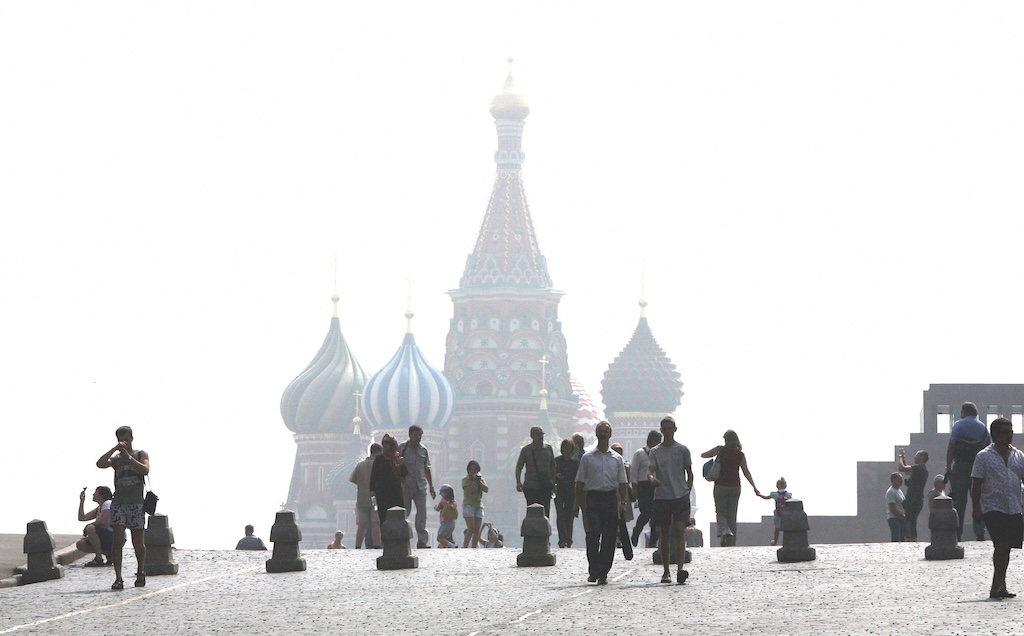
In Russia in the summer of 2010, a compound drought-heatwave event – and the associated wildfires – caused the death of nearly 55,000 people, the study notes.
The record-breaking Pacific north-west “heat dome” in 2021 triggered extreme drought conditions that caused “significant declines” in wheat yields, as well as in barley, canola and fruit production in British Columbia and Alberta, Canada, says the study.
Increasing events
To assess how CDHEs are changing, the researchers use daily reanalysis data to identify droughts and heatwaves events. (Reanalysis data combines past observations with climate models to create a historical climate record.) Then, using an algorithm, they analyse how these events overlap in both time and space.
The study covers the period from 1980 to 2023 and the world’s land surface, excluding polar regions where CDHEs are rare.
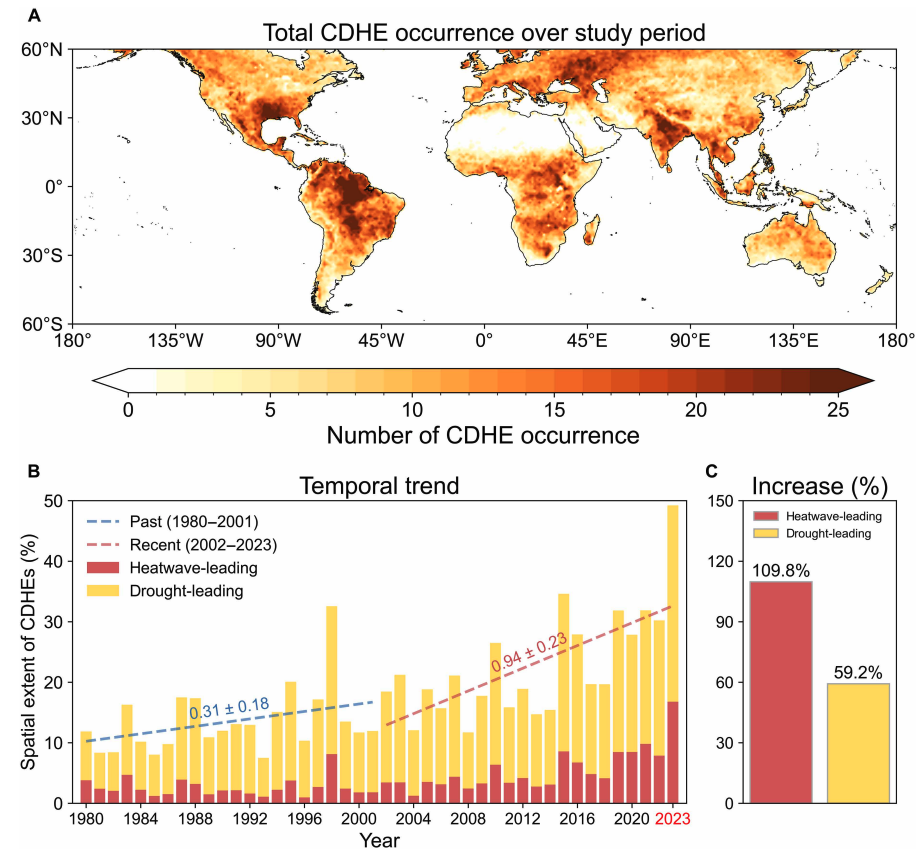
The research finds that the area of land affected by CDHEs has “increased substantially” since the early 2000s.
Heatwave-led events have been the main contributor to this increase, the study says, with their spatial extent rising 110% between 1980-2001 and 2002-23, compared to a 59% increase for drought-led events.
The map below shows the global distribution of CDHEs over 1980-2023. The charts show the percentage of the land surface affected by a heatwave-led CDHE (red) or a drought-led CDHE (yellow) in a given year (left) and relative increase in each CDHE type (right).
The study finds that CDHEs have occurred most frequently in northern South America, the southern US, eastern Europe, central Africa and south Asia.
Threshold passed
The authors explain that the increase in heatwave-led CDHEs is related to rising global temperatures, but that this does not tell the whole story.
In the earlier 22-year period of 1980-2001, the study finds that the spatial extent of heatwave-led CDHEs rises by 1.6% per 1C of global temperature rise. For the more-recent period of 2022-23, this increases “nearly eightfold” to 13.1%.
The change suggests that the rapid increase in the heatwave-led CDHEs occurred after the global average temperature “surpasse[d] a certain temperature threshold”, the paper says.
This threshold is an absolute global average temperature of 14.3C, the authors estimate (based on an 11-year average), which the world passed around the year 2000.
Investigating the recent surge in heatwave-leading CDHEs further, the researchers find a “regime shift” in land-atmosphere dynamics “toward a persistently intensified state after the late 1990s”.
In other words, the way that drier soils drive higher surface temperatures, and vice versa, is becoming stronger, resulting in more heatwave-led compound events.
Daily data
The research has some advantages over other previous studies, Yeh says. For instance, the new work uses daily estimations of CDHEs, compared to monthly data used in past research. This is “important for capturing the detailed occurrence” of these events, says Yeh.
He adds that another advantage of their study is that it distinguishes the sequence of droughts and heatwaves, which allows them to “better understand the differences” in the characteristics of CDHEs.
Dr Meryem Tanarhte is a climate scientist at the University Hassan II in Morocco, and Dr Ruth Cerezo Mota is a climatologist and a researcher at the National Autonomous University of Mexico. Both scientists, who were not involved in the study, agree that the daily estimations give a clearer picture of how CDHEs are changing.
Cerezo-Mota adds that another major contribution of the study is its global focus. She tells Carbon Brief that in some regions, such as Mexico and Africa, there is a lack of studies on CDHEs:
“Not because the events do not occur, but perhaps because [these regions] do not have all the data or the expertise to do so.”
However, she notes that the reanalysis data used by the study does have limitations with how it represents rainfall in some parts of the world.
Compound impacts
The study notes that if CDHEs continue to intensify – particularly events where heatwaves are the precursors – they could drive declining crop productivity, increased wildfire frequency and severe public health crises.
These impacts could be “much more rapid and severe as global warming continues”, Yeh tells Carbon Brief.
Tanarhte notes that these events can be forecasted up to 10 days ahead in many regions. Furthermore, she says, the strongest impacts can be prevented “through preparedness and adaptation”, including through “water management for agriculture, heatwave mitigation measures and wildfire mitigation”.
The study recommends reassessing current risk management strategies for these compound events. It also suggests incorporating the sequences of drought and heatwaves into compound event analysis frameworks “to enhance climate risk management”.
Cerezo-Mota says that it is clear that the world needs to be prepared for the increased occurrence of these events. She tells Carbon Brief:
“These [risk assessments and strategies] need to be carried out at the local level to understand the complexities of each region.”



The post Heatwaves driving recent ‘surge’ in compound drought and heat extremes appeared first on Carbon Brief.
Heatwaves driving recent ‘surge’ in compound drought and heat extremes
Greenhouse Gases
DeBriefed 6 March 2026: Iran energy crisis | China climate plan | Bristol’s ‘pioneering’ wind turbine
Welcome to Carbon Brief’s DeBriefed.
An essential guide to the week’s key developments relating to climate change.
This week
Energy crisis
ENERGY SPIKE: US-Israeli attacks on Iran and subsequent counterattacks across the Middle East have sent energy prices “soaring”, according to Reuters. The newswire reported that the region “accounts for just under a third of global oil production and almost a fifth of gas”. The Guardian noted that shipping traffic through the strait of Hormuz, which normally ferries 20% of the world’s oil, “all but ground to a halt”. The Financial Times reported that attacks by Iran on Middle East energy facilities – notably in Qatar – triggered the “biggest rise in gas prices since Russia’s full-scale invasion of Ukraine”.
‘RISK’ AND ‘BENEFITS’: Bloomberg reported on increases in diesel prices in Europe and the US, speculating that rising fuel costs could be “a risk for president Donald Trump”. US gas producers are “poised to benefit from the big disruption in global supply”, according to CNBC. Indian government sources told the Economic Times that Russia is prepared to “fulfil India’s energy demands”. China Daily quoted experts who said “China’s energy security remains fundamentally unshaken”, thanks to “emergency stockpiles and a wide array of import channels”.
‘ESSENTIAL’ RENEWABLES: Energy analysts said governments should cut their fossil-fuel reliance by investing in renewables, “rather than j