

Welcome to Carbon Brief’s DeBriefed.
An essential guide to the week’s key developments relating to climate change.
This week
Congress passes Trump’s ‘megabill’
TAX CREDITS CRUSHED: A major budget bill passed by US congress this week is “poised to remake American energy by slashing tax breaks for wind and solar power and electric cars”, reported the New York Times. The legislation, which was “muscled” through by Republicans, “provides a boost to fossil fuels and dismantles many of the biggest actions the federal government has ever taken to fight climate change”, the newspaper said.
‘CRACKDOWN’: The version of the bill approved by the Senate on Tuesday included “compromise language” that gave wind and solar projects one year to begin construction to claim current tax credits, noted Politico. “Hard-line” Republicans in the House of Representatives told the outlet that they backed the bill only after receiving assurances from Donald Trump that he would use executive action to further “constrict” wind and solar.
LAB LIABILITY: The bill, which is expected to be signed by Trump today, also “seeks to defund” multiple climate labs, according to CNN. This includes the Mauno Lao laboratory in Hawaii, where measurements since 1958 have produced the iconic “Keeling Curve” of rising atmospheric CO2, the outlet noted. See below for more on the emissions impact of Trump’s bill.
Record-breaking heatwave ‘grips’ Europe
RED ALERTS: At least eight people died across Europe as a heatwave gripped much of the continent, reported Reuters, “triggering health alerts and forest fires and forcing the closure of a nuclear reactor at a Swiss power plant”. The New York Times quoted UN secretary general António Guterres, who said: “Extreme heat is no longer a rare event – it has become the new normal.”
RECORD-BREAKING: Both Spain and England had their hottest June on record, noted BBC News, with the Spanish weather service saying the average of 23.6C “pulverised records”. The outlet added that France registered its second-hottest June, while the Guardian reported that Portugal hit a provisional record high for June of 46.6C.
FLASH FLOODS: Elsewhere, a record downpour in the central Chinese province of Hubei brought a month’s worth of rain in just 12 hours to the city of Xianfeng, reported Reuters. Authorities moved 18,000 people to safety, the newswire said. Flooding in India’s northern state of Himachal Pradesh left five people dead, reported the Hindustan Times.
Around the world
- ‘WATER[ED] DOWN’: The European Commission’s newly proposed target to cut the EU’s carbon emissions by 90% by 2040 has been criticised for allowing up to 3% of the goal to be met with international carbon credits, reported Carbon Brief.
- BRAZIL OIL BID: Brazil’s COP30 president-designate, André Corrêa do Lago, has “played down concerns” on Brazil’s oil expansion after a new analysis found the nation will drive a surge in new production by 2030, reported the Financial Times.
- ‘REPUTATIONAL RISK’: The nomination of an economist from the Saudi Aramco oil company as a coordinating lead author for an Intergovernmental Panel on Climate Change report has been denounced as “political capture”, reported Politico.
- FLIGHT FEE: A group of countries, including France, Kenya and Barbados, have pledged to tax private jets and premium-class flying in a bid to raise funds for climate action at a summit in Spain, Reuters reported. Climate Home News has all the key climate-finance takeaways from the event.
- ‘MAJOR SETBACK’: A £65m satellite launched last year to detect methane emissions from oil and gas production has been “lost in space”, reported BBC News.
£528m
The amount by which “climate aid” given by the UK government to developing countries was inflated through controversial changes to the way climate finance is now being designated, Carbon Brief analysis showed.
Latest climate research
- Sustained cuts to US military spending could result in annual energy savings by 2032 equivalent to the energy consumption of Slovenia, a study in PLOS Climate found.
- Using satellite data, a study in the Proceedings of the National Academy of Sciences revealed a marked increase in surface salinity across the Southern Ocean since 2015, coinciding with a “dramatic decline” in Antarctic sea ice.
- Research in Nature Cities highlighted the “disproportionate flood exposure” faced by urban slum populations in the global south, with one in three living on a floodplain.
(For more, see Carbon Brief’s in-depth daily summaries of the top climate news stories on Monday, Tuesday, Wednesday, Thursday and Friday.)
Captured
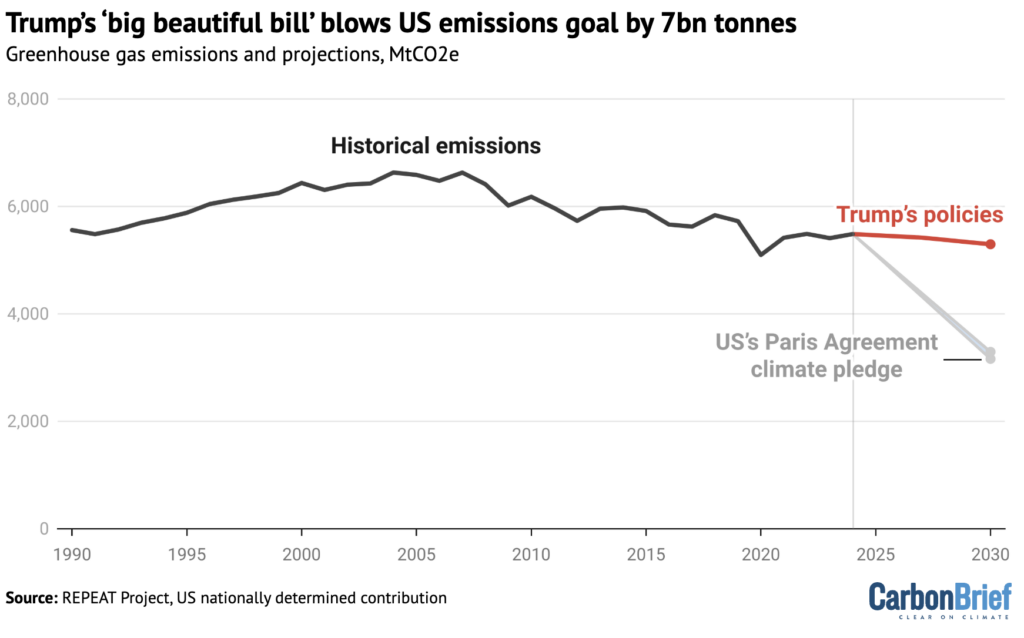
Trump’s dismantling of climate policy means the US will add an extra 7bn tonnes of emissions to the atmosphere from now until 2030, compared to meeting its former climate pledge under the Paris Agreement, according to new Carbon Brief analysis of modelling from Princeton University. The approval of Trump’s megabill repealing clean-energy tax credits, alongside a series of executive orders, means that US emissions are now set to drop to just 3% below current levels by 2030 – effectively flatlining – rather than falling 40% as required to hit the now-defunct target, according to the analysis.
Spotlight
Tipping points that worry scientists the most
This week, delegates at the Global Tipping Points 2025 conference in Exeter tell Carbon Brief which potential tipping “element” in the Earth system they are most worried about.
Prof Tim Lenton, founding director of the Global Systems Institute and chair in climate change and Earth system science at the University of Exeter:
“The Atlantic Meridional Overturning Circulation, or AMOC, for sure. The consequences of crashing that would be devastating globally – and also for where I live in the UK. By our own calculation, we could have less than half the viable area for growing a couple of major staple crops, wheat and maize, worldwide. We would have a widespread water crisis. We could have collapses of the monsoons in West Africa and India that would displace hundreds of millions of people. It is hard to see that in anything other than a catastrophe.”
Prof Ricarda Winkelmann, founding director of the Max Planck Institute of Geoanthropology and professor of climate system analysis at the University of Potsdam:
“So I am thinking about this from a risk perspective – so both the likelihood as well as the impacts – and I think the answer depends on that. Because when it comes to the likelihood and the particular threshold – and we know about those – I’m mostly concerned about the Greenland and the West Antarctic ice sheets. This is because we know that, even at lower warming levels, they’re already at risk of transgressing tipping points in certain regions.
“But when it comes to the impacts and also the timescales over which those play out, there are other tipping elements that worry me most. In particular, regional tipping elements. So, if we think of the mountain glaciers, for instance, these impacts are already experienced right now and several mountain glaciers are undergoing these accelerated changes.”
Prof Gabi Hegerl, chair in climate system science in the school of geosciences at the University of Edinburgh:
“I am worried about all of them. But, for the immediate future, I am particularly worried about tipping points that involve the biosphere and humans due to breaching thresholds for heat or drought that then ripple into food availability, livelihood and ecosystems. The Earth system tipping points will do that, too, but maybe a little bit later. Examples are coral diebacks triggered by marine heatwaves, forest change and fires, and droughts threatening livelihoods and putting people on the move.
“I did a research project on the US dustbowl and the trigger was drought causing vegetation and crop dieback, then [leading to] extreme heat and dust storms in response – and migration, as memorialised in [the 1939 John Steinbeck novel] The Grapes of Wrath. And, now with warming, all droughts get supercharged.”
Prof Carlos Nobre, Brazilian scientist and meteorologist who spearheaded the multi-disciplinary, multinational large-scale biosphere-atmosphere experiment in the Amazon:
“The Amazon is a very serious tipping point, because [dieback] could release around 250bn tonnes of CO2 by 2100 – which will make it impossible to [limit global warming] at 1.5C. We could also lose the largest [host to] biodiversity on the planet, which would induce a tremendous, large number of epidemics and several pandemics. Also, of course, the Amazon forest controls aspects of the global climate. In South America, the climate is entirely controlled by the Amazon forest.”
Carbon Brief will publish further coverage of the Global Tipping Points conference next week.
Watch, read, listen
‘CLIMATE ACTION IS UNSTOPPABLE’: In a talk at the recent TED Countdown Summit 2025 in Nairobi, former US vice-president Al Gore explained why the narrative of “climate realism” is a “myth”.
PROTESTOR IN PRISON: A BBC Radio 4 Currently documentary followed the story of a “law-abiding Middle England mum”, who received a four-year prison sentence for a Just Stop Oil protest on the M25 motorway.
‘FROM THE GREEN TO THE UNSEEN’: In its L is for Labour YouTube show, the Migration Project asked what a “just transition” to electric vehicles would look like for the traditional automotive industry and its workers in India.
Coming up
- 6-7 July: 17th BRICS summit, Rio de Janeiro, Brazil
- 8-11 July: AI For Good global summit 2025, Geneva, Switzerland
- 7-11 July: 47th Meeting of the Open-ended Working Group of the Parties to the Montreal Protocol, Bangkok, Thailand
Pick of the jobs
- Climate Policy Initiative, senior communications associate, climate finance | Salary: Unknown. Location: Cape Town, South Africa
- Global Action Plan, partnerships manager and campaigner | Salary: £36,000 and £36,000-£45,000, respectively. Location: London
- European Bank for Reconstruction and Development, principal manager, nature & climate finance | Salary: Unknown. Location: London
- Cheltenham Borough Council, climate and decarbonisation manager | Salary: £47,227-52,547. Location: Cheltenham, UK
DeBriefed is edited by Daisy Dunne. Please send any tips or feedback to debriefed@carbonbrief.org.
This is an online version of Carbon Brief’s weekly DeBriefed email newsletter. Subscribe for free here.


The post DeBriefed 4 July 2025: Trump ‘megabill’ guts clean energy; Europe’s record heat; Scientists discuss ‘most worrying’ tipping points appeared first on Carbon Brief.

Climate Change
“Sink or swim”: WA Gov hugely underestimating decline in regional gas demand while sleeping on green exports, new report finds
PERTH, Tuesday 13 October 2026 — A new report from Greenpeace Australia Pacific and Springmount Advisory reveals green commodity exports are an untapped economic opportunity for Western Australia in a declining Asian gas market, while offering a genuine solution for decarbonising Asia.
From Gas to Green: Building Western Australia’s Future State is a comprehensive analysis of the declining gas market in Asia, and the untapped economic opportunity for WA to become a global leader in green commodity exports while driving the regional shift away from fossil fuels.
The report offers key recommendations for the WA Government to support regional decarbonisation through an orderly phase out of gas exports in favour of green iron and other green exports. It comes as global climate leaders from across business, politics and advocacy prepare to meet for the Global Citizen Now: Perth event focused on decarbonising WA.
Key findings:
- Gas demand is falling across WA’s core markets in Asia: Gas demand fell in 2025 and is projected to continue to decline, driven by a combination of global geopolitical factors and domestic concerns.
- Policy shifts in key markets since the war on Iran now prioritise renewables and nuclear over gas: Japan, South Korea and China have legislated energy plans that prioritise renewables and nuclear over gas.
- New WA gas would arrive in a saturated, uncertain Asian market filled with cheaper gas: The US is now the world’s largest liquefied gas producer and plans to double its capacity as it also targets Asian markets.
- Green commodities offer a real solution to sustain WA’s economy: WA can lead Australia’s green commodity exports, which by 2060 could be worth almost a trillion dollars.
- Exporting more WA gas is likely to delay or impede Asia decarbonisation: Despite claims by the gas industry, there is no evidence that WA gas is displacing coal in Asia, and in fact diverts resources from genuine decarbonisation options.
Geoff Bice, WA Campaign Lead at Greenpeace Australia Pacific said: “As our export partners in Asia shift away from expensive and polluting gas, the WA Government has a golden opportunity to pivot our economy to green exports, like green iron, which is the most effective way to help our region to decarbonise.
“The writing is on the wall: gas is in decline, renewables are our future. In this context, it makes zero sense for the government to encourage high risk projects like Woodside’s reckless Browse gas proposal at Scott Reef.
“This report clearly shows that the WA Government faces a choice: sink or swim. They can either allow the gas industry to keep ripping off West Australians and continue propping up its decline, or choose the path that will deliver enormous benefits to the state and the world by becoming a leader in the rapidly expanding green economy.”
Tom Quinn, Managing Director of Springmount Advisory: “Western Australia prospers when it looks to the future and builds for future demand. Twenty years from now, what the world needs is green commodities made using WAs abundant renewable resources. Just like it did with iron ore in the 1950s and gas in the 1970s, WA should look to the future and build what the world will need, not sunsetting industries like gas that are already past their peak.”
-ENDS-
Media contact
Kate O’Callaghan on 0406 231 892 or kate.ocallaghan@greenpeace.org
Lucy Keller on 0491 135 308 or lucy.keller@greenpeace.org
A report from Greenpeace Australia Pacific and Springmount Advisory reveals the untapped green economic opportunity for Western Australia in a declining Asian gas market, which also offers a genuine solution for decarbonisation in Asia.
Is Western Australia clinging to a fading gas industry while a thriving green future passes it by? As major Asian trading partners rapidly pivot away from volatile gas imports toward cheap solar and battery storage, this report exposes a high-stakes choice: risk becoming stranded in an oversupplied fossil fuel market, or harness WA’s unmatched sun and wind to lead the global clean energy transition.
Summary
From Gas to Green: Building Western Australia’s Future State reveals that Western Australia (WA) faces a critical juncture as falling Asian gas demand, geopolitical gas supply volatility and accelerating renewable energy deployment undermine the long-term economic viability of gas exports. By harnessing its world-class wind and solar resources, the report demonstrates that WA can execute an orderly phase-out of gas and pioneer a green commodity export economy that could generate $987 billion in economic value by 2060, create 24,000 ongoing jobs, and drive a 9.6% reduction in global greenhouse gas emissions.
Key Findings
- Gas demand is falling in Asia – WA can no longer rely on gas exports: Gas demand in core Asian markets fell in 2025 and is projected to continue to decline in 2026. Legislated energy plans in Japan, South Korea, and China now prioritise renewables and nuclear over gas.
- Asia is increasing renewables, importing gas just gets in the way: Evidence from markets like Thailand suggests that gas imports are increasingly crowding out cheaper renewable energy investments and battery storage rather than displacing coal, locking in more emissions over time.
- Green commodities offer a real solution to decarbonise Asia – this is a major win for WA: With world-class renewables, WA can lead Australia’s green commodity exports, which by 2060 could be worth almost a trillion dollars ($987 billion) and support a genuine 9.6% reduction in global emissions.
Recommendations to WA government
Recommendation 1: Plan an orderly gas phase-out aligned with a trading partner pivot plan
Implement a managed, orderly phase-out of gas exports aligned with trading partners’ decarbonisation pathways, rather than waiting for demand to collapse, by:
- Developing and implementing a staged phase-out of gas facilities aligned with feedstock supply expiry or typical end of facility lifespans.
- Committing to no new gas development for gas expansion, including Browse and Kimberley fields.
- Developing new, reciprocal trade relationships with existing gas trade partners, structured to progressively replace gas exports with green commodities – integrated with recommendation 2.
Recommendation 2: Develop an integrated green commodity export strategy, positioning WA as a global green iron manufacturing hub
Establish an integrated green commodity export strategy that immediately prioritises green iron development, positioning WA as a global green iron manufacturing hub, by:
- Committing to green commodity export targets to give industry and investors a clear demand signal.
- Prioritising green iron as the lead sector within the broader green commodity strategy, given WA’s iron ore endowment and first-mover potential.
Recommendation 3: Reject false solutions such as carbon dumping (CCS) and blue hydrogen
Reject carbon dumping (also described as carbon capture and storage, or CCS) and blue hydrogen as viable decarbonisation technologies, and prioritise green hydrogen and proven renewables for clean energy and fuel production by:
- Excluding blue hydrogen projects (and CCS-dependent projects) from all government support programs.
- Requiring existing hydrogen-based production (including ammonia, methanol, synthetic fuels) to have clear, near-term transition timelines to switch to green hydrogen production.

What you can do
Together, we can push for a prosperous green future.
You can help by:
- Sending an email to Environment Minister Murray Watt and Prime Minister Anthony Albanese, calling on them to reject Browse.
- Sharing this story to help more Australians understand what’s at stake.
- Encouraging your friends and family to take action.
REPORT: “From Gas to Green” Building Western Australia’s Future State