

Welcome to Carbon Brief’s DeBriefed.
An essential guide to the week’s key developments relating to climate change.
This week
Biden’s ‘climate legacy’
BIDEN OUT: US energy policy expert Jason Bordoff was among commentators reacting to the news that Joe Biden has withdrawn from the 2024 presidential race, telling Axios that he will “leave office with the strongest record on climate change of any president in US history”. The Associated Press reported that the Environmental Protection Agency announced $4.3bn in funding this week for decarbonisation efforts across 30 states. The timing of the grants will “ensure Biden’s environmental legacy will remain intact”, Inside Climate News said.
STILL OFF TRACK: Despite Biden’s efforts, the US remains off track for its Paris Agreement pledge of halving emissions from 2005 levels by 2030, according to a new report from US thinktank Rhodium Group, covered by the Financial Times. Rhodium’s analysis suggests the US would only reach 32-43% reductions by 2030, despite a record $71bn of clean energy investment in the first quarter of 2024. The Guardian covered how the US became the world’s biggest oil and gas producer, noting that no other country has ever produced as much of the fossil fuels.
KAMALA IN?: The New York Times is among publications examining the climate record of Kamala Harris, current vice-president and Biden’s most likely successor in the presidential race. “Harris has for years made the environment a top concern,” the newspaper said. The Guardian noted that, when Harris ran for the Democratic presidential primary in 2019, she promoted a “green agenda that was more ambitious than Biden’s, including calling for a carbon tax, a ban on fracking on public lands and a $10tn investment” to help combat climate change.
Global burning
NORTH AMERICA ON FIRE: Biden’s departure from the presidential race comes as US firefighters continue to battle wildfires in Utah and California amid blistering heat, the Guardian reported. NBC News noted that wildfires are also raging across Oregon and Washington, as well as across the border in Alberta, Canada. Fires forced 25,000 people to evacuate the tourist town of Jasper in Alberta, where flames have reached as high as 100 metres, the New York Times reported.
EUROPE ON FIRE: Parts of Europe are also battling blazes, with Greece facing its “most difficult wildfire season in two decades”, according to Bloomberg. There were 30 wildfires reported within a 24-hour period through last Sunday, it added. At least 20 wildfires were also reported in North Macedonia, with firefighters from neighbouring countries called in to help, according to Euronews.
Around the world
- FOSSIL CLIMATE FUNDS: Azerbaijan, host of the COP29 climate summit in November, is setting up a “Climate Finance Action Fund”, which will take money from fossil-fuel producing countries and companies in order to finance climate action in the global south, Reuters reported.
- ALTÉRRA-IA MOTIVE: Climate Home News reported on how money from a $30bn climate fund set up by COP28 host UAE, known as ALTÉRRA, has been used to help finance a gas pipeline project in the US.
- CLIMATE HYPOCRISY: A Guardian exclusive revealed how five wealthy countries are responsible for the majority of the new oil and gas licences handed out in 2024, with these projects due to emit 12bn tonnes of CO2 over their lifetimes. UN chief Antonio Guterres responded to the news by saying rich nations “are signing away our future”, reported Inside Climate News.
- WORST OIL SPILL: An oil tanker carrying 1.4m litres of oil capsized off the coast of the Philippines, with the country’s coast guard saying it “would be the worst oil spill in Philippine history if it were to leak”, reported the Inquirer.
- SA CLIMATE BILL: South Africa’s president Cyril Ramaphosa signed a new climate change bill into law this week, reported the Citizen. The bill introduces a regulatory framework for climate mitigation and adaptation, something that had been lacking up to now.
- ETHIOPIA MUDSLIDES: At least 229 people have been killed in mudslides triggered by heavy rains in Ethiopia, Al Jazeera reported.
17.15C
The global temperature on Monday 22 July, which was likely the hottest day in human history, according to Carbon Brief’s latest “state of the climate” update.
Latest climate research
- A study in Nature Climate Change showed that only 8% and 53% of African nations’ nationally determined contributions (NDCs) and national adaptation plans (NAPs), respectively, provide sufficient baselines for tracking progress on climate adaptation.
- The current “science-based” climate targets that have been adopted by companies across the world suffer from three issues: “basic misrepresentation”; “narrow and arbitrary benchmarks”; and “unequal effort sharing in an unequal world”. This makes them in need of reform, argued a comment piece published in Nature Communications Nature and Environment.
- A Nature study found that as well as absorbing carbon dioxide, trees also absorb methane from the atmosphere through their bark, making them more effective in absorbing greenhouse gases than previously thought.
(For more, see Carbon Brief’s in-depth daily summaries of the top climate news stories on Monday, Tuesday, Wednesday, Thursday and Friday.)
Captured
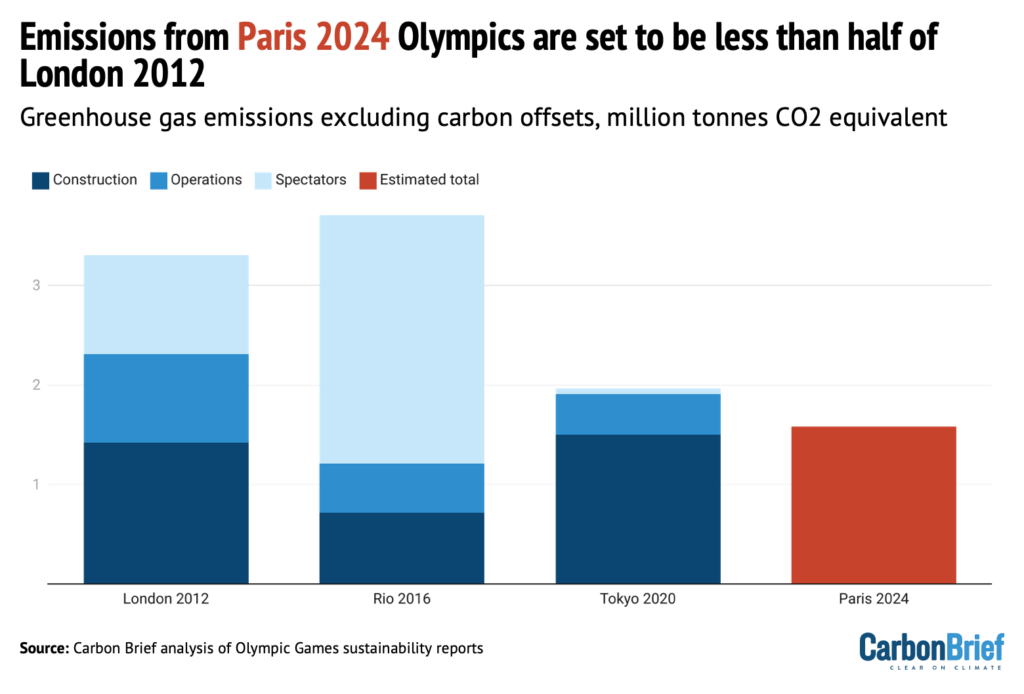
The Paris 2024 Olympics officially start today and these Games are likely to be the hottest ever, with the organisers attempting to mitigate impacts from the likely heatwaves. Carbon Brief analysis shows that the greenhouse gas emissions from these Games are expected to be less than half of those from London 2012. The Paris organisers have explicitly set a carbon budget of 1.75m tonnes of CO2 equivalent (which is half of the average of London 2012 and Rio 2016) and, according to their latest estimates, they are set to meet this target with total emissions coming in at 1.58m tonnes. Organisers said they had aimed to reduce emissions through use of temporary and low-carbon construction materials, as well as by encouraging sustainable travel. The Paris total is set to be even lower than the emissions from the Tokyo 2020 games held in 2021, when emissions were significantly reduced due to a ban on spectators amid the Covid-19 pandemic. The emissions figures exclude any carbon offsets and, for Rio 2016, do not include emissions from legacy construction.
Spotlight
Life in Louisiana’s ‘Cancer Alley’

This week, Carbon Brief interviews Dr Joy Banner, co-founder and co-director of the Descendants Project, about her work trying to uplift Black communities in the face of industrial pollution and increasing climate impacts.
Banner is based in a region along the Mississippi River in Louisiana known as “Cancer Alley”. It is so named due to the high prominence of cancer, which has been linked to local industrial air pollution from the area’s 150 industrial plants. These plants contributed 66% of Louisiana’s greenhouse gas emissions in 2020.
Levels of the carcinogen ethylene oxide, used in plastics production, were found to be 1,000 times higher than safe levels in the region. The health impacts disproportionately affect Black communities. This has been labelled by the UN as a form of “environmental racism”.
Banner’s organisation, the Descendants Project, aims to raise awareness of how Black communities in the region are “descended from the enslaved men, women and children who were forced to labour at plantations”, many of which were purchased by “large industrial petrochemical plants” fromin the 1970s onwards.
Carbon Brief: How would you say that your work relates to petrochemicals and climate change?
Joy Banner: To be honest, when we first started the Descendents Project…we didn’t see it as intersecting our work. But, pretty early on, Jo [co-founder and Joy’s sister] was invited to a conference in Texas, which is another location where there is a proliferation of petrochemical development. That work brought to mind the environmental issues that we are having in Louisiana. So, we are known as “Cancer Alley”, because of the health consequences of having so much industry right on top of us. Our cancer risk is 95% higher than the rest of the country. And the reason why we have so much production is plastics – and plastics is petrochemical[s] and so I guess I didn’t put two and two together [until then].
CB: The carbon emissions released in the production of plastics is having a global impact, but what are the kind of local impacts that you’re seeing in your community?
JB: I don’t know the statistics of how much [petrochemical production in] the Gulf Coast region is impacting climate overall, but it’s not insignificant at all. But, it’s just, for us, we are inundated with the smells. You can taste it, you can feel it, you can see it, you can hear it. It takes over your senses. And the other side of it is the impact that is happening to our climate and the way it’s impacting the strength of the hurricanes and the storm systems that are coming through…Our storms are getting worse. Those hurricanes are getting worse. And the impact of those storms are having more dire consequences.
CB: What are things that you’re trying to do [through the Descendants Project]?
JB: One of the strategies…[is] this dependence that we feel that we have on industries is false. It’s an illusion, it’s not actually a dependence because the plants are not doing s**t for us. Excuse my language, they really are not. Like they’re making billions of dollars. And why, if they’re so rich, then why are we in an impoverished community? Why do we have food deserts? Why are our school systems not better? And so, so our work is breaking that illusion, educating people and getting them to the point where they’re asking questions…We’re just strategising and highlighting the ways in which our communities are doing things for ourselves.
Watch, read, listen
BATTERY DEMANDS: A new report from the US thinktank RMI explored future demand for batteries and the critical raw minerals required to make them.
NOT SO RARE: The podcast BBC Rare Earth explored whether the rise in wildfires around the world is unstoppable and whether the solutions might be found through applying Indigenous fire management practices.
JAILED PROTEST: George Monbiot appeared on Guardian’s Science Weekly podcast to discuss the record-long jail terms for non-violent protest given to five Just Stop Oil activists for planning the blocking of a motorway in the UK.
Coming up
- 27 July-2 August: 61st session of the Intergovernmental Panel on Climate Change, Sofia, Bulgaria
- 28 July: Venezuelan presidential elections
- 29 July-2 August: International Seabed Authority Assembly, second part of the 29th session, Kingston, Jamaica
- 30 July-1 August: UN Environment Programme Dialogue on Actionable Steps for Inclusive Climate Resilience Monitoring and Reporting, online
Pick of the jobs
- International Energy Agency, China programme officer | Salary: €5,741 per month. Location: Paris
- Internews, environmental media consultant – Middle East North Africa | Salary: Unknown. Location: Remote (based in UK or Tunisia)
- Earth Journalism Network, virtual reporting fellowships to the UNCBD (COP16) and UNFCCC (COP29) | Salary: $100 communications stipend
- Reuters Institute, Oxford Climate Journalism Network Engagement Manager | Salary: £32,332-£38,205. Location: Oxford, UK
DeBriefed is edited by Daisy Dunne. Please send any tips or feedback to debriefed@carbonbrief.org.
This is an online version of Carbon Brief’s weekly DeBriefed email newsletter. Subscribe for free here.


The post DeBriefed 26 July 2024: Biden’s ‘climate legacy’; Global wildfires; Life in Louisiana’s ‘Cancer Alley’ appeared first on Carbon Brief.

The launch of the Africa Energy Bank (AEB) has been put back yet again, raising doubts about the institution’s future ability to finance fossil fuel projects – its main objective – as global lenders retreat from such investments over climate concerns, experts told Climate Home News.
The bank, which had been billed to launch in September after a series of delays, is now scheduled to begin operations in November, according to the head of the African Energy Chamber, an advocacy body for the continent’s oil and gas sector.
Even as the world aims to transition away from fossil fuels, many African leaders have made clear they want to continue exploring and extracting the continent’s large oil and gas deposits – estimated at around 125 billion barrels of crude and over 600 trillion cubic feet of gas – to boost economic development.
As a group, Africa sided with a number of powerful oil-and-gas producing nations in blocking progress on negotiations to craft a global roadmap to transition away from fossil fuels at last year’s UN COP30 climate talks, although some countries did individually support the proposal.
-
Campaigners oppose Dangote’s planned Kenya refinery over climate and ecological risks
Plans to build Africa’s second largest oil refinery in ecologically sensitive region criticised as “environmental recklessness” -
Tanzania pushed African nations to oppose fossil fuel transition at COP30
While chairing the African group at the summit, the gas-dependent nation advised the continent’s ministers to block language on transitioning away from fossil fuels


Meanwhile, major projects under development across the continent – including the 1,443-km East African Crude Oil Pipeline (EACOP) and Dangote’s 700,000-barrel-per-day Kenyan refinery – show that African governments see oil and gas as playing a significant role in meeting their energy and economic needs for many years to come.
In 2022, at a gathering of the African Petroleum Producers’ Organization (APPO) in oil-rich Angola, ministers from its member states adopted a resolution to create the Africa Energy Bank to finance projects for the production, use and trade of oil, gas and broader energy sources.
African control over energy resources
An article on the APPO website explains that the bank was conceived as a way to overcome “disenchantment” with fossil fuels among “the international community” which it said had crystallised around the “energy transition” concept.
“If Western countries, after having long taken advantage of the energy sources they now revile to develop, can afford the luxury of abandoning them, this is not the case in Africa,” it adds, noting that many of the continent’s economies are still largely dependent on oil and gas revenues.
A separate web page about the bank, also hosted on APPO’s website, says its objectives include financing the exploration, production and refining of oil and gas, as well as supporting member states in transitioning from fossil fuels to cleaner energy sources “while ensuring energy security”.
Said Addi, a former executive with Shell and energy commodities trading house Gunvor, said the new bank was judged necessary because financing for hydrocarbons from many traditional international lenders has become constrained.
In trying to fill this financing gap, Africa is not simply setting up another fund to support oil and gas, he added. “It is also an attempt to give African countries greater control over how their energy resources and infrastructure are financed,” he explained.
Nigeria to host the AEB
The energy bank – a joint initiative of APPO and the African Export–Import Bank (Afreximbank) – has so far suffered several delays and is almost two years behind schedule. The initial plan was to start operations in January 2025, with Nigeria as the host country, but the bank’s opening was delayed to June of that year to allow Nigeria time to finalise the construction of the bank’s headquarters in Abuja.
After the government announced the completion of the offices in late November 2025, a new launch date was set for January 2026, which was moved back to April, June and then September. Now it has shifted again to November, raising concerns that the institution may be losing momentum.
Former Shell executive Addi said that if the capital is eventually paid in, the bank becomes operational and its first projects are commercially credible, then the delays will be regarded as normal teething troubles in setting up a multilateral institution. But, he added, scepticism will be justified if it continues to stall.
Uganda may see lower oil revenues than expected as costs rise and demand falls
Baron Lamarré, an oil and gas expert and former Petronas oil trader, said that missing “three deadlines in a row is not normal”, and warned that if the timeline slips again, “the story flips from ‘ambitious institution finding its footing’ to ‘good idea that lost momentum before it found any’.”
The Nigerian government, APPO and Afreximbank did not respond to requests for comment by the time of publication.
The funding challenge
The Africa Energy Bank is targeting base capital of $5 billion, with plans to scale up to $120 billion within five years by mobilising private-sector funds. However, it is expected to start operations with initial seed capital of $500 million.
The funding plan is to have the 18 member countries of the APPO contribute $83 million each to the bank as equity for a combined $1.5 billion. Afreximbank, other non-APPO African countries and investors outside the continent are expected to provide the remaining $3.5 billion.
But even the initial $500 million has not been easy to mobilise. In May, APPO Secretary-General Farid Ghezali called on members to deliver on their pledges towards the startup goal before the end of June. But the delays suggest this may not have been met, with experts saying Africa may be finding it difficult to self-fund its oil and gas projects in the absence of international capital.
Lamarré said every extension of the deadline points to the fact that “raising fossil fuel capital in Africa without the majors and their financing networks is brutally hard”.
Why the global electrification agenda misses the point on Africa’s energy crisis
Since 2020, Western lenders, export credit agencies and insurers have been in steady retreat from African hydrocarbons, he said, while oil majors are divesting their African assets, handing over fields to smaller local operators whose credit ratings are not high enough to borrow cheaply.
Even capital from China and the Gulf, which has partially filled the gap, cannot match the volume, tenor or pricing that Western investors once offered, Lamarré argued.
“If mobilising the first $500 million of seed capital [for the AEB] has taken this long, that’s the clearest signal yet of how steep the climb to $120 billion looks,” he said, noting that the continent’s energy financing gap is as large as $30 billion-$45 billion per year.
Africa’s investment landscape, meanwhile, has been shifting. While foreign direct investment dropped from a 2024 peak, inflows remained roughly one-third above the continent’s long-term average in 2025, according to the 2026 World Investment Report from UN Trade and Development (UNCTAD). They are concentrated in a few sectors including critical minerals needed for renewable energy technologies, battery manufacturing and advanced industrial production.
At the same time, data on global energy investment from the International Energy Agency (IEA) shows that fossil fuel investment in Africa has declined over the last decade.

“Trojan horse” for fossil fuels
While the Africa Energy Bank struggles to get off the ground, climate campaigners have criticised its primary aim of financing oil and gas on the continent at a time when the world is starting to move away from high-carbon fuels to cleaner alternatives.
Bhekumuzi Dean Bhebhe, founder of Africa Change Lab, described the bank as a “Trojan horse”, arguing that its focus on fossil fuel financing runs counter to the global energy transition and the African Union’s Agenda 2063 goals of sustainable development and inclusive growth.
The energy bank, he warned, “risks locking Africa into a new cycle of debt, dependency and fossil fuel entrenchment”, adding that its financing blueprint does not pave the way for a climate-resilient future. “In truth, it is to deepen the same extractive, carbon-heavy pathways that the continent should be moving away from,” he added.
Ugandan farmers use British court to try to stop East Africa oil pipeline
Kenya-based climate and energy expert Joab Okanda said the AEB’s plan to finance oil and gas is “a misplaced priority” and it should instead back clean energy in line with the policies of some of Africa’s major export markets like Europe.
In addition, the new bank could struggle to mobilise enough resources to advance large-scale oil and gas projects, he added, noting that its proposed $5-billion initial capital is equivalent to the cost of the East African Crude Oil Pipeline alone.
The AEB’s aim of backing more fossil fuels should be flipped “to support countries that are oil-dependent to start working on their transition plans”, Okanda said.
The post Launch of Africa Energy Bank delayed again in blow to oil and gas hopes appeared first on Climate Home News.
Launch of Africa Energy Bank delayed again in blow to oil and gas hopes