

Welcome to Carbon Brief’s DeBriefed.
An essential guide to the week’s key developments relating to climate change.
This week
World court’s ‘landmark’ climate opinion
POLLUTERS ‘ACCOUNTABLE’: The UN’s highest court has told “wealthy” countries “they must comply with their international commitments to curb pollution or risk having to pay compensation to nations hard hit by climate change”, reported Reuters. The International Court of Justice (ICJ) issued a much-awaited advisory opinion that small island states have described as a “legal stepping stone to make big polluters accountable”, the newswire added.
‘INHERENT RIGHT’: The Associated Press said that, during a two-hour hearing to present the unanimous opinion, Japanese judge Yuji Iwasawa told the court that the “human right to a clean, healthy and sustainable environment is…inherent in the enjoyment of other human rights”. The newswire said activists described this as a “turning point in international climate law”.
‘LEGAL WEIGHT’: The Times noted that the “view is non-binding on governments, including the [UK], and the US does not recognise the court’s jurisdiction”. However, the “ICJ’s advisory opinions carry great legal weight and are seen to contribute to the clarification of international law”, the newspaper added. Carbon Brief has just published an in-depth Q&A on what the opinion means for climate change.
Renewables ‘breakthrough’
BRINK OF BREAKTHROUGH: UN secretary-general António Guterres said on Tuesday that the “world is on the brink of a breakthrough in the climate fight and fossil fuels are running out of road”, the Guardian reported, as two new reports were published illustrating the growing dominance of renewable energy. In his online speech, Guterres said the global energy transition is now “unstoppable” due to “smart economics”.
RENEWABLES ‘CHEAPER’: The first of the new reports, from the International Renewable Energy Agency (IRENA), said that around 90% of renewable power projects globally are now cheaper than fossil fuel alternatives, Reuters said. The second, from the UN drawing on data from multiple international agencies, found that renewables made up 92.5% of all new electricity capacity additions and 74% of electricity generation growth in 2024, the Financial Times reported. Carbon Brief pulled out five key takeaways from both reports.
Around the world
- IN DANGER: The Trump administration has “drafted a plan to repeal a fundamental scientific finding”, known as the “endangerment finding”, that “gives the US government its authority to regulate greenhouse-gas emissions and fight climate change”, reported the New York Times.
- EU-CHINA SUMMIT: The EU and China have “committed to leading the world in the fight against climate change” in a joint statement released on Thursday following a meeting between the two superpowers, Bloomberg said. Carbon Brief’s China Briefing newsletter provided more details.
- JAPAN EYES NUCLEAR: A Japanese utility has become the first since the Fukushima nuclear disaster 14 years ago to take steps towards building a new reactor, reported Channel News Asia.
- SHELL QUITS INITIATIVE: Shell and other fossil-fuel companies have “abandoned” a six-year-long attempt to define a net-zero emissions strategy “after being told that such a standard would require them to stop developing new oil and gas fields”, according to the Financial Times.
- FLASH FLOODS: Ongoing flash flooding in Pakistan has killed at least 266 people over the past month, the Hindu reported.
50C
The temperature in some parts of Iran this week – as authorities asked people to limit drinking water amid an ongoing drought crisis, reported the Guardian.
Latest research
- Climate change is creating “new vulnerabilities” for pandemics | Carbon Brief
- South American lands stewarded by “Afro-descendant” people coincide with areas with “high biodiversity” and are associated with a 29-55% reduction in forest loss, compared to control sites | Communications Earth & Environment
- The “true price” of solar geoengineering is “much higher than its modest technical costs would indicate” | npj Climate Action
(For more, see Carbon Brief’s in-depth daily summaries of the top climate news stories on Monday, Tuesday, Wednesday, Thursday and Friday.)
Captured
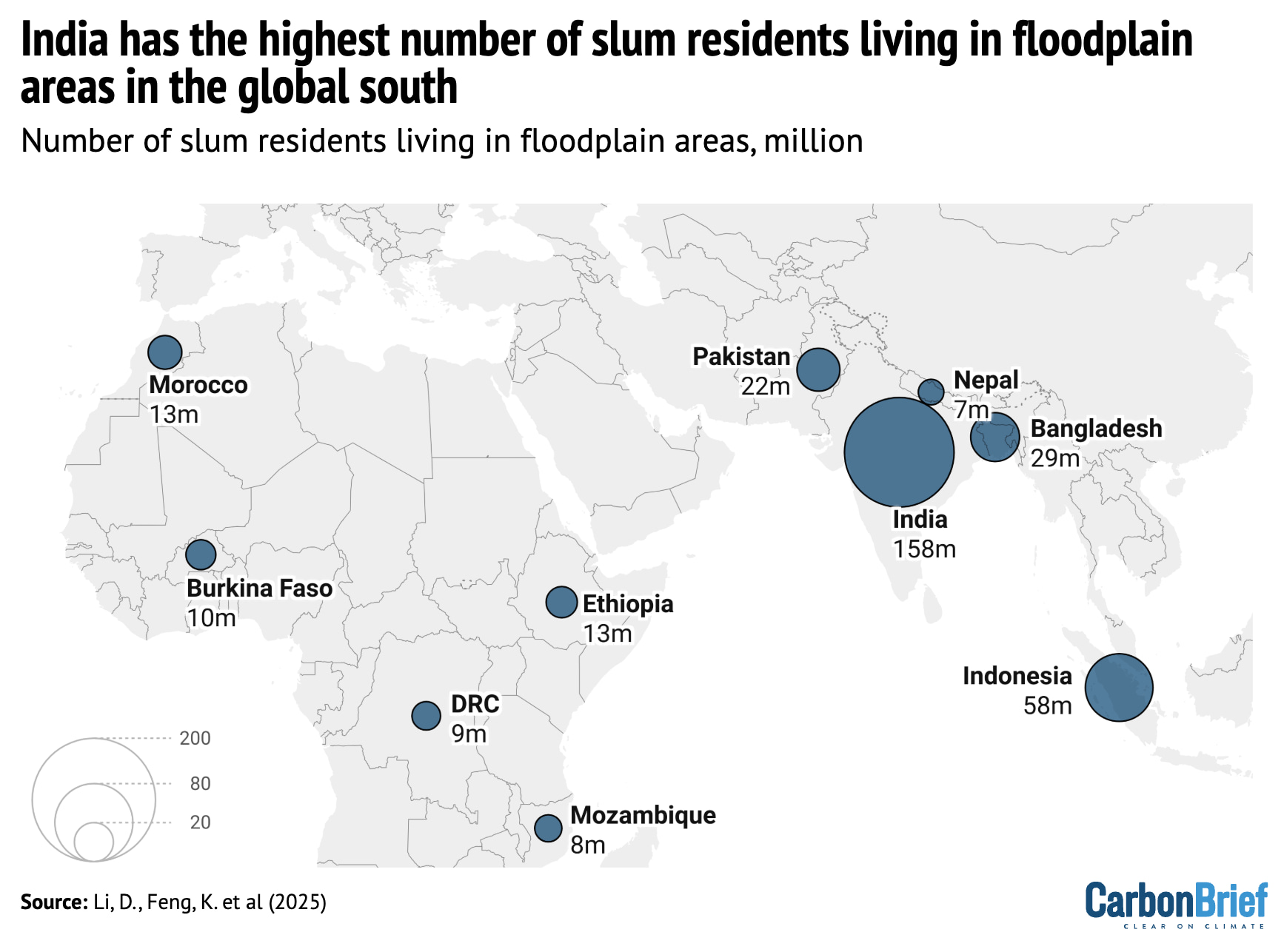
New research covered by Carbon Brief this week found that one in three people in informal settlements in the global south live in floodplains and are at risk of a “disastrous flood”. The chart above draws on data from the study, published in Nature Cities, to illustrate where in the world has the highest number of “slum residents” living in floodplains.
Spotlight
Antarctica’s oldest ice arrives in UK
Carbon Brief recently visited British Antarctic Survey scientists responsible for uncovering the secrets of Antarctica’s oldest ice.
Standing in a freezer in Cambridge – with a -25C chill licking at his nostrils – British Antarctic Survey (BAS) lab manager Jack Humby excitedly opens up an unassuming polystyrene box.
Using his bare hands, he pulls out its contents. Long square-shaped sections of crystal clear ice – wrapped in plastic labelling which way is up – are revealed.
Little about the appearance of the ice gives away that it is at least 1.2m years old.
It has journeyed to the BAS headquarters on the outskirts of Cambridge from an ice core drilling camp in East Antarctica.
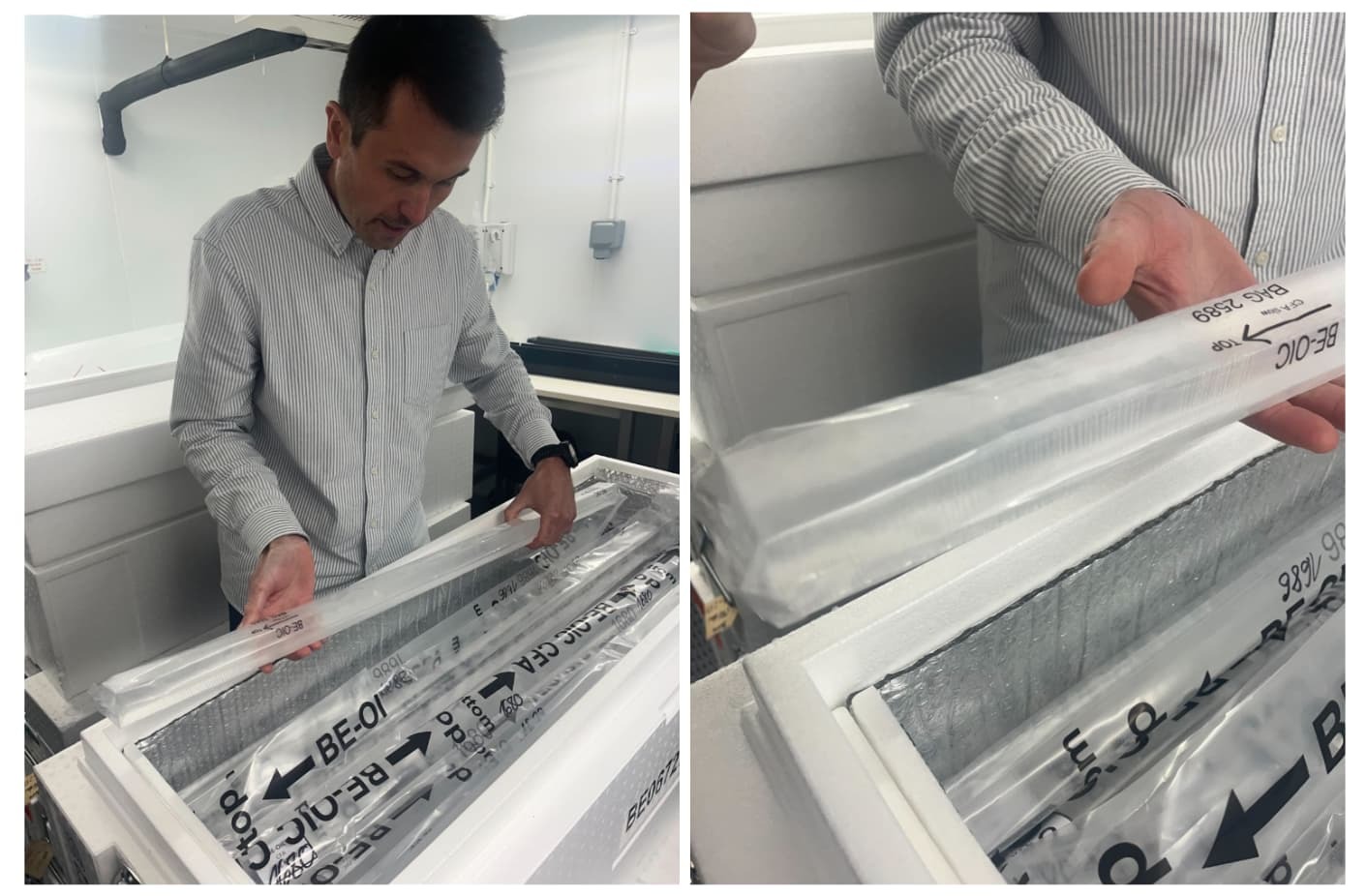
In January, scientists at the camp vertically drilled a 2,800m-long ice core, with on-site tests revealing it was likely to be at least 1.2m years old. The ice was then flown to a nearby port and shipped to Europe aboard the Italian icebreaker Laura Bassi.
The ice was drilled as part of the Beyond Epica Oldest Ice project, a large-scale field operation involving multiple research teams and laboratories across Europe.
‘One shot’
Owing to its specialist equipment and research expertise, BAS has been tasked with analysing the ice to reveal its secrets.
Though not visible to the human eye, the ice contains organic compounds and tiny pockets of air from periods stretching back hundreds of thousands of years.
Over the next seven weeks, the research team at BAS will work around the clock to analyse these features. However, in order to do so, they will have to melt the ice.
Dr Liz Thomas, head of the ice cores team at BAS, told journalists:
“It’s a huge responsibility because this is a one shot. Given how much effort has gone into drilling these cores, we have to get this absolutely right.”
To conduct their analysis, the team plan to use a gold-plated instrument to melt the square-shaped sections of ice being stored in the freezer room.
The meltwater will then be piped into a specially designed lab next door, which contains millions of pounds worth of analysis equipment, according to Humby.
Climates past
The analysis will help scientists work out how old the ice actually is. Though initial tests suggest it is at least 1.2m years old, but the team believe it could be up to 1.5m years old or even older.
It will also enable researchers to paint a more detailed picture of Earth’s past climates.
In turn, this could inform scientists’ understanding of how large swings in temperature in the past have affected various parts of the Earth climate system, including its ice sheets and ecosystems.
Ultimately, this could help researchers to make more informed projections about the likely impacts of human-caused climate change, Thomas explained:
“As climate scientists, it’s our job to provide as much information as we can. What we’re relying on to understand the next steps is climate models. They are fantastic, but they’re only as good as the information we put into them. That really is the justification for looking back in time.”
Watch, read, listen
COP30 LOOMS: A long-read in the Brazilian culture magazine Piauí examined the fraught road that the nation faces to host the next UN climate summit in November.
ARCTIC ‘MELTING POINT’: In Nature Communications, researchers recounted how the Arctic island of Svalbard is facing a “dramatic shift” to high air temperatures and rainfall in the depths of winter.
STUDENT VICTORY: The Guardian spoke to a group of students from the Pacific islands who started the campaign for the world’s top court, the ICJ, to take on the issue of climate change.
Coming up
- 23-31 July: COP15 of the Ramsar Convention on Wetlands, Victoria Falls, Zimbabwe
- 30 July: International Energy Agency electricity mid-year update
- 30 July: Advancing the implementation of the Chilean framework Law on Climate Change, Santiago, Chile
Pick of the jobs
- Boston Globe, climate science and environment reporter | Salary: Unknown. Location: Boston, US
- Science Museum London, curator of climate and earth sciences | Salary: £41,770. Location: London
- Netflix, manager, sustainability standards and partnerships | Salary: Unknown. Location: Amsterdam, Netherlands
DeBriefed is edited by Daisy Dunne. Please send any tips or feedback to debriefed@carbonbrief.org.
This is an online version of Carbon Brief’s weekly DeBriefed email newsletter. Subscribe for free here.
The post DeBriefed 25 July 2025: World court delivers climate ‘turning point’; Renewables ‘unstoppable’; Antarctica’s oldest ice examined appeared first on Carbon Brief.

Farmers and fishermen in the Maldives have long relied on an ancient calendar to guide their daily lives.
The Nakaiy system divides the year into 27 distinct periods, each named after a star or constellation in the night sky.
Any one period in the calendar tells you about expected weather and tidal patterns, navigational routes, and fishing conditions. The Nakaiy was created through centuries of careful observation and local knowledge, passed down through families as an essential tool for survival.
But things are now changing. The climate crisis is leading to more extreme weather events across the Indian Ocean island nation and upending the Nakaiy calendar.
“When you go and speak to communities and ask them what kind of impacts they are facing, a lot of elders will tell you that the weather, it doesn’t follow the calendar anymore,” explained Aishath Reesha Suhail, a programme officer in the Maldives’ Ministry of Tourism and Environment.
As the effects of climate change worsen, it is a real prospect that the Nakaiy may be abandoned by local people, representing a major cultural loss to the Maldives.
‘Systemic and growing threat’
With extreme weather becoming the norm, communities are observing a domino effect of consequences in their everyday lives. The slow onset of heritage loss is now being seen across continents, but notably among small islands in remote parts of the ocean.
“Climate change represents a systemic and growing threat to cultural heritage worldwide,” a UNESCO spokesperson told Climate Home, adding that the World Heritage Committee has identified climate change as “one of the most significant long-term risks affecting properties across all regions.”
UNESCO, the UN body for education, science and culture, defines the loss of cultural heritage as “the erosion of traditional knowledge systems, craftsmanship, social practices and identity, particularly where communities are displaced or livelihoods disrupted”. A clear example is historical sites and even entire islands washed into the ocean as a result of rising sea levels and coastal erosion.
The Maldives is dealing with such a situation now. The Koagannu Cemetery is a 900-year-old resting place, located on the country’s southernmost atoll, a mere 50 metres from the shoreline. The monument’s intricate coral gravestones are being actively threatened by the encroaching Indian Ocean.
The government and local community have responded to this challenge with emergency protection measures. Sandbags and concrete structures have been installed along the coastline, complemented by large numbers of palm trees to create a seawall. A wider solution is ‘beach nourishment’, a common practice in the Maldives where sand from elsewhere is brought in to replace what has been lost through erosion. Taken together, these solutions have so far protected the cemetery.
Among the many issues climate change creates, cultural heritage is not always front of mind. In the Maldives, one of the main barriers people face is awareness. “Most of what we are dealing with relates to the erosion of our islands along with areas such as fisheries… but we are quite limited in our capacity to do something about it,“ Suhail said.
“We don’t understand the full breadth of the issue at present because we haven’t been able to do extensive research on the matter,” she added. However, assessing the extent of the damage – and how to respond effectively – is a key priority for the government, outlined in its latest climate plan, known as a Nationally Determined Contribution, and as part of its National Adaptation Plan process.
Fishing is at the core of the country’s culture and identity, employing thousands of people. Most dishes include fish – “we have it for breakfast, lunch and dinner,” Suhail noted – but the climate crisis and overfishing are shifting how and when communities can fish. Tuna makes up 98% of all fish caught in the Maldives, but warmer ocean temperatures are changing migratory patterns, pushing the species into deeper, colder waters.
As a critical economic and cultural resource, the government has outlined a range of solutions to protect the fisheries sector in its first Biennial Transparency Report to the UN. These include using real-time tracking data to improve the efficiency of fishing operations; investing in canneries to increase fish storage; and diversifying away from tuna through marine farming.

Culture and nature go hand-in-hand
The same pattern is playing out elsewhere.
Palau and the Maldives are not close to one another. The two states are separated by around 4,000 miles and sit in different corners of the ocean. But both are experiencing very similar climate challenges, based on their position as a set of scattered, low-lying islands surrounded by an imposing body of blue water.
In the same way as the Maldives, Palau’s cultural heritage is closely tied to “land, coastlines and traditional food systems,” according to Toni Soalabla, at the Palau Office of Climate Change.
“Many of the places that hold stories, history and identity of our communities are located along the coast and are increasingly exposed to erosion and sea level rise,” she said.
One of these places is Ngerutechei village, reportedly the oldest in Palau, and home to ancient stone paths and carvings. The village provides a glimpse into the past social values and culture of the people in this western Pacific nation.
As part of the development of Palau’s National Adaptation Plan, the government has worked with local leaders to identify similar sites of cultural significance. The plan encourages communities to use their own knowledge to create protective measures for these sites.
Climate change is also prompting communities to take up traditional land and food practices again. These include cultivating taro, a stable food source that has historically supported water, soil and food security on the islands.
“These systems developed over generations in response to local environmental conditions, so strengthening them today is both a climate adaptation measure and a way of maintaining cultural knowledge that might otherwise fade,” said Soalabla.
Cultural practices in Palau have developed alongside the natural ecosystems that people rely on to survive. It is within this context that researchers believe adaptation policies should be created. Recognising this relationship “can strengthen both community identity and environmental resilience at the same time”, according to Soalabla.


Heritage on the global stage
The issue of cultural loss has not gone unnoticed in international climate negotiations.
Small island states such as the Maldives have used their role at the UN to push for greater awareness and action, with some key successes.
In 2015, the Paris Agreement established a Global Goal on Adaptation (GGA) which recognised that countries needed to do something about climate change now and not later. However, it took six years before a framework and a set of adaptation targets were agreed at the UN climate summit in Glasgow to pursue this goal.
From this came the establishment of seven overall themes – from poverty eradication to access to health – to guide adaptation action and a set of around 60 indicators to measure progress against the targets.
World leaders invited to see Pacific climate destruction before COP31
Emilie Beauchamp, an adaptation specialist at the International Institute for Sustainable Development (IISD), said that “cultural heritage was highlighted as one of the global priorities [of the GGA Framework] and is one of the seven themes, so it is considered very important by the international community.”
The much-debated set of indicators, only finalised in Belém at last year’s COP30, include five related to cultural heritage with a focus on preserving cultural practices and important sites that are “guided by traditional knowledge, Indigenous Peoples’ knowledge and local knowledge systems”. A spokesperson for UNESCO said the inclusion of heritage indicators “marks an important recognition that climate impacts extend beyond economic losses”.
While critics said the set of final indicators was rushed through by the Brazilian presidency, they now serve as guidance for national governments that wish to implement plans to protect their common heritage. The missing piece of the puzzle remains how to finance these plans – something notably absent from the Belém text, which made clear that the adaptation indicators “do not create new financial obligations or commitments, nor liability or compensation”.
The lack of financial commitments proved disappointing for many small states grappling with how to prevent their cultural history from being entirely forgotten, especially at a time when adaptation finance remains below requirements. A recent UNEP report found that developing nations would need an estimated US$310 billion per year in 2035 to adapt to climate change, while current public financing was around $26 billion.
At these low levels “only a small percentage of what the framework outlines could be implemented,” according to Beauchamp.

The challenge of cultural heritage
When looking at low-lying islands on a map, they can appear as specks of land amid a vast ocean. Many of the stories from these remote places go unnoticed. But the specks represent millennia of human culture that is slowly being lost to the ocean.
While the international community has now recognised the problem and solutions exist, the recurring issue of scarce finance may prevent governments from taking sustained action. Island communities have already been forced to move home as sea levels rise, leaving behind their cultural connections to a place.
The value of any cultural asset, or of human heritage, can be judged by how it is engaged with over generations. Without human intervention, many historical sites, language, cuisine and other local customs would become a forgotten part of history. The rapid onset of climate change brings the role of cultural heritage into sharp relief, challenging communities to decide in real time what they value, what deserves saving, and how to achieve that.
Stories of cultural loss are not confined to small islands but it is here where the challenge is presenting most acutely. The experiences of these vulnerable nations in protecting their heritage will provide the litmus test for effective adaptation responses elsewhere.
Adam Wentworth is a freelance writer based in Brighton, UK.
(Main image: The Isdhoo Havitha is an ancient Buddhist monastery in the Maldives, located moments from the shoreline. Photo: Ashwa Faheem)
The post Island nations fight to save cultural heritage from climate change appeared first on Climate Home News.
Island nations fight to save cultural heritage from climate change
The invasive emerald ash borer, native to northeast Asia, has spread to 37 states over the past quarter century, killing nearly all of the ash trees it infests. But in Maine, a coalition of basketmakers, scientists and government officials are plotting a future for their trees.
Each strip of wood in Richard Silliboy’s hands started as a year of an ash tree’s life.
Climate Change
Toxic Ocean Crisis in Papua New Guinea Sparks Mass Marine Die-Off and Public Health Emergency
Thousands of dead fish are washing ashore and people are falling ill too, as officials investigate possible sources of contamination.
It started in December, when dead fish began washing ashore New Ireland—a mountainous island in Papua New Guinea’s New Ireland Province, flanked by the Pacific Ocean and the Bismarck Sea.
Toxic Ocean Crisis in Papua New Guinea Sparks Mass Marine Die-Off and Public Health Emergency



-
Climate Change8 months ago
Guest post: Why China is still building new coal – and when it might stop
-
Greenhouse Gases8 months ago
Guest post: Why China is still building new coal – and when it might stop
-

 Greenhouse Gases2 years ago
嘉宾来稿:满足中国增长的用电需求 光伏加储能“比新建煤电更实惠”
-
Climate Change2 years ago
Bill Discounting Climate Change in Florida’s Energy Policy Awaits DeSantis’ Approval
-

 Climate Change2 years ago
嘉宾来稿:满足中国增长的用电需求 光伏加储能“比新建煤电更实惠”
-
Climate Change Videos2 years ago
The toxic gas flares fuelling Nigeria’s climate change – BBC News
-

 Renewable Energy5 months ago
Sending Progressive Philanthropist George Soros to Prison?
-

 Carbon Footprint2 years ago
US SEC’s Climate Disclosure Rules Spur Renewed Interest in Carbon Credits