

Welcome to Carbon Brief’s DeBriefed.
An essential guide to the week’s key developments relating to climate change.
This week
Brazil’s oil ‘evolution’
OIL BE FRIENDS: Brazil’s government has approved an invitation to join OPEC+, a group representing the interests of oil-exporting nations, just months ahead of hosting the COP30 climate summit, the Associated Press reported. The move signals the “country’s evolution into a major oil state”, the newswire said. Brazil’s energy minister said the country’s participation will be limited to a “forum for discussing strategies” and that “we should not be ashamed of being oil producers”.
SHIPPING SHOWDOWN: Brazil was also among 15 countries that asked the UN to ditch plans for a new levy on CO2 emissions from global shipping, reported the Guardian. Ahead of an International Maritime Organisation (IMO) meeting this week, the group – which includes China, Saudi Arabia and South Africa – “argued a levy could reduce exports from the developing world, raise food prices and increase inequalities”, the newspaper said. It added that the levy “could still pass”, if the IMO takes a “firm stance”.
NO HOTEL, NO PROBLEM: During a visit to Belém, the host city for COP30 this November, Brazilian president Luiz Inácio Lula da Silva responded to concerns that it does not have enough accommodation by saying delegates could “sleep [under the] star[s] in the sky…which will be wonderful”, Folha de São Paulo reported. And Reuters covered the latest raids as part of “Operation Maravalha” to curb illegal logging in the Amazon.
Trampling Trump
ACCESS DENIED: US state department officials have been denied permission to participate in an Intergovernmental Panel on Climate Change (IPCC) meeting in China next week, Axios reported. A contract for an IPCC working group technical support unit was also “recently terminated by NASA”, it added. Axios also reported that NASA and NOAA (the National Oceanic and Atmospheric Administration) are in line for a “10% reduction in staff”, which could “imperil” the work of the National Weather Service.
‘CHAOTIC’: In US president Donald Trump’s latest move to dismantle federal climate policies, the Department of Homeland Security has been ordered to “eliminate all climate change activities and the use of climate change terminology”, Bloomberg reported. This includes the Federal Emergency Management Agency, which “has been responding to more disasters”, the newswire added, as “wildfires, storms and floods increase”.
‘LIQUID GOLD’: Trump has signed an executive order formally creating a “National Energy Dominance Council”, reported the Associated Press, and “directed it to drive up already record-setting domestic oil and gas production”. Trump said: “We’re going to make more money than anybody’s ever made with energy.” E&E News examined how his ambitions could hit “economic and geologic realities”.
Around the world
- ABOUT TURN: In a “major policy shift”, Japan’s newly approved energy plan will aim to produce 20% of its electricity from nuclear power by 2040, reported BBC News.
- RISING SEAS: The Pacific Ocean nation of Nauru is aiming to sell citizenships to help meet the cost of moving 10,000 residents from low-lying areas into the island’s “barren interior”, Bloomberg reported.
- LANDSLIDE RISK: Heavy rainfall in Peru has killed at least 46 people and left more than 8,000 people homeless, reported El Comercio, which noted that the extreme weather was expected to continue in the coming days.
- ‘GREEN CORRIDOR’: Environmentalists warned that a new protected area – the size of France – in the Democratic Republic of Congo has so far failed to include Indigenous people and local communities in its design, Climate Home News said.
- ICE IN DECLINE: According to BBC News analysis of satellite data, global sea ice extent dropped to a record low in mid-February.
- ‘FRAGILE GLOBAL EXISTENCE’: A G20 meeting of foreign ministers has started in Johannesburg, South Africa, with “stepping up the fight against global warming” on the agenda, reported Bloomberg. US secretary of state Marco Rubio has “snubbed” the event due, in part, to its climate focus, it added.
10%
The record proportion of China’s GDP coming from clean-energy technologies in 2024, according to analysis published by Carbon Brief.
Latest climate research
- Glaciers across the world collectively lost 273bn tonnes of ice every year between 2000 and 2023, a new Nature study found, with a 36% increase in ice loss from the first (2000-11) to the second (2012-23) half of the research period.
- New research in a Royal Society journal used data collected from 600 green turtles over three decades to show that females are bringing forward their nesting dates by six days for every 1C of sea surface temperature rise.
- The timing of plant flowering and insect flight in the US is “highly responsive” to extreme weather events, a Nature Climate Change study showed.
(For more, see Carbon Brief’s in-depth daily summaries of the top climate news stories on Monday, Tuesday, Wednesday, Thursday and Friday.)
Captured
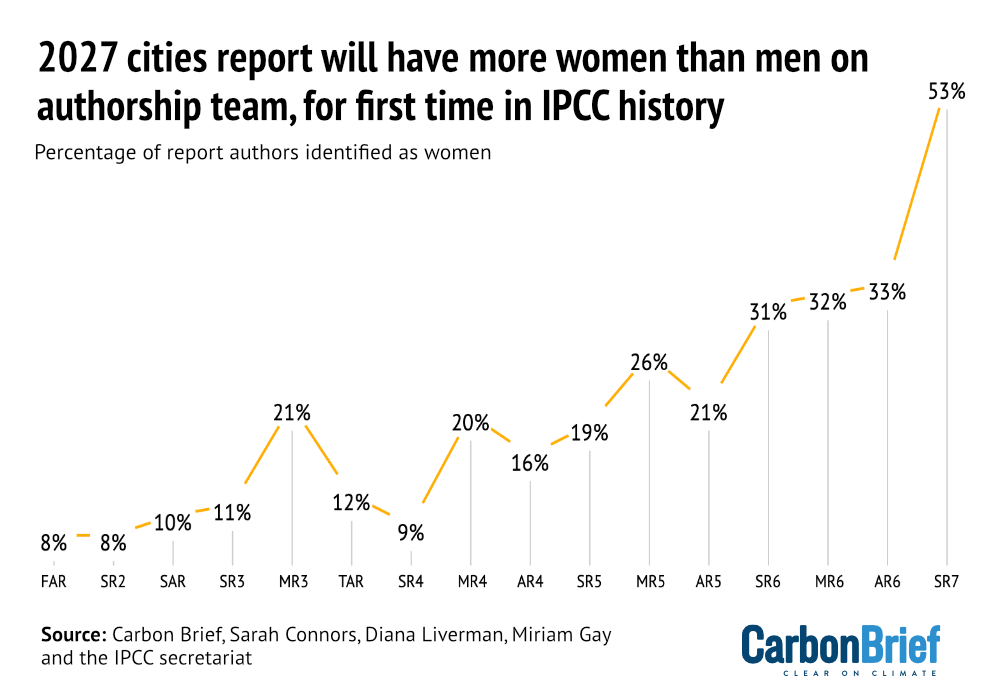
The Intergovernmental Panel on Climate Change’s (IPCC) forthcoming special report on climate change and cities has more women than men on its authorship team, for the first time in the organisation’s history, according to analysis by Carbon Brief. The analysis covers all assessment, special and methodology reports published over the IPCC’s 37-year history. It revealed how the representation of women in the IPCC has steadily risen over time, from just 8% of authors in its first report in 1990 to 53% in its cities report, due to be published in March 2027.
Spotlight
Cooling cities with ‘smart’ surfaces
Carbon Brief reports on how “smart” surfaces can be used to cool cities in the face of worsening extreme heat.
Last month, new research showed that increasing the reflectivity of surfaces at San Francisco International airport could cut the risk of heat stress in its outdoor workers and see fewer working hours lost at the height of summer.
At its heart, the idea is a simple one – making the ground surface and roofs of buildings more reflective means they absorb less of the sun’s energy. This, in turn, means they warm up less and radiate less heat back into the surroundings.
This helps offset the “urban heat island” effect, where temperatures in cities are consistently higher than in the surrounding countryside due to heat-trapping urban infrastructure.
Heat inequality
The airport study was conducted by the Smart Surfaces Coalition, a not-for-profit organisation that works with cities to use “smart” surfaces – including reflective, porous and green surfaces, solar panels and urban trees – to help manage the impacts of extreme heat and rainfall.
The coalition is working with 11 “partner cities” in the US – plus Bhopal in India – to drive adoption of smart surfaces through citywide policies and local implementation projects.
According to coalition founder Greg Kats, cities have typically followed “business as usual” for public construction projects – opting for “dark, impervious surfaces of tarmac” at the lowest cost, which “absorbs 90% of the incoming sunlight”.
As well as leaving cities at higher risk of getting “hotter and hotter and more prone to flooding”, these choices have contributed to urban inequality, Kats explained to Carbon Brief.
In the case of Baltimore on the US east coast, “at the same time of day in the summer afternoon” there will be a “14F [7.8C] temperature difference between wealthy, treed areas and low-income, dark, impervious areas”, he said.
This “structural inequality is a legacy of redlining” – long-abolished discriminatory lending practices in the US – and is a “hallmark of American cities”, Kats added.
Urban cooling
In partner cities, the coalition is conducting citywide surface mapping and heat modelling, developing cost-benefit tools and helping cities craft policies and building codes.
In Baltimore, for example, installing smart surfaces could bring more than 5F (2.8C) of citywide cooling, coalition analysis has shown, with benefits that outweigh the costs at a ratio of 10 to 1.
These measures also reduce the need for air conditioning, Kats explained:
“For 1F of ambient temperature reduction, it reduces an air conditioning electricity bill by 4-5%, so a 5F reduction is a 20-25% reduction in electricity bills.”
As a result, smart surfaces are a “really big deal” for climate mitigation, Kats said. And it taps into another aspect of the urban island effect – a key contribution comes from human activity, such as the use of cars and air conditioning.
Air conditioners cool the air inside buildings by pumping waste heat outside, so “you have this perverse effect of private cooling heating the city, which means more air conditioning”. Kats explained:
“So you’ve got two different pathways for a city: do you do citywide cooling, or do you keep relying on the private sector to buy more air conditioning?”
While cool surfaces do have their barriers and challenges, Kats argued that they offer the “only viable, scalable, cost-effective, urban-cooling strategy”, adding: “There really isn’t anything else.”
Watch, read, listen
‘TRAPPED IN EXPLOITATION’: Climate Home News reported on how “nearly all” Bangladeshi migrants who leave areas hit hard by climate change to seek work elsewhere end up “subject to forms of forced labour”.
RECORDS SMASHED: A Guardian interactive mapped the record heat experienced by two-thirds of the Earth’s surface in 2024.
PRESERVING WEBSITES: A research librarian and policy scholar in North America outlined in the Conversation how to “find climate data and science the Trump administration doesn’t want you to see”.
Coming up
- 23 February: Germany general election
- 24-28 February: 62nd session of the Intergovernmental Panel on Climate Change, Hangzhou, China
- 25-27 February: Resumed session of the UN biodiversity summit COP16, Rome
- 26 February: UK Climate Change Committee seventh carbon budget advice published
- 26-28 February: Finance in common summit, Cape Town, South Africa
Pick of the jobs
- The China Global South Company, critical minerals editor | Salary: Unknown. Location: Remote (Africa preferred)
- Dioceses of Leicester and Peterborough, net-zero carbon projects development officer | Salary: £30,000. Location: Peterborough, Leicester or Northampton, UK
- Imperial War Museum, head of sustainability and environment | Salary: £65,000. Location: Duxford, London or Manchester, UK
- Groundwork, goals for climate co-ordinator | Salary: £24,716. Location: Hybrid (Northern Ireland)
- Energy and Climate Intelligence Unit, consultant analyst – trade and net-zero | Salary: Unknown. Location: Flexible
DeBriefed is edited by Daisy Dunne. Please send any tips or feedback to debriefed@carbonbrief.org.
This is an online version of Carbon Brief’s weekly DeBriefed email newsletter. Subscribe for free here.


The post DeBriefed 21 February 2025: Brazil joins oil bloc ahead of COP30; US ‘pulled’ from IPCC meeting; Cooling cities with ‘smart’ surfaces appeared first on Carbon Brief.

Drought and heatwaves occurring together – known as “compound” events – have “surged” across the world since the early 2000s, a new study shows.
Compound drought and heat events (CDHEs) can have devastating effects, creating the ideal conditions for intense wildfires, such as Australia’s “Black Summer” of 2019-20 where bushfires burned 24m hectares and killed 33 people.
The research, published in Science Advances, finds that the increase in CDHEs is predominantly being driven by events that start with a heatwave.
The global area affected by such “heatwave-led” compound events has more than doubled between 1980-2001 and 2002-23, the study says.
The rapid increase in these events over the last 23 years cannot be explained solely by global warming, the authors note.
Since the late 1990s, feedbacks between the land and the atmosphere have become stronger, making heatwaves more likely to trigger drought conditions, they explain.
One of the study authors tells Carbon Brief that societies must pay greater attention to compound events, which can “cause severe impacts on ecosystems, agriculture and society”.
Compound events
CDHEs are extreme weather events where drought and heatwave conditions occur simultaneously – or shortly after each other – in the same region.
These events are often triggered by large-scale weather patterns, such as “blocking” highs, which can produce “prolonged” hot and dry conditions, according to the study.
Prof Sang-Wook Yeh is one of the study authors and a professor at the Ewha Womans University in South Korea. He tells Carbon Brief:
“When heatwaves and droughts occur together, the two hazards reinforce each other through land-atmosphere interactions. This amplifies surface heating and soil moisture deficits, making compound events more intense and damaging than single hazards.”
CDHEs can begin with either a heatwave or a drought.
The sequence of these extremes is important, the study says, as they have different drivers and impacts.
For example, in a CDHE where the heatwave was the precursor, increased direct sunshine causes more moisture loss from soils and plants, leading to a drought.
Conversely, in an event where the drought was the precursor, the lack of soil moisture means that less of the sun’s energy goes into evaporation and more goes into warming the Earth’s surface. This produces favourable conditions for heatwaves.
The study shows that the majority of CDHEs globally start out as a drought.
In recent years, there has been increasing focus on these events due to the devastating impact they have on agriculture, ecosystems and public health.
In Russia in the summer of 2010, a compound drought-heatwave event – and the associated wildfires – caused the death of nearly 55,000 people, the study notes.

The record-breaking Pacific north-west “heat dome” in 2021 triggered extreme drought conditions that caused “significant declines” in wheat yields, as well as in barley, canola and fruit production in British Columbia and Alberta, Canada, says the study.
Increasing events
To assess how CDHEs are changing, the researchers use daily reanalysis data to identify droughts and heatwaves events. (Reanalysis data combines past observations with climate models to create a historical climate record.) Then, using an algorithm, they analyse how these events overlap in both time and space.
The study covers the period from 1980 to 2023 and the world’s land surface, excluding polar regions where CDHEs are rare.
The research finds that the area of land affected by CDHEs has “increased substantially” since the early 2000s.
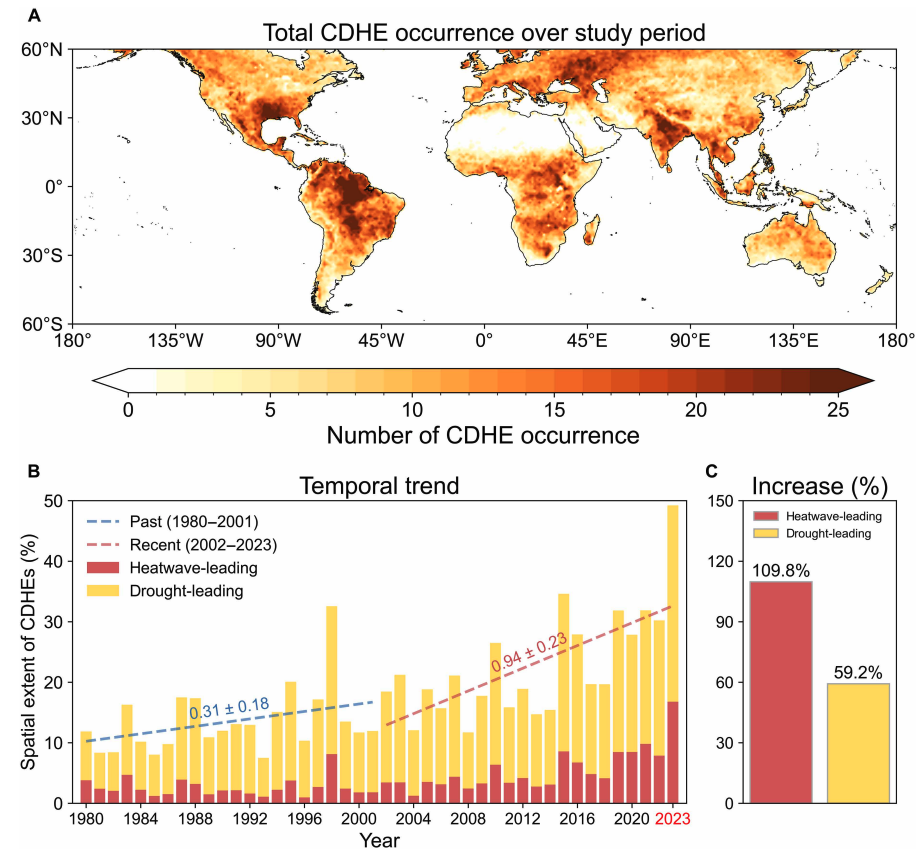
Heatwave-led events have been the main contributor to this increase, the study says, with their spatial extent rising 110% between 1980-2001 and 2002-23, compared to a 59% increase for drought-led events.
The map below shows the global distribution of CDHEs over 1980-2023. The charts show the percentage of the land surface affected by a heatwave-led CDHE (red) or a drought-led CDHE (yellow) in a given year (left) and relative increase in each CDHE type (right).
The study finds that CDHEs have occurred most frequently in northern South America, the southern US, eastern Europe, central Africa and south Asia.
Threshold passed
The authors explain that the increase in heatwave-led CDHEs is related to rising global temperatures, but that this does not tell the whole story.
In the earlier 22-year period of 1980-2001, the study finds that the spatial extent of heatwave-led CDHEs rises by 1.6% per 1C of global temperature rise. For the more-recent period of 2022-23, this increases “nearly eightfold” to 13.1%.
The change suggests that the rapid increase in the heatwave-led CDHEs occurred after the global average temperature “surpasse[d] a certain temperature threshold”, the paper says.
This threshold is an absolute global average temperature of 14.3C, the authors estimate (based on an 11-year average), which the world passed around the year 2000.
Investigating the recent surge in heatwave-leading CDHEs further, the researchers find a “regime shift” in land-atmosphere dynamics “toward a persistently intensified state after the late 1990s”.
In other words, the way that drier soils drive higher surface temperatures, and vice versa, is becoming stronger, resulting in more heatwave-led compound events.
Daily data
The research has some advantages over other previous studies, Yeh says. For instance, the new work uses daily estimations of CDHEs, compared to monthly data used in past research. This is “important for capturing the detailed occurrence” of these events, says Yeh.
He adds that another advantage of their study is that it distinguishes the sequence of droughts and heatwaves, which allows them to “better understand the differences” in the characteristics of CDHEs.
Dr Meryem Tanarhte is a climate scientist at the University Hassan II in Morocco, and Dr Ruth Cerezo Mota is a climatologist and a researcher at the National Autonomous University of Mexico. Both scientists, who were not involved in the study, agree that the daily estimations give a clearer picture of how CDHEs are changing.
Cerezo-Mota adds that another major contribution of the study is its global focus. She tells Carbon Brief that in some regions, such as Mexico and Africa, there is a lack of studies on CDHEs:
“Not because the events do not occur, but perhaps because [these regions] do not have all the data or the expertise to do so.”
However, she notes that the reanalysis data used by the study does have limitations with how it represents rainfall in some parts of the world.
Compound impacts
The study notes that if CDHEs continue to intensify – particularly events where heatwaves are the precursors – they could drive declining crop productivity, increased wildfire frequency and severe public health crises.
These impacts could be “much more rapid and severe as global warming continues”, Yeh tells Carbon Brief.
Tanarhte notes that these events can be forecasted up to 10 days ahead in many regions. Furthermore, she says, the strongest impacts can be prevented “through preparedness and adaptation”, including through “water management for agriculture, heatwave mitigation measures and wildfire mitigation”.
The study recommends reassessing current risk management strategies for these compound events. It also suggests incorporating the sequences of drought and heatwaves into compound event analysis frameworks “to enhance climate risk management”.
Cerezo-Mota says that it is clear that the world needs to be prepared for the increased occurrence of these events. She tells Carbon Brief:
“These [risk assessments and strategies] need to be carried out at the local level to understand the complexities of each region.”



The post Heatwaves driving recent ‘surge’ in compound drought and heat extremes appeared first on Carbon Brief.
Heatwaves driving recent ‘surge’ in compound drought and heat extremes
Greenhouse Gases
DeBriefed 6 March 2026: Iran energy crisis | China climate plan | Bristol’s ‘pioneering’ wind turbine
Welcome to Carbon Brief’s DeBriefed.
An essential guide to the week’s key developments relating to climate change.
This week
Energy crisis
ENERGY SPIKE: US-Israeli attacks on Iran and subsequent counterattacks across the Middle East have sent energy prices “soaring”, according to Reuters. The newswire reported that the region “accounts for just under a third of global oil production and almost a fifth of gas”. The Guardian noted that shipping traffic through the strait of Hormuz, which normally ferries 20% of the world’s oil, “all but ground to a halt”. The Financial Times reported that attacks by Iran on Middle East energy facilities – notably in Qatar – triggered the “biggest rise in gas prices since Russia’s full-scale invasion of Ukraine”.
‘RISK’ AND ‘BENEFITS’: Bloomberg reported on increases in diesel prices in Europe and the US, speculating that rising fuel costs could be “a risk for president Donald Trump”. US gas producers are “poised to benefit from the big disruption in global supply”, according to