

In his final letter published on the eve of COP30’s opening day on Monday, the summit’s Brazilian boss André Aranha Corrêa do Lago spelled out his top priority: ensure that the nearly 200 disparate country delegations gathering in Belèm “evolve into one cohesive team”.
But his hopes of channelling global togetherness look set to get a reality check. A familiar battle is brewing over the conference’s agenda for the coming two weeks, after negotiating groups tabled six proposals for additional topics to be discussed.
Emerging economies ask for talks on finance and trade
Two come from the Like-Minded Group of Developing Countries (LMDCs), which includes China, India and Saudi Arabia, with support from the Arab Group of predominantly oil-rich nations and cover well-trodden territory: finance and trade.
On finance, the bloc wants dedicated discussions on Article 9.1 of the Paris Agreement, which sets out an obligation for developed countries to provide financial help for developing nations’ efforts to cut emissions and adapt to a warming world.
Their demand that rich governments stump up cash is nothing new. But that has now been fuelled further by disappointment over the outcome of last year’s negotiations which produced the new UN climate finance goal of $300 billion a year by 2035. The LMDCs are now calling for a three-year “work programme” to discuss how the provision of money from developed nations under Article 9.1 is crucial to reach a broad range of goals in the Paris accord.
-
Five big questions hanging over COP30
From insufficient emissions-cutting plans to a shortfall in adaptation finance, here’s our guide to the thorny issues facing the UN climate summit in Belém -
Health check: 10 years of the Paris Agreement
A decade since the deal was adopted, climate experts say it is working to cut emissions, spur action and reduce the projected temperature rise – but not as fast as we need it to


The bloc also wants the summit to tackle “unilateral trade-restrictive measures”. That is code for mechanisms such as the EU’s carbon border adjustment mechanism (CBAM), which is essentially a carbon tax on imports aimed at creating a level-playing field between domestic and overseas producers.
But emerging economies – such as China and India – say those measures are protectionist, do not take different levels of development into account, and would harm their economies. They have been calling for the inclusion of this agenda item at the previous two COPs – but so far have not succeeded in their bid to separate the topic out from existing discussions.
Since taking on the presidency, Brazil has been trying to defuse a likely COP30 agenda fight over trade measures. But Do Lago’s proposal to create a new forum to discuss climate and trade outside of the UN climate regime was met with a lukewarm response.
Small islands push ‘survival’ agenda
Hot on the heels of UN chief Antonio Guterres conceding that a breach of the 1.5C warming limit is “inevitable”, the Alliance of Small Island States (AOSIS) has put forward a proposal for discussions on how to react to that and raise emission-cutting ambition.
The group, predominantly composed of low-lying Pacific island nations, wants to create a dedicated space to agree “on concrete follow-up actions” to accelerate implementation of efforts before 2030. This also feeds into existing divisions over how COP30 should respond to a wide shortfall in ambition in countries’ updated national climate plans (NDCs) submitted this year.
“We are proposing this agenda item because the world’s current trajectory toward climate catastrophe is unacceptable – morally, scientifically, and legally,” said AOSIS Chair Ambassador Ilana Seid. “For small island nations, this is not about negotiation tactics – it’s about survival.”
The EU, for its part, wants dedicated discussions over a transparency mechanism of the Paris Agreement that requires countries to report a vast amount of national-level information, including inventories of greenhouse gas emissions and measures taken to act on promises made in their NDCs.
In its submission, the EU says it is “crucial” that good practices are shared and that barriers to boosting climate action are identified and urgently fixed.

Forests, mountains and health
Forest nations Honduras, Suriname and Papua New Guinea, meanwhile, are calling for discussions on the need for an “urgent” increase in financial support for global efforts “to reverse global deforestation and degradation by 2030” – one of the key agreements made at COP28 in Dubai two years ago.
Two additional proposals came in at the last minute on Sunday from Zimbabwe and Kyrgyzstan, respectively.
The Southeast African nation wants to create a new space for discussions on the impact of climate change on health. Its submission calls for a “structured dialogue” between negotiators and health experts that could come up with concrete actions to advance health considerations in adaptation interventions and meet the needs of the most vulnerable communities.
The Central Asian country wants better integration of mountain-related issues into the global climate agenda and, more specifically, the creation of an Annual Expert Dialogue on Mountains and Climate Change.
In an attempt to enable the smooth adoption of the conference agenda and prevent fireworks at the opening session, the COP30 presidency met with heads of government delegations on Sunday. The plenary will show whether those efforts to accommodate new agenda demands have been successful.
UN climate chief: Fight the climate crisis not each other
The head of the UN’s climate body kicked off the summit with a reminder to governments that “your job here is not to fight one another – your job is to fight this climate crisis, together”.
How far that advice is taken on board will be evident from day one, as a fight loomed over several new agenda items put forward by countries in the run-up to the conference
Simon Stiell told the assembled delegates he wasn’t “sugar-coating” the challenge ahead. “We have so much more work to do,” he said in his opening speech. “We must move much, much, faster on both reductions of emissions and strengthening resilience,” he added.

While the Paris Agreement, adopted 10 years ago, has started to bend the emissions curve downwards, it will not be enough to meet the lowest 1.5C warming limit in the accord, the UN has admitted in recent days based on new national climate plans (NDCs) submitted for the next 10 years.
“We can and must bring temperatures back down to 1.5C after any temporary overshoot,” Stiell said. For that to happen, countries need to make decisions in Belem to move forward on things they have already agreed, he emphasised.
For example, at COP28 in Dubai two years ago, governments pledged to transition away from fossil fuels in energy systems. “Now’s the time to focus on how we do it fairly and orderly,” said Stiell. “Focusing on which deals to strike, to accelerate the tripling of renewables and doubling energy efficiency.”
Other agreed areas for action at COP30 that need “strong and clear outcomes” include a roadmap to raise climate finance to $1.3 trillion a year by 2035, a set of indicators to measure progress on the Global Goal of Adaptation, a technology implementation programme and just transition pathways for economies and societies, he added.
World leaders get behind climate action at first COP in the Amazon
Stiell did not mince his words about the ramifications if the talks do not spur greater climate action in the real world. He told delegates that squabbling while famines, extreme weather and conflicts ruin the lives of millions would never be forgotten or forgiven.
“We don’t need to wait for late NDCs to slowly trickle in, to spot the gap and design the innovations necessary to tackle it,” he said, emphasising that the solutions already exist. “Not one single nation among you can afford this, as climate disasters rip double-digits off GDP,” he warned.
While noting that the Paris Agreement “is working to deliver real progress”, Stiell ended by calling on the assembled negotiators to “strive valiantly for more”.
The post COP30 Bulletin Day 1: Agenda fight looms over opening day appeared first on Climate Home News.

The African continent’s hopes for a legally binding agreement to combat drought have been dashed again, as UN land restoration talks in Mongolia passed the issue onto the next set of talks in Egypt in two years’ time.
For over a decade, Africa has pushed for a UN protocol on drought risk management that would acknowledge drought as an issue requiring a regional and global – not just a national – response, potentially paving the way for more finance to help ensure water is available when drought hits.
A formal protocol would enable countries to transition from reacting to drought once it hits to “a proactive enabling mechanism to address drought and its effects such as migration”, said a Tunisian negotiator on behalf of the African Group of countries last week. Once land is regularly too dry and infertile to grow crops or graze animals, people often leave to seek a living elsewhere.
But this effort to adopt a protocol, led by Africa, has been resisted at successive land restoration COPs under the UN Convention to Combat Desertification (UNCCD), mainly by developed countries, which argue that a legally weaker alternative – a framework – would be faster and cheaper to set up.
Governments at the previous COP in Saudi Arabia in 2024 failed to reach agreement despite talks running past midnight, while this year’s saw African officials coordinate a walkout from negotiating rooms on Wednesday morning, according to two sources at the talks.
Drought deal delayed until 2028
The IISD’s Earth Negotiations Bulletin, a non-governmental organisation which unlike the media is allowed to watch and report on closed-door talks, said a call to suspend negotiations on Wednesday showed negotiations had reached “boiling point” and “made some jaws drop”.
Negotiations resumed after a lunchtime meeting with the Mongolian COP presidency although governments were only eventually able to agree that they could not find consensus in Ulaanbaatar and should resume talks on an instrument to deal with drought in 2028.
Christine Colvin, WWF’s head of freshwater policy, told Climate Home News that, with droughts hitting from Honduras to the English region of Hampshire, something concrete – whether a protocol or a framework – is needed urgently “rather than the can being kicked down the road for another two years as will now happen with the protocol procrastination”.
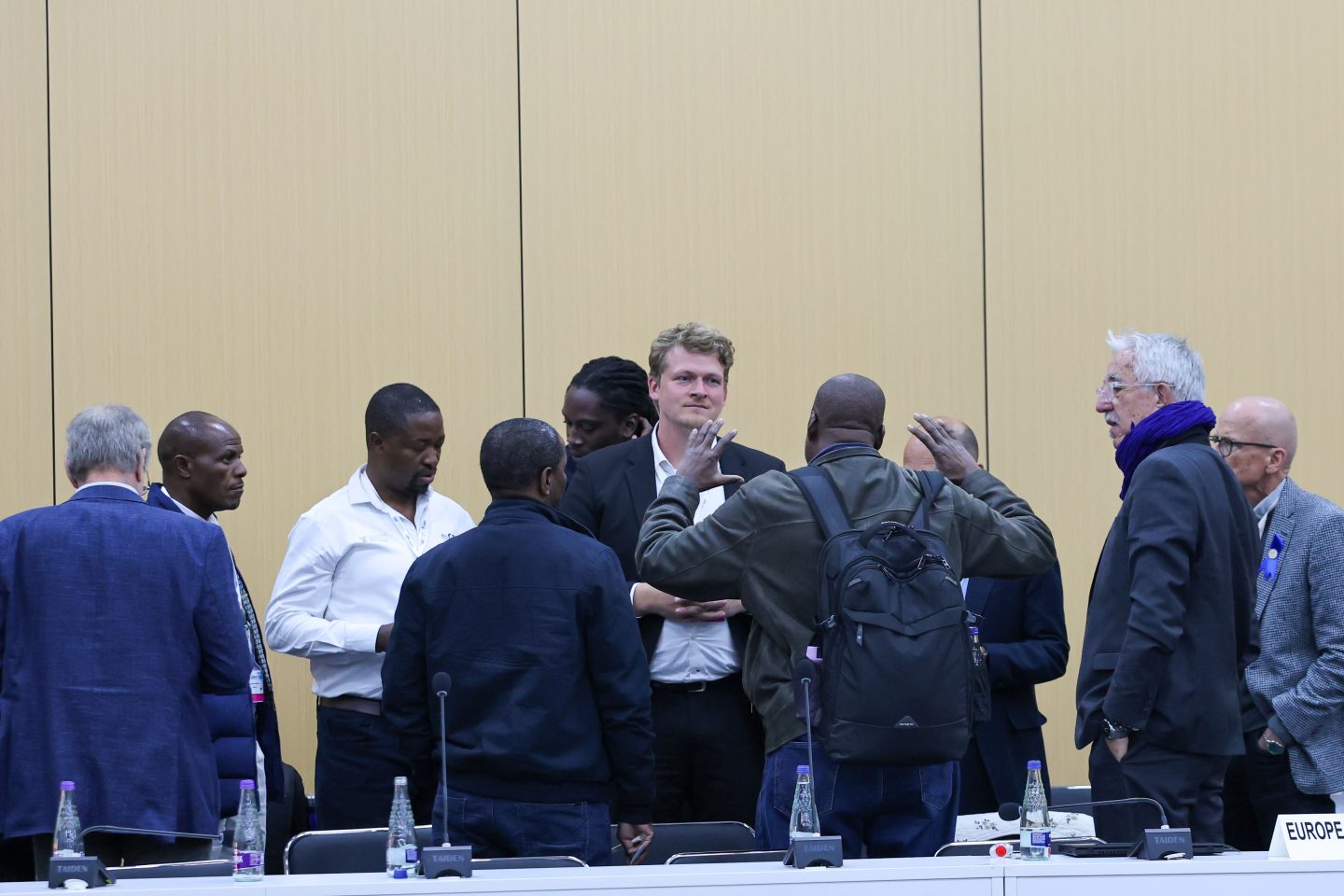
But, in a closing press conference on Friday, the Mongolian minister presiding over talks celebrated that governments had reached consensus on several “contentious” issues and that agenda items blocked at this year’s COP17 would be put on the agenda for COP18 in Egypt.
US blocks agenda items
Other agenda items that divided countries were on measuring land degradation’s effects on women, enhancing the involvement of civil society and women in land COPs, and the UNCCD working more closely and effectively with the UN’s climate and nature conventions.
On the COP’s opening day two weeks ago, the US representative said the Trump government objects to these agenda items “on their premise and no amount of negotiation will allow us to join consensus on these items. As such we request that they be struck from the agenda at which time we will then be able to approve it, saving us valuable negotiating time.”
A US State Department spokesperson later told Climate Home News that the US wants the UN “to get back to basics by refocusing on its core mandate, eliminating overlap, and reducing competition for scarce resources”.
The spokesperson added, “that means prioritising the concrete work member states created [the UN] to do – rather than diverting limited time, attention, and resources toward social and political agendas, including gender-related initiatives.”
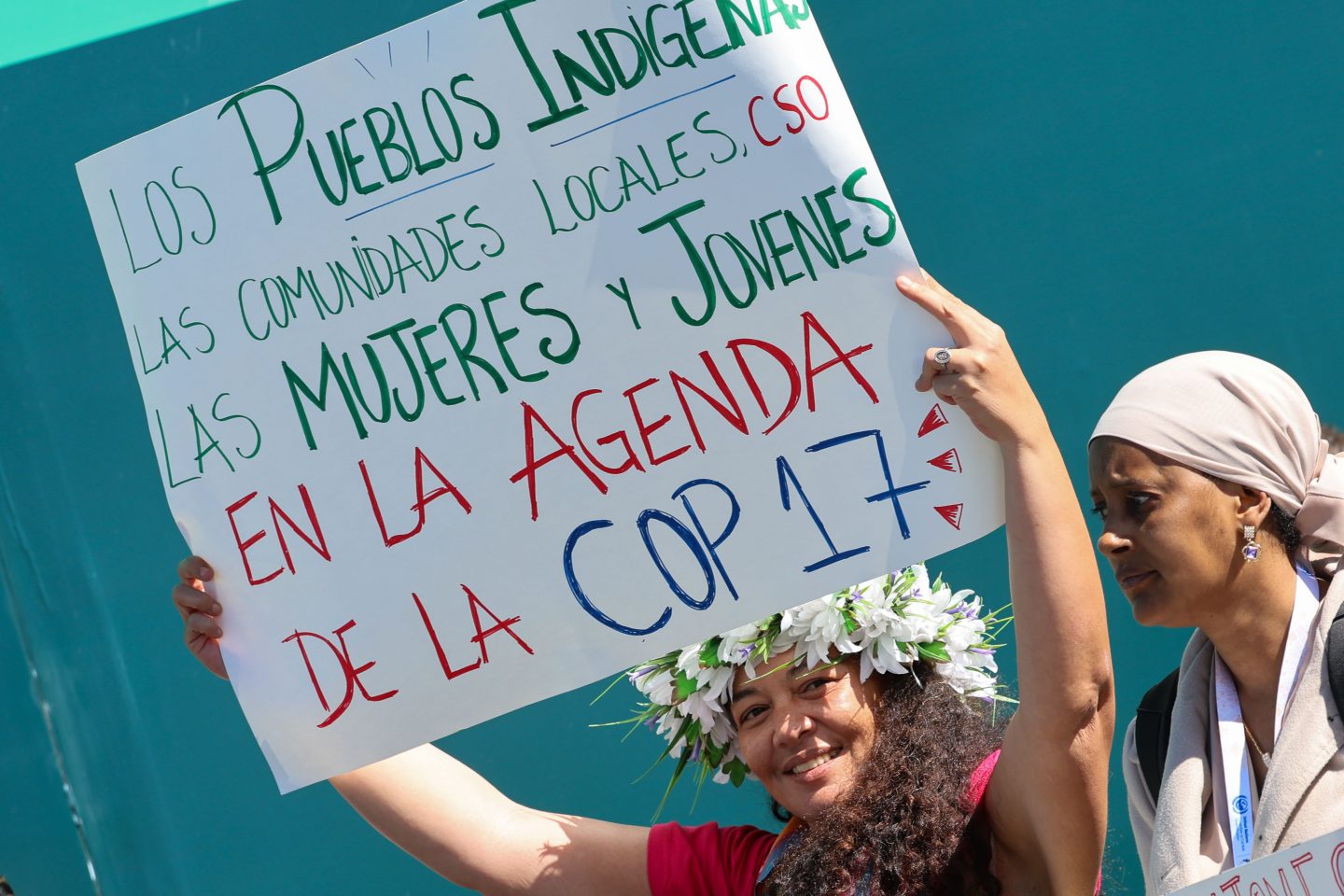
On COP’s first day, the European Union and Brazil pushed back against the blocking of these agenda items, with a Brazilian negotiator saying his country attaches “great importance” to them. But the Mongolian presidency directed governments to adopt the rest of the agenda without the controversial items, which were discussed privately with countries throughout the two weeks.
An EU statement, read out later by Irish minister Timmy Dooley, accused “some parties” (meaning national governments) of having adopted a “less constructive approach” and preventing “discussions on important matters from even commencing”.
The agenda items the US refused to engage with were never discussed and were only placed onto the agenda for the next COP on the last day. Those talks will take place in Egypt in two years’ time, with Donald Trump due then to be in his last year as US president.
No restoration without women
The blocking of the gender agenda item has stymied attempts, agreed on by governments at the last COP, to develop gender-specific indicators for the UNCCD’s next overall framework and to facilitate more women delegates at COPs. Women made up only about a quarter of delegates to COP15 in 2022, UNCCD analysis with the latest data shows
Criticising the move to keep gender off the agenda, the EU said in a statement that it welcomes “the attention being given at COP17 to women pastoralists and herders, recognising their contribution to sustainable land management and resilient rural livelihoods”.
The head of the UNCCD, former Egyptian environment minister Yasmine Fouad, said on Friday that “regardless that the agenda item was blocked”, she was proud that she and COP17 President Batmunkh Battsetseg had led the COP as women and attended the gender caucus (a meeting of groups supporting women at the talks).

“Without the women,” she told the closing press conference on Friday, “we will not be able to restore land, restore hope, restore life or restore even our children and grandchildren. And we will keep on pushing that agenda.”
The civil society agenda item aimed to allow NGOs to attend land COP negotiations, as they do at climate COPs, and included terms of reference for an Indigenous Peoples Caucus.
A representative of Indigenous Peoples told the COP’s closing plenary meeting that the group had “deep disappointment that the agenda of this COP has removed the dedicated space for indigenous peoples”. “We cannot restore the land while removing the voices of those who care for it,” she said.
On Tuesday, the UNCCD’s deputy head Andrea Meza was asked about Indigenous Peoples’ participation. She said that the blocking of “one agenda item” is “generating uncertainty in the progress” towards creating caucuses for Indigenous Peoples and for Local Communities within the talks.
Because of the “complex geopolitical situation” making it hard to obtain consensus, coalitions of the willing have become more important, she added.
Mining out, money in
Outside the formal negotiations, the summit was marked by a focus on the strongly Mongolian issues of the role played by pastoralists and rangelands like grasslands, as well as mining, in both degrading and restoring land.
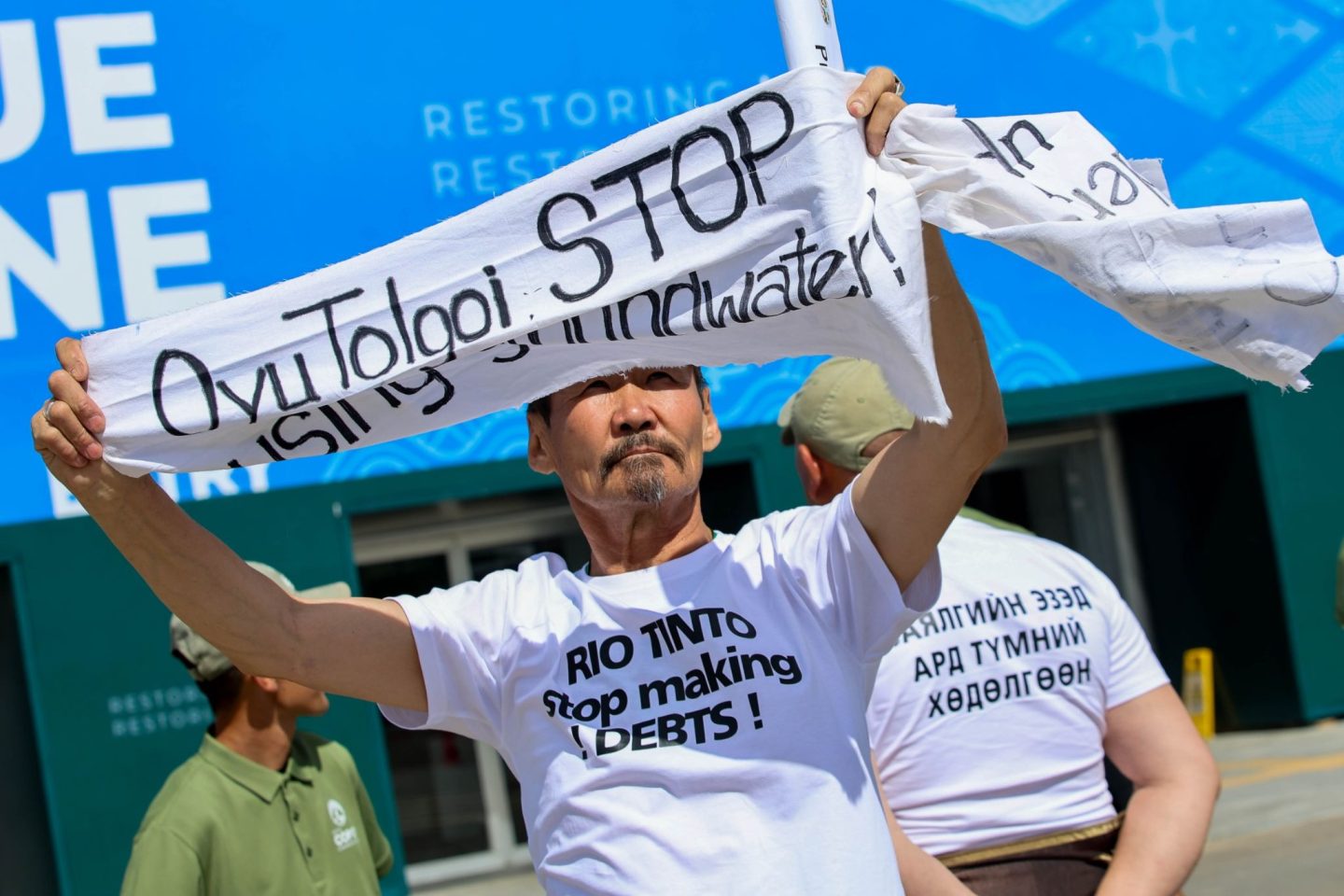
Part of the conference was sponsored by Australian mining company Rio Tinto and its local partner Oyu Tolgoi. Their presence was protested by campaigners wearing T-shirts calling on the companies to “stop wasting drinking water” and to “get out of Mongolia”.
The UNCDD and others praised the success of the summit in raising more finance for land restoration. The COP saw institutions like the Asian Development Bank and Global Environment Facility pledge money to combat land degradation, with the UNCCD estimating that $645 million of new commitments were made.
An estimated $355 billion a year is needed through 2030 to meet global land restoration commitments, compared with around $77 billion currently invested. Private finance accounts for only around 6% of global investment, according to the UNCCD.
UNCCD chief scientist Baron Orr told a press conference that many of the announcements were public-private partnerships that use government money to “even the playing field” for companies that want to protect land, in a bid to ensure they are not disadvantaged compared with those that do not.
Such partnerships are a “huge opportunity”, he said, especially as “we’re not in a moment of public finance – public finance is tight in every country.”
The post Despite African walkout, fractious land COP ends without drought deal appeared first on Climate Home News.
Despite African walkout, fractious land COP ends without drought deal
Burdened by rising fuel import costs and an “ocean crisis” of record-breaking heat, Pacific island nations are seeking to build support for a new regional fund ahead of COP31, intended to channel investment into renewable energy, community resilience and ocean protection, experts said.
Leaders from the 18-member Pacific Islands Forum (PIF), including Australia and New Zealand, are expected to issue a call for global pledges to the Pacific Resilience Facility (PRF) at a high-level meeting this coming week in Palau, seeking to build a new model for financing climate action.
The new regional fund was formally launched in May this year and is meant to “serve communities at a community level”, swiftly channelling investments for their projects on the ground, according to Fiji’s assistant minister for foreign affairs, Lenora Qereqeretabua.
“We are expecting pledges for the PRF, and these funds will go to communities that apply,” she told journalists at an online briefing. “We have organised it in such a way that it makes our application processes much, much easier than applying for global funding.”
Qereqeretabua added that she expects that PRF funds will be “utilised by communities to protect themselves from climate change and the effects of climate change.”
The Pacific Islands Forum meeting is expected to shape the region’s priorities ahead of this year’s pre-COP, hosted by Fiji and Tuvalu, and COP31, which will be co-led by Australia and Türkiye.
At COP31, a dedicated session on the climate finance needs of small island states will seek to drive pledges into the PRF. The fund has so far received about $172 million in capital – with about $67 million coming from Australia – and aims to close the year with $500 million.
-
Battle over cleaning up shipping set to resume at London talks
The US and Saudi Arabia want to scrap shipping’s Net-Zero Framework and have swung behind a far less ambitious alternative -
As marine heat breaks records, countries seek ocean roadmap at COP31
Africa and the EU are leading a push for COP31 to deliver a roadmap that lays out measures to protect fast-warming oceans -
Indonesia’s nickel production cuts are not enough to create a sustainable industry
The government is restricting nickel production to push up prices but producing more sustainable nickel for a premium requires addressing the industry’s coal issue


Ocean heat and fossil fuel shocks
Leaders from the Pacific will meet in Palau from Sunday amid an “ocean crisis” of record-breaking ocean heat caused by this year’s “super El Niño”, according to Kevin Chand, Pacific ocean policy director at National Geographic’s Pristine Seas conservation project.
Leaders at the PIF are expected to put forward commitments towards new marine protected areas, which will be key for shielding ecosystems from future climate extremes, Chand said. The forum is expected to issue a statement on the need for ocean action at COP31, and announce commitments towards reaching the global goal of protecting 30% of the planet’s land and sea ecosystems by 2030.
Rising ocean heat could lead to food insecurity and lost government earnings in the region, as key fish stocks like tuna start migrating away from their coastline in search of colder waters, said Coral Pasisi, director of climate change and sustainability at the Pacific Community (SPC).
Climate shocks are deepening existing economic pressures, as Pacific nations have spent up to a quarter of their GDP on fossil fuel imports due to the war in Iran, according to a recent report by the University of New South Wales (UNSW) in Australia.
Wesley Morgan, one of the study’s authors, told journalists that partner nations “ought to be putting their money where their mouth is”, and should support the energy transition in the Pacific by covering the upfront costs of switching from polluting diesel to solar power, batteries and electricity grid upgrades.
China keeps Indonesia’s battery dream afloat but future less certain
Given the increase in climate-related shocks and sea-level rise, the PIF should also mention the need to phase out fossil fuel extraction and consumption, said Sindra Sharma, international policy lead at the Pacific Islands Climate Action Network (PICAN).
Last year’s COP30 failed to deliver a global roadmap on transitioning away from fossil fuels, which led to a group of countries – including several Pacific island nations – pursuing their own fossil fuel phase-out summit in Santa Marta, Colombia. Next year’s conference will be hosted by Tuvalu and co-chaired by Ireland, which should also receive backing from the PIF, Sharma said.
Both the chairs of the Santa Marta coalition and the Australian COP31 co-presidency have vowed to continue a push for this topic to be discussed at COP31.

New fund to test allies
As local communities in the Pacific struggle to access global climate funds, the PRF’s planned model for quick, direct disbursements has “very solid and good” intentions, Sharma said, but it will need political and financial backing from donor countries.
“The proof is going to be when the fund actually starts operating and delivering to communities,” she added. “If there is too much bureaucracy in being able to access the funds, for example. These things will have to be scrutinised.”
The facility aims to deliver funds in two categories: one for climate adaptation and “disaster resilience”, and another for social and community resilience that includes areas like community capacity-building, education, data analytics and financial management, among others. It will launch its first call for proposals at the PIF.
Morgan added that Australia will need to “leverage global interests” so that funding is directed to the Pacific Resilience Facility “or else the Pacific won’t be able to trust Australia as a partner”. The country ratified the PRF treaty in May, triggering its entry into force.
“The perception [of Australia] in the region is genuinely divided, and it’s worth being honest about it,” Sharma said, adding that the pre-COP31 in Fiji, which is usually limited to a technical space for negotiations, will determine how meaningful Australia’s advocacy for the Pacific can be.
This time, Pacific nations want to use the pre-COP in early October as an opportunity to demonstrate the challenges their largely low-lying islands face and to advocate for their political priorities, including a renewed global effort to limit global warming to 1.5C by cutting emissions faster and deeper. World leaders are due to visit Tuvalu to experience the frontline of rising sea levels, although Australia and Fiji have yet to confirm who will attend.
“In Bonn, Australia was largely missing on the negotiated outcomes that we so urgently need to see. It’s not enough to get Pacific priorities on the agenda. Agenda placement is not delivery,” Sharma added.
The post Pacific islands seek backing for new regional fund ahead of COP31 appeared first on Climate Home News.
Pacific islands seek backing for new regional fund ahead of COP31
Climate Change
Climate change exposes 580 million children to 20 extra ‘heat-stress days’ every year
More than 40% of children under the age of 10 globally are already experiencing at least 20 additional “heat-stress days” due to climate change.
This is according to a new attribution study, published in Science Advances, which combines climate models with demographic data to assess the age groups and regions that are exposed to the most hot, humid days.
The study finds that children up to the age of nine already face more additional heat-stress days globally as a result of climate change than any other age group.
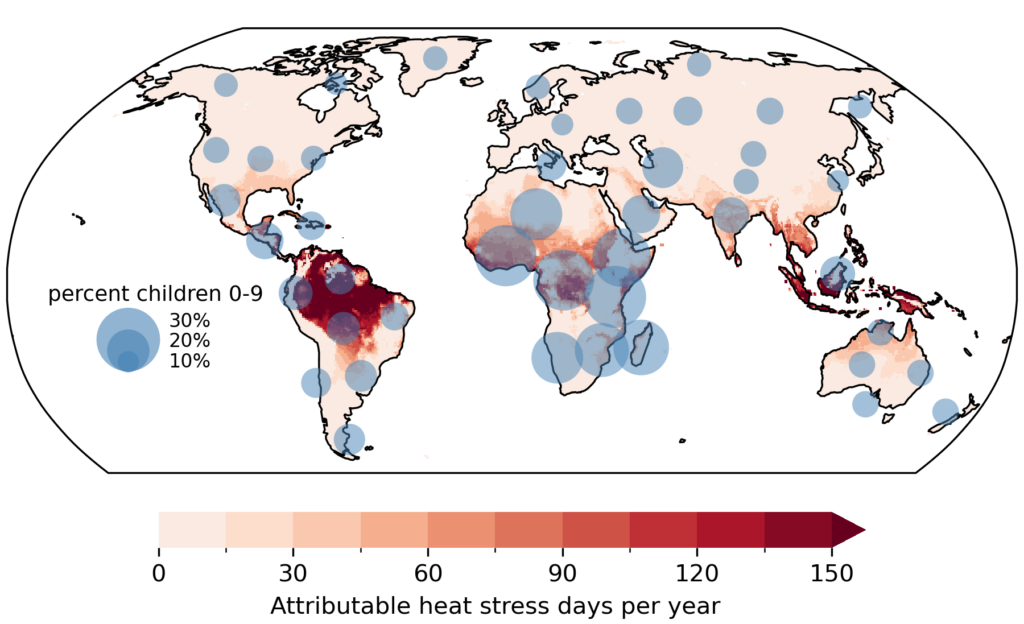
It adds that south Asia and west Africa are recording the greatest childhood exposure to dangerous levels of humid heat – largely because these regions have a rapidly growing population with the highest proportion of young children.
As the climate warms, children will continue to be more exposed to heat stress than any other age group, the paper warns.
The lead author of the study tells Carbon Brief that the findings should inform discussions about climate justice, noting that children in developing countries “have contributed the least to historical greenhouse gas emissions”.
Humid heat
High temperatures can be deadly. For example, the heatwaves that swept across Europe in the summer of 2026 have been linked to tens of thousands of “excess deaths”.
A prominent 2021 study found that children born in the 21st century will be exposed to more extreme weather events in their lifetimes than their parents and grandparents.
Four years later, a study conducted by scientists from the same team found that more than half of children born in 2020 – around 62 million people – will experience “unprecedented lifetime exposure” to heatwaves, even if warming is limited to 1.5C.
Now, the latest research from the same team finds that children already face greater exposure to dangerous levels of humid heat than adults as a result of human-caused climate change.
Extreme heat is particularly dangerous when combined with high humidity. In hot weather, the human body produces sweat to cool itself down. However, as humidity increases, sweating becomes less effective.
The study uses wet-bulb globe temperature – a measure of temperature that takes humidity and wind into account – to calculate heat stress. It defines a “heat-stress day” as any day with a wet-bulb globe temperature above 28C, as this is considered the threshold for “moderate heat stress”
The authors then use climate models to simulate global temperature patterns in the present-day climate. (The authors use the climate of 2023, in which human activity has caused 1.3C of warming, to represent the “present-day”.)
They then count the number of heat-stress days that each country records on average, per year. The authors then repeat this exercise, simulating a pre-industrial climate without human-caused warming.
By comparing the number of heat-stress days in the present-day climate with the number in a pre-industrial climate, the authors can determine how many extra heat-stress days were driven by climate change. They refer to these as “extra” or “attributable” heat-stress days.
The authors find that “low-latitude” countries, located in the tropics, record the most extra heat-stress days.
For example, the paper finds that people living in Côte d’Ivoire currently face 112 heat-stress days every year. It adds that around half of these are due to human-caused climate change.
In contrast, Germany sees only 0.1 heat-stress days per year in today’s climate on average, which is largely attributable to human-caused climate change.
Rosa Pietroiusti, a PhD student at Vrije Universiteit Brussel and lead author on the study, explains why this number may seem lower than expected.
She tells Carbon Brief that the paper “really focuses on humid heat, at levels that are relatively rarely felt in Europe”. She adds:
“Our data also doesn’t capture the urban heat island effect, due to the resolution of the data we use, which also would lead to underestimations of heat stress locally, and lead to a mismatch with what people are experiencing at local scales, particularly in cities.”
Inequality
Extreme heat affects some people more severely than others. Children, people over 65 and those with pre-existing medical conditions or certain disabilities are among the most vulnerable. This is because their bodies are less able to regulate their temperature.
The authors use gridded demographic data to determine the age structure of each country. From this, they calculate how many people from each age cohort are exposed to extra heat days as a result of climate change.
The research finds that globally, 583 million children under the age of 10 already live through at least 20 attributable heat days every year. This accounts for 44% of all children in this age bracket.
In comparison, 190 million people aged 60-69 face at least 20 attributable heat days per year, accounting for 30% of this age cohort.
The authors find that children face the greatest exposure to humid heat for two main reasons.
First, there are more young people alive today than older people, with 1.3 billion children aged under 10 in the world, compared to 0.6 billion people aged 60-69.
Second, they find that countries in Africa and Asia typically have rapidly growing populations with more young children. In contrast, many countries in the northern hemisphere – which are typically cooler – have older populations.
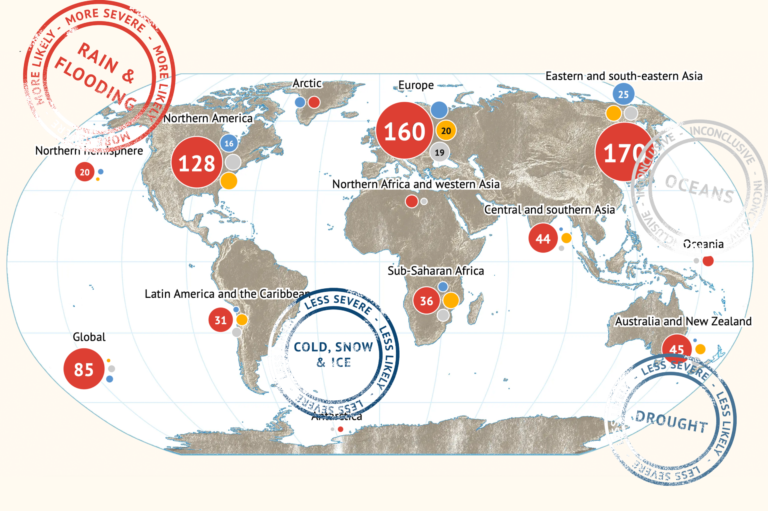
The map below shows how many extra stress heat days each country currently faces as a result of human-caused climate change. Darker reds indicate a higher number of attributable heat days. The blue circles show the percentage of the population under the age of 10, with larger circles indicating a higher percentage.
Warming world
The authors also repeat their analysis for a 1.5C and 2C warmer world. They use population estimates from the SSP2 scenario, which projects that the world’s population will peak at more than nine billion in the second half of the 21st century, with most growth occurring in low-latitude regions – especially in sub-Saharan Africa.
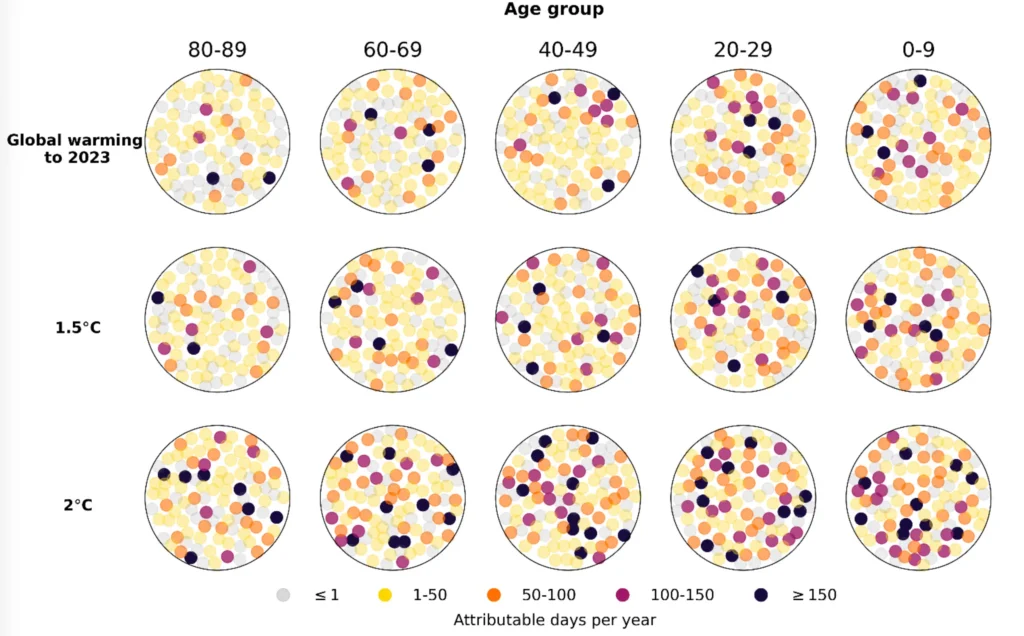
The research finds that, in today’s climate, 11% of all under 10s currently experience 100 or more extra heat-stress days per year due to climate change. In worlds warmed by 1.5C and 2C, the percentage rises to 13% and 23%, respectively.
In contrast, only 6% of all people aged 60-69 currently face 100 or more extra heat-stress days each year due to climate change. This number rises to 9% and 17% for 1.5C and 2C worlds, respectively.
These results are shown in the plot below. The three rows represent the climates of 2023 (top), a 1.5C world (middle) and a 2C world (bottom). The columns show different age cohorts, from the oldest on the left to the youngest on the right.
Each circle contains 100 coloured dots, with each dot representing 1% of the age cohort.
The colour of the dot represents exposure to annual heat-stress day, with darker dots indicating more heat-stress days. Grey dots mean that people experience fewer than one extra heat-stress day per year due to human-caused climate change, while black dots mean more than 150 extra heat-stress days due to climate change.
The figure shows that higher warming levels expose more people to heat stress and that younger cohorts tend to be worst affected.
For example, the top-right circle represents heat stress for under 10s in the present-day climate. Three of these dots are coloured black, indicating that 3% faced at least 150 attributable heat-stress days in 2023.
Pietroiusti tells Carbon Brief the study uses wet-bulb temperature because it is a “well-established heat stress metric”. However, she notes that it was not “explicitly defined to focus on children”. She continues:
“A really important step forward in the research community would be to link up climate science and health science experts to do research on what metrics are really most representative of, for example, health impacts and educational impacts that children will be suffering.”
Vulnerability
Dr Qinqin Kong, a postdoctoral researcher at the departments of medicine and health policy at Stanford University, who was not involved in the study, praises its “robust” methodology.
He tells Carbon Brief that the research provides “a timely quantitative evidence for discussions of climate justice, children’s rights and intergenerational equity”.
However, Kong suggests that the paper “may overstate the contrast between children and the elderly and underestimate the relative burden of older adults”.
He says:
“The elderly may also be more vulnerable due to their social circumstances. Children often benefit from parental supervision and caregiving, whereas many older adults live alone, have limited mobility and face barriers to accessing cooling or emergency assistance during heat events.”
Kong also notes that “people and societies in the mid-latitudes [for example, across much of Europe and North America] are less adapted to heat”, which may make them vulnerable to its impacts.
For example, he says that Europe “shows substantially stronger relative risk of heat mortality likely due to less heat-acclimatised populations, lower air conditioning prevalence and urban designs that don’t favour heat dissipation”.
Similarly, Dr Daniel Vecellio – a researcher at the University of Nebraska, who was not involved in the study – tells Carbon Brief that children are an “understudied cohort”.
However, he says there is “reason for hope” because “children are typically pretty good behavioural adapters to extreme heat” and because people who are “chronically exposed to extreme heat” will “have a better chance at better acclimatisation”.
Pietroiusti tells Carbon Brief that global reporting on heatwaves is often skewed towards wealthier nations.
For example, she notes that large-scale databases of disasters, such as EM-DAT, often underrepresent heatwaves in Africa, due in part to a lack of news coverage and formal reporting. She adds:
“Studies like this, which start from the climate data, can start to fill some of these gaps.”
She adds that the paper should inform discussions about climate justice, noting that children in developing countries, who are most severely affected by the increase in heat-stress days, “have contributed the least to historical greenhouse gas emissions”.
Pietroiusti, R. et al. (2026) Age-specific exposure to human-induced increases in humid heat, Science Advances, doi:10.1126/sciadv.aeb3232


The post Climate change exposes 580 million children to 20 extra ‘heat-stress days’ every year appeared first on Carbon Brief.
Climate change exposes 580 million children to 20 extra ‘heat-stress days’ every year



-
Climate Change1 year ago
Guest post: Why China is still building new coal – and when it might stop
-
Greenhouse Gases1 year ago
Guest post: Why China is still building new coal – and when it might stop
-

 Greenhouse Gases2 years ago
嘉宾来稿:满足中国增长的用电需求 光伏加储能“比新建煤电更实惠”
-

 Climate Change2 years ago
嘉宾来稿:满足中国增长的用电需求 光伏加储能“比新建煤电更实惠”
-
Climate Change2 years ago
Bill Discounting Climate Change in Florida’s Energy Policy Awaits DeSantis’ Approval
-

 Renewable Energy10 months ago
Sending Progressive Philanthropist George Soros to Prison?
-
Greenhouse Gases1 year ago
嘉宾来稿:探究火山喷发如何影响气候预测
-

 Carbon Footprint2 years ago
US SEC’s Climate Disclosure Rules Spur Renewed Interest in Carbon Credits