

Welcome to Carbon Brief’s China Briefing.
Carbon Brief handpicks and explains the most important climate and energy stories from China over the past fortnight. Subscribe for free here.
Key developments
Clean-energy industry drives China growth in 2023
CLEANTECH BOOM: New analysis for Carbon Brief found that clean-energy sectors – spanning low-carbon power, grids, energy storage, electric vehicles (EVs) and railways – contributed 11.4tn yuan ($1.6tn) to China’s economy in 2023, accounting for “all of the growth in Chinese investment and a larger share of economic growth than any other part of the economy”. This was driven, in particular, by the “new three” industries of solar power, EVs and batteries. Investment totalled 6.3tn yuan ($890bn), growing 40% year-on-year and almost equalling all global investments in fossil fuel supply last year – or the entire economies of Switzerland or Turkey.
GDP BOOST: Clean-energy sectors accounted for 40% of the expansion of GDP in 2023, the analysis showed. Without this contribution, China’s GDP would have risen only by 3% instead of 5.2% – well below the growth target set for 2023. This makes the industry not only crucial for China’s energy transition, but also for “broader economic and industrial” development, found the analysis.
OVERCAPACITY CONCERNS: However, the analysis continued, “the spectre of overcapacity means China’s clean-energy investment growth…cannot continue indefinitely”, adding that “the manufacturing expansion has already saturated most of the global market”. In related news, Jiemian reported exports of the “new three” industries reached more than 1tn yuan ($141bn). This has seen the EU, among others, take steps to support their own clean-energy industries, reported Agence France-Presse, adding that Chinese premier Li Qiang recently held “frank” talks with European Commission president Ursula von der Leyen on trade imbalances.
China relaunched voluntary carbon market
RESUMED TRADING: State-run broadcaster CCTV reported that China’s voluntary carbon-trading system, the China Certified Emission Reduction (CCER) programme, resumed trading on 22 January. CCER’s relaunch “marks the completion of China’s domestic carbon-market architecture”, the broadcaster added. Beijing News described CCER as an “institutional innovation to mobilise the power of the whole society to participate in greenhouse gas emission reduction actions”.
NEW CREDITS?: Economic outlet Jiemian said that CCER project registration was suspended in 2017. It reported that “preparation on the policy end” for restarting issuance of carbon credits under the scheme is “almost complete”, pending the “state administration for market regulation (SAMR)…releas[ing] the list of recognised validation and verification institutions”. The scale of new CCER issuance is predicted to be between tens of millions to 100m tonnes per year, according to one analyst, the newspaper adds.
INCLUDED SCOPE: Finance news outlet EastMoney reported that the greenhouse gas trading under the scheme is primarily open to enterprises or institutions in four major sectors: “afforestation carbon sinks, grid-connected solar-thermal power generation, grid-connected offshore wind power generation and mangrove plantation”. It may in future allow individuals “to sell carbon emissions generated from green behaviours under the CCER scheme…as the trading mechanism matures”, according to the South China Morning Post.
Tasks, measures and timelines for ‘Beautiful China’
BEAUTIFUL CHINA: The top bodies of the Chinese government and governing Communist party – the state council and the central committee, respectively – issued the full text of new instructions on “comprehensively promoting the construction of a Beautiful China” in a 27 December official release, published by state news agency Xinhua on 11 January. The Beautiful China initiative is a “top-level development blueprint detailing specific targets for…the nation’s green and high-quality growth”, another Xinhua report explained. ClientEarth’s Dimitri De Boer wrote in China Dialogue that the initiative “ties a good environment to a sense of national pride”.
KEY GOALS: The document outlined a slew of tasks, measures and timelines within China’s overall push to peak its carbon emissions before 2030 and reach carbon neutrality by 2060. By 2027, “green and low-carbon development” will be “further promoted”, it said. By 2035, “green production methods and lifestyles will be widely formed”. By the middle of the century, “ecological civilisation will be comprehensively upgraded…[with] deep decarbonisation achieved in key areas”. Goals listed in the document include: the country will compile an annual national greenhouse gas inventory; “gradually shift” to “dual control” of carbon emissions; protect more than 3.15m square kilometres of land from being eligible for development projects under the national ecological “red line” policy; ensure China’s cities become “waste-free” by 2035; and see new energy vehicles (NEVs, mostly electric vehicles) comprise around 45% of new cars by 2027.
OFFICIAL COMMENT: The document was passed in a meeting chaired by Chinese president Xi Jinping, who said that “building a Beautiful China is an important goal for building a modern socialist country”, the state-run China Daily reported – giving the document more weight and signalling to officials that China’s carbon-neutrality goals remain an important target. Adding to the momentum, following its publication, Sun Jinlong and Huang Runqiu – the Communist party secretary and the minister at the ministry of ecology and environment (MEE), respectively – wrote an opinion piece in the Communist party-backed newspaper People’s Daily saying that the document “clearly defines the overall requirements, key tasks and major initiatives” guiding the Beautiful China initiative. In an interview with Xinhua, a senior official of the MEE said incentives and policy measures could “mobilise enthusiasm, initiative and creativity” to build a Beautiful China.
US and China climate envoys step down
KERRY RETIRES: US climate envoy John Kerry plans to retire from his role in the next few months, in order “to help President Biden’s [re-election] campaign”, Axios reported. In stepping back from “a major diplomatic role that was created especially for him”, the New York Times reported, Kerry casts the position into “an uncertain future”. The fact that he has chosen to do so following the retirement of Chinese climate envoy Xie Zhenhua “[raises] concerns about what climate diplomacy will look [like]” without their cooperative personal dynamic, it added.
END OF AN ERA: Xie and Kerry “have a close personal relationship”, Climate Home News reported, adding that “Xie’s return from retirement in 2021 was widely interpreted as a response to Kerry’s appointment [to the climate envoy role]”. “If Kerry and Xie weren’t in office…there’s no way we’d be even close to where we’re at,” the Financial Times quoted Jake Schmidt, a senior director at thinktank NRDC, saying. It also reported that Kerry said he and Xie were “doing all we can to stay in very close touch; and he and I will continue to work in respective institutions [to forge collaboration on climate change]”.
NEW BLOOD: Career diplomat Liu Zhenmin – profiled in Carbon Brief’s DeBriefed newsletter – will become China’s new climate envoy, Reuters reported. The newswire added that Liu has “long experience in climate diplomacy”, participating in both the Kyoto Protocol and Paris Agreement negotiations. Liu “was a key driver in landing the Kyoto Protocol”, Greenpeace East Asia chief China representative Yuan Ying told Carbon Brief, which is “a promising piece of experience”. However, Climate Home News quoted an anonymous analyst as saying “many experts wanted someone from the environment ministry appointed”, as “[the foreign ministry] approaches climate as a card in US-China [manoeuvring]” instead of seeing it “as a real issue that needs to be solved”.
Spotlight
Interview with Prof Zou Ji, CEO and president of the Energy Foundation China

At COP28, Carbon Brief sat down with Prof Zou Ji, CEO and president of the Energy Foundation China, to discuss China’s energy transition.
Prof Zou previously served as a deputy director-general of China’s National Center for Climate Change Strategy and International Cooperation.
He was part of China’s negotiation team for the Paris Agreement and a lead author of several Intergovernmental Panel on Climate Change assessment reports.
Below are highlights from the wide-ranging conversation, covering China’s stance on coal, renewables, issues-based alliances and more. The full interview will be published on the Carbon Brief website soon.
China’s decisions at COP28
On signing pledges at COP: “If you look at the whole history of the COP…I do not [remember] China joining any alliances. I have never seen that…As a party, China [is only concerned with] official procedures, waiting for a legal framework of the UNFCCC or the Paris Agreement.”
On why China did not join the pledge to triple renewables and double efficiency: “[Before COP28] we have not seen [it laid out] very clearly which year should be the base year [from which tripling renewables should be calculated]. Should it be 2020? Should it be 2022? This might seem to be technical but, [in] the past two years, global development of renewables, especially in China, [have been significantly boosted, and so]…the difference in targets might be very significant.”
On China’s commitment to decarbonisation: “If you look back at history, there have been very few cases that show China [first making] and then [giving up] a commitment. This is not the political culture in China.”
The future of coal
On fossil fuel phaseout: “I would like to see…[China] very quickly enlarging its renewable capacity. Only if [there is] adequate capacity and generation of renewables can this lead to a real phasing out or phasing down of fossil fuels.”
On others’ views of required coal capacity: “Even though China will reach its [2060] carbon neutrality target, it will continue to have to maintain 600 gigawatts of coal-fired power plant capacity. These are the sort of estimations [we’re working with now].” (Prof Zou disagrees with this, believing that renewables growth, better grid connectivity and increased energy storage capacity should reduce the need for such a large amount of coal capacity.)
On the need for CCUS: “In some sectors, like, for example, iron and steel, cement, chemicals and petrochemicals, we do need carbon capture, utilisation and storage (CCUS), because it is very difficult to phase out coal or carbon dioxide [completely].”
On CCUS in the power sector: “I have mixed feelings about CCUS for the power sector. I have an ideal vision that we can reach real zero emissions in these sectors through a more developed grid system, with more connectivity across provinces or regions and the use of AI technology.”
Transitioning to renewable energy
On ensuring more renewables uptake: “We have raised the share of renewable power generation from seven, eight, nine per cent to today’s 16%. This is progress, but it is not quick enough or large enough. We want to push the grid companies…to do more and do it faster.”
On the power of distributed solar: “We should also consider…creat[ing] another, totally new power system. This would be a sort of nexus of a centralised and decentralised grid system…If [the central grid] is having difficulties [increasing renewable generation], and if these are very challenging to overcome, then let’s [shift] to a lot of microgrids.”
On distributed solar growth: “Today, the share of distributed [renewables] is still lower than centralised renewables. But the incremental [distributed] renewables growth has become higher than growth of centralised renewables in the past year or two, and I would assume this will remain a trend in the future.”
Measuring energy use
On China’s electricity consumption: “For low-income level groups, although their income has not grown very much, their consumption preferences and mindsets – especially for younger generations of consumers – mean they are more willing to use electricity [than previous generations].”
On comparisons of China to the EU and US: “There is a structural [difference] compared to the [energy mix] in Europe and the US. The majority of energy use [in China] has been for industrial production, rather than for residential [use]…In China, the average power consumption per capita is around 6,000 kilowatt-hours (kWh), compared to 8,000kWh in Europe and over 12,000kWh in the US.”
On energy efficiency: “Physically, I think China has become better and better [in terms of] its efficiency, but, economically, this cannot produce as high a value-add as Europe and the US in monetary terms.”
On challenges calculating carbon intensity: “The raising of interest rates by the US Federal Reserve makes US dollars more expensive, increasing foreign exchange rates which then enlarges the monetary GDP gap making Chinese GDP [in dollar terms] fall, and carbon intensity rise.”
Watch, read, listen
FOSSIL FUEL HIGHS: Clyde Russell, Asia commodities and energy columnist at Reuters, wrote that, although China’s crude oil and coal imports “all soared to record highs in 2023”, crude oil is likely being added to inventories rather than being used, while the spike in coal is a temporary response to hydropower shortages.
ROSEWOOD DEFORESTATION: The China-Global South Project spoke to Ma Haibing, Asia policy specialist at the Environmental Investigation Agency, about illegal harvesting of rosewood by Chinese traders in the “rapidly shrinking forests” of west Africa.
GREEN SHOOTS: Yicai interviewed Zhang Xiaoqiang, executive vice-president of the China Center for International Economic Exchanges (CCIEE), on prospects for “green” development in China in 2024, the growth of renewables, cross-provincial power transmission and other topics.
ANTARCTIC RESEARCH: CCTV broadcasted a short news report on the progress of the 40th Chinese Antarctic research expedition in building China’s newest research station in Antarctica.
New science
Drought-related wildfire accounts for one-third of the forest wildfires in subtropical China
Agricultural and Forest Meteorology
A new study found that “drought plays a dominant role” in wildfires in subtropical China, adding that “from 2001 to 2020, excess wildfires caused by drought accounted for approximately 31% of the total number of forest fire points during the fire season (November to May)”. As the drying trend caused by climate change intensifies, wildfires will “show different patterns due to the large differences in the sensitivity of wildfire to drought in subtropical China”, it added.
Bulletin of the American Meteorological Society
Human-caused climate change made the August 2022 heatwave in southern China 50% hotter than it would have been without global warming, according to new research. The heatwave, the researchers noted, was “extraordinary and unprecedented”, being the “longest-lasting and most intense [China has seen] since 1961”. The study also found that, although it was focused on southern China, “the main conclusions also apply to the eastern Tibetan plateau”.
Potential for CO2 storage in shale basins in China
International Journal of Greenhouse Gas Control
Researchers used the latest data to calculate new “potentials of [carbon dioxide (CO2)] storage in major shale gas/oil basins in China”, driven by the fact that China, as the second largest shale gas and oil producing country, possesses “large and significant” shale basins. They found that China could sequester approximately 6,194bn tonnes of CO2 in shale basins, equivalent to 620 years’ of China’s projected carbon emissions.
China Briefing is compiled by Anika Patel and edited by Wanyuan Song and Simon Evans. Please send tips and feedback to china@carbonbrief.org
The post China Briefing 25 January: Clean energy drives growth; ‘Beautiful China’ instructions; Interview with EFC’s Prof Zou Ji appeared first on Carbon Brief.

Some 58% of countries have met a UN call to submit new pledges on addressing nature loss – two years after the original deadline – according to Carbon Brief analysis.
Countries were asked to submit new pledges, known as national biodiversity strategies and action plans (NBSAPs), by the start of the COP16 biodiversity summit in October 2024.
After only 15% of nations met the original deadline, countries agreed at the summit to a new text that “urges” countries to release their NBSAPs “as soon as possible”.
Carbon Brief analysis shows that 113 countries have now come forward with new NBSAPs – up from 55 nations a year ago.
Countries will gather in Yerevan, Armenia, next week for COP17.
COP17 marks the halfway point of the Kunming-Montreal Global Biodiversity Framework (GBF), a landmark agreement made in 2022 to reverse nature decline by 2030.
The summit will provide the stage for the first global review of countries’ progress towards meeting the targets of the GBF.
Global review
In Montreal, Canada, in 2022, nearly every country in the world agreed to the GBF. The overall “mission” of the framework is to “halt and reverse” biodiversity loss by 2030.
The GBF includes a list of 23 targets for 2030. They cover an expansive range of topics, including restoring ecosystems, addressing climate change and providing developing nations with finance to help cover the costs of protecting nature.
As part of the GBF and its underlying documents, countries agreed to a schedule for monitoring their progress towards achieving the 2030 targets.
This included the preparation of a “global report” of progress coordinated by the UN, which will inform a “global review” undertaken by countries at COP17.
The global report draws on countries’ NBSAPs and national targets. It also draws on countries’ seventh national reports, which were due to be submitted to the UN in February of this year.
Carbon Brief analysis shows that 113 out of 196 parties (58%) have now met the call to produce a new NBSAP – up from 55 nations just a year ago.
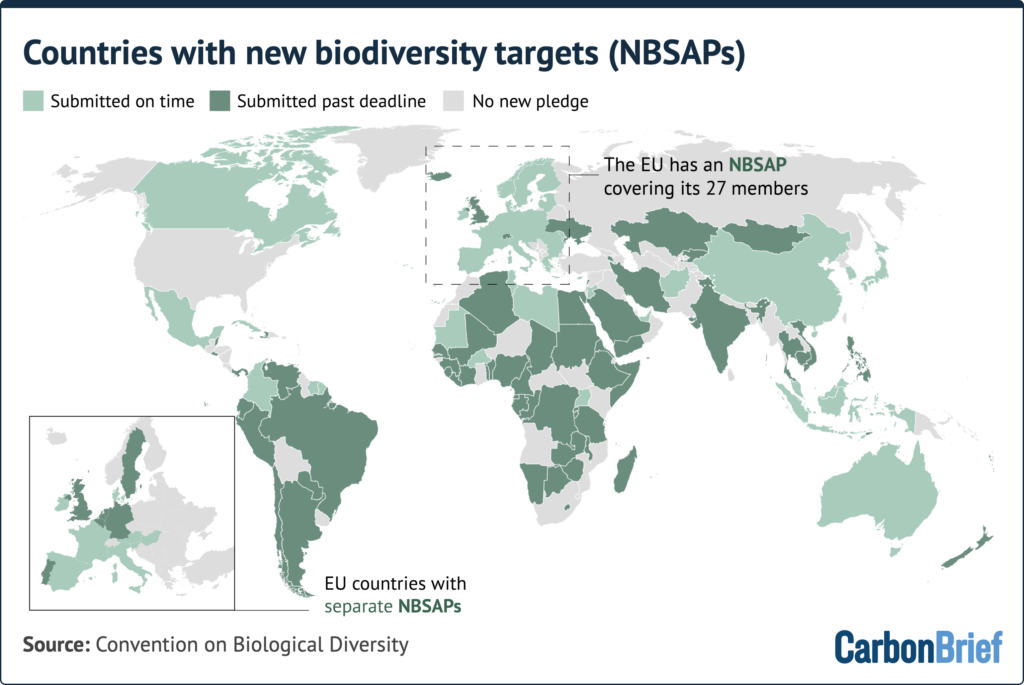
Since last year, many African nations have now published new NBSAPs.
African countries that have released new plans in the last year include: Algeria, Benin, Botswana, Cameroon, Comoros, Congo, Côte d’Ivoire, the Democratic Republic of Congo, Egypt, Equatorial Guinea, Eritrea, Ethiopia, Gabon, Gambia, Guinea, Lesotho, Liberia, Madagascar, Malawi, Mali, Namibia, Rwanda, Senegal, Sierra Leone, Somalia, Sudan, Zambia and Zimbabwe.
More South American nations have also published new NBSAPs. This includes Brazil – the world’s most biodiverse nation – as well as Belize and Chile.
COP17 host nation Armenia published its new NBSAP in April.
According to the GBF and its underlying documents, countries that were “not in a position” to meet the deadline to submit NBSAPs ahead of COP16 were requested to instead submit national targets.
Unlike NBSAPs, national targets simply list biodiversity goals that countries will aim for, without an accompanying plan for how they will be achieved.
Four of the world’s megadiverse nations – countries that account for the majority of Earth’s species – have not yet published new NBSAPs. These countries are Papua New Guinea, Peru, South Africa and the US.
The US is the only UN member country that is not a signatory to the UN Convention on Biological Diversity.
The country with the most land on Earth, Russia, has also not produced a new NBSAP.
By the end of COP16, some 119 parties had produced at least one national target. Two years later, this figure has risen to 175, or 89% of countries.
In addition, around half of countries met the deadline to produce their seventh national reports by February of this year. This figure has now risen to 73% of countries.
Over the past two years, many developing countries have expressed concerns that a lack of available funding has prevented them from publishing their NBSAPs.
A spokesperson for the Global Environment Facility (GEF), the multilateral fund that provides funding to help with the preparation of NBSAPs, told Carbon Brief in 2025 that 120 out of 139 countries that had requested financial support since COP16 had been able to access it.
The spokesperson added that the UN Environment Programme was “working to resolve outstanding issues” to allow the remaining 19 countries to access financial assistance.
Related



The post COP17: Which countries have released new pledges to tackle nature loss? appeared first on Carbon Brief.
COP17: Which countries have released new pledges to tackle nature loss?
The World Bank president said on Friday his organisation will continue to support some gas projects in developing countries alongside renewables, nuclear and hydropower, despite criticism from climate campaigners who say fossil gas is expensive and polluting.
“Homes, mines, factories, farms, and growing cities – what do they need? Reliable, affordable baseload power,” Ajay Banga told the bank’s annual meeting in Bangkok on Friday. “Our approach is balanced by design – a full mix of renewables, hydro, gas where appropriate, nuclear when it makes sense, transmission, grids, storage – the whole thing.”
His comments come in a week during which he faced pressure from the US to finance more gas projects and from climate campaigners to stop funding fossil fuels altogether, part of a tightrope he has walked on the bank’s climate policy since Donald Trump’s re-election in 2025.
The bank ended its support for coal around ten years ago and last year, for the first time, funded no oil projects. It has ended support for gas exploration but still backs some projects to do with transporting and using gas, such as a $140-million project to help Benin, Côte d’Ivoire and Togo in West Africa to import liquefied natural gas (LNG).