


- Formal negotiations
- Finance
- Global review
- Global report
- Digital sequence information
- Harmful subsidies
- Marine biodiversity
- Planning, monitoring, reporting and review
- Article 8(j) implementation
- Biodiversity and climate change
- Links with other bodies
- Around the COP
- Armenian presidency
- Protests
- Lobbying and influence
- Carbon and biodiversity markets

The UK should make an international pledge to cut its greenhouse gas emissions to 81% below 1990 levels by 2035, according to the government’s advisory Climate Change Committee (CCC).
The recommendation for the UK’s next “nationally determined contribution” (NDC) under the Paris Agreement comes just weeks before the government is expected to announce its new target at the COP29 climate talks in Baku, Azerbaijan.
It follows a request from secretary of state Ed Miliband for guidance from the CCC, taking into account the levels of ambition set in the 2033-37 period covered by the “sixth carbon budget”.
Miliband also asked for the committee’s views on the impact of including, or not including, international aviation and shipping emissions. This mirrors the approach taken in 2020 for the UK’s previous NDC.
While the government is not obliged to follow the CCC’s advice, it has almost always done so in the past.
Such a target would be “ambitious, deliverable and consistent” with the UK’s legally binding sixth carbon budget, the CCC notes, providing a “credible contribution” towards limiting warming to 1.5C above pre-industrial levels.
Existing targets
Under the UK’s Climate Change Act, the government must set a long-term goal for cutting emissions by 2050, as well as five-yearly “carbon budgets” along the way.
The legally binding carbon budgets, detailing allowable levels of economy-wide emissions, are designed to provide “stepping stones” towards the 2050 goal.
When it was passed in 2008, the UK’s target was to cut greenhouse gas emissions to 60% below 1990 levels by 2050, but this was quickly increased to 80%.
The UK’s first five carbon budgets, covering the period from 2008 through to 2032, were set in the context of that 80% by 2050 goal.
However, in 2019, the Conservative prime minister Theresa May raised the UK’s long-term goal to a 100% reduction by 2050, commonly referred to as “net-zero”.
After the UK officially left the European Union in 2020, the increased ambition of the net-zero target provided the context for the UK’s first NDC, which pledges to cut emissions to “at least 68%” below 1990 levels by 2030 – excluding emissions from international aviation and shipping (IAS), in line with UN convention.
(This is more ambitious than the fifth carbon budget target of a 57% reduction between 2028 and 2032, which was set under the lower 80% by 2050 goal.)
Subsequently, in 2021, the Conservative government “enshrined” the UK’s sixth carbon budget in law, targeting a 78% cut in emissions during 2033-2037. This budget was also set in line with the new net-zero target.
In addition, the sixth carbon budget includes the UK’s share of international aviation and shipping for the first time, “in line with the CCC’s long-held view that all UK carbon budgets should account for emissions from both sources”.
The CCC recommends that the budget should be set at 965m tonnes of CO2 equivalent (MtCO2e) for the period 2033 to 2037. This equates to, on average, 193MtCO2e annually. In 2019, annual emissions stood at 522MtCO2e.
It evaluated the potential level of the target under different scopes, including noting that changes to the methods it uses for estimating UK emissions could lead to higher estimates for both historical and future emissions. These “higher inventory changes” were taken into account for the 78% target.
If international aviation and shipping are excluded, but the higher inventory changes remain, the CCC’s recommended emissions reduction by 2035, on the basis of 1990, is 82%.
According to independent research group Climate Action Tracker (CAT), the UK’s NDC pledge to reduce emissions by 68% below 1990 levels is “almost sufficient”. It notes that, while the UK’s current target is not consistent with limiting warming to 1.5C, it could be with “moderate improvements”.
CAT had previously rated the target as compatible with 1.5C in 2022, but it has since updated its modelled pathways “to reflect the latest science”. This resulted in more stringent reductions being needed to get on track.
NDC recommendations
The CCC has recommended that the UK’s next NDC commits to reducing territorial emissions by 81% from 1990 to 2035, as shown in the chart below, based on the committee’s forthcoming advice on the seventh carbon budget.

Such a reduction would be consistent with the UK’s existing net-zero-aligned targets: the 2030 NDC; the sixth carbon budget; and net-zero by 2050.
Meeting the 2035 recommendation and the adopted 2030 NDC will require “rapid, but achievable action with low-carbon technologies becoming mainstream”, the CCC states. It points to the 10 recommendations made in its progress report, released earlier this year.
These include making electricity cheaper, reversing policy rollbacks seen under the previous Conservative government and removing planning barriers for technologies, such as heat pumps, EV chargers and onshore wind.
In a statement accompanying the CCC’s letter, Prof Piers Forster, interim chair of the committee, said:
“The technologies needed to achieve it are available, at a competitive price, today. Investment in low-carbon technologies – electric vehicles, heat pumps and renewables – needs to come now for this target to be achievable. Businesses will start to invest when they have confidence in what the government’s long-term policy plans are. We need to see the government’s commitment to climate reflected in the upcoming budget.”
The CCC has provided its NDC recommendation excluding emissions from international aviation and shipping, “in line with UNFCCC convention”, it notes.
If they were included, the committee’s recommendation would sit at 77-78% – almost the same as the level set in the sixth carbon budget.
Most NDCs historically have not included international aviation and shipping. This is consistent with the Paris Agreement, which excluded emissions from these sectors due to the difficulty in attributing emissions to individual countries.
Instead, emissions from these sections are addressed under the International Civil Aviation Organisation and the International Maritime Organisation.
While international aviation and shipping have, therefore, not been included within the CCC’s recommendation for the UK’s 2035 NDC, it notes that the UK is “well-positioned to drive international aviation and shipping decarbonisation”.
Stronger action is “urgently needed” to address international aviation and shipping emissions, the CCC says, which are expected to be the third largest source of emissions in the UK by 2035 and the second by 2050 (after agriculture).
The CCC notes that there have been some accounting changes since the release of the sixth carbon budget. As such, the UK emissions inventory has been revised to lower some estimates for the country’s total greenhouse gas emissions.
This means that the amount of emissions reduction required to meet the sixth carbon budget is now “slightly smaller” – falling from 78% to 77% as noted above.
This has led to some small differences between the percentage reduction required to meet the legislated sixth carbon budget target and those recommended by the CCC in its advice in 2020, as shown in the table below.
| 2035 UK emissions reduction excluding IAS (NDC basis) |
2035 UK emissions reduction including IAS |
|
| CCC NDC recommendation (based on forthcoming CB7 pathway) |
81% | 77-78% |
| CCC CB6 advice | 82% | 77-78% |
| CB6 legislated basis (comparing annualised legislated CB6 number with latest inventory estimate of 1990 emissions) | 80% | 77% |
Source: CCC analysis.
As such, the CCC’s NDC recommendation for 2035 is 81%, while the sixth carbon budget advice was 82%. The actual amount of emissions reduction does not change, remaining at 965MtCO2e for the period 2033 to 2037.
The delivery plan for the NDC should be aligned with the UK’s international and domestic goals on nature, the CCC adds. It should also be fully integrated with the forthcoming National Biodiversity Strategy and Action Plan to the UN Convention on Biological Diversity.
Additional advice for the UK’s wider contribution to tackling climate change includes strengthening the UK’s national adaptation programme, supporting climate finance and “championing international transparency” by submitting a best practice NDC technical annex.
The UK should “strengthen and contribute to key international initiatives”, such as the global methane pledge. However, the CCC notes that international credits should not be used to achieve any NDC.
What happens next?
All parties within the Paris Agreement are expected to communicate their NDCs at least 9-12 months ahead of the relevant COPs. For the upcoming 2035 NDC, this means parties must submit their targets between November 2024 and February 2025.
Speaking at the UN general assembly in September, prime minister Keir Starmer said the UK would:
“Meet our net-zero target, backed up with an ambitious NDC at COP29, consistent with limiting warming to 1.5C, and we’ll support others to do the same.”
As such, Carbon Brief understands that it is likely Starmer will unveil the UK’s NDC on the first day of COP29 during the leaders summit.
Prof Forster, adds:
“More than any commitment, what we really need is action. I have no doubt that the UK can once again be a leader on the international stage – in both deeds and words.”
Other nations are also likely to publish their NDCs in the coming months, including the US, COP28 host the UAE, COP29 host Azerbaijan and upcoming COP30 host Brazil.
These NDCs will “form the foundation of international climate action”, according to the World Resources Institute. They will be presented and adopted at COP30 in late 2025.
Underlying its NDC advice is the CCC’s work on the seventh carbon budget, its recommendations for which will be published on 26 February 2025. This will cover the period from 2038 to 2042.
The post CCC: UK’s next Paris pledge should commit to ‘81% emissions cut by 2035’ appeared first on Carbon Brief.
CCC: UK’s next Paris pledge should commit to ‘81% emissions cut by 2035’
Continue Reading
Countries have completed the first “global review” of their progress towards reversing nature loss by 2030 at the COP17 biodiversity talks in Yerevan, Armenia.
The review “notes with deep concern” that, unless action is “rapidly accelerated”, the goal to reverse nature loss and meet a set of 23 targets by 2030 “will not be achieved”.
It “urges” countries to accelerate action, including by “increased ambition in addressing the gaps”.
Much of the discussions in Yerevan focused on how to raise the necessary funds to help developing countries protect nature.
Some major economies pushed to expand the range of nations that are expected to provide finance, with countries agreeing at the end of the two weeks of talks that non-donors that want to contribute can “signal interest” before COP18.
This came after developed countries failed to meet a target to significantly ramp up nature finance over the last few years.
It also came as a landmark fund agreed at COP16 in Colombia to pay communities for the genetic resources derived from nature stands nearly empty two years on.
The Yerevan talks marked the halfway point of the “Kunming-Montreal Global Biodiversity Framework” (GBF), the “Paris Agreement for nature” first made in 2022 and due to be achieved by 2030.
During the nearly 12-hour-long final plenary, countries voted for Quito, Ecuador, to host the COP18 nature talks, which will be held in 2028.
Countries managed to sign off on all the major negotiation texts, marking a stark contrast to COP16, which ran so far over time that the Colombian presidency lost “quorum”, forcing talks to resume in Rome months later.
Below, Carbon Brief has detailed analysis of all of the key outcomes from COP17.
Formal negotiations
Finance
Finance, predictably, was at the heart of the discord and deadlock at the Yerevan talks.
At COP17, discussions on finance had to achieve several outcomes.
The first part – to take stock of biodiversity finance mobilised so far to meet the nature deal’s goals – fell under the global review.
As the global report noted, developed countries failed to meet their commitments to raise “at least $20bn a year by 2025” for nature. Delegates pointed to falling aid levels and a sharp 27% decline in environmental funding for the 2026-30 period.
The second part was to agree on how to mobilise resources for the next four years, to meet the GBF’s goals and targets.
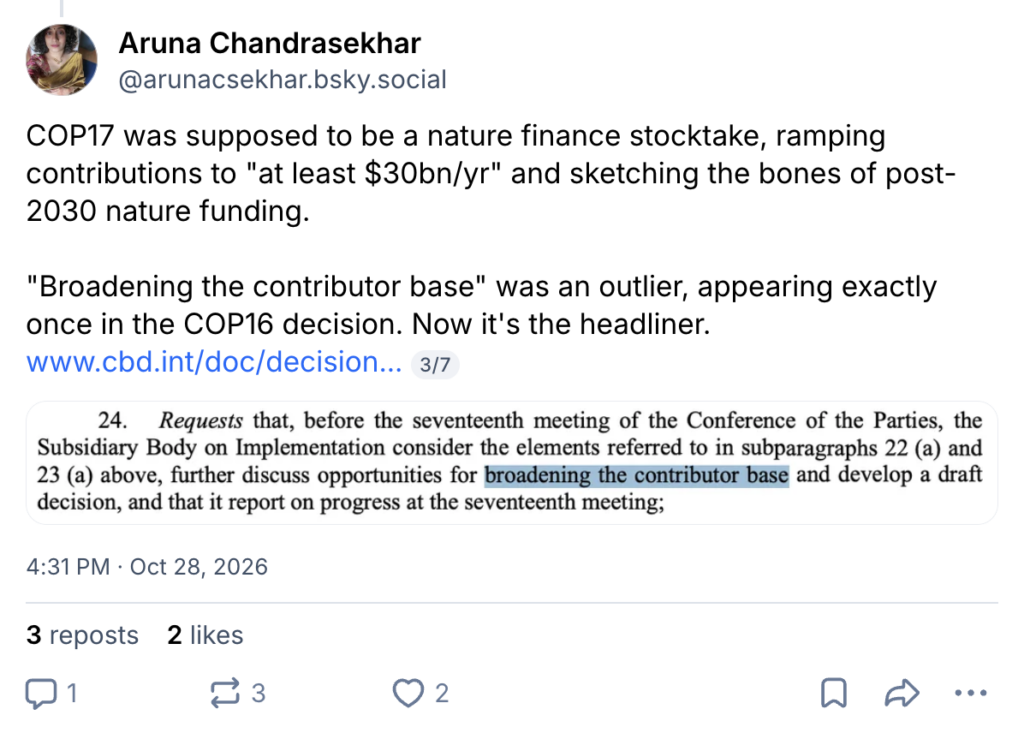
Calls to “broaden the contributor base” of who pays to protect nature – and whether that should include emerging economies – became the most fraught element of the talks.
Eventually, countries agreed on what Switzerland described as a “super, mega-delicate” text. It hinged on major “political compromises”, with “no major winner or loser”, according to Kenya.
Per the decision, countries that want to be included on a list of developed country donors can “signal interest” through bilateral, confidential consultations before COP18 and every alternate COP after.
Finally, countries also agreed on criteria to shape and resource a new, permanent financial mechanism to protect nature after 2030.
However, this did not immediately take the form of a new fund under the COP that biodiverse countries have demanded since 2022, deferring the mechanism’s institutional structure to COP18.
Resource mobilisation discussions at the GBF’s halfway mark were supposed to agree on how to close the “biodiversity finance gap” and to “increase resources from all sources” to “at least” $200bn per year by 2030, as set out in target 19 of the GBF.
The talks were largely dominated by a push, led by the JUSCANZ bloc of developed countries, to “broaden the contributor base”. This could see emerging economies, such as Qatar, China, Saudi Arabia and India, being added to the list of countries that pay to protect nature.
Article 20 of the UN Convention on Biological Diversity (CBD) states that developed countries “shall provide new and additional financial resources” to developing countries to meet the costs of implementing measures to protect nature.
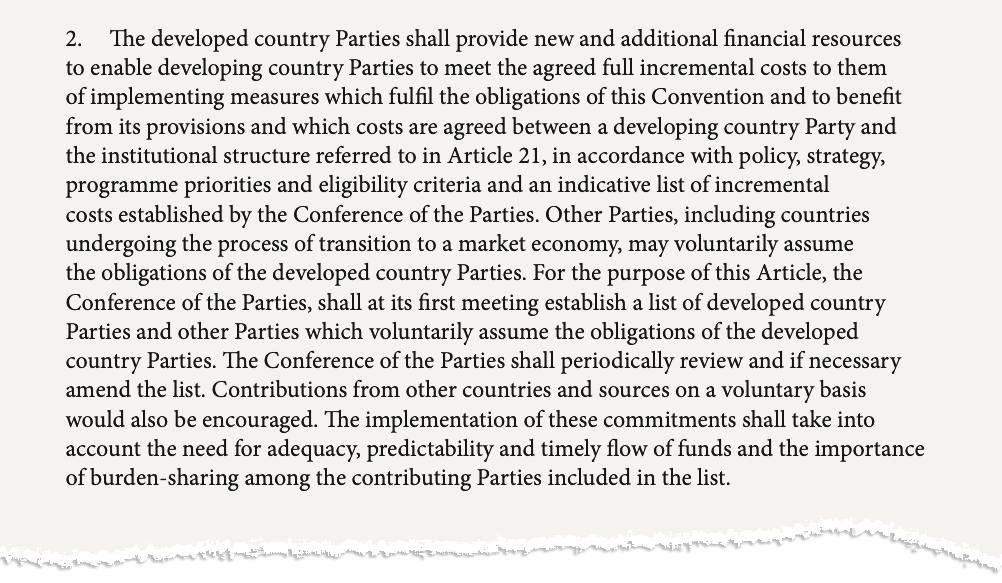
The text states that other countries – including emerging economies – may “voluntarily assume” these obligations to pay. However, it adds that this list of developed countries “shall” be reviewed periodically and amended “if necessary”.
The list was last amended in 2006.
(See this “jargon buster” which explains the specific meaning and legal weight of various terms and verbs used in UN formal documents.)