Connect with us

Published

on

Canada and the European Union’s commitment to strengthen cooperation on energy security and the energy transition lays the foundation to put clean growth and climate priorities at the heart of their alliance, according to experts.

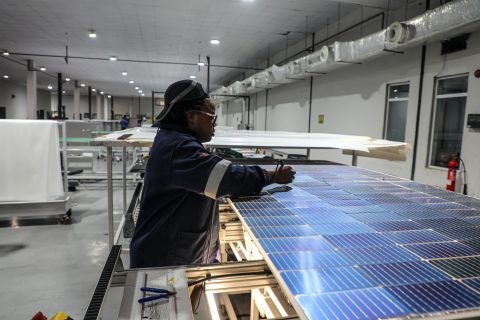
In a seven-page joint statement agreed at the end of a two-day summit in Montreal on Friday, both sides committed to work more closely on investment in critical minerals, green grids, energy sources, battery storage and the protection of energy infrastructure.

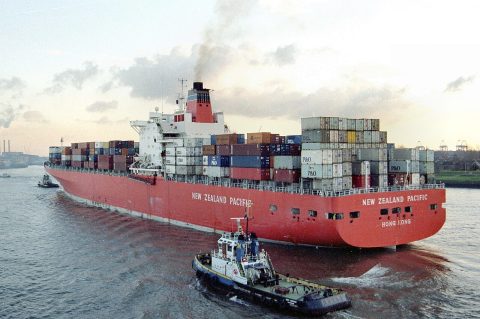
They agreed to assess opportunities for long-term energy connectivity across the Atlantic, including through a feasibility study on liquefied gas (LNG) exports to Europe. The statement also includes a pledge to “deepen targeted industrial cooperation” on technology value chains and “address bilateral trade barriers”.

“Canada and the European Union have sent a clear and unwavering signal that closer cooperation on decarbonisation and climate resilience will be central to their new strategic alliance,” said Canadian Climate Institute president Rick Smith. “The task now is to turn talk into action.”

Foundation for climate action

The EU and Canada’s “alliance for the future” aims to deepen their partnership across investment, trade and economic security to weather geopolitical tensions and global threats, including “the existential threat of the interdependent crises of climate change, biodiversity loss, ocean and land degradation, and pollution”. 

These threats are “increasingly impossible to ignore as the impacts of extreme heat, wildfires, floods, and other disasters become more disruptive and expensive,” Smith said.

    The statement reaffirms existing commitments established by the Canada-European Union Green Alliance, which both parties described as “our compass for advancing decarbonisation while also strengthening competitiveness, affordability, and economic security”.

    Investment in critical minerals

    During the summit, the European Investment Bank (EIB) announced a “new chapter” for its presence in Canada, beginning with accelerated investment in critical minerals.

    “At a time when both sides of the Atlantic are working to reduce strategic dependencies, we want to turn our partnership into investment in real projects, from mining and processing to recycling,” EIB Vice-President Nicolas Beer said in a statement. “That is how we build supply chains that are not only more secure, but more competitive too.”

    Joanna Kyriazis, director of policy and strategy at Clean Energy Canada, welcomed the EIB announcement as a “bright spot of the summit” and “one of the few tangible actions”.

    “As the EU and Canada seek to advance a partnership anchored in ensuring mutual security and navigating an uncertain world, it is essential that electrification remains a north star… one of the greatest ways we can advance both short- and long-term affordability, competitiveness, and energy security,” she said.

    Feasibility of Canadian LNG exports to the EU

    In addition, the agreement calls for a joint long-term feasibility study on LNG exports to Europe, although no immediate investment was announced to support this.

    A media briefing circulated by climate advocacy groups in advance of the summit had warned that a call for such a study would support Canada’s efforts to rebrand gas, a highly polluting fossil fuel, as a reliable, low-carbon energy source.  

    Yet, the agreement was interpreted by some observers as a Canadian concession following more than a year of rhetoric predicting a boom in Canadian gas exports to the EU and elsewhere.   

      “What is clear is that the EU is reducing its gas consumption drastically,” Adrian Hiel, director of the Brussels-based Electrification Alliance, told the Globe and Mail. “The long-term trend is clear and by the middle of the next decade, Europe should be out of the LNG game.”

      Last year, The Energy Mix and Berlin-based Clean Energy Wire reported on mounting doubts that serious European demand for additional gas supplies would ever materialise after Energy and Natural Resources Minister Tim Hodgson touted LNG exports to Germany in “as little as five years”.

      Rapprochement on a ‘trade irritant’

      In the lead-up to the summit, the Canadian Broadcasting Corporation reported that Canadian iron, steel, fertiliser and aluminium would not be exempt from carbon tariffs under the EU’s Carbon Border Adjustment Mechanism (CBAM), as it moves toward full implementation in 2034.

      The CBAM is a trade tool designed to protect the continent’s domestic industries from competitors in countries with less stringent carbon controls.

      Unlike other non-EU members like Switzerland, Norway, Iceland, and the UK, Canada is unlikely to be exempted from the CBAM because there are no plans to link its carbon market to Europe’s.

      However, at the end of the Montreal summit, Canadian Prime Minister Mark Carney and EU Commission President Ursula von der Leyen told a press conference they had made progress on finding joint solutions to the issue, which von der Leyen described as a “trade irritant”.

      Canada’s EU ambassador, Jonathan Wilkinson, formerly the environment and climate minister, said Canada sees it as a problem that the CBAM “did not acknowledge Canadian producers were doing their part to reduce their greenhouse gas footprint by paying an industrial carbon price”.

      He “confirmed diplomatic talks are heading in the right direction but not resolved”, CBC reported.

      A longer version of this story was originally published by The Energy Mix as part of its partnership with Small Change Fund.

      The post Canada, EU agree deeper cooperation on energy and cleantech supply chains appeared first on Climate Home News.

      Canada, EU agree deeper cooperation on energy and cleantech supply chains

      Continue Reading

      Climate Change

      State of the climate: 2026 likely to tie with 2024 as the warmest year on record

      Published

      on

      Article Contents

      With three-quarters of the year now past, it is virtually certain that 2026 will be the warmest or second-warmest year on record.

      A rapidly strengthening El Niño, alongside human-caused global warming, made this year’s August the warmest on record and September the second-warmest.

      El Niño is the warm phase of a recurring climate pattern in the tropical Pacific that releases heat from the ocean into the atmosphere and temporarily boosts global temperatures.

      Carbon Brief’s analysis gives 2026 a 67% chance of surpassing 2024 as the warmest year on record across an average of six global temperature datasets.

      In January, it is likely the groups that report global surface temperatures will be divided on whether 2026 officially beat 2024’s record.

      Currently, the odds for a record year range from as high as 97% in Berkeley Earth’s dataset to less than 20% in European Copernicus/ECMWF’s ERA5 reanalysis product.

      With El Niño expected to intensify into the winter, Carbon Brief projects that 2027 will be 1.7C above pre-industrial levels, with a 96% chance that it is the warmest year on record.

      In this latest “state of the climate” quarterly update, Carbon Brief finds:

      • August 2026 was the warmest August on record in all six major datasets, at around 0.12C above the previous record. September was the second-warmest September, behind 2023.
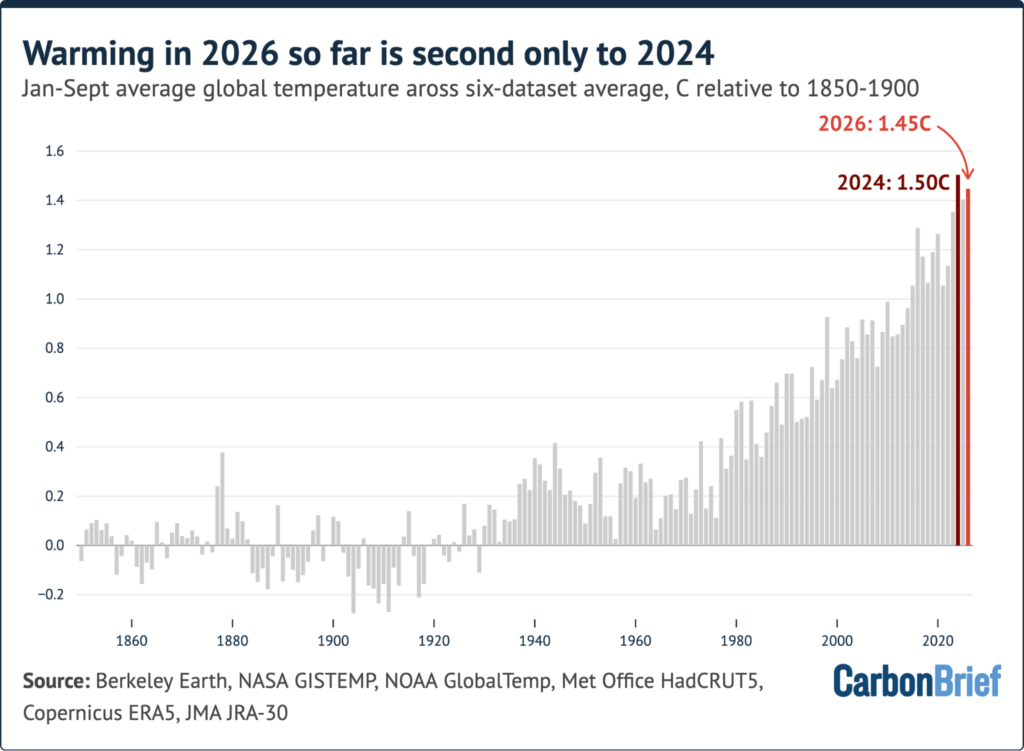
      • January-September was the second-warmest such period on record, at around 1.45C above pre-industrial levels, behind only 2024.
      • El Niño broke the daily “Niño3.4” region record in September and has stayed above the previous record every day since. Nearly all forecast model runs have it as the strongest El Niño on record, with a peak of around 4C occurring this winter.
      • Around 22% of the world’s surface saw its warmest July-September on record, including much of the tropical Pacific, the western Mediterranean and Iberia. Western Europe had its hottest summer on record and Spain its warmest September, beating the previous record by 0.7C.
      • Carbon Brief projects that 2026 will end up around 1.52C above pre-industrial levels, with a 67% chance of beating 2024’s record.
      • Whether 2026 is declared the warmest year depends on the dataset; a record is likely in Berkeley Earth and NASA GISTEMP, is too close to call in HadCRUT5, JRA-3Q and NOAA and is unlikely in ERA5.
      • Earth’s energy imbalance has more than doubled since the start of the satellite record, from around 0.5 watts per metre squared (W/m2) in the 2000s to around 1.25W/m2 over the past decade.
      • The Arctic sea ice minimum was tied for 10th lowest in the satellite record, while Antarctic sea ice saw its third-lowest winter peak.
      • This year’s record-setting El Niño will have its largest effect on global temperatures in 2027. Carbon Brief projects 2027 at around 1.7C above pre-industrial levels, with a 96% chance that it will be the warmest year on record.

      A record August and the second-warmest year to date

      Carbon Brief analyses records from six different groups that report global surface temperatures:

      There are a number of additional groups that feature in Carbon Brief’s annual “state of the climate” update, but are not included here due to a lack of regular monthly updates.

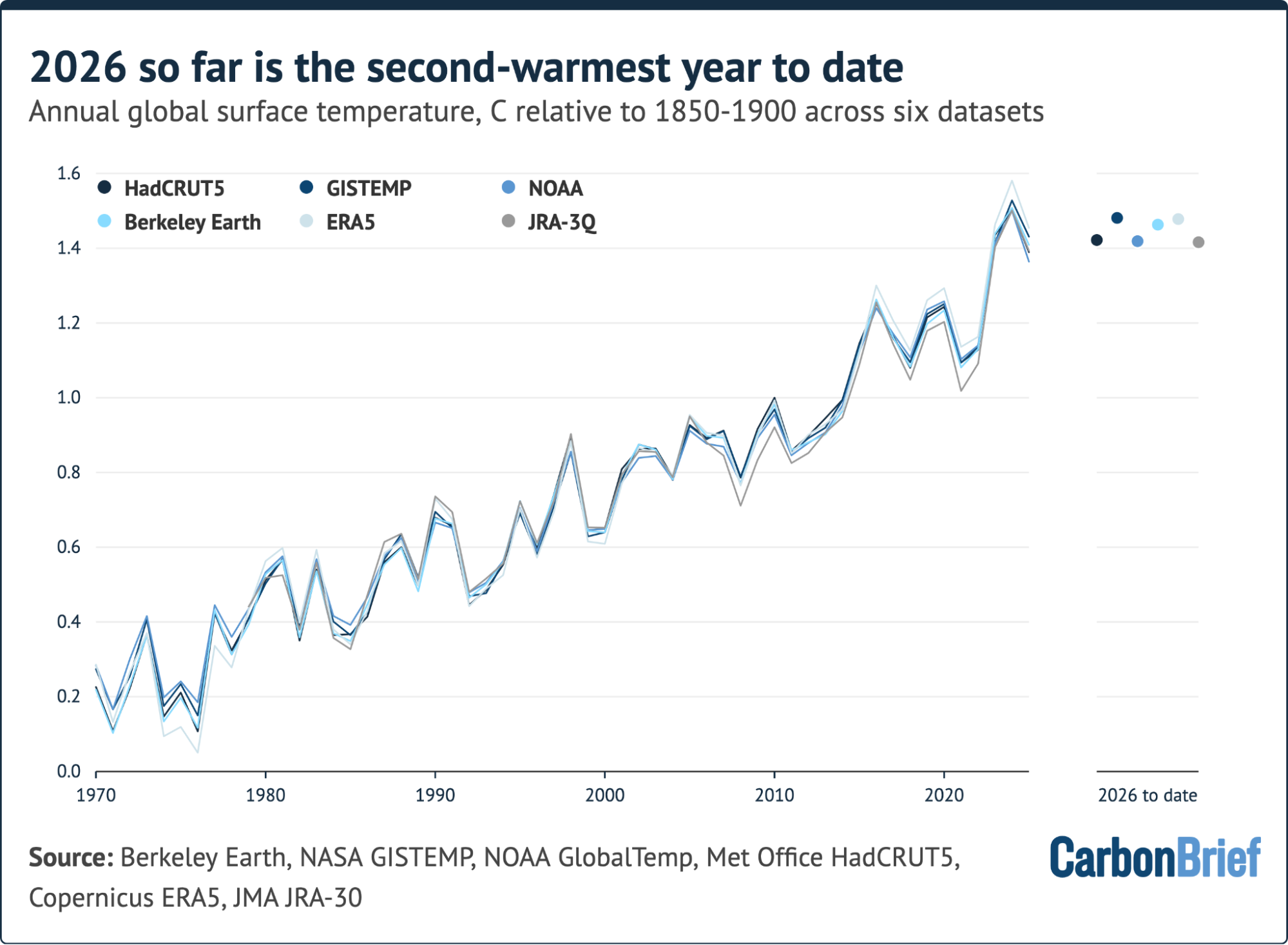
      The first nine months of 2026 were the second warmest on record in all six datasets, behind only 2024.

      The figure below shows annual temperatures in each dataset since 1970, along with the 2026 average to date.

      Chart titled "2026 so far is the second-warmest year to date"
      Global mean surface temperatures datasets aligned on a common 1981-2010 baseline, then shifted by the average 1850-1900 to 1981-2010 warming (0.67C) in HadCRUT5, NOAA and Berkeley Earth. 2026 to-date dots are staggered horizontally to avoid overlaps and the HadCRUT5 is for January-August as September data was not available at time of publication.

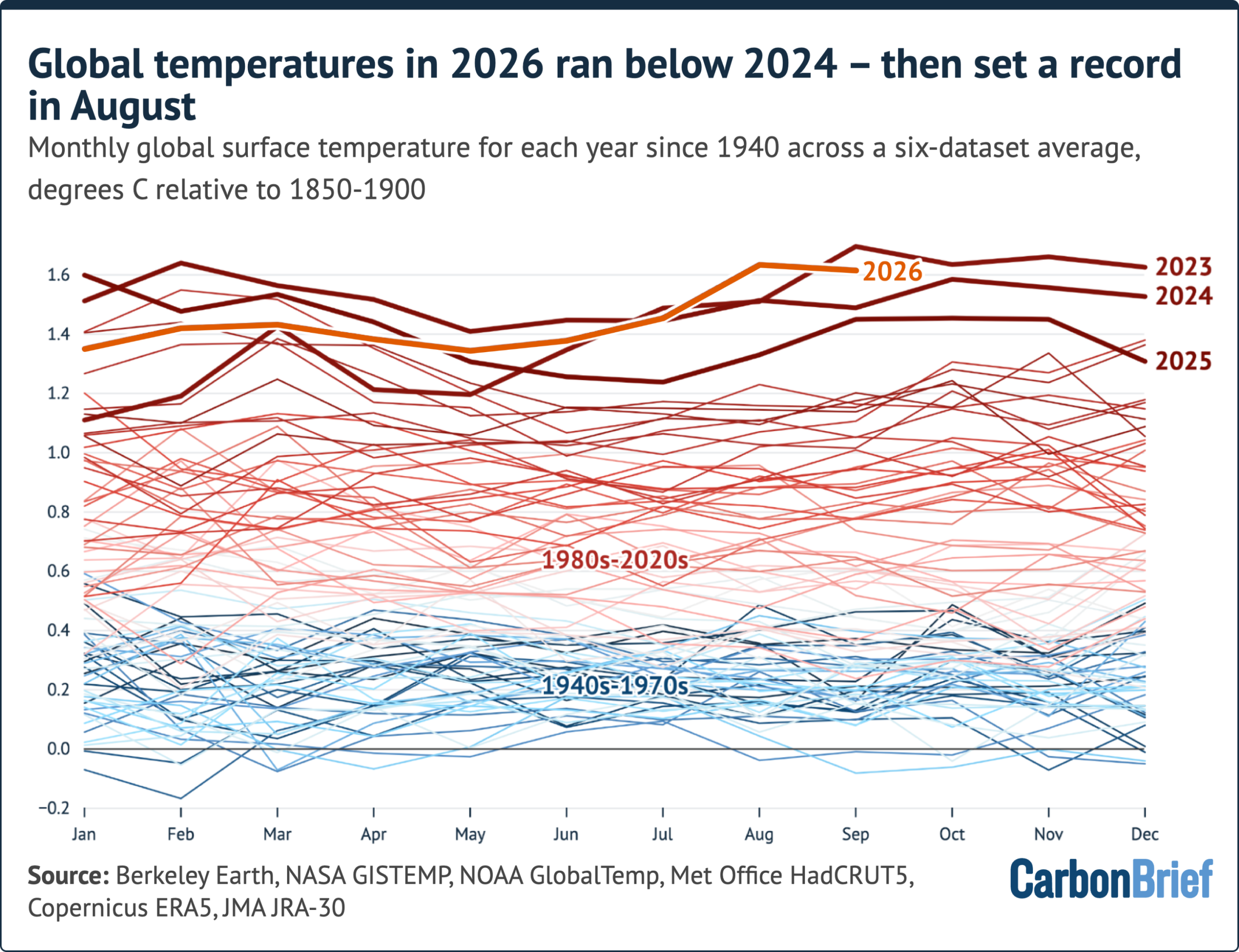
      The year got off to a comparatively slow start. Each month from January to June ran cooler than the same month in 2024, as the lingering effects of weak La Niña conditions gave way to a developing El Niño.

      La Niña and El Nino are the cool and warm phases of the El Niño-Southern Oscillation (ENSO), a recurring climate pattern in the tropical Pacific that reshapes weather patterns around the world.

      That changed in the third quarter of the year. July 2026 was the second-warmest July in the six-dataset average and a narrow record in the NASA GISTEMP and NOAA datasets. (NOAA’s own assessment described it as tied with July 2024.)

      August then set a new record for the month by around 0.12C in the six-dataset average. It was the warmest August on record in every one of the six datasets, by margins ranging from 0.07C (HadCRUT5 and NOAA) to 0.13C (ERA5).

      September temperatures stalled a little following the rise in July and August. At around 1.62C, it was the second-warmest September on record in all five datasets to have reported so far, around 0.08C below the record set in September 2023.

      The figure below shows each month of 2026 alongside every year since 1940, with 2023, 2024 and 2025 highlighted.

      Chart showing that global temperatures in 2026 ran below 2024 – then set a record in August.
      Monthly averages of six global mean surface temperature datasets. The September datapoint excludes HadCRUT5 which had not reported at the time of publication.

      Across the six-dataset average, July-September 2026 was effectively tied with the same period in 2023 as the warmest on record, at around 1.57C. It ranked first in GISTEMP and NOAA (and in HadCRUT5 for July-August), and second in Berkeley Earth, ERA5 and JRA-3Q.

      The figure below shows the January-September average for every year since 1850. It shows how temperatures in 2026 to date sit at 1.45C – around 0.06C below 2024.

      Chart titled "Warming in 2026 so far is second only to 2024"

      A record-setting El Niño event

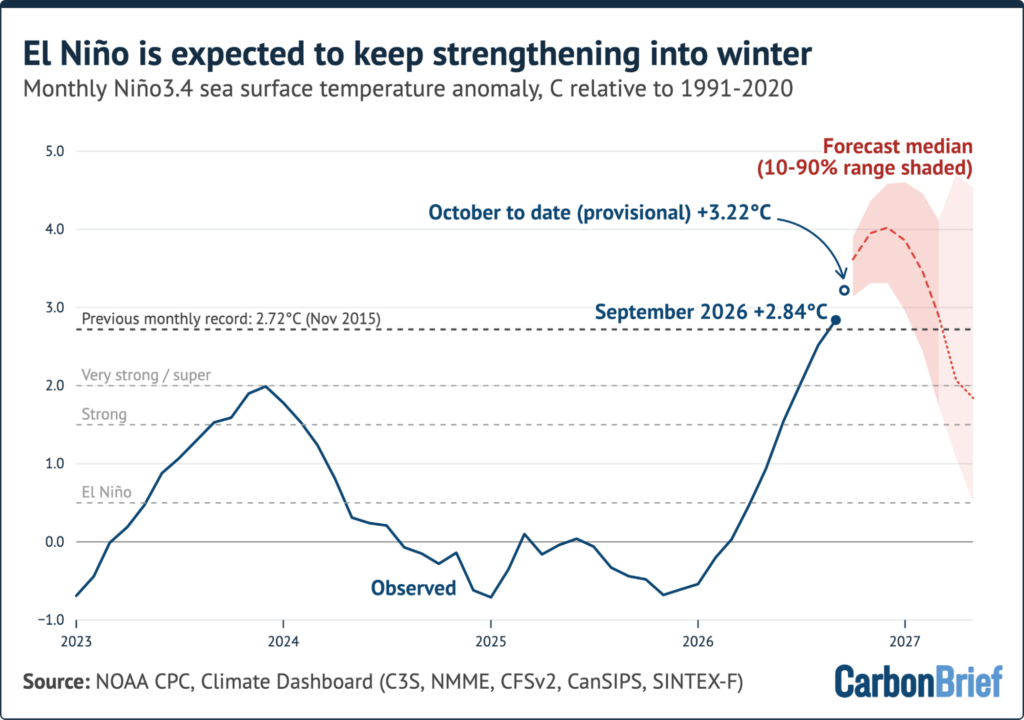
      In September, El Niño crossed a milestone. The daily sea surface temperature anomaly in the “Niño3.4” region of the tropical Pacific – the area most widely used to gauge El Niño strength – broke the record, previously set in November 2015, to become the strongest event since the satellite era began in 1981.

      This year’s El Niño has remained above that record every day since. September recorded the highest monthly Niño3.4 region temperature anomaly since records began in the mid-1800s.

      As of 18 October, the daily value stood at around 3.5C above the 1996-2025 average for the time of year and around 0.4C above the 2015 peak.

      The figure below shows how El Nino is projected to keep intensifying until the end of this year.

      Chart showing that El Niño is expected to keep strengthening into winter.
      Average of 656 forecasts across 14 dynamical models. The lighter shaded area reflects the period when only seven models are available.

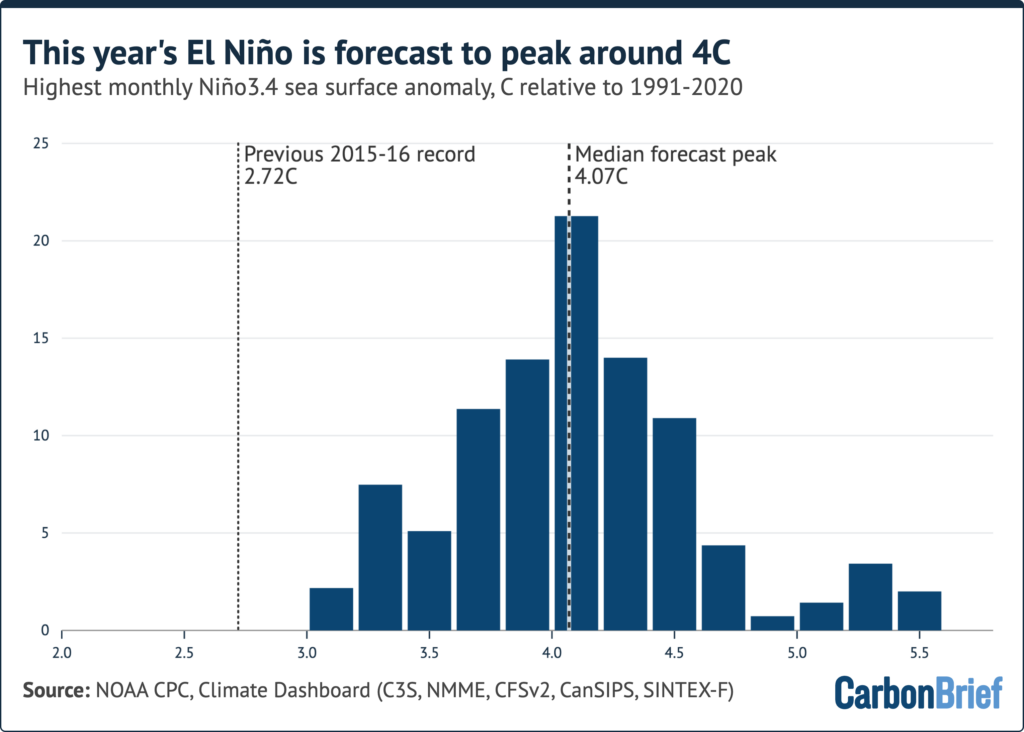
      Carbon Brief examined 656 forecasts from 14 different climate models that were run between late September and mid-October. On average they estimate that this year’s El Niño will peak around 4C in December – more than 1C above the prior record.

      (Ten models expect a December peak and four anticipate a November peak.)

      Based on an analysis of tree rings and coral sediments, it is possible that this will be the strongest El Niño event in a millennium.

      Chart showing that this year's El Niño is forecast to peak around 4C
      Niño3.4 region sea surface temperature peak warming projected from 656 runs of 14 different dynamical El Niño models. Y-axis denotes the share of model runs in each 0.2C “bin”.

      The forecasts have strengthened since Carbon Brief’s July “