

This could be a big year for the circular economy.
In autumn, the European Commission is due to adopt the Circular Economy Act (CEA), aimed at supporting the EU in its stated aim to become a world leader in circularity by 2030.
There is a clear environmental imperative behind the legislation, but also a geopolitical one. Europe imports the vast majority of all its critical raw materials; for example, 100% of its heavy rare earth metals come from China and 71% of its platinum from South Africa.
The bloc is seeking to reduce its dependency on imports of key commodities, energy and materials, and as a result achieve greater self-sufficiency. Circular products are one route to achieving that.
Circular ambitions
Whether the EU’s aim is achievable, or not, brings into sharp relief the current state of the circular economy. According to the European Environment Agency, in 2024, secondary recovered materials made up 12% of total material use across Europe. This was only 1.5% higher than in 2010.
But, by some estimates, the global circular economy is already worth around $700 billion and could reach several trillion within the next decade. This rate of growth would take considerable support from national governments, starting with something akin to the CEA, which aims to double the EU’s circularity rate to 24% and create a single market for secondary raw materials. The hope is that this will stoke demand from businesses to adopt more circular practices.
Carsten Wachholz, business-policy engagement lead at the Ellen MacArthur Foundation, described the forthcoming act as “a critical opportunity to turn circular solutions from a niche proposition into a mainstream market choice,” adding that by harmonising rules across the single market the EU can allow the circular economy to “scale across borders”.
From there the argument runs that rules created in Europe will be copied in other markets, shaping global supply chains and standards elsewhere. “The EU can work towards shared international ambition, reducing protectionism risks, and unlocking large-scale investment globally,” he added.
Making two ends meet
Raising awareness of what is meant by circularity, and being able to identify and treat circular products correctly, is one of the challenges the sector faces.
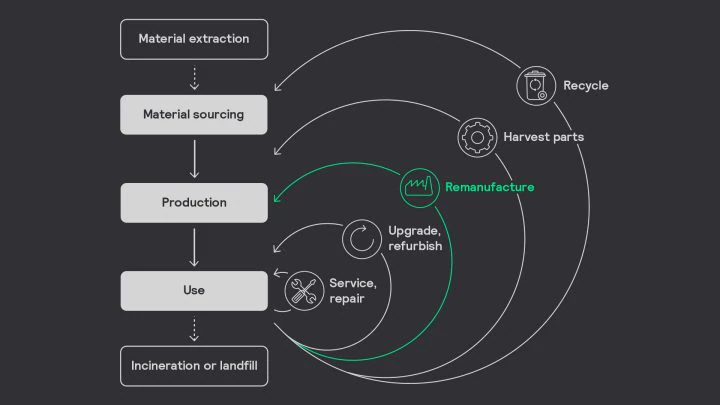
The global economy has been built on a simple linear structure where we source a material, create something out of it, sell it on and then throw it away. This process, sometimes called ‘take, make, use, dispose’ is the opposite of the principles of circularity.
The Ellen MacArthur Foundation defines the circular economy as a system where “materials never become waste”. In such a system, products and materials are “kept in circulation through processes like maintenance, reuse, refurbishment, remanufacture, recycling and composting”.
Circularity is about the whole life cycle of a product, seeing how it can be used for longer, upgrading when possible, and then potentially using that product to create something else afterwards. The intention with circularity is to increase the use of non-virgin materials, reducing the need to extract more from the ground.
Signify: “We believe resilience is becoming more important to businesses right now”
Thomas Marinelli, head of sustainable innovation and design at Signify, a global lighting company, said: “I once explained it to a child with Lego. You put Lego blocks together and you can pull them apart again and make something new.”
Circular practices also lead to more products – phones, washing machines, lighting – being leased instead of created from scratch. These services cut the need for large upfront investments and reduce environmental impacts.
How business is responding
The next step is to convince businesses it is the right thing to do, from a financial, environmental and product perspective.
“Using products for longer and using less material and energy is a topic of interest in our markets,” added Marinelli, while at the same time acknowledging that part of the challenge is “awareness creation”.
“We need to prove that products made from non-virgin, or bio-circular materials are at least as good. And that a business’s environmental footprint is much lower when you use non-virgin materials,” he said.
Part of the awareness-raising piece is showing that older products can be repaired, refurbished and remanufactured, depending on their condition. Signify takes lighting systems that are up to 10 years old, and makes them new again, saving on material waste and cutting emissions, often at a lower cost than buying a new product.
A growing number of companies are already sold on the benefits of going circular. A recent survey from the World Economic Forum found that out of 491 manufacturing executives, 79% said circularity is crucial to their business, and 95% said it will be important within three years.
Carrefour, the French retail giant, has adopted circular practices in some of its stores as a way of driving down energy costs and cutting carbon emissions. In one of its Belgian stores, the company installed 3D-printed light fixtures made from recycled water bottles. Lighting systems were made from recycled materials that can be fully dismantled and used to make new ones after they reach the end of their natural life.
A separate example comes from Denmark where the area of Tuborg Havn in Copenhagen chose to upgrade its historic street lamps with efficient LEDs instead of replacing them. More than 80 light fixtures were cleaned, upgraded and reinstalled as part of the new initiative, and the new lights will be 3.5 times more efficient than the old ones. The initiative has allowed the harbour to retain its historic character while reducing energy consumption and modernising the area.
Overcoming barriers
The Ellen MacArthur Foundation recently coordinated an open letter to the European Commission – signed by 12 global brands including The LEGO Group, H&M and Philips – calling for lawmakers to support new reforms that address common barriers facing circular products.
These include simplifying EU-wide rules, creating tax incentives and stronger financial support for the burgeoning sector. Current VAT rules, for example, can mean secondhand goods are repeatedly taxed across their lifetime, something the charity is seeking to change.
“Capital is not lacking,” said Wachholz, “but the risk profile of circular economy projects keeps too many ventures stuck at pilot scale rather than reaching industrial deployment.”
The letter calls for the creation of a secondary materials platform to improve price transparency, digital product passports to track material flows, and the creation of new industrial hubs to provide the infrastructure and technology the sector needs in order to scale up.
Those measures, coupled with fossil energy price spikes, will help circular products compete on cost with the extractive economy, experts say. “Using recycled materials or non-virgin alternatives can become competitive in the long run,” said Marinelli, pointing to the volatility in the price of raw materials. “If you look at plastics, when oil is a problem, the price of plastics goes up. But recycled plastic stays at the same level.”
“And it’s not only about materials but production as well. When volumes of recycled materials go up, then the price remains stable or goes down,” he added.
Opportune moment
The current geopolitical environment could serve to support growth in the circular economy. Supply chain constraints caused by the war in Iran have caused commodity prices to skyrocket. This has led many companies – and countries – to seek ways to protect themselves against future shocks.
In that context, new circular policies and products could receive a favourable hearing from businesses looking to build resilience, cut costs and protect nature. A future where circularity is fully embedded across society will need time and support to grow, but may well be on its way.
Adam Wentworth is a freelance journalist based in Brighton, UK
The post Can the circular economy win over big business? appeared first on Climate Home News.

Next week, diplomats from around the world will descend on Yerevan, Armenia, to negotiate a series of decisions under the UN Convention on Biological Diversity (CBD).
Between 19 and 30 October, 196 parties will gather to hammer out the precise wording of the dozens of legal texts that make up the decisions under the Conference of the Parties (COP) to the CBD.
This year’s summit is particularly significant, as it marks the halfway point between the agreement of the Kunming-Montreal Global Biodiversity Framework and the deadline for achieving its targets.
The CBD has found that countries are currently not on track to meet 22 out of the framework’s 23 targets.
During the fortnight, delegates will also be negotiating decisions relating to the two supplemental protocols to the CBD: the Cartagena Protocol, which covers biosafety; and the Nagoya Protocol, which covers access and benefit-sharing for the use of genetic resources.
(The Cartagena and Nagoya Protocols, which are each governed by a “meeting of the parties”, or “MOP”, have fewer parties than the CBD as a whole, with 173 and 141, respectively.)
Carbon Brief is tracking the progress of countries towards consensus on dozens of negotiating texts using the interactive table below.
The tracker includes texts from the COP, as well as the MOPs for the Cartagena and Nagoya protocols. It also includes draft decisions from the most recent subsidiary body meetings, as these form the starting point for the negotiations in Yerevan.
The CBD has three subsidiary bodies: the subsidiary body on scientific, technical and technological advice (SBSTTA), the subsidiary body on implementation (SBI) and the subsidiary body on article 8(j) and other provisions (SB8J).
SB8J focuses on issues related to the Indigenous peoples and local communities. It was established at COP16 in Cali, Colombia, in 2024.
The first two columns of the interactive tracker list the topic of each agenda item and the relevant body, with subsequent columns including dates, page counts and links to the original documents.
The table is searchable and can be sorted using the arrows in the header.
Areas of disagreement in UN draft texts are denoted by square brackets. Counting the brackets in a particular iteration of a text therefore gives a sense of how far parties are from reaching consensus.
The bracket column is colour-coded, with dark green indicating a low number of brackets and red indicating a high number of brackets remaining.
Texts can also present parties with choices using “options” or alternatives (“alt”), which are counted together in the sixth column of the table.
The key discussions in Yerevan will centre around two agenda items in particular. The first is the global review, which will assess progress towards the GBF and make recommendations for accelerating action.
The second is finance, which can be separated into two parts: resource mobilisation and the financial mechanism. On resource mobilisation, biodiverse global south countries are likely to push for an increased amount of international finance for conservation.
Disagreement over the creation of the financial mechanism led to the suspension of COP16 in Cali in October 2024, as parties failed to find agreement on the mobilisation of finance before the end of the summit.
Global south countries want the establishment of a separate financial mechanism under the control of the CBD; global north countries largely prefer to maintain the existing mechanism, which sits under the Global Environment Facility.
At the resumed session of COP16 in Rome in early 2025, countries agreed on a roadmap that would lead to the establishment of a permanent mechanism.
related

Analysis: Lula presidency saved at least 20,000km2 of Brazilian Amazon since 2022
Why land-use emissions have fallen by a third this century – in six charts

Analysis: 84% of nations miss deadline to identify ‘nature-harming’ subsidies by 2025

UK withdraws millions in funding from world’s second-largest rainforest in Congo
The post Interactive: Tracking negotiating texts at the COP17 biodiversity summit appeared first on Carbon Brief.
Interactive: Tracking negotiating texts at the COP17 biodiversity summit
A beacon of love
On an outer island of Fiji, two thousand nautical miles from Sydney, is a shining light of hope and resilience for our troubled world.
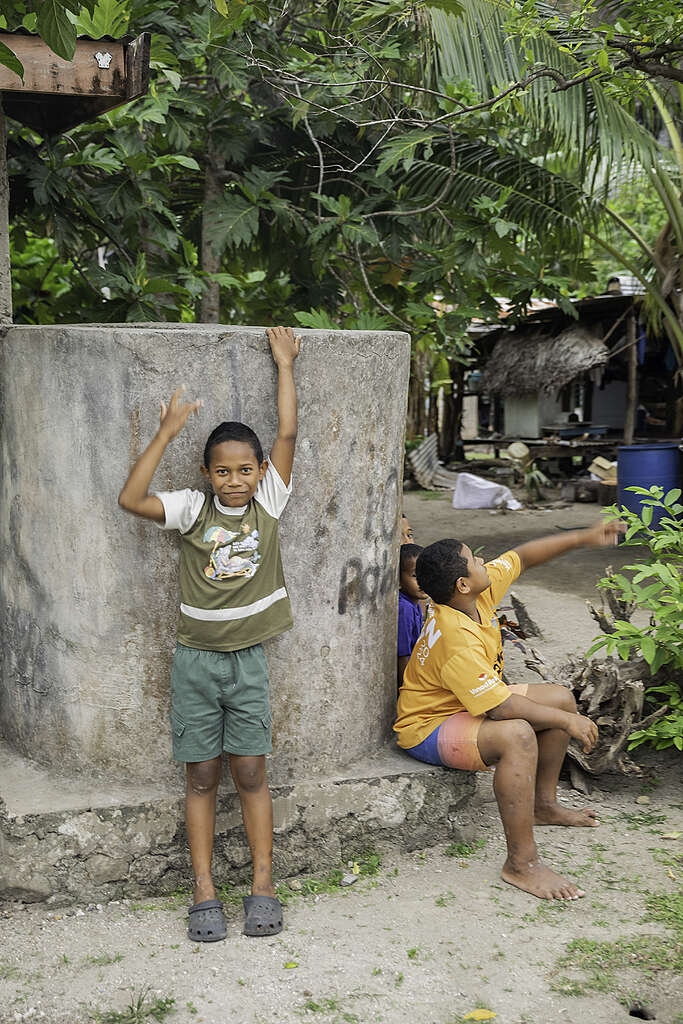
The island of Kioa is home to a Tuvaluan community who migrated from their atoll of Vaitupu in the late 1940s. It is a land of warm hearts, big smiles, and deep cultural roots; a place where the sound of a conch still summons the island together, where islanders paddle out to fish in carved outrigger canoes, and healthy happy children walk barefoot to school.
Here, culture is life. Kioans live sustainably through their traditional knowledge and practices. The island is alive with song, dance and the rhythms of a life tied to the tides, the winds, and the seasons.
Facing the future
Greenpeace has been lucky to have a relationship with Kioa for a number of years now, and we are continually learning from this remarkable community.
Last week, as part of our Voyaging Oceania project, we returned to the island. Our purpose was twofold —- to carry messages from the island to leaders gathering in Nadi this week for the Pacific Pre-COP, and to support the Kioa community in their efforts to improve water security for the island.
Unlike Tuvalu itself, with its eight atolls, Kioa is a mountainous, forested and richly fertile island. It will remain habitable far into the future. Kioans did not initially migrate from Vaitupu due to climate change, but the move was prophetic. They now have a lifeboat.
However, even Kioa faces challenges on our rapidly warming planet, in particular when it comes to water. Climate change is shifting once reliable rainfall patterns. On top of this, the island is already feeling the effect of this year’s intensifying El Niño event, which for Fiji means reduced rainfall and prolonged dry spells.
Right now, fresh water has to be carefully rationed, and is only available for a few hours a day. During last week’s visit aboard our campaigning ship Oceania, Greenpeace was privileged to work with the Kioa community on a new solar-powered water distribution project for the island.
Designed and led by the island, the project involves using a solar pump to move water from a reliable source to a storage tank and then using gravity to distribute the water around the village.
It was a lesson in how local knowledge and ingenuity can be the backbone of today’s climate solutions. To build a dam around the source, the local community knew the exact spot where they could gather gravel at low tide to mix with the cement. They took only what was needed, knowing that all resources must be carefully conserved. Kioa has no roads and no machinery, and it was an all-of-island effort to carry the materials up to the project site, including many heavy bags of sand and rock.
Such projects truly bring to life the vision of a resilient, locally-led, fossil fuel free Pacific.