

The move comes amid the agency’s renewed focus on prioritizing both conservation and resource extraction and compounds pressure on coal communities to diversify their economies.
The Bureau of Land Management announced Thursday that it would no longer make federally managed lands in Wyoming’s Powder River Basin available for new coal mining leases, drawing condemnation from the fossil fuel industry in the region that produces the most coal in the country, but delivering a boon to the nation’s clean energy transition.
BLM Ends Future Coal Mining on Powder River Basin Federal Lands


Climate Change
Cropped 8 April 2026: Iran war drives up food prices | Two nature talks conclude | Return of UK’s tallest bird
We handpick and explain the most important stories at the intersection of climate, land, food and nature over the past fortnight.
This is an online version of Carbon Brief’s fortnightly Cropped email newsletter.
Subscribe for free here.
Key developments
Iran war and food systems
PLANTING AT RISK: The war in the Middle East “has hit the epicentre of global fertiliser production”, threatening both the spring planting season in the northern hemisphere and winter planting in Australia, according to a comment by the Daily Telegraph’s world economy editor. Ambrose Evans-Pritchard noted that the supply of urea, ammonia and sulphur transported through the Persian Gulf has been “shut off” for nearly a month. The world’s two largest fertiliser producers, China and Russia, have recently reduced fertiliser exports, he added.
COMING CRISIS: Fuel costs and food prices are skyrocketing in Asia and Africa as the Iran war unfolds, reported the Financial Times, ahead of the new “two-week ceasefire”. According to the outlet, the impacts “could be even bigger than the crisis triggered by Russia’s 2022 full-scale invasion of Ukraine”. Even regions less directly exposed to the conflict, such as the US, “will feel the effects through higher [food] prices”, the outlet added.
CLIMATE FACTORS: New Scientist noted that the severity of the rise in food prices will depend on the length of the conflict and “how hard global warming-fuelled weather extremes” impact crops this year. A separate New Scientist piece pointed out that reducing farming’s dependence on fossil fuels could “prevent this from happening again [and] help slash the massive greenhouse gas emissions from farming”.
Nature talks outcomes
CONSERVATION WINS: The 15th Conference of the Parties to the UN Convention on Migratory Species ended on 29 March with an agreement to add 40 migratory species, including cheetah, striped hyena and snowy owls, to the convention’s “protected list”, reported Down To Earth. The conference in Brazil also delivered plans for conserving multiple species that live in the same ecosystems, such as the Amazon. The convention’s executive secretary said the new conservation rules are expected to be implemented “immediately”, added the outlet.
-
Sign up to Carbon Brief’s free “Cropped” email newsletter. A fortnightly digest of food, land and nature news and views. Sent to your inbox every other Wednesday.
MARINE PROTECTION: The conference was considered a “significant step forward” for marine species, as it reached a number of agreements, including commitments for reducing bycatch and a decision for countries to include “critical marine designations into their national biodiversity strategies”, reported Oceanographic. The meeting also adopted transboundary action plans for conserving the “critically endangered” European eel and the tope shark, it said.
HIGH SEAS MEETING: The final preparatory meetings for the High Seas Treaty ended on Friday with “meaningful progress in several key areas”, according to the Fishing Daily. Countries agreed on the “functioning of most subsidiary bodies” and several financial matters, but the “negotiations lost momentum toward the end of the session”, noted the outlet. The Financial Times reported that China is pushing to host the UN permanent body that will oversee High Seas Treaty talks. Earth Negotiations Bulletin reported that the treaty’s first summit will likely take place in New York in January 2027.
News and views
- FOREST LOSS: Deforestation in Indonesia surged by 66% in 2025, hitting its highest rate in eight years as a “result of weak environmental protections and an ambitious food and energy self-sufficiency drive”, said Reuters.
- DEFORESTATION REGULATION: Brazil introduced a new regulation last week requiring banks to use satellite data provided by the government to verify if borrowers of rural loans have deforested farmlands in the Amazon or other forests since July 2019, reported Folha de São Paulo.
- FACTORY FARMING: The UK government is overhauling planning rules to “make it easier to build intensive livestock farms despite concerns about water pollution, air quality and local opposition”, according to documents obtained under the freedom-of-information act by the Guardian.
- INITIATIVE ‘ABANDONED’: The European Commission has officially “abandoned” its sustainable EU food system initiative, according to the commission’s website. The framework was meant to integrate sustainability into all food-related policies, including for food labelling and public procurement.
- BLUE MILESTONE: The UN Environment Programme’s World Conservation Monitoring Centre announced that 10% of the global ocean is officially protected; however, the figure needs to triple for the world to meet its conservation commitments by 2030, according to EFE Verde.
Spotlight
Return of UK’s tallest bird
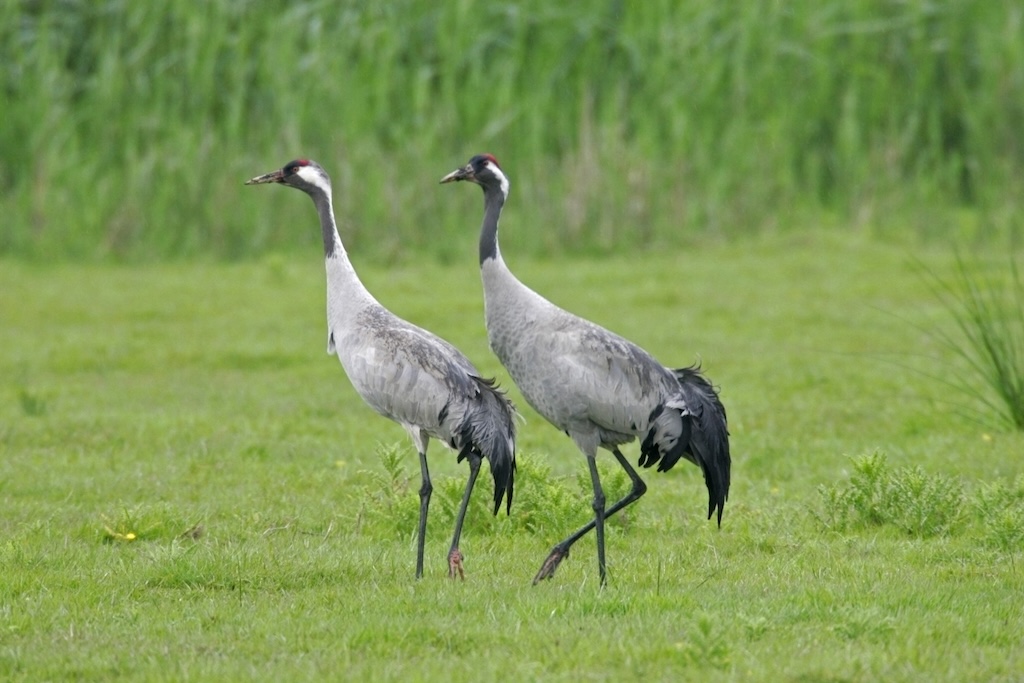
This week, Carbon Brief reports on how cranes, the UK’s tallest bird at more than 1 metre high, are making a remarkable comeback from extinction.
Standing at more than 1m with a 2m wingspan, cranes are comfortably the tallest bird in the UK.
Hundreds of years ago, they were a common sight in the UK. But, in the 1600s, they went extinct in the UK, due to overhunting and the large-scale loss of their wetland habitat. (Henry III reportedly served 115 cranes at one of his Christmas feasts in 1251.)
However, in 1979, a small number of wild cranes flew in from Europe and settled in Norfolk, eastern England. As efforts to restore and protect the UK’s wetland habitats have grown over the past few decades, so has the number of cranes.
In 2025, cranes had a record breeding season in the UK, with 87 pairs raising 37 chicks, according to data from the Royal Society for the Protection of Birds (RSPB). This has brought the total number of cranes in the country to around 250, says the charity.
Cranes and carbon
The majority of the UK’s growing crane population can be found in wetland areas that have been actively restored and protected by the RSPB and other conservation groups.
This includes Lakenheath Fen, a former carrot field in Suffolk, eastern England, that over the past 30 years has been restored into a diverse wetland habitat for birds, otters and water voles, among other species.
Cranes first arrived at Lakenheath from Europe in 2007, site manager Dave Rodgers explained to Carbon Brief:
“The conditions we created – a patchwork of developing reedbed, interspersed with shallowly flooded areas – were perfect for cranes. In 2007, there was an influx of birds from Europe. Two pairs flew over Lakenheath, landed and they’ve been nesting here ever since.”
As well as providing a home for cranes and other vulnerable water birds, the restoration of Lakenheath Fen and other sites like it is also helping to reduce the UK’s greenhouse gas emissions.
This is because Lakenheath Fen is a peatland.
Peatlands are waterlogged environments where plants decay very slowly, eventually forming a carbon-rich soil called peat. Across the world, peatlands cover just 3% of land area, but store more carbon than all of Earth’s trees combined.
In the UK, around 80% of all peatlands are degraded, with the greenhouse gases they emit accounting for around 5% of the country’s total emissions.
Rodgers explained:
“By re-wetting the peat, we’re almost completely preventing further loss of carbon from the soil.”
Flying future
According to the RSPB, cranes are now found at multiple wetland sites in the south-east and south-west of England. Some have even settled as far as Scotland.
With wetland restoration taking place across the country, including in cities such as London and Bristol, it is likely the birds will continue to spread to new areas, said Rodgers:
“There are a lot of wetlands around the country that would be suitable for cranes to nest in that are not currently occupied.
“With care, we should see cranes expand more widely across the country so that people who don’t currently have them might see them within the next 10 years.”
Watch, read, listen
NEW CHANCE FOR BEAVERS: A video from the Guardian showed the positive effects of the reintroduction of beavers into the wild in England.
INKCAP RELAUNCH: The UK online nature publication, Inkcap, headed by former Carbon Brief journalist Sophie Yeo, has relaunched with a new look.
BIRDS ARE BACK: Mongabay covered five bird species thought extinct that were rediscovered in 2025.
GREAT SHIFT: This Nature Answers podcast told the story of a community in Côte d’lvoire, where farmers moved from climate scepticism to adopting climate-adaptation measures.
New science
- Many insects in the tropics are already approaching their heat limits – the upper bound of the temperatures at which they can live | Nature
- More than 8,000 species could face increased exposure to wildfires by 2100 as a result of climate change under a moderate-warming scenario | Nature Climate Change
- Two temperate tree species, European beech and downy oak, can adapt to rising temperatures – but not when those high temperatures are accompanied by drought | Proceedings of the National Academy of Sciences
In the diary
- 10 April: Djibouti presidential election
- 12 April: Hungary presidential election
- 13-18 April: World Bank/International Monetary Fund spring meetings | Washington DC
- 21-22 April: 17th Petersberg climate dialogue | Berlin, Germany
- 21-25 April: UNFCCC climate week 1 | Yeosu, South Korea
Cropped is researched and written by Dr Giuliana Viglione, Aruna Chandrasekhar, Daisy Dunne, Orla Dwyer and Yanine Quiroz. Please send tips and feedback to cropped@carbonbrief.org

The post Cropped 8 April 2026: Iran war drives up food prices | Two nature talks conclude | Return of UK’s tallest bird appeared first on Carbon Brief.
The Indian government has quietly withdrawn its offer to host the COP33 climate summit in 2028, Climate Home News has learned.
An Indian official informed other nations of the decision on April 2, saying the offer – first made by Prime Minister Narendra Modi in December 2023 – was being withdrawn “following a review of its commitments for the year 2028”.
No additional explanation has been provided. The Indian government has not publicly announced the decision and did not immediately respond to a request for comment. Climate Home News is the first to report the withdrawal.
The decision leaves uncertainty over the host of COP33, which will follow COP31 in Türkiye and COP32 in Ethiopia. South Korea is now the only country to have expressed interest in hosting the 2028 summit, with a decision expected later this year.
The right to host the annual climate COP negotiations rotates between the UN’s five regional groups. This year’s COP31 will be co-hosted by Türkiye and Australia – both members of the Western Europe and Others Group – and next year’s will be in the capital city of Ethiopia, a representative of the African Group.
-
Colombia pledges to exit investment protection system after fossil fuel lawsuits
Experts warn that unwinding the Investor-State Dispute Settlement system will be complex, especially without international coordination -
Funding gap threatens next round of IPCC climate science reports, chair warns
The latest IPCC session in Bangkok was clouded by persistent differences over when its flagship reports should be published and concern over cost-cutting proposals -
Nepal’s EV revolution pays off as oil crisis causes pain at the pumps
Import subsidies, abundant hydropower and charging investments have spurred EV adoption, with electric vehicles now making up about three-quarters of new car sales


The Asia-Pacific Group is next in line. India had been widely expected to host COP33 after Modi announced the country’s bid at COP28 in Dubai in 2023.
In July 2025, the BRICS group of Brazil, Russia, India, China and South Africa said in a joint statement that they “welcomed” India’s candidacy to host COP33.
In the same month, The Hindu reported that the Indian government had set up a “cell” under the climate change division of the environment ministry to prepare for the summit.
But a letter dated 2 April – seen and verified by Climate Home News – confirms the reversal. In it, Rajat Agarwal, the environment ministry official responsible for liaising with the UNFCCC, informed the chair of the Asia-Pacific Group that India is withdrawing its candidacy.
The four-paragraph letter says India will continue to engage constructively with the international community on climate action and appreciates the “support and solidarity” of the Asia-Pacific countries during its bid for candidacy.
The post India withdraws bid to host COP33 climate talks appeared first on Climate Home News.
Climate Change
Alabama’s Governor Signed a Landmark Utility Regulation Bill Into Law. Many Say It’s a Win For Alabama Power.
The legislation was weakened so significantly its original sponsor ultimately voted against it. Alabamians say they’ll continue to push for real reform.
BIRMINGHAM, Ala.—Alabama Power customers aren’t giving up yet. On Monday, around two dozen of them marched from Birmingham’s Kelly Ingram Park to the nearby headquarters of the investor-owned utility company to make that much clear.

Cropped 8 April 2026: Iran war drives up food prices | Two nature talks conclude | Return of UK’s tallest bird

India withdraws bid to host COP33 climate talks

Best of Sustainability In Your Ear: Plastic Bank’s David Katz on Grassroots Recycling Solutions
-
Climate Change8 months ago
Guest post: Why China is still building new coal – and when it might stop
-
Greenhouse Gases8 months ago
Guest post: Why China is still building new coal – and when it might stop
-

 Greenhouse Gases2 years ago
嘉宾来稿:满足中国增长的用电需求 光伏加储能“比新建煤电更实惠”
-
Climate Change2 years ago
Bill Discounting Climate Change in Florida’s Energy Policy Awaits DeSantis’ Approval
-

 Climate Change2 years ago
嘉宾来稿:满足中国增长的用电需求 光伏加储能“比新建煤电更实惠”
-
Climate Change Videos2 years ago
The toxic gas flares fuelling Nigeria’s climate change – BBC News
-

 Renewable Energy6 months ago
Sending Progressive Philanthropist George Soros to Prison?
-

 Carbon Footprint2 years ago
US SEC’s Climate Disclosure Rules Spur Renewed Interest in Carbon Credits