


Ambuja Cements Limited, the top cement and building materials company in India announced joining the Alliance for Industry Decarbonization (AFID). Ambuja’s membership marks a historic moment as it becomes the world’s first cement manufacturer to join AFID, setting a milestone in decarbonization for the cement industry.
Adani’s Acquisition and Significance of Joining the AFID
In September 2022, Adani Group completed the acquisition of Ambuja Cements Ltd and ACC Ltd. Thus, Ambuja Cements is now part of the growing Adani Portfolio. With its subsidiaries, ACC Limited and Sanghi Industries Limited, Ambuja Cements aims to help the Adani Group reach a cement production capacity of 140 MTPA by 2028.
Joining AFID is a significant milestone for the cement behemoth. Simply put, this global initiative aims to accelerate the transition to net zero as it aligns with the Paris Agreement. The AFID focuses on reducing emissions in industrial sectors and boosts the net-zero goals of the hard-to-abate industries. It brings together public and private organizations from energy-intensive industries to work toward a greener future. It serves as a platform for industry dialogue, fostering cooperation among private and public stakeholders in energy-intensive sectors.
By collaborating with other members, Ambuja aims to develop robust decarbonization strategies that align with national commitments. Notably, The International Renewable Energy Agency (IRENA) coordinates the alliance’s activities, ensuring a unified approach to achieving net-zero goals across industries.
Furthermore, the cement giant earned an A- ‘Leadership Score’ from CDP for its climate action. The company was also named one of ‘India’s Most Trusted Cement Brands’ by TRA Research in 2024 and listed among the ‘Iconic Brands of India’ by The Economic Times.
Currently, it has 18 integrated plants and 19 grinding units. Its highly advanced port infrastructure ensures timely, cost-effective bulk cement shipments, giving the company a competitive edge in the market.
Now, the big question is how Ambuja Cements plans to decarbonize its cement manufacturing process and achieve its Net Zero goals. What are its strategies and investments in renewable energy? Let’s explore.
Ambuja Cements: Leading the Way to Net Zero by 2050
Mr. Karan Adani, Non-Executive Director, Ambuja Cements.
“This marks another significant step for Ambuja in its sustainability journey. We are already amongst the lowest emission-intensity cement producers globally and are undertaking several strategic initiatives to further reduce our GHG emission footprint. Being a member of the Alliance for Industry Decarbonization would allow us to leverage the experiences of global cross-sector industry peers, and in turn, share our approach to decarbonization.”
Emission Reduction Target
Ambuja Cements, India’s second-largest cement producer with a capacity of 78.9 million tons per annum, has set a bold goal to achieve net zero emissions by 2050. Its targets are validated by the Science Based Targets initiative (SBTi). The company is committed to reducing greenhouse gas (GHG) emissions and is recognized as one of the lowest-emission cement producers globally.
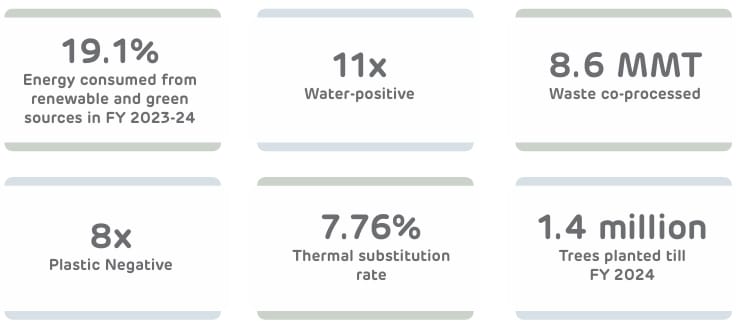
- This year the company utilized over 8.6 million tonnes of waste-derived resources. It boldly highlighted being 11 X water-positive and 8 X plastic-negative.
Source: Ambuja Cements
Scope 1 and Scope 2 Emissions
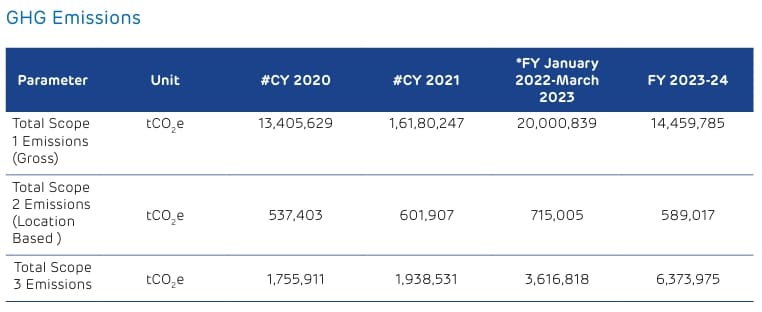
The sustainability report explains how the company is combating its Scope 1 and Scope 2 emissions by 21% per ton of cementitious material by 2030. Notably, these efforts align with the Global Cement and Concrete Association’s roadmap for achieving Net Zero by 2050. The company has also conducted a climate risk assessment to ensure business resilience. They integrate recommendations from the Task Force on Climate-Related Financial Disclosures (TCFD).
 Source: Ambuja Cements
The company has established an Internal Carbon Pricing (ICP) mechanism which is an integral part of its emission management strategy. This tool helps the company make informed decisions to reduce carbon emissions and fund low-carbon projects.
Mega Investment Plan in Renewable Energy
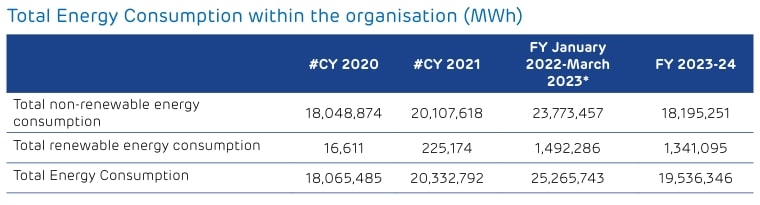
A key strategy to decarbonize the cement industry is the use of renewable energy. Ambuja Cements focuses on cutting energy consumption by harnessing solar and wind power, along with utilizing waste heat recovery systems (WHRS). At present, it has installed 76 MW of WHRS.
The press release reveals Ambuja Cements’ significant investment plan of approximately $1.2 billion (₹10,000 crore) in renewable energy projects. The company is targeting a total capacity of 1 gigawatt (GW) and an additional 376 megawatts (MW) from Waste Heat Recovery Systems (WHRS). This initiative will ensure that 60% of its expanded capacity will be powered by renewable energy by 2028.
 Source: Ambuja Cements
Thus, all these efforts will significantly reduce the company’s carbon footprint and gain economic benefits through reduced energy costs and improved operational efficiency.
- FURTHER READING: C-Capture’s Innovative Carbon Capture Solution: A Game-Changer for the Cement Industry
The post Ambuja Cements Makes History: First to Join the Alliance for Industry Decarbonization (AFID) appeared first on Carbon Credits.

The post Promoting Improved Cooking Practices in Nigeria appeared first on Terrapass.
For most companies, the largest figure in the carbon inventory is not the office, the vehicle fleet, or the electricity bill. It sits upstream, in the goods and materials a business buys to make and sell its products. These purchased inputs form the bulk of a company’s Scope 3 emissions, which routinely exceeds everything the business controls directly, and can add up to 90% of their global footprint.




-
Climate Change1 year ago
Guest post: Why China is still building new coal – and when it might stop
-

 Greenhouse Gases2 years ago
嘉宾来稿:满足中国增长的用电需求 光伏加储能“比新建煤电更实惠”
-
Greenhouse Gases1 year ago
Guest post: Why China is still building new coal – and when it might stop
-

 Climate Change2 years ago
嘉宾来稿:满足中国增长的用电需求 光伏加储能“比新建煤电更实惠”
-

 Renewable Energy12 months ago
Sending Progressive Philanthropist George Soros to Prison?
-
Climate Change2 years ago
Bill Discounting Climate Change in Florida’s Energy Policy Awaits DeSantis’ Approval
-
Greenhouse Gases1 year ago
嘉宾来稿:探究火山喷发如何影响气候预测
-

 Climate Change2 years ago
Analysis: China’s CO2 falls 1% in Q2 2024 in first quarterly drop since Covid-19