The year 2025 saw the return to power of Donald Trump, a jewellery heist at the Louvre museum in Paris and an engagement that “broke the internet”.
Amid the biggest stories of the year, climate change research continued to feature prominently in news and social media feeds.
Using data from Altmetric, which scores research papers according to the attention they receive online, Carbon Brief has compiled its annual list of the 25 most talked-about climate-related studies of the past year.
The top 10 – shown in the infographic above and list below – include research into declining butterflies, heat-related deaths, sugar intake and the massive loss of ice from the world’s glaciers:
- Indicators of Global Climate Change 2024: annual update of key indicators of the state of the climate system and human influence
- Rapid butterfly declines across the US during the 21st century
- Global warming has accelerated: Are the UN and the public well informed?
- Community estimate of global glacier mass changes from 2000 to 2023
- The EAT-Lancet Commission on healthy, sustainable and just food systems
- Carbon majors and the scientific case for climate liability
- Estimating future heat-related and cold-related mortality under climate change, demographic and adaptation scenarios in 854 European cities
- Systematic attribution of heatwaves to the emissions of carbon majors
- Ambient outdoor heat and accelerated epigenetic aging among older adults in the US
- Rising temperatures increase added sugar intake disproportionately in disadvantaged groups in the US
Later in this article, Carbon Brief looks at the rest of the top 25 and provides analysis of the most featured journals, as well as the gender diversity and country of origin of authors.
New for this year is the inclusion of Altmetric’s new “sentiment analysis”, which scores how positive or negative a paper’s social media attention has been.
(For Carbon Brief’s previous Altmetric articles, see the links for 2024, 2023, 2022, 2021, 2020, 2019, 2018, 2017, 2016 and 2015.)
Global indicators
The top-scoring climate paper of 2025, ranking 24th of any research paper on any topic, is the annual update of the “Indicators of Global Climate Change” (IGCC) report.
The report was established in 2023 to help fill the gap in climate information between assessments of the Intergovernmental Panel on Climate Change (IPCC), which can take up to seven years to complete. It includes the latest data on global temperatures, the remaining carbon budget, greenhouse gas emissions and – for the first time – sea level rise.
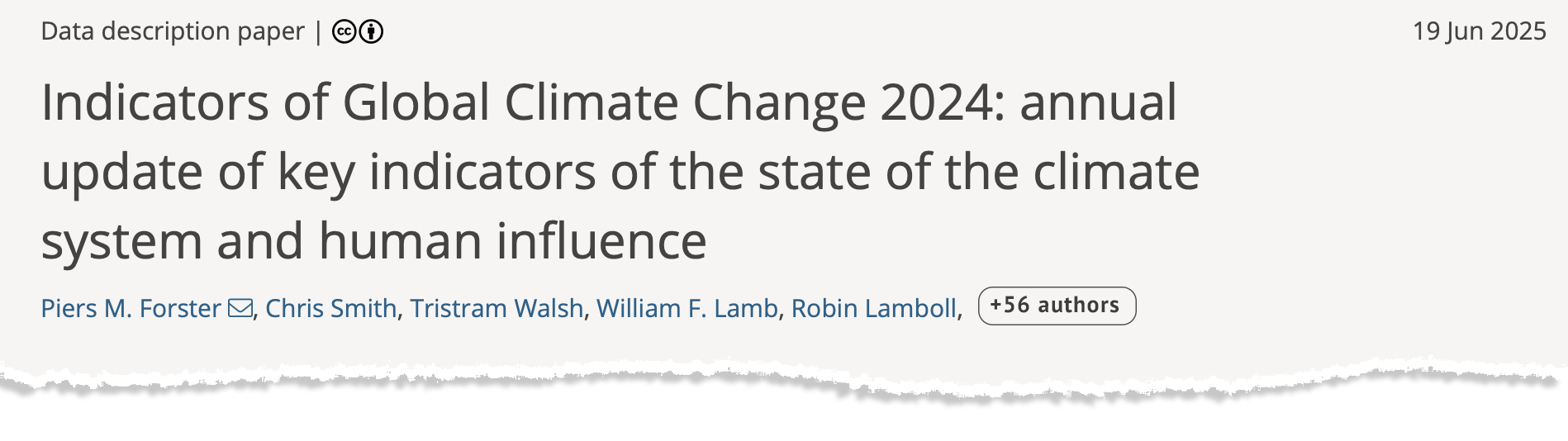
The paper, published in Earth System Science Data, has an Altmetric score of 4,099. This makes it the lowest top-scoring climate paper in Carbon Brief’s list since 2017.
(An Altmetric score combines the mentions that published peer-reviewed research has received from online news articles, blogs, Wikipedia and on social media platforms such as Facebook, Reddit, Twitter and Bluesky. See an earlier Carbon Brief article for more on how Altmetric’s scoring system works.)
Previous editions of the IGCC have also appeared in Carbon Brief’s list – the 2024 and 2023 iterations ranked 17th and 18th, respectively.
This year’s paper was mentioned 556 times in online news stories, including in the Associated Press, Guardian, Independent, Hill and BBC News.
Many outlets led their coverage with the study’s findings on the global “carbon budget”. This warned that the remaining carbon budget to limit warming to 1.5C will be exhausted in just three years if global emissions continue at their current rate.
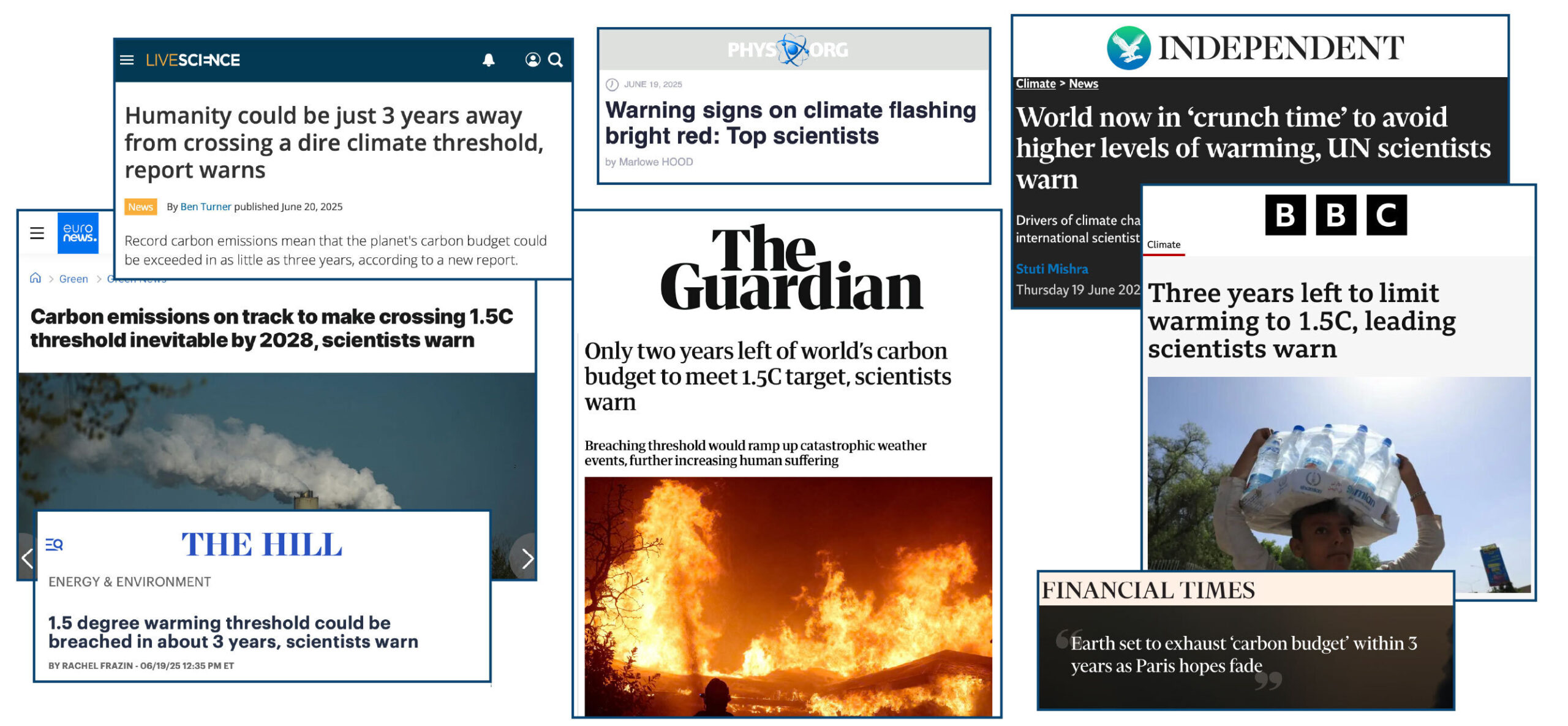
In a Carbon Brief guest post about the study, authors Prof Piers Forster and Dr Debbie Rosen from the University of Leeds wrote:
“It is also now inevitable that global temperatures will reach 1.5C of long-term warming in the next few years unless society takes drastic, transformative action…Every year of delay brings reaching 1.5C – or even higher temperatures – closer.”
Forster, who was awarded a CBE in the 2026 new year honours list, tells Carbon Brief that media coverage of the study was “great” at “putting recent extreme weather in the context of rapid long-term rates of global warming”.
However, he adds:
“Climate stories are not getting the coverage they deserve or need at the moment so the community needs to get all the help we can for getting clear consistent messages out there.”
The paper was tweeted more than 300 times and posted on Bluesky more than 950 times. It also appeared in 22 blogs.
Using AI, Altmetric now analyses the “sentiment” of this social media attention. As the summary figure below shows, the posts about this paper were largely positive, with an approximate 3:1 split of positive and negative attention.

Butterfly decline
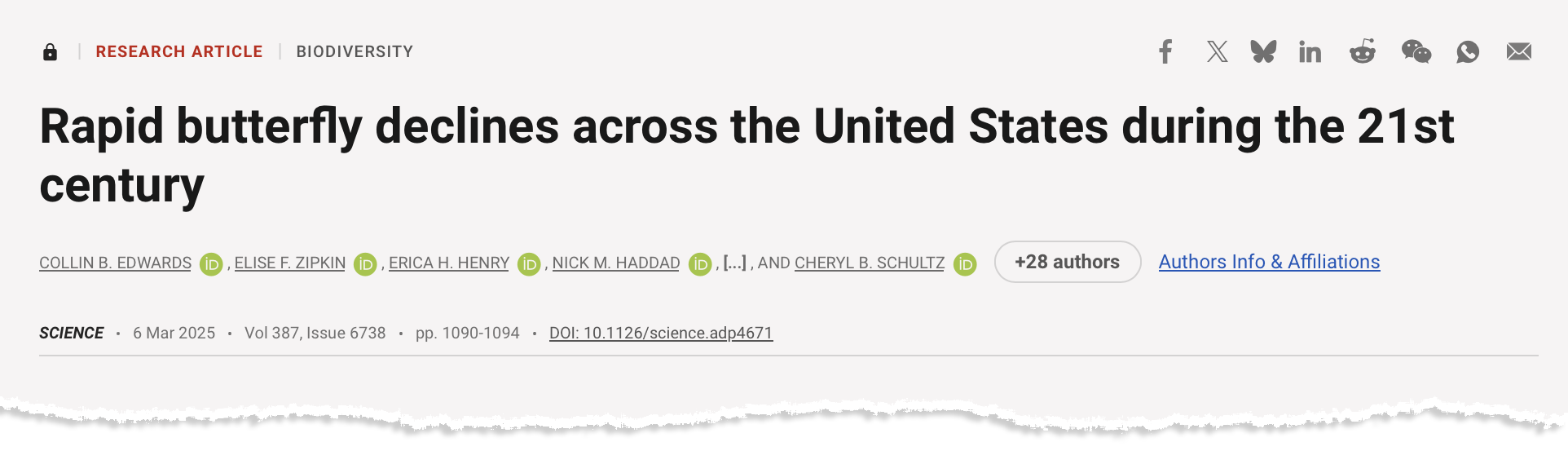
With an Altmetric score of 3,828, the second-highest scoring climate paper warns of “widespread” declines in butterfly numbers across the US since the turn of the century.
The paper, titled “Rapid butterfly declines across the US during the 21st century” and published in Science, identifies a 22% fall in butterfly numbers across more than 500 species between 2000 and 2020.
(There is a higher-scoring paper, “The 2025 state of the climate report: a planet on the brink”, in the journal BioScience, but it is a “special report” and was not formally peer reviewed.)
The scale of the decline suggests “multiple and broadly acting threats, including habitat loss, climate change and pesticide use”, the paper says. The authors find that “species generally had stronger declines in more southerly parts of their ranges”, with some of the most negative trends in the driest and “most rapidly warming” US states.
The research was covered in 560 news articles, including the New York Times, Guardian, Associated Press, NPR, El País and BBC News. Much of the news coverage led with the 22% decline figure.
The paper was also mentioned in 13 blogs, more than 750 Bluesky posts and more than 600 tweets.
The sentiment analysis reveals that social media posts about the paper were largely negative. However, closer inspection reveals that this negativity is predominantly towards the findings of the paper, not the research itself.
For example, a Bluesky post on the “distressing” findings by one of the study’s authors is designated as “neutral negative” by Altmetric’s AI analysis.
In a response to a query from Carbon Brief, Altmetric explains that the “goal is to measure how people feel about the research paper itself, not the topic it discusses”. However, in some cases the line can be “blurred” as the AI “sometimes struggles to separate the subject matter from the critique”. The organisation adds that it is “continuously working on improving our models to better distinguish between the post’s content and the research output”.

On the attention that the paper received, lead author Dr Collin Edwards of Washington State University in Vancouver says that “first and foremost, people care about butterflies and our results are broad-reaching, unequivocal and, unfortunately, very concerning”.
Edwards tells Carbon Brief he hopes the clarity of the writing made the paper accessible to readers, noting that he and his co-authors “sweat[ed] over every word”.
The resulting news coverage “accurately captured the science”, Edwards says:
“Much as I wish our results were less consistently grim, the consistency and simplicity of our findings mean that even if a news story only provides the highest level summary, it isn’t misleading readers by skipping some key caveat or nuance that changes the interpretation.”
Warming ‘acceleration’
In third place in Carbon Brief’s list for 2025 is the latest scientific paper from veteran climatologist Dr James Hansen, former director of the NASA Goddard Institute for Space Studies and now adjunct professor at Columbia University’s Earth Institute.
The paper, titled “Global warming has accelerated: Are the UN and the public well-informed?” was published in the journal Environment: Science and Policy for Sustainable Development. It generated an Altmetric score of 3,474.

The study estimates that the record-high global temperatures in the last few years were caused by a combination of El Niño and a reduction in air pollution from international shipping.
The findings suggest that the cooling effect of aerosols – tiny, light‑scattering particles produced mainly by burning fossil fuels – has masked more of the warming driven by greenhouse gases than previously estimated by the IPCC.
As efforts to tackle air pollution continue to reduce aerosol emissions, warming will accelerate further – reaching 2C by 2045, according to the research.
The paper was covered by almost 400 news stories – driven, in part, by Hansen’s comments in a press briefing that the Paris Agreement’s 2C warming limit was already “dead”.
Hansen’s analysis received a sceptical response from some scientists. For example, Dr Valerie Masson-Delmotte, an IPCC co-chair for its most recent assessment report on climate science, told Agence France-Presse the research “is not published in a climate science journal and it formulates a certain number of hypotheses that are not consistent with all the available observations”.
In addition, other estimates, including by Carbon Brief, suggest new shipping regulations have made a smaller contribution to warming than estimated by Hansen.
Hansen tells Carbon Brief that the paper “did ok” in terms of media coverage, although notes “it’s on [scientists] to do a better job of making clear what the core issues are in the physics of climate change”.
With more than 1,000 tweets, the paper scored highest in the top 25 for posts on Twitter. It was also mentioned in more than 800 Bluesky posts and on 27 blogs.
The sentiment analysis suggests that these posts were largely positive, with just a small percentage of negative comments.

Making the top 10
Ranking fourth in Carbon Brief’s analysis is a Nature paper calculating changes in global glacier mass over 2000-23. The study finds glaciers worldwide lost 273bn tonnes of ice annually over that time – with losses increasing by 36% between 2000-11 and 2012-23.
The study has an Altmetric score of 3,199. It received more news coverage than any other paper in this year’s top 25, amassing 1,187 mentions. with outlets including the Guardian, Associated Press and Economic Times.
At number five, with an Altmetric score of 2,860, is the EAT-Lancet Commission on healthy, sustainable and just food systems.
Carbon Brief’s coverage of the report highlights that “a global shift towards ‘healthier’ diets could cut non-CO2 greenhouse gas emissions, such as methane, from agriculture by 15% by 2050”. It adds:
“The findings build on the widely cited 2019 report from the EAT-Lancet Commission – a group of leading experts in nutrition, climate, economics, health, social sciences and agriculture from around the world.”
Also making the top 10 – ranking sixth and eighth – are a pair of papers published in Nature, which both link extreme heat to the emissions of specific “carbon majors” – large producers of fossil fuels, such as ExxonMobil, Shell and Saudi Aramco,.
The first is a perspective, titled “Carbon majors and the scientific case for climate liability”, published in April. It begins:
“Will it ever be possible to sue anyone for damaging the climate? Twenty years after this question was first posed, we argue that the scientific case for climate liability is closed. Here we detail the scientific and legal implications of an ‘end-to-end’ attribution that links fossil fuel producers to specific damages from warming.”
The authors find “trillions (of US$) in economic losses attributable to the extreme heat caused by emissions from individual companies”.
The paper was mentioned 1,329 times on Bluesky – the highest in this year’s top 25. It was also mentioned in around 270 news stories.
Published four months later, the second paper uses extreme event attribution to assess the impact of climate change on more than 200 heatwaves recorded since the year 2000.
The authors find one-quarter of the heatwaves would have been “virtually impossible” without human-caused global warming. They add that the heatwaves were, on average, 1.7C hotter due to climate change, with half of this increase due to emissions stemming from the operations and production of carbon majors.
This study was mentioned in almost 300 news stories – including by Carbon Brief – as well as 222 tweets and 823 posts on Bluesky.
In seventh place is a Nature Medicine study, which quantifies how heat-related and cold-related deaths will change over the coming century as the climate warms.
A related research briefing explains the main findings of the paper:
“Heat-related deaths are estimated to increase more rapidly than cold-related deaths are estimated to decrease under future climate change scenarios across European cities. An unrealistic degree of adaptation to heat would be required to revert this trend, indicating the need for strong policies to reduce greenhouse gases emissions.”
The paper was mentioned 345 times in the news, including in the Financial Times, New Scientist, Guardian and Bloomberg.
The paper in ninth place also analyses the health impacts of extreme heat. The study, published in Science Advances, finds that extreme heat can speed up biological ageing in older people.
Rounding out the top 10 is a Nature Climate Change study, titled “Rising temperatures increase added sugar intake disproportionately in disadvantaged groups in the US”.
The study finds that at higher temperatures, people in the US consume more sugar – mainly due to “higher consumption of sugar-sweetened beverages and frozen desserts”. The authors project that warming of 5C would drive additional sugar consumption of around 3 grams per day, “with vulnerable groups at an even higher risk”.
Elsewhere in the top 25
The rest of the top 25 includes a wide range of research, from “glacier extinction” and wildfires to Amazon drought and penguin guano.
In 13th place is a Nature Climate Change study that finds the wealthiest 10% of people – defined as those who earn at least €42,980 (£36,605) per year – contributed seven times more to the rise in monthly heat extremes around the world than the global average.
The authors also explore country-level emissions, finding that the wealthiest 10% in the US produced the emissions that caused a doubling in heat extremes across “vulnerable regions” globally.
(See Carbon Brief’s coverage of the paper for more details.)
In 15th place is the annual Lancet Countdown on health and climate change – a lengthy report with more than 120 authors.
The study warns that “climate change is increasingly destabilising the planetary systems and environmental conditions on which human life depends”.
This annual analysis from the Lancet often features in Carbon Brief’s top 25 analysis. After three years in the Carbon Brief’s top 10 over 2020-23, the report landed in 20th place in 2023 and missed out on a spot in the top 25 altogether in 2024.
In 16th place is a Science Advances study, titled “Increasing rat numbers in cities are linked to climate warming, urbanisation and human population”. The study uses public complaint and inspection data from 16 cities around the world to estimate changes in rat populations.
It finds that “warming temperatures and more people living in cities may be expanding the seasonal activity periods and food availability for urban rats”.
The study received 320 new mentions, including in the Washington Post, New Scientist and National Geographic.
In 21st place is a Nature Climate Change paper, titled “Peak glacier extinction in the mid-21st century”. The study authors “project a sharp rise in the number of glaciers disappearing worldwide, peaking between 2041 and 2055 with up to ~4,000 glaciers vanishing annually”.
Completing the top 25 is a Nature study on the “prudent planetary limit for geological carbon storage” – where captured CO2 is injected deep underground, where it can stay trapped for thousands of years.
In a Carbon Brief guest post, study authors Dr Matthew Gidden and Prof Joeri Rogelj explain that carbon dioxide removal will only be effective at limiting global temperature rise if captured CO2 is injected “deep underground, where it can stay trapped for thousands of years”.
The guest post warns that “geological carbon storage is not limitless”. It states that “if all available safe carbon storage capacity were used for CO2 removal, this would contribute to only a 0.7C reduction in global warming”.
Top journals
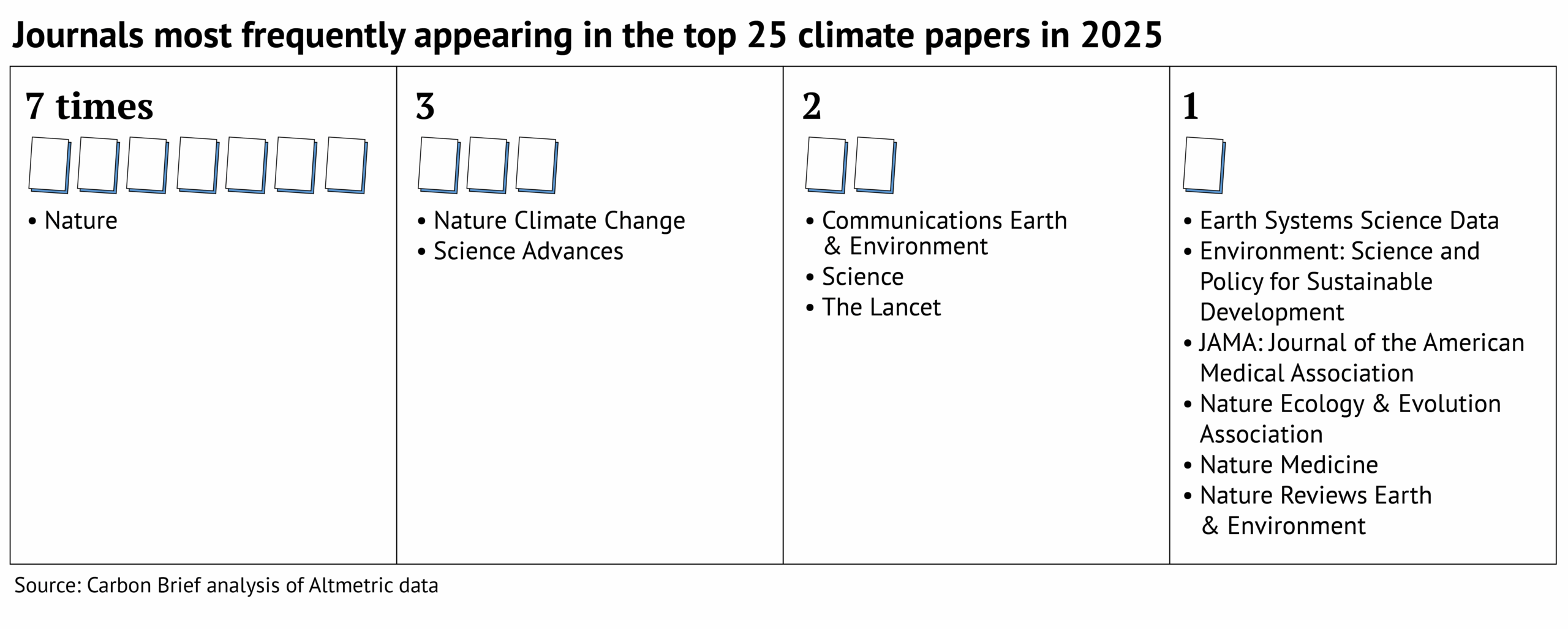
The journal Nature dominates Carbon Brief’s top 25, with seven papers featured.
Many other journals in the Springer Nature stable also feature, including Nature Climate Change (three), Communications Earth & Environment (two), as well as Nature Ecology & Evolution, Nature Medicine and Nature Reviews Earth & Environment (one each).
Also appearing more than once in the top 25 are Science Advances (three), Science (two) and the Lancet (two).
This is shown in the graphic below.
All the final scores for 2025 can be found in this spreadsheet.
Diversity in the top 25
The top 25 climate papers of 2025 cover a huge range of topics and scope. However, analysis of their authors reveals a distinct lack of diversity.
In total, the top 25 includes more than 650 authors – the highest number since Carbon Brief began this analysis in 2022.
This is largely due to a few publications with an exceptionally high number of authors. For example, the 2025 report of the Lancet Countdown on health and climate change has almost 130 authors alone, accounting for almost one-fifth of authors in this analysis.
Carbon Brief recorded the gender and country of affiliation for each of these authors. (The methodology used was developed by Carbon Brief for analysis presented in a special 2021 series on climate justice.)
The analysis reveals that 88% of the authors of the climate papers most featured in the media in 2025 are from institutions in the global north.
Carbon Brief defines the global north as North America, Europe, Japan, Australia and New Zealand. It defines the global south as Asia (excluding Japan), Africa, Oceania (excluding Australia and New Zealand), Latin America and the Caribbean.
The analysis shows that 53% of authors are from European institutions, while only 1% of authors are from institutions in Africa.
Further data analysis shows that there are also inequalities within continents. The map below shows the percentage of authors from each country, where dark blue indicates a higher percentage. Countries that are not represented by any authors in the analysis are shown in grey.
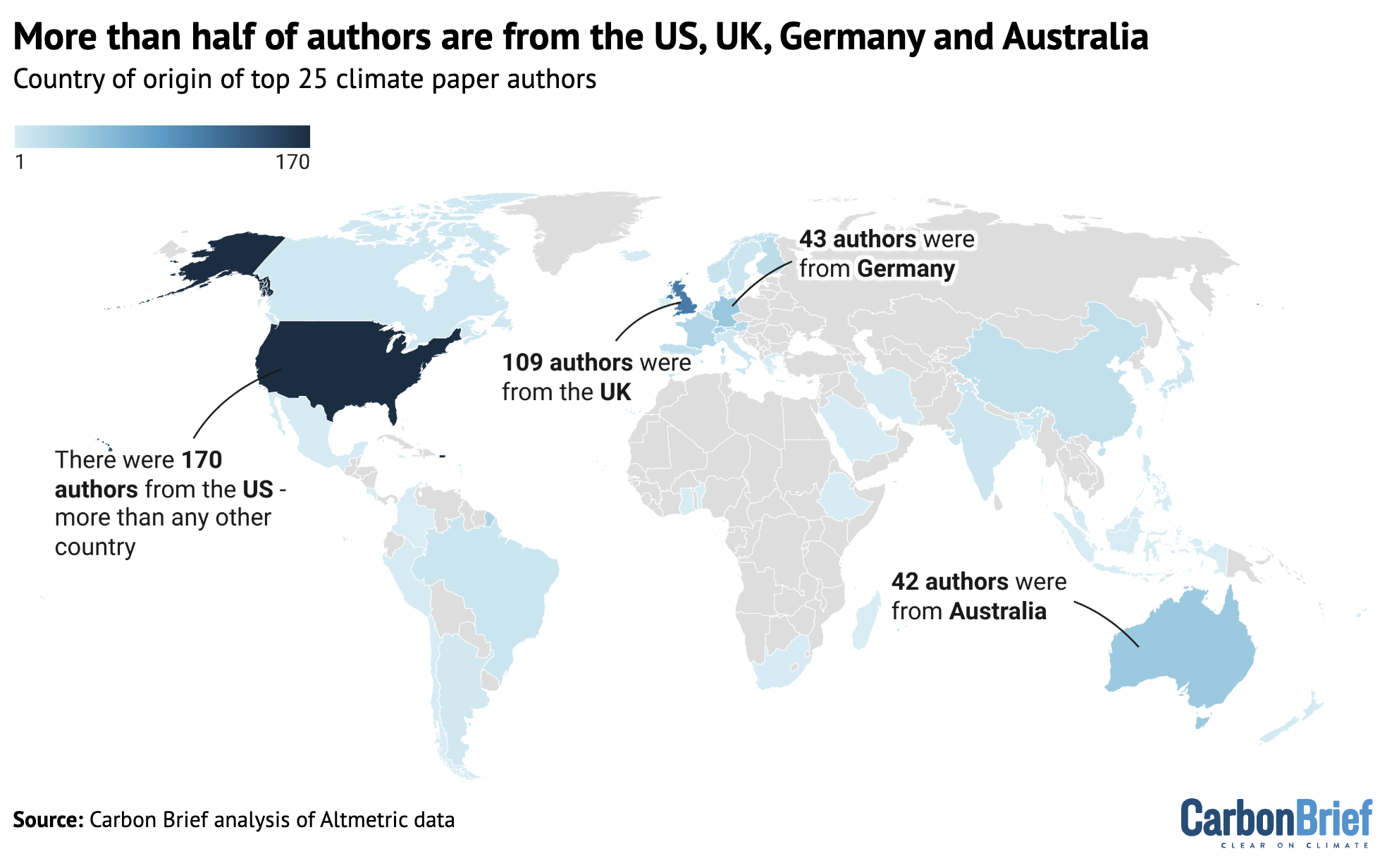
The top-ranking countries on this map are the US and the UK, which account for 26% and 16% of the authors, respectively.
Carbon Brief also analysed the gender of the authors.
Only one-third of authors from the top 25 climate papers of 2025 are women and only five of the 25 papers list a woman as lead author.
The plot below shows the number of authors from each continent, separated into men (dark blue) and women (light blue).

The full spreadsheet showing the results of this data analysis can be found here. For more on the biases in climate publishing, see Carbon Brief’s article on the lack of diversity in climate-science research.

The post Analysis: The climate papers most featured in the media in 2025 appeared first on Carbon Brief.
Analysis: The climate papers most featured in the media in 2025
Climate Change
‘Rush’ for new coal in China hits record high in 2025 as climate deadline looms
Proposals to build coal-fired plants in China reached a record high in 2025, finds a new study.
The report, released by the Centre for Research on Energy and Clean Air (CREA) and Global Energy Monitor (GEM), says that, in 2025, developers submitted new or reactivated proposals to build a total of 161 gigawatts (GW) of new coal-fired power plants.
The new proposals come even as China’s buildout of renewable energy pushed down coal-power generation and carbon dioxide (CO2) emissions in 2025, meaning many coal plants are already running at just half of their maximum capacity.
The co-authors argue that while clean-energy growth may limit emissions from coal power in the short term, the surge in proposals could lock in new coal assets, “weaken…incentives” for power-system reform and help keep coal capacity online in spite of China’s climate goals.
The high rate of new proposals, the study says, likely reflects a “rush by the coal industry stakeholders” to develop projects before an expected tightening of climate policy in the next five years.
In addition, “misaligned” payment mechanisms are encouraging developers to propose large-scale coal units, which – if developed – could impact the transition of the coal sector from playing the central role in electricity generation to flexibly supporting a system built on clean power.
Significant additions pushing down running hours
The report finds that the amount of new coal-fired power proposals by Chinese developers, including reactivated applications, hit a new peak in 2025, at 161GW. This is equal to 13% of the coal capacity currently online in China.
The country is continuing to add significant coal-power capacity, with a record 95GW added to the grid last year and another 291GW in the pipeline – meaning units that have been proposed, are actively under construction or have already been permitted.
Moreover, around two-thirds of coal-power capacity proposed in China since 2014 has either been commissioned – meaning it has been completed and started operating – or remains in the pipeline, Christine Shearer, report co-author and research analyst at thinktank Global Energy Monitor, tells Carbon Brief.
She adds that this is the “reverse of what we see outside China, where roughly two-thirds of proposed coal capacity never makes it to construction”.
Coal remains a significant part of China’s power mix, making the nation’s electricity sector one of the world’s largest emitters. Indeed, the power sector emitted more than 5.6bn tonnes of carbon dioxide (GtCO2) in 2024 – meaning that if it were its own country, it would have the highest emissions of any country except China itself.
But emissions from the power sector have been flat or falling since March 2024, according to analysis for Carbon Brief by CREA lead analyst Lauri Myllyvirta.
This is largely due to China’s rapid installation of renewable power, which is covering nearly all of new electricity demand and pushing coal generation into decline in 2025.
Some parts of the coal-power pipeline are reflecting this shift. In 2025, construction began on 83GW of new coal capacity – down from 98GW in 2024.
In addition, new permitting fell to a four-year low, at 45GW, which could point to tighter controls on coal-plant approvals in the future, says the report.
The chart below shows the amount of new coal-power capacity being proposed in China each year, in GW.

The shift from new power demand being met by coal to being met by renewable energy means any “additional coal power capacity would face structurally low utilisation”, the report says, referring to the number of hours that plants are able to operate each year.
This reduces coal-plant earnings needed to cover the cost of investment and makes instances of “stranded [coal] assets and compensation pressures” more likely.
A previous analysis for Carbon Brief finds that “larger additions of coal capacity are often followed by falling utilisation” – meaning that the construction of new coal plants does not necessarily increase emissions.
Utilisation rates for coal-fired power plants have hovered around 51% since 2025, according to the CREA and GEM report.
Shearer argues that while low utilisation rates would “dampen the immediate impact on annual CO2 emissions”, in the long-term the buildout “locks capital into fossil fuels” and “weakens incentives to build the cleaner forms of flexibility” needed for a renewables-centred system.
Low utilisation has also not led to coal plant capacity being retired in any notable way, the report notes, with generators instead supported by the coal “capacity payment” mechanism and extending the life of older units.
Delayed retirement of older coal plants causes “persistent overcapacity” and adds to calls for further compensation and policy support, the report says.
Coal generation has “no room to expand” under China’s international climate pledge for 2030, it adds, with utilisation rates for coal units likely to fall to 42% if renewables continue to meet all additional demand and if all of the plants currently under construction or permitted are brought online.
Crunch-time for coal
The surge in new proposals reflects a “rush” by the coal industry to ensure their projects are approved before the policy environment tightens, according to the report.
China is expected to introduce absolute emissions targets over the next five years. While these are expected to be aspirational for the first five years – alongside binding targets for carbon intensity, the emissions per unit of GDP – from 2030 they will be binding.
The current five-year period until 2030 will also likely see most of China’s energy-intensive industries pulled into the scope of its national carbon market.
In the power sector, government officials have said that coal is expected to shift from playing a major role in power supply to supporting “flexibility” operations.
This would require coal plants to shift between varying load levels and respond quickly to changes in demand and other system needs.
However, the report finds, the approvals for coal power “continue to reflect expectations of high operating hours”, instead of flexible operations.
For many of these proposals, planned annual utilisation was stated to be more than 4,800 hours, or 55% of hours in the year. This is greater than the 4,685 utilisation hours (53%) logged in 2023, the year in which the most coal power was generated over the past decade, according to data shared by the report authors with Carbon Brief.
In addition, the report says that many of the new coal-power proposals in 2025 were for “large-scale units”, each representing at least 1GW of power, as shown in the figure below.

These larger units are designed for “stable, continuous operation” and are “poorly suited to the type of flexibility increasingly required in a power system dominated by wind and solar”, says the report.
This suggests that “project developers still anticipated base-load style operation”, it adds, “sitting uneasily” with the fact of higher clean-energy generation and falling coal plant utilisation.
Reliance on sales and subsidies
This persistence in developing large-scale units could be explained by the financial incentives that govern the coal-power industry.
Coal power plants are cheap to build but risk low profits and high costs, with many current operators already facing losses at recent utilisation rates.
In 2024, the government established a capacity payment mechanism for coal-fired power plants. This mechanism rewards developers for adding “seldom-utilised, backup” capacity to the grid.
These capacity payments, as well as regulated pricing and implicit government backing “can make plants viable on paper even if utilisation and operating margins are weak”, Shearer tells Carbon Brief, which may explain the continued appetite for new coal from developers.
More than 100bn yuan ($14bn) in capacity payments were made to coal plants in 2024, although it has not yet had a discernable impact on utilisation.
Large-scale units, the report says, are “particularly well positioned” to benefit from the policy, as it rewards maximising capacity and does not favour plants that are more suited for flexible operations.
(The Chinese government recently announced plans to adjust the mechanism, confirming that in some cases capacity payments could be more than the initial expected threshold of 50% of a benchmark coal plant’s total fixed costs.)
Meanwhile, the report adds that coal-fired power plants continue to earn most of their revenue from selling electricity, with only 5% of total income coming from capacity payments.
As such, these “misaligned incentives” encourage producing power and installing significant new capacity, despite the government’s aim to shift coal to a supporting role in the system.
Shearer tells Carbon Brief that a better approach to flexibility would be to “adopt technology-neutral flexibility standards”, rather than focusing on “flexible coal”, which would mean coal would have to “compete directly with storage, demand response, grid upgrades and other clean options”. She adds:
“The risk of coal-specific flexibility policies is that they lock in capacity rather than solve the underlying system need.”
The post ‘Rush’ for new coal in China hits record high in 2025 as climate deadline looms appeared first on Carbon Brief.
‘Rush’ for new coal in China hits record high in 2025 as climate deadline looms
Climate Change
The EU should partner with Global South to protect carbon-storing wetlands
Fred Pearce is a freelance author and journalist writing on behalf of Wetlands International Europe.
Everybody knows that saving the Amazon rainforest is critical to our planet’s future. But the Pantanal? Most people have never heard of Brazil’s other ecological treasure, the world’s largest tropical wetland – let alone understood its importance, as home to the highest concentration of wildlife in the Americas, while keeping a billion tonnes of carbon out of the atmosphere, and protecting millions of people downstream from flooding.
Hundreds of millions of euros are spent every year on protecting and restoring the world’s forests. Wetlands are just as important, yet don’t get anything like the same recognition or investment. That, scientists insist, has to change. And Europe can lead the way.
For forests, the EU already provides financial and technical assistance for a series of Forest Partnerships with non-EU countries, as part of its Global Gateway strategy for investing globally in environmentally and socially sustainable infrastructure. Such partnerships operate in Guyana, the Democratic Republic of the Congo, Mongolia and elsewhere.
I believe the time is now right to establish a parallel EU Wetland Partnerships, framing wetlands as a strategic, cost-effective investment offering high financial, environmental and social returns.
Wetlands store a third of global soil carbon
Wetlands come in many shapes and sizes: freshwater peatlands, lakes and river floodplains, as well as coastal salt marshes, mangroves and seagrass beds. They are vital natural infrastructure, maintaining river flows that buffer against extreme weather events such as floods and drought, as well as protecting biodiversity, and providing jobs and economic opportunities, often for the most vulnerable nature-dependent communities.
Wetlands cover just six percent of the land surface, but store a third of global soil carbon – twice the amount in all the world’s forests. Yet they have been disappearing three times faster than forests, with 35 percent lost in the past half century.
Their loss adds to climate change, causes species extinction, triggers mass exoduses of fishers and other people whose livelihoods disappear, and depletes both surface and underground water reserves. Continued wetlands destruction is estimated to contribute five percent of global CO2 emissions – more than aviation and shipping combined.
EU Wetland Partnerships can be critical to unlocking finance to stem the losses and realise the benefits by promoting nature-based economic development, such as sustainable aquaculture, eco-tourism, and forms of wetlands agriculture known as paludiculture, while contributing to climate adaptation by improving the resilience of water resources.
Pantanal faces multiple threats
The Pantanal would be a prime candidate for a flagship project. The vast seasonal floodplain stretching from Brazil into Paraguay and Bolivia, is home to abundant populations of cayman, capybaras, jaguars and more than 600 species of birds. It is vital also for preventing flooding on the River Paraguay for some 2000 kilometres downstream to the Atlantic Ocean.
The Pantanal faces multiple threats, from droughts due to upstream water diversions and climate change, invasions by farmers setting fires and a megaproject to dredge the river and create a shipping corridor through the wetland.
But EU investment to achieve partnership targets agreed with Brazil on restoration, conservation and sustainable management could reinvigorate traditional sustainable land use – including cattle ranching that helps sustain the Pantanal’s open flooded grasslands.


Accounting for wetlands carbon in national emissions targets
Africa, a main focus of the Global Gateway, has abundant potential for early partnership initiatives. They include the Inner Niger Delta in Mali, which sustains some three million inhabitants, but is threatened by upstream dams and conflicts over resources between farmers and herders.
Another is the Sango Bay-Minziro wetland, a region of swamp forests, flooded grasslands and papyrus swamp straddling the border between Uganda and Tanzania on the shores of Lake Victoria, Africa’s largest lake.
The two countries have agreed to cooperate in pushing back against illegal logging, papyrus extraction and farming, and Wetlands International has been working with local governments to encourage community-based initiatives. But an EU partnership could dramatically expand this work, helping sustain the wider ecology of Lake Victoria and the Nile Basin.
Deep in the Amazon, forest protection cash must vie with glitter of illegal gold
National pledges to bring wetlands to the fore of environmental action are proliferating rapidly, especially since the 2023 global climate stocktake at COP28 in the UAE emphasised the importance of accounting for wetlands carbon in national emissions targets.
Since then, more than 50 countries have signed up to the 2023 Freshwater Challenge to protect freshwater ecosystems; more than 40 governments with 40 percent of the world’s mangroves have endorsed the 2022 Mangrove Breakthrough that aims to protect and restore 15 million hectares by 2030; and the newly established Peatland Breakthrough aims at rewetting at least 30 million hectares and halting the loss of undrained peatland by 2030.
Such ambition will almost certainly be endorsed at the 2026 UN Water Conference to be hosted by the UAE and Senegal in December this year. But the key to turning targets into reality on the ground lies in finding the billions of Euros needed to deliver on the ambition. EU Wetlands Partnerships could help seal the deal.
The post The EU should partner with Global South to protect carbon-storing wetlands appeared first on Climate Home News.
The EU should partner with Global South to protect carbon-storing wetlands
Climate Change
DeBriefed 30 January 2026: Fire and ice; US formally exits Paris; Climate image faux pas
Welcome to Carbon Brief’s DeBriefed.
An essential guide to the week’s key developments relating to climate change.
This week
Fire and ice
OZ HEAT: The ongoing heatwave in Australia reached record-high temperatures of almost 50C earlier this week, while authorities “urged caution as three forest fires burned out of control”, reported the Associated Press. Bloomberg said the Australian Open tennis tournament “rescheduled matches and activated extreme-heat protocols”. The Guardian reported that “the climate crisis has increased the frequency and severity of extreme weather events, including heatwaves and bushfires”.
WINTER STORM: Meanwhile, a severe winter storm swept across the south and east of the US and parts of Canada, causing “mass power outages and the cancellation of thousands of flights”, reported the Financial Times. More than 870,000 people across the country were without power and at least seven people died, according to BBC News.
COLD QUESTIONED: As the storm approached, climate-sceptic US president Donald Trump took to social media to ask facetiously: “Whatever happened to global warming???”, according to the Associated Press. There is currently significant debate among scientists about whether human-caused climate change is driving record cold extremes, as Carbon Brief has previously explained.
Around the world
- US EXIT: The US has formally left the Paris Agreement for the second time, one year after Trump announced the intention to exit, according to the Guardian. The New York Times reported that the US is “the only country in the world to abandon the international commitment to slow global warming”.
- WEAK PROPOSAL: Trump officials have delayed the repeal of the “endangerment finding” – a legal opinion that underpins federal climate rules in the US – due to “concerns the proposal is too weak to withstand a court challenge”, according to the Washington Post.
- DISCRIMINATION: A court in the Hague has ruled that the Dutch government “discriminated against people in one of its most vulnerable territories” by not helping them to adapt to climate change, reported the Guardian. The court ordered the Dutch government to set binding targets within 18 months to cut greenhouse gas emissions in line with the Paris Agreement, according to the Associated Press.
- WIND PACT: 10 European countries have agreed a “landmark pact” to “accelerate the rollout of offshore windfarms in the 2030s and build a power grid in the North Sea”, according to the Guardian.
- TRADE DEAL: India and the EU have agreed on the “mother of all trade deals”, which will save up to €4bn in import duty, reported the Hindustan Times. Reuters quoted EU officials saying that the landmark trade deal “will not trigger any changes” to the bloc’s carbon border adjustment mechanism.
- ‘TWO-TIER SYSTEM’: COP30 president André Corrêa do Lago believes that global cooperation should move to a “two-speed system, where new coalitions lead fast, practical action alongside the slower, consensus-based decision-making of the UN process”, according to a letter published on Tuesday, reported Climate Home News.
$2.3tn
The amount invested in “green tech” globally in 2025, marking a new record high, according to Bloomberg.
Latest climate research
- Including carbon emissions from permafrost thaw and fires reduces the remaining carbon budget for limiting warming to 1.5C by 25% | Communications Earth & Environment
- The global population exposed to extreme heat conditions is projected to nearly double if temperatures reach 2C | Nature Sustainability
- Polar bears in Svalbard – the fastest-warming region on Earth – are in better condition than they were a generation ago, as melting sea ice makes seal pups easier to reach | Scientific Reports
(For more, see Carbon Brief’s in-depth daily summaries of the top climate news stories on Monday, Tuesday, Wednesday, Thursday and Friday.)
Captured

Sales of electric vehicles (EVs) overtook standard petrol cars in the EU for the first time in December 2025, according to new figures released by the European Automobile Manufacturers’ Association (ACEA) and covered by Carbon Brief. Registrations of “pure” battery EVs reached 217,898 – up 51% year-on-year from December 2024. Meanwhile, sales of standard petrol cars in the bloc fell 19% year-on-year, from 267,834 in December 2024 to 216,492 in December 2025, according to the analysis.
Spotlight
Looking at climate visuals
Carbon Brief’s Ayesha Tandon recently chaired a panel discussion at the launch of a new book focused on the impact of images used by the media to depict climate change.
When asked to describe an image that represents climate change, many people think of polar bears on melting ice or devastating droughts.
But do these common images – often repeated in the media – risk making climate change feel like a far-away problem from people in the global north? And could they perpetuate harmful stereotypes?
These are some of the questions addressed in a new book by Prof Saffron O’Neill, who researches the visual communication of climate change at the University of Exeter.
“The Visual Life of Climate Change” examines the impact of common images used to depict climate change – and how the use of different visuals might help to effect change.
At a launch event for her book in London, a panel of experts – moderated by Carbon Brief’s Ayesha Tandon – discussed some of the takeaways from the book and the “dos and don’ts” of climate imagery.
Power of an image
“This book is about what kind of work images are doing in the world, who has the power and whose voices are being marginalised,” O’Neill told the gathering of journalists and scientists assembled at the Frontline Club in central London for the launch event.
O’Neill opened by presenting a series of climate imagery case studies from her book. This included several examples of images that could be viewed as “disempowering”.
For example, to visualise climate change in small island nations, such as Tuvalu or Fiji, O’Neill said that photographers often “fly in” to capture images of “small children being vulnerable”. She lamented that this narrative “misses the stories about countries like Tuvalu that are really international leaders in climate policy”.
Similarly, images of power-plant smoke stacks, often used in online climate media articles, almost always omit the people that live alongside them, “breathing their pollution”, she said.

During the panel discussion that followed, panellist Dr James Painter – a research associate at the Reuters Institute for the Study of Journalism and senior teaching associate at the University of Oxford’s Environmental Change Institute – highlighted his work on heatwave imagery in the media.
Painter said that “the UK was egregious for its ‘fun in the sun’ imagery” during dangerous heatwaves.
He highlighted a series of images in the Daily Mail in July 2019 depicting people enjoying themselves on beaches or in fountains during an intense heatwave – even as the text of the piece spoke to the negative health impacts of the heatwave.
In contrast, he said his analysis of Indian media revealed “not one single image of ‘fun in the sun’”.
Meanwhile, climate journalist Katherine Dunn asked: “Are we still using and abusing the polar bear?”. O’Neill suggested that polar bear images “are distant in time and space to many people”, but can still be “super engaging” to others – for example, younger audiences.
Panellist Dr Rebecca Swift – senior vice president of creative at Getty images – identified AI-generated images as “the biggest threat that we, in this space, are all having to fight against now”. She expressed concern that we may need to “prove” that images are “actually real”.
However, she argued that AI will not “win” because, “in the end, authentic images, real stories and real people are what we react to”.
When asked if we expect too much from images, O’Neill argued “we can never pin down a social change to one image, but what we can say is that images both shape and reflect the societies that we live in”. She added:
“I don’t think we can ask photos to do the work that we need to do as a society, but they certainly both shape and show us where the future may lie.”
Watch, read, listen
UNSTOPPABLE WILDFIRES: “Funding cuts, conspiracy theories and ‘powder keg’ pine plantations” are making Patagonia’s wildfires “almost impossible to stop”, said the Guardian.
AUDIO SURVEY: Sverige Radio has published “the world’s, probably, longest audio survey” – a six-hour podcast featuring more than 200 people sharing their questions around climate change.
UNDERSTAND CBAM: European thinktank Bruegel released a podcast “all about” the EU’s carbon adjustment border mechanism, which came into force on 1 January.
Coming up
- 1 February: Costa Rican general election
- 3 February: UN Environment Programme Adaptation Fund Climate Innovation Accelerator report launch, Online
- 2-8 February: Intergovernmental Platform on Biodiversity and Ecosystem Services (IPBES) 12th plenary, Manchester, UK
Pick of the jobs
- Climate Central, climate data scientist | Salary: $85,000-$92,000. Location: Remote (US)
- UN office to the African Union, environmental affairs officer | Salary: Unknown. Location: Addis Ababa, Ethiopia
- Google Deepmind, research scientist in biosphere models | Salary: Unknown. Location: Zurich, Switzerland
DeBriefed is edited by Daisy Dunne. Please send any tips or feedback to debriefed@carbonbrief.org.
This is an online version of Carbon Brief’s weekly DeBriefed email newsletter. Subscribe for free here.
The post DeBriefed 30 January 2026: Fire and ice; US formally exits Paris; Climate image faux pas appeared first on Carbon Brief.
DeBriefed 30 January 2026: Fire and ice; US formally exits Paris; Climate image faux pas
-
Greenhouse Gases6 months ago
Guest post: Why China is still building new coal – and when it might stop
-
Climate Change6 months ago
Guest post: Why China is still building new coal – and when it might stop
-
Climate Change2 years ago
Bill Discounting Climate Change in Florida’s Energy Policy Awaits DeSantis’ Approval
-
Greenhouse Gases2 years ago嘉宾来稿:满足中国增长的用电需求 光伏加储能“比新建煤电更实惠”
-
Climate Change2 years ago
Spanish-language misinformation on renewable energy spreads online, report shows
-
Climate Change2 years ago嘉宾来稿:满足中国增长的用电需求 光伏加储能“比新建煤电更实惠”
-
Climate Change Videos2 years ago
The toxic gas flares fuelling Nigeria’s climate change – BBC News
-
Carbon Footprint2 years agoUS SEC’s Climate Disclosure Rules Spur Renewed Interest in Carbon Credits